Is a Verbal Agreement Legally Binding?
Usually yes. A deal agreed on a call binds both sides in the U.S. and in England and Wales, unless it is one of the kinds a statute says must be in writing, such as a sale of land, a U.S. promise not to be performed within a year, or a U.S. sale of goods for $500 or more. The hard part is proving what was agreed: a week after a conversation, only 4.7% of its details were recalled by both people. So confirm the terms in writing the same day.
Is a verbal agreement legally binding? Usually, with a short list of exceptions
A spoken deal is a contract when the two sides agreed, meant it to bind, and settled the terms that matter. The UK Supreme Court put the test this way: what counts is "what was communicated between them by words or conduct", judged objectively, not anyone's private intentions (RTS v Müller, para 45). U.S. sales law says the same of goods: a contract "may be made in any manner sufficient to show agreement" (UCC § 2-204). Nothing in either rule asks for paper.
The exceptions are written into statutes, and they are narrow. A few kinds of deal need a signed writing before a court will enforce them:
| Deal | What the law asks | Where it is written |
|---|---|---|
| Sale of land or an interest in land, England and Wales | "Can only be made in writing", with all the agreed terms in one document signed by each party | Law of Property (Miscellaneous Provisions) Act 1989, s.2 |
| Sale of real property, New York | Void unless the contract or a note of it, expressing the consideration (what is given in return, such as the price), is in writing and signed by the party it is enforced against | N.Y. General Obligations Law § 5-703 |
| A promise "not to be performed within one year", New York | Void unless in writing and signed by the party it is enforced against | N.Y. General Obligations Law § 5-701 |
| A promise to pay someone else's debt, New York | The same writing rule | N.Y. General Obligations Law § 5-701 |
| Sale of goods for $500 or more, U.S. states that adopted the UCC | Not enforceable without "some writing" signed by the party it is enforced against | UCC § 2-201 |
Source: the statutes linked in each row, read on 2026-11-03. New York stands in for the U.S. states: each state writes its own list, so check yours (N.Y. GOL § 5-701).
A price change, a new deadline or extra scope on a service job is not on this list, so it can usually be agreed on a call. Whether yours can depends on your state and on what your written contract says about changes. This article is general information, not legal advice: for a dispute of your own, ask a lawyer in your state or country.
The phone call that became a contract: Mansion Place v Fox
On 14 October 2020, shortly after 6 pm, two company directors spoke by phone, both driving, on hands-free, for under ten minutes. Neither took a note, and neither made a written record immediately afterwards (Mansion Place v Fox, para 52). One was Shankar Ramanathan, for Mansion Place, the developer of a student housing scheme in Nottingham. The other was Mark Kite, managing director of Fox Industrial Services, the builder (paras 1 and 4).
Their accounts of that call were far apart. Kite said they agreed a swap: Fox would drop its claims for more time and money, and Mansion would drop its claim for late-completion damages (para 57). Ramanathan said there was "no suggestion let alone any agreement" to give up those damages (para 56). The judge found both men honest: "A witness can be completely honest but also completely mistaken" (para 54).
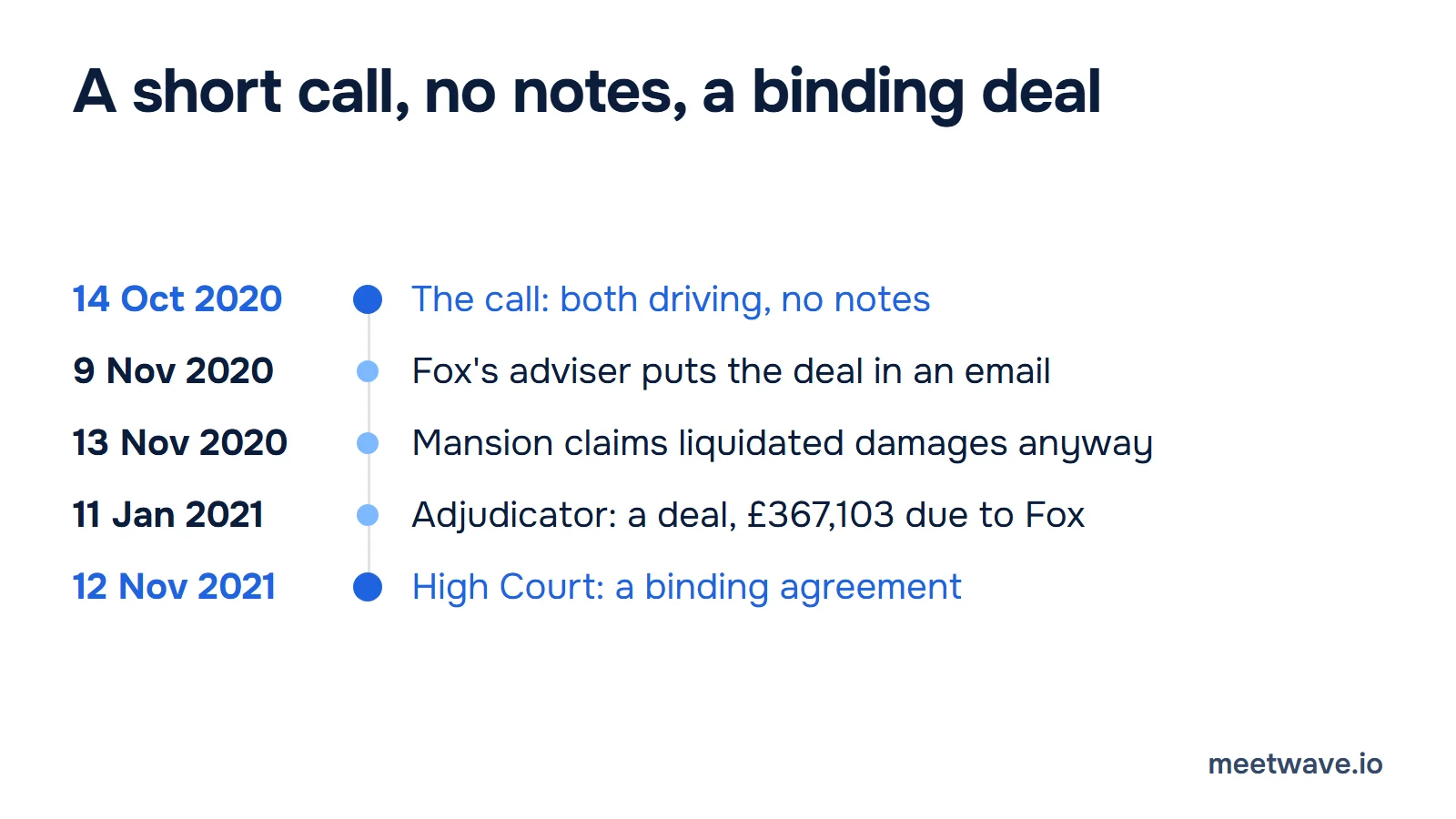
 Figure 1. A call of under ten minutes became a binding agreement a year later. The adjudicator's sum is £367,103.44 plus interest. Source: Mansion Place v Fox [2021] EWHC 2972 (TCC), paras 6, 42, 44, 52 and 79.
Figure 1 shows how it went. On 9 November 2020 a consultant advising Fox wrote to Fox's managing director that "it also sounded like he agreed not to levy any liquidated damages against Fox" (paras 20 and 42). On 13 November Mansion served notices claiming those damages anyway (para 44). An adjudicator found that the call made a deal and that £367,103.44 plus interest was due (para 6). Mansion went to the High Court for a declaration that no deal existed (para 7).
It lost. With no record of the words, the judge looked for "the gist of the conversation" (para 77). He found it was a swap of claims, made "on a final and not a provisional basis" (para 78). The parties "reached a binding agreement", and Mansion gave up its right to those damages (para 79).
What turns a call into a deal
A court does not ask what each side privately meant. It asks whether what was said, read objectively, shows that both sides intended to be bound and agreed every term they treated as essential (RTS v Müller, para 45). In plain words, four things:
- An offer: one side proposes terms that can simply be accepted ("we drop ours if you drop yours").
- Acceptance: the other side says yes to those terms, not to something close to them.
- Something given for something: each side gives or gives up something. In Mansion Place, each dropped a claim (para 78).
- Certain terms: enough is settled to enforce. For goods, a deal "does not fail for indefiniteness" when the parties meant to contract and a court can work out a remedy (UCC § 2-204).
What the court reads to decide is mostly paper written afterwards. The judge in Mansion Place tested both stories "through the prism of the contemporaneous documents" (para 55). Fox's consultant had written an internal email, the day after the call, giving his understanding of the deal (paras 42 and 65); no email to Mansion stated it clearly until 16 November (para 63). Mansion had internal papers that never mentioned it, which the judge counted in Mansion's favour (para 61). A note sent the same day to the other side would have given the court something written to read, which neither side had.
The habit: confirm what you agreed, the same day
Write it down while both of you still remember, because memory of a conversation fades fast and differently for each person. In a study of 21 pairs of test participants, only 4.7% of a conversation's details were recalled by both partners a week later; that is a strict overlap, not each person's recall (Brown-Schmidt et al., 2023; Vanderbilt University). A same-day email turns two fading memories into one document that the other side can correct.
Here is what a good confirmation looks like, taken from a demo client call. A web agency and a dental group agree on a call to add Spanish pages and move the launch. MeetWave's Client Recap writes the result as What we agreed, one line per agreement, with the numbers in bold (demo notes).
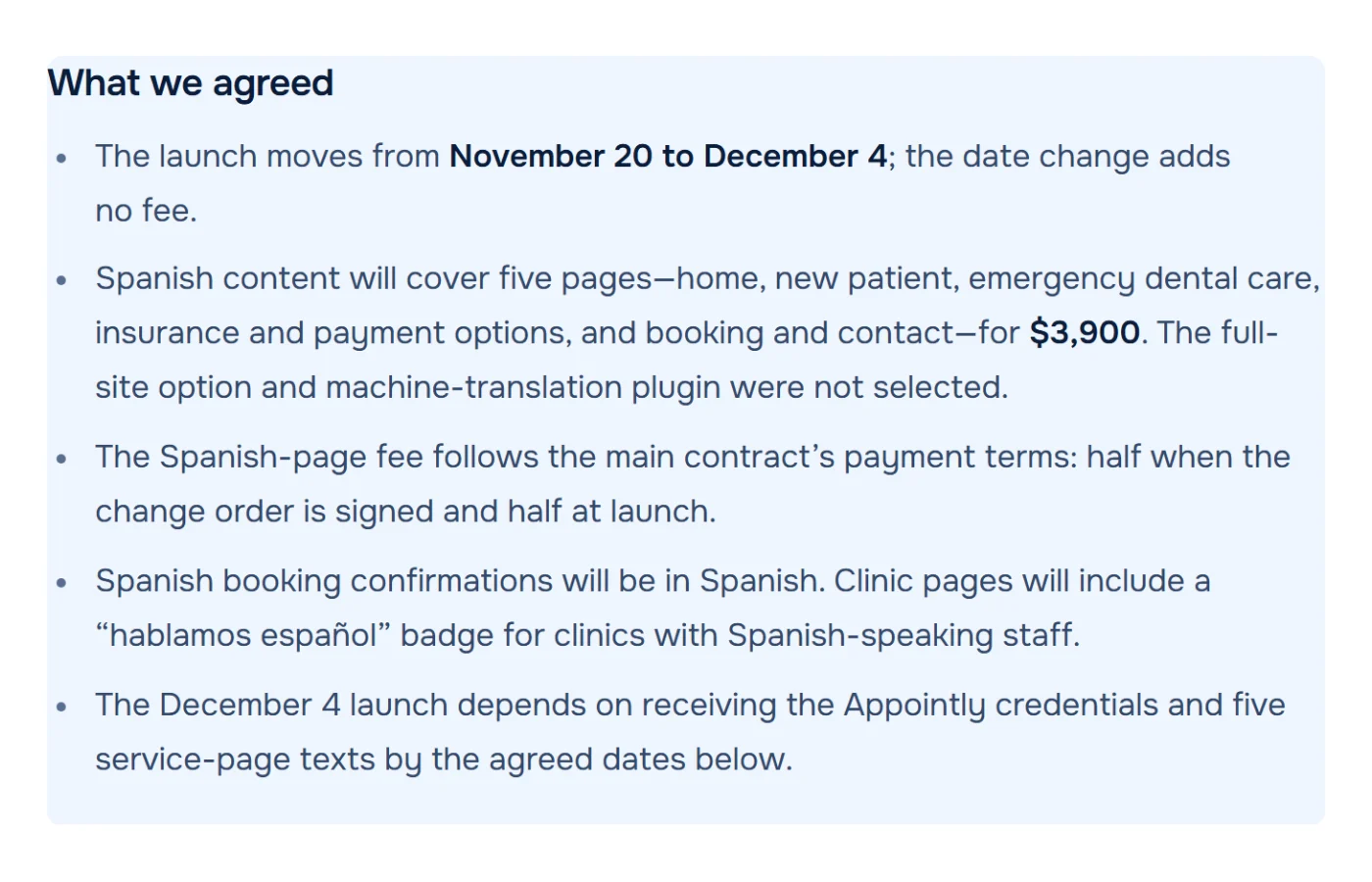
 Figure 2. Demo meeting, people are fictional. Each line is an outcome with its number: a new date, a price, the payment terms and what the date depends on. Source: demo client call, recap, October 2026.Analyzed with MeetWaveSee the full notesTry it on your next client call
Figure 2 has the three things a dispute turns on. The date moved from November 20 to December 4, and "the date change adds no fee". The extra work costs $3,900 for five named pages. The fee is paid half when the change order is signed and half at launch (demo notes). Lines like these are what the Mansion Place parties did not have: the judge had to find "the gist of the conversation" with no record (para 77).
| Who | What | By when |
|---|---|---|
| Patrick | Obtain production client ID and secret from Appointly; prompt Dr. Ahmed to review her two texts | Friday, October 9 |
| Megan | Send five service-page texts; prioritize emergency care | Wednesday, October 14 |
Source: demo client call, recap, October 2026. Demo meeting, people are fictional. Two rows of the "Who does what" table; the recap adds the line "The December 4 launch holds if the Appointly credentials arrive by October 9 and the five texts by October 14."
The table shows the part people forget to confirm: the condition. The new date "holds if the Appointly credentials arrive by October 9 and the five texts by October 14" (demo notes). If the client is late, the agency can point to a line both sides received, not to its memory of a call. The formula for your own email: [what changes] for [price], by [date], if [condition], one line per agreement (demo notes).
Template: the confirmation email
Send it within the day, to everyone who was on the call. Ask for a reply instead of reading silence as a yes (UCC § 2-201).
Subject: Confirming what we agreed on today's call ([date])

Hi [name],

Just confirming what we agreed on today's call, so we both have the same record:

- [What changes]: [before] becomes [after].
- Price: [amount], paid [when and how].
- Date: [deliverable] by [date].
- This depends on: [what you need from them] by [date].
- Not included: [what was discussed but not agreed].

Please reply to confirm, or tell me what I got wrong and I'll correct it. Until you confirm, I won't treat this as agreed.

Thanks,
[your name]
The last line matters both ways. Between merchants in the U.S., a written confirmation that the receiver does not object to within 10 days can satisfy the writing rule against the receiver (UCC § 2-201(2)). So if you receive a confirmation that is wrong, answer it in writing at once. Short of time? The free follow-up email generator drafts this email from your notes.
Can I record the call instead?
You can, if the law where each person sits allows it, and it is a different question with its own rules. U.S. federal law lets a party to a call record it (18 U.S.C. § 2511(2)(d)), but some states require everyone's consent. Our state-by-state reading is in Can I record my boss?: 9 states need everyone's consent or knowledge, 5 are split or disputed, and 36 states plus D.C. need one party, as of 2026-10-30.
The safe way is to ask at the start, on the recording: "Is it OK if I record this, so I can send you a summary afterwards?" A recording everyone agreed to meets every consent rule, and the email above still matters: it is the version both sides read and confirm (Can I record my boss?).
Key numbers
- A call of under ten minutes, between two drivers who took no notes, was held to be a binding agreement by the High Court of England and Wales in 2021 (Mansion Place v Fox, paras 52 and 79).
- An adjudicator found £367,103.44 plus interest due on the strength of that call, in January 2021 (Mansion Place v Fox, para 6).
- A U.S. sale of goods for $500 or more needs a signed writing to be enforced, under UCC § 2-201 as read in 2026 (UCC § 2-201).
- A merchant who receives a written confirmation has 10 days to object in writing, under UCC § 2-201(2) as read in 2026 (UCC § 2-201).
- A week after a conversation, only 4.7% of its details were recalled by both partners, in 21 pairs of test participants, 2023 (Brown-Schmidt et al.; Vanderbilt University).
FAQ
Is a verbal contract enforceable?
Yes, unless it is one of the kinds a statute requires in writing, such as land, a U.S. promise not to be performed within a year, or U.S. goods for $500 or more (N.Y. GOL § 5-701; UCC § 2-201). Enforcing it still means proving its terms.
How do I prove a verbal agreement?
With what was written around it: emails, messages, invoices, and what each side did next. In Mansion Place the judge tested both accounts against "the contemporaneous documents" and the parties' conduct (para 55). A same-day confirmation email the other side did not dispute is usually strong evidence.
Is a text message a contract?
It can be. U.S. federal law says a contract may not be denied effect "solely because it is in electronic form" (15 U.S.C. § 7001). Whether a given text is a contract depends on the same test as a call: offer, acceptance and settled terms (RTS v Müller, para 45).
Does a confirmation email make a verbal agreement binding?
It does not create the deal, the call did; it records it. Between U.S. merchants, though, an unanswered written confirmation can satisfy the writing rule after 10 days (UCC § 2-201).
Can the other side just deny the call happened?
They can, and then it is one account against another. In Mansion Place both men were found honest and still disagreed; the judge weighed the documents, what the parties did next and how reliable each account was, and preferred Kite's (paras 54–55 and 73–74).
Sources
- The National Archives, Find Case Law — Mansion Place Ltd v Fox Industrial Services Ltd [2021] EWHC 2972 (TCC) (2021). Accessed 2026-11-03.
- The National Archives, Find Case Law — RTS Flexible Systems Ltd v Molkerei Alois Müller GmbH [2010] UKSC 14 (2010). Accessed 2026-11-03.
- Legal Information Institute — UCC § 2-201, Formal Requirements; Statute of Frauds. Accessed 2026-11-03.
- Legal Information Institute — UCC § 2-204, Formation in General. Accessed 2026-11-03.
- New York State Senate — General Obligations Law § 5-701. Accessed 2026-11-03.
- New York State Senate — General Obligations Law § 5-703. Accessed 2026-11-03.
- legislation.gov.uk — Law of Property (Miscellaneous Provisions) Act 1989, section 2. Accessed 2026-11-03.
- Legal Information Institute — 15 U.S.C. § 7001, General rule of validity. Accessed 2026-11-03.
- Legal Information Institute — 18 U.S.C. § 2511, Interception and disclosure of communications. Accessed 2026-11-03.
- Brown-Schmidt, Jaeger, Evans & Benjamin — MEMCONS: How contemporaneous note-taking shapes memory for conversation, Cognitive Science 47(4) (2023); figures as reported by Vanderbilt University (2023). Accessed 2026-11-03.
Still comparing tools?
See how MeetWave stacks up against the tools most teams evaluate alongside it.
- MeetWave vs NottaSee how MeetWave compares to Notta for meeting transcription
- MeetWave vs KrispSee how MeetWave compares to Krisp for meeting notes
- MeetWave vs JamieSee how MeetWave compares to Jamie AI for bot-free meeting notes
More on this: Meeting minutes template