Can I Record My Boss? And Can My Boss Record Me?
Often yes: U.S. federal law lets you record a conversation you are part of, and 36 states plus D.C. leave it at that one-party rule. But 9 states require everyone's consent or knowledge, 5 more are split or disputed, and a company rule can still cost you the job. So ask openly first, and send a same-day email either way: a week after a conversation, only 4.7% of its details were recalled by both people.
Is it legal to record a conversation at work? Your state decides
Federal law sets the floor: a person who is part of a conversation may record it, unless the purpose is a crime or a tort (18 U.S.C. § 2511(2)(d)). States can ask for more. We sorted all 50 states and D.C. on 2026-10-30: 9 states need every party's consent or knowledge, 5 are split or disputed, and 36 states plus D.C. keep the one-party rule (how we counted).
This article is not legal advice. It gives the rules as written, and one person's case can turn on facts we cannot see.
One party means a party. The rule covers a conversation you are in; recording people talking when you are not part of it, with nobody's consent, is what the same federal section does not excuse (18 U.S.C. § 2511(2)(d)).
Figure 1 shows the three groups. Each state links to its statute in the tables below.
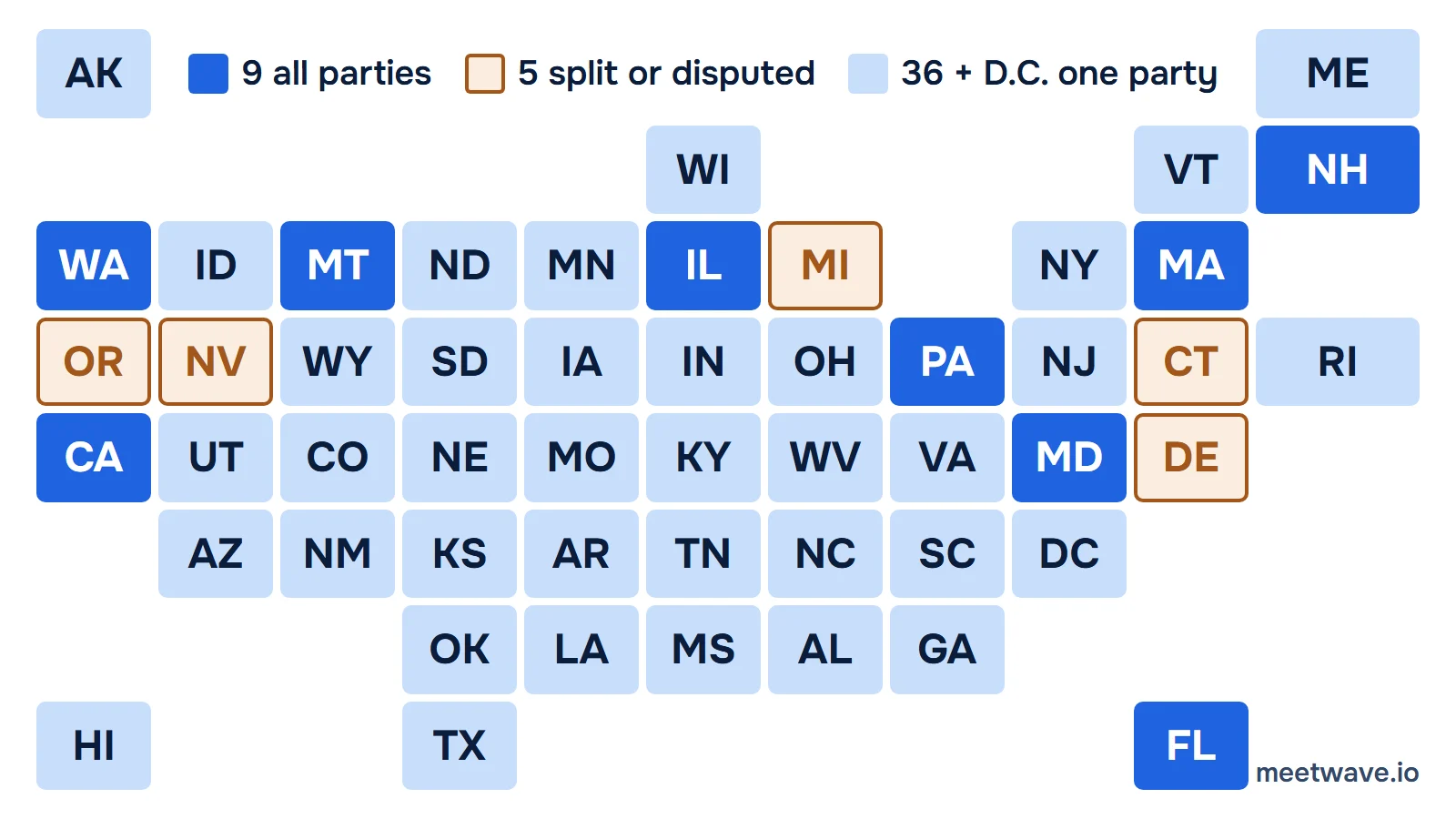
 Figure 1. 9 states need everyone, 5 are split or disputed, 36 states plus D.C. need one party. Source: MeetWave reading of state statutes and court rulings, 2026-10-30.
The 9 all-party states
Three of these laws (Massachusetts, Illinois, Montana) are written around secret or hidden recording, and the other six ask for consent without that wording. Either way, telling people is the lawful path as well as the decent one. Massachusetts bans recording "secretly", Illinois reaches a "surreptitious" recording, Montana a "hidden" device, and Washington treats a recorded announcement as consent (RCW 9.73.030).
| State | What the statute asks for, and its limit |
|---|---|
| California | Consent of all parties. Applies to a "confidential communication", not "a public gathering" |
| Florida | "all of the parties" give prior consent |
| Illinois | Consent of all other parties. Applies to a surreptitious recording, one made by "stealth or deception" |
| Maryland | "all of the parties" give prior consent |
| Massachusetts | Prior authority from all parties. Applies to recording "secretly" |
| Montana | Knowledge of all parties. Applies to a "hidden" device; a warning from one person is enough |
| New Hampshire | Consent of all parties. Covers a person who is a party |
| Pennsylvania | "all parties" give prior consent. Breaking it is a third-degree felony |
| Washington | Consent of everyone in the conversation. An announcement, itself recorded, counts as consent |
Source: the statute linked on each row, read 2026-10-30 (method).
The 5 split or disputed states
These five have no single answer, so we show them as disputed instead of picking a side. Some lists put Delaware and Nevada in the all-party column, and each state's own law only half supports that. In Delaware two statutes conflict. In Nevada the answer changes between a call and a room.
| State | Why there is no single answer |
|---|---|
| Connecticut | Phone calls: a civil statute asks for all parties' consent, or a recorded notice or tone. In person: the criminal statute reaches only "a person not present" |
| Delaware | The wiretap chapter says one party. The privacy statute says "all parties". As of 2026-10-30 we found no Delaware appellate ruling that settles it |
| Michigan | The statute says "all parties". The Court of Appeals read it as not reaching a participant in 1982. The state Supreme Court declined to answer in May 2021, and the Sixth Circuit followed the Court of Appeals in 2022 |
| Nevada | Phone: the state Supreme Court held that a participant's taping broke NRS 200.620 (Lane v. Allstate, 1998). In person: one person may authorize it |
| Oregon | In person: all participants must be specifically informed. Phone: the same statute covers a call "to which the person is not a participant", unless one participant consents, so a call is one-party |
Source: the statutes and rulings linked on each row, read 2026-10-30 (method).
Lists also disagree on New Jersey and Vermont. New Jersey's statute is plain: one party. Vermont has no recording-consent statute that we could find, so the federal rule stands, and we count it with the one-party states.
A call across state lines
Treat the stricter state's rule as the one that applies, because you cannot know in advance which state's law a court will use. California's Supreme Court applied California law to a firm that recorded calls from Georgia (Kearney v. Salomon Smith Barney, 2006). Nevada's went the other way: its statute "does not apply when the act of interception takes place outside Nevada" (Ditech v. Buckles, 2017).
Kearney also shows the simple way out. A business that says at the outset that the call is being recorded "would not violate" the California statute (Kearney, 2006).
Legal is not the same as allowed: company rules
A recording that is legal in your state can still break a company rule, and the law that protects complaints "does not shield an employee from all discipline or discharge" (EEOC). Read the handbook before the meeting, not after it.
Blanket bans are weaker than they look for most private-sector staff. Under the test then in use, the National Labor Relations Board held in 2015 that Whole Foods' no-recording rules violated federal labor law, and it said recording is "protected under certain circumstances", such as "documenting inconsistent application of employer rules" when coworkers act together (Whole Foods, 363 NLRB 800). The Second Circuit upheld that in a 2017 summary order, and the Fifth Circuit enforced the Board's view of T-Mobile's recording policy that year, though it refused the Board's finding on three other provisions.
That protection has limits. The Board did not ban every rule: "those rules must be narrowly drawn" (Whole Foods). The law also leaves out public-sector workers, supervisors, agricultural laborers, domestic workers, independent contractors and Railway Labor Act employees (NLRB). And it protects recording tied to those rights, which is not every recording.
The test itself may move. Since 2023 a work rule is judged by its "reasonable tendency to chill employees from exercising their rights" (NLRB on Stericycle). On 2026-09-11 the Board's General Counsel asked it to overturn that test (brief in Atlassian Corp.). That is a request in a brief, not a ruling, and in our search we found no decision overruling Stericycle as of 2026-10-30.
What a court may do with a recording
An unlawful recording can be useless in court and expensive for the person who made it. In California it is not admissible, except to prove the violation (§ 632(d)), and a person harmed can sue for $5,000 per violation or three times actual damages (§ 637.2). Florida (§ 934.06) and Washington (RCW 9.73.050) keep it out too.
Two cases show how this reaches employees. In Nevada, a former employee who taped calls with people at the company saw the district court suppress the tapes and his recollections of those calls (Lane v. Allstate, 1998). In Illinois, on 2003 facts, an employee who "surreptitiously tape-recorded a closed-door workplace meeting with two of her superiors" was arrested on a felony eavesdropping charge and dismissed almost at once; the employer won summary judgment, and the appeals court affirmed (Argyropoulos v. City of Alton, 2008).
Can my boss record me?
Often yes, under the same rule that applies to you. The federal one-party rule covers an employer too, so a boss who is in the conversation can record it where one party is enough (18 U.S.C. § 2511(2)(d)), and the 9 all-party statutes above bind your boss as they bind you. Federal law also carves out phone equipment that a carrier supplied and the business uses "in the ordinary course of its business" (§ 2510(5)(a)).
Some states add a notice duty. New York requires "prior written notice upon hiring" for electronic monitoring (Civil Rights Law § 52-c). Connecticut requires "prior written notice" too, with limits, such as when the employer has reasonable grounds to suspect misconduct (§ 31-48d), and Delaware requires notice before an employer monitors calls, email or internet use (19 Del. C. § 705).
Some places are off limits. California bars audio or video recording of an employee in a restroom, locker room or changing room without a court order (Labor Code § 435), and New York bars video there (Labor Law § 203-c). Under federal labor law an employer may not "spy on employees' union activities" (NLRB).
In a video meeting you usually get a warning. In Teams "everyone will be notified automatically" when a recording starts (Microsoft), and "all participants see a notification" when a transcript starts (Microsoft). Zoom asks participants to consent, and Leave is how you opt out; admins can limit that prompt to external participants (Zoom). If someone switches on a recording or an AI note feature and you did not agree, say so in the meeting.
AI notetakers raise the same question, and three proposed class actions now test who has to agree.
Outside the U.S.: the UK and Canada
In the UK a secret recording is risky but not automatically fatal. Acas, the UK's workplace conciliation service, says "a covert recording of an investigation meeting might be viewed as a misconduct matter" and that any decision to record "should be agreed by all parties" (Acas). In 2019 the Employment Appeal Tribunal said a tribunal is not bound to find that a covert recording undermines trust, that "the purpose of the recording will be relevant", and it left in place a 10% cut to one employee's award (Phoenix House v Stockman).
UK employers have the narrower room. The regulator says "you must inform workers about any monitoring" apart from very exceptional cases, and that covert monitoring is unlikely to be justified "in most usual circumstances"; that guidance is under review (ICO).
Canada's Criminal Code works like the U.S. federal rule: the interception offence does not apply to someone with the consent of the originator or of the person meant to receive the communication (s. 184(2)(a)). In Ontario, employers with 25 or more employees must have a written policy on electronic monitoring (Ontario).
What to do instead of a secret recording
Ask openly, and send a same-day email whatever the answer. This is the order in Figure 2, and it works in all 51 jurisdictions. A recording everyone agreed to meets every consent statute above, and a same-day email needs no permission at all (federal rule).
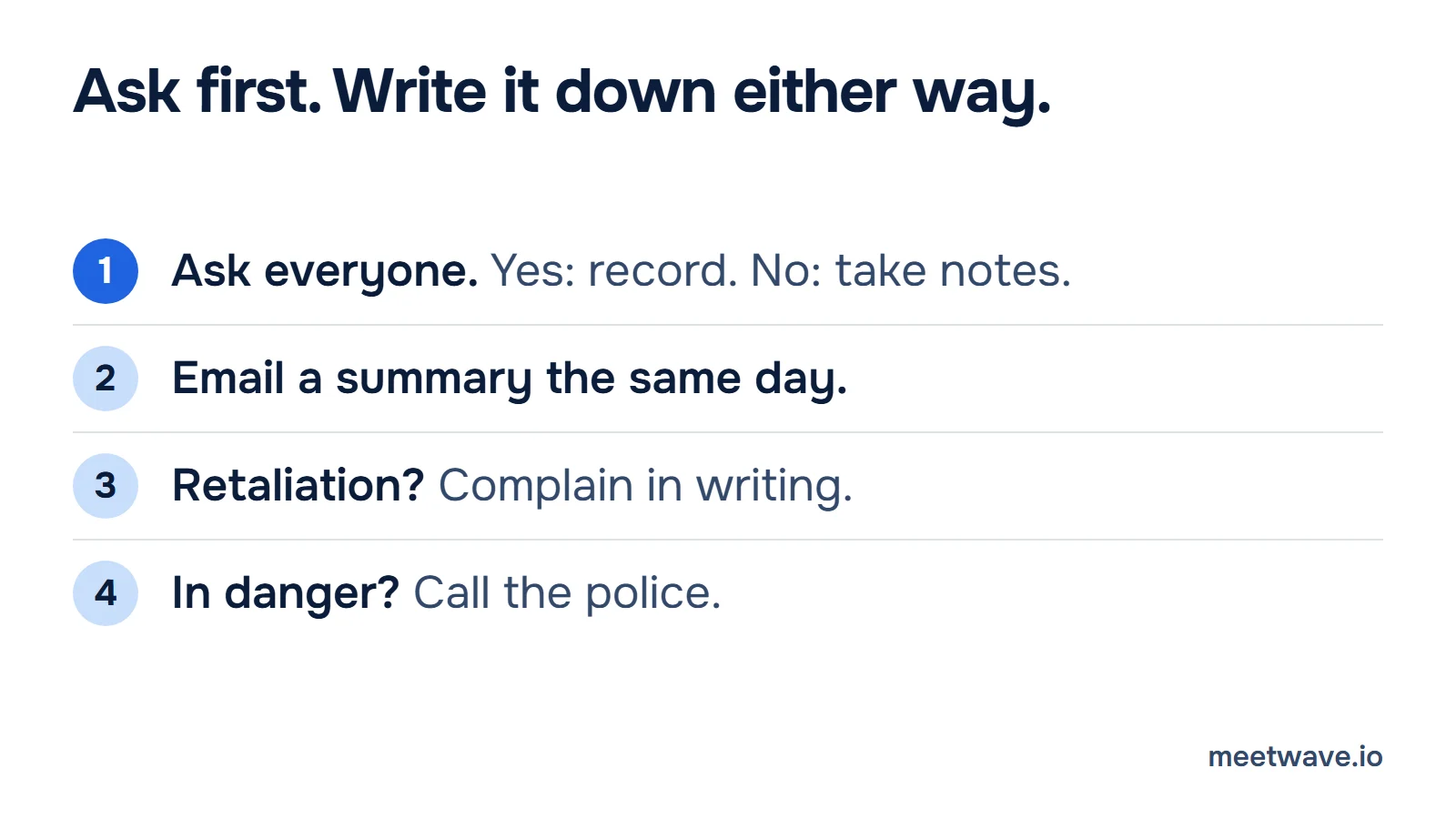
 Figure 2. Ask first, write it down either way, escalate in writing. Source: MeetWave, 2026.
Say this before the meeting starts:
Before we start: I'd like to record this so my notes are accurate. It's for my own notes only. Are you OK with that?

If they say yes, say this once the recording is running:
"It's [date]. This is [your name] with [their name], and we've both agreed to record this."

If they say no:
"No problem. I'll take notes and send you a summary today."
A same-day email fixes the words while both sides still remember them, and it invites a correction. In a study of 21 pairs of university participants, a week after a conversation only 4.7% of its details were recalled by both partners; that is a strict overlap, not each person's recall (Brown-Schmidt et al., 2023). In the same study, people who wrote a memo right after the talk recalled more (Brown-Schmidt et al., 2023).
Subject: Notes from our conversation on [date]

Hi [name],

Thanks for talking with me today. So that we both have the same notes, here is what I took away:

- What we discussed: [topic]. You said: "[their exact words]".
- What changed: [target, deadline or promise] was [before], and is now [after].
- I'll [what you agreed to do] by [date].
- You'll [what they agreed to do] by [date].

If I got anything wrong, please tell me and I'll correct my notes.

Thanks,
[your name]
Short of time? The free follow-up email generator drafts the same email from your notes.
If the conversation was harassment, a threat or retaliation, put the complaint in writing and ask an employment lawyer what to do next. A U.S. discrimination charge goes to the EEOC "within 180 calendar days", extended to 300 where a state or local agency enforces a similar law (EEOC). Complaining is protected on "a reasonable belief" (EEOC). If you are in danger, call the police first.
The other 37: one-party states and D.C.
These 36 states and D.C. let a participant record, or have no statute that says otherwise. "Party or one party's consent" below is the wording most of them share: the recorder is a party, or one party gave prior consent. A company rule still applies in every one of them.
| Jurisdiction | Statute and rule |
|---|---|
| Alabama | § 13A-11-30: "at least one of the persons engaged" |
| Alaska | AS 42.20.310: "a party to the conversation". SB 85 would change this to "all parties"; it has sat in committee since 2025-02-05 |
| Arizona | § 13-3005, § 13-3012(9): "a party to the communication or a person who is present" |
| Arkansas | § 5-60-120: Party or one party's consent |
| Colorado | § 18-9-303, § 18-9-304: "at least one of the principal parties" |
| D.C. | § 23-542(b)(3): Party or one party's consent |
| Georgia | § 16-11-66(a): Party or one party's consent |
| Hawaii | § 803-42(b)(3)(A): Party or one party's consent. Some lists add an all-party rule for a device installed in a private place |
| Idaho | § 18-6702(2)(d): One party's consent |
| Indiana | § 35-31.5-2-176: Sender or receiver; speaks of electronic communications, not in-person talk |
| Iowa | § 808B.2(2)(c): Party or one party's consent |
| Kansas | 21-6101(a)(1): Sender or receiver; the Attorney General reads one party's consent as enough |
| Kentucky | KRS 526.010: "at least one (1) party" |
| Louisiana | 15:1303(C)(4): Party or one party's consent |
| Maine | 15 M.R.S. § 709(4): Excludes "the sender or receiver" |
| Minnesota | § 626A.02(2)(d): Party or one party's consent |
| Mississippi | § 41-29-531(e): Party or one party's consent |
| Missouri | § 542.402.2(3): Party or one party's consent |
| Nebraska | § 86-290(2)(c): Party or one party's consent |
| New Jersey | 2A:156A-4(d): Party or one party's consent |
| New Mexico | § 30-12-1(C): "a sender or intended recipient"; speaks of telegraph and telephone messages |
| New York | § 250.00, § 250.05: "at least one party", by "a person not present" |
| North Carolina | § 15A-287(a): "at least one party" |
| North Dakota | § 12.1-15-02(3)(c): Party or one party's consent |
| Ohio | § 2933.52(B)(4): Party or one party's consent |
| Oklahoma | 13 O.S. § 176.4: Party or one party's consent; current text as printed in an unpassed 2023 bill |
| Rhode Island | § 11-35-21(c)(3): Party or one party's consent |
| South Carolina | § 17-30-30(C): Party or one party's consent |
| South Dakota | 23A-35A-20: "a party to the conversation or discussion" |
| Tennessee | § 39-13-601(b)(5): Party or one party's consent |
| Texas | § 16.02(c)(4): Party or one party's consent |
| Utah | § 77-23a-4(7)(b): Party or one party's consent |
| Vermont | Federal rule: No state statute found |
| Virginia | § 19.2-62(B)(2): Party or one party's consent |
| West Virginia | § 62-1D-3(e): Party or one party's consent |
| Wisconsin | § 968.31(2)(c): Party or one party's consent |
| Wyoming | § 7-3-702(b)(iv): Party or one party's consent |
Source: the statute linked on each row, read 2026-10-30 (method).
Key numbers
- 9 U.S. states need every party's consent or knowledge to record a conversation, as of 2026-10-30 (our count).
- 36 U.S. states plus D.C. keep the one-party rule, and 5 states are split or disputed, as of 2026-10-30 (our count).
- A week after a conversation, only 4.7% of its details were recalled by both partners, in 21 pairs of university participants, 2023 (Brown-Schmidt et al.).
- California allows a claim of $5,000 per violation for an unlawful recording, as read in 2026 (Penal Code § 637.2).
- A U.S. discrimination charge is due within 180 calendar days, or 300 where a state or local agency enforces a similar law, as read in 2026 (EEOC).
- A UK tribunal's 10% cut to an award for a covert recording was left in place in 2019 (Phoenix House v Stockman).
How we calculated
The state count is our own reading, not an official list. On 2026-10-30 we opened the recording statute of each state that has one, plus the rulings that split them, and sorted 51 jurisdictions into three groups.
- One party: the statute lets a participant record, or there is no state statute and the federal rule stands.
- All parties: the statute needs every party's consent or knowledge.
- Split or disputed: the answer changes with the medium, or statutes and courts point different ways.
The total is 9 + 5 + 37 = 51, where 37 is 36 states plus D.C. Vermont is one of the 36. A law can change after this date, so check the linked text.
The 4.7% is the study's own figure: 369 of 7,856 idea units were recalled by both partners after a week, in the 21 pairs analysed of 33 recruited (Brown-Schmidt et al., 2023).
FAQ
These answers are general information, not legal advice.
Can I record my boss yelling at me in California or Texas?
In California, not without everyone's consent if the conversation is confidential (Penal Code § 632). In Texas, a party to the conversation may record it (Penal Code § 16.02(c)(4)). In both, a company rule can still apply, so write down what was said and send the same-day email.
Can I secretly record a PIP meeting?
We do not recommend it. In the 9 all-party states the statute is against you (table above), and elsewhere a company rule can still end the job, which is the last thing you need during a plan. Ask at the start, and if the answer is no, keep a written log of each check-in.
Can I record a conversation if I feel threatened at work?
A few all-party states have narrow safety exceptions, and they are easy to get wrong. Ask an employment lawyer before you rely on one. If you are in danger, call the police first.
Can I record a phone call with my boss in the UK?
Acas says any decision to record "should be agreed by all parties" and warns a covert recording "might be viewed as a misconduct matter" (Acas). That guidance is written for investigation meetings, and the same logic is the safe one for a call: ask first.
Can my employer record me in a company vehicle?
We found no rule written for vehicles. Audio of your conversations falls under the same federal rule (18 U.S.C. § 2511), and the notice laws in New York, Connecticut and Delaware cover electronic monitoring. Check your employer's written monitoring notice.
Can I record my boss firing me?
The same rules apply: your state first, then the company's. Being fired ends neither, and a recording made against your state's law can be kept out of a later case (what a court may do). The EEOC deadline runs from the day the discrimination took place, so write down what was said that same day (EEOC).
Sources
State statutes are linked on each row of the tables above, as read on 2026-10-30.
- U.S. Code — 18 U.S.C. § 2511, interception prohibited (2026). Accessed 2026-10-30.
- U.S. Code — 18 U.S.C. § 2510, definitions (2026). Accessed 2026-10-30.
- National Labor Relations Board — Whole Foods Market, 363 NLRB 800 (2015). Accessed 2026-10-30.
- U.S. Court of Appeals, Second Circuit — Whole Foods Market v. NLRB, summary order (2017). Accessed 2026-10-30.
- U.S. Court of Appeals, Fifth Circuit — T-Mobile USA v. NLRB (2017). Accessed 2026-10-30.
- National Labor Relations Board — Board adopts new standard for assessing lawfulness of work rules (2023). Accessed 2026-10-30.
- NLRB General Counsel — Answering brief, Atlassian Corp., 16-CA-324971 (2026). Accessed 2026-10-30.
- National Labor Relations Board — Employee rights (2026). Accessed 2026-10-30.
- National Labor Relations Board — Interfering with employee rights, Section 8(a)(1) (2026). Accessed 2026-10-30.
- U.S. Equal Employment Opportunity Commission — Retaliation (2026). Accessed 2026-10-30.
- U.S. Equal Employment Opportunity Commission — Time limits for filing a charge (2026). Accessed 2026-10-30.
- Supreme Court of California — Kearney v. Salomon Smith Barney, 39 Cal.4th 95 (2006). Accessed 2026-10-30.
- Supreme Court of Nevada — Ditech Financial v. Buckles, No. 70475 (2017). Accessed 2026-10-30.
- Supreme Court of Nevada — Lane v. Allstate, 114 Nev. 1176 (1998). Accessed 2026-10-30.
- U.S. Court of Appeals, Seventh Circuit — Argyropoulos v. City of Alton, 539 F.3d 724 (2008). Accessed 2026-10-30.
- Microsoft Support — Record a meeting in Microsoft Teams (2026). Accessed 2026-10-30.
- Microsoft Support — View live transcription in Microsoft Teams meetings (2026). Accessed 2026-10-30.
- Zoom Support — Recording consent for participants (2026). Accessed 2026-10-30.
- Acas — Holding investigation meetings (2026). Accessed 2026-10-30.
- Employment Appeal Tribunal — Phoenix House v Stockman, UKEAT/0058/18/OO (2019). Accessed 2026-10-30.
- Information Commissioner's Office — Data protection and monitoring workers (2026). Accessed 2026-10-30.
- Justice Laws Website — Criminal Code, section 184 (2026). Accessed 2026-10-30.
- Government of Ontario — Your guide to the Employment Standards Act: written policy on electronic monitoring (2026). Accessed 2026-10-30.
- Brown-Schmidt et al., Cognitive Science 47(4) — accepted manuscript, DOI 10.1111/cogs.13271 (2023). Accessed 2026-10-30.
Still comparing tools?
See how MeetWave stacks up against the tools most teams evaluate alongside it.
- MeetWave vs JamieSee how MeetWave compares to Jamie AI for bot-free meeting notes
- MeetWave vs Otter AISee how MeetWave compares to Otter AI for meeting intelligence
- MeetWave vs Fireflies.aiSee how MeetWave compares to Fireflies.ai for meeting intelligence
More on this: Meeting minutes template