How to Ask for a Raise: Build the Case From Your 1:1s
Ask for a raise with evidence your manager has already heard, put first the wins you mentioned only in passing, and ask for more than the default: in the 12 months to September 2026 the median US worker who stayed in a job got 3.4% more per hour, while prices rose 3.7%. Write each 1:1 down the same day: a week after a conversation, both people recalled only 4.7% of its details. Say each result at full size: in an experiment, women rated their own performance on a math and science test 13 points lower out of 100 than men with the same score.
What a raise is worth in 2026
A raise at the default rate does not keep up with prices. Employers paid a mean total increase of 3.4% in 2026 (Mercer, 2026), the median job stayer's hourly pay grew 3.4% (Atlanta Fed, 2026), and prices rose 3.7% (BLS, 2026). The Mercer figure is a survey of employers who chose to answer, not a statistic of all workers.
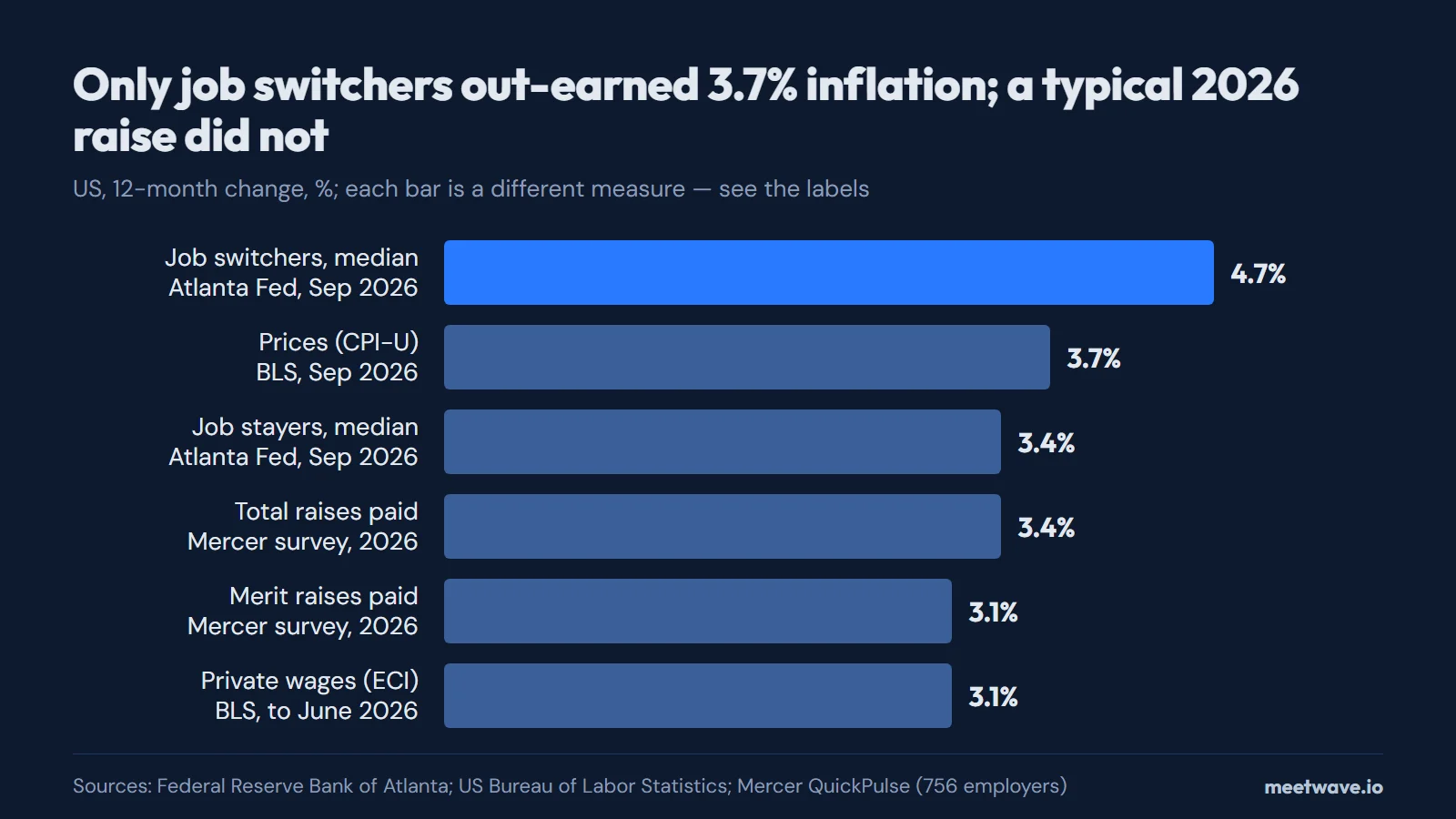 Figure 1. Only job switchers out-earned prices in 2026. Each bar is a different measure of a 12-month change. Source: Federal Reserve Bank of Atlanta; US Bureau of Labor Statistics; Mercer QuickPulse, 2026.
Switching jobs pays more than staying in most years, and that gap is your manager's real competition. In September 2026 switchers' median wage growth was 4.7% against 3.4% for stayers, 1.3 percentage points apart; switchers were ahead in 7 of the last 8 Septembers and level in 2024 (Atlanta Fed, 2026; our arithmetic). The tracker counts a change of employer, occupation, industry or job duties as a switch (Atlanta Fed method).
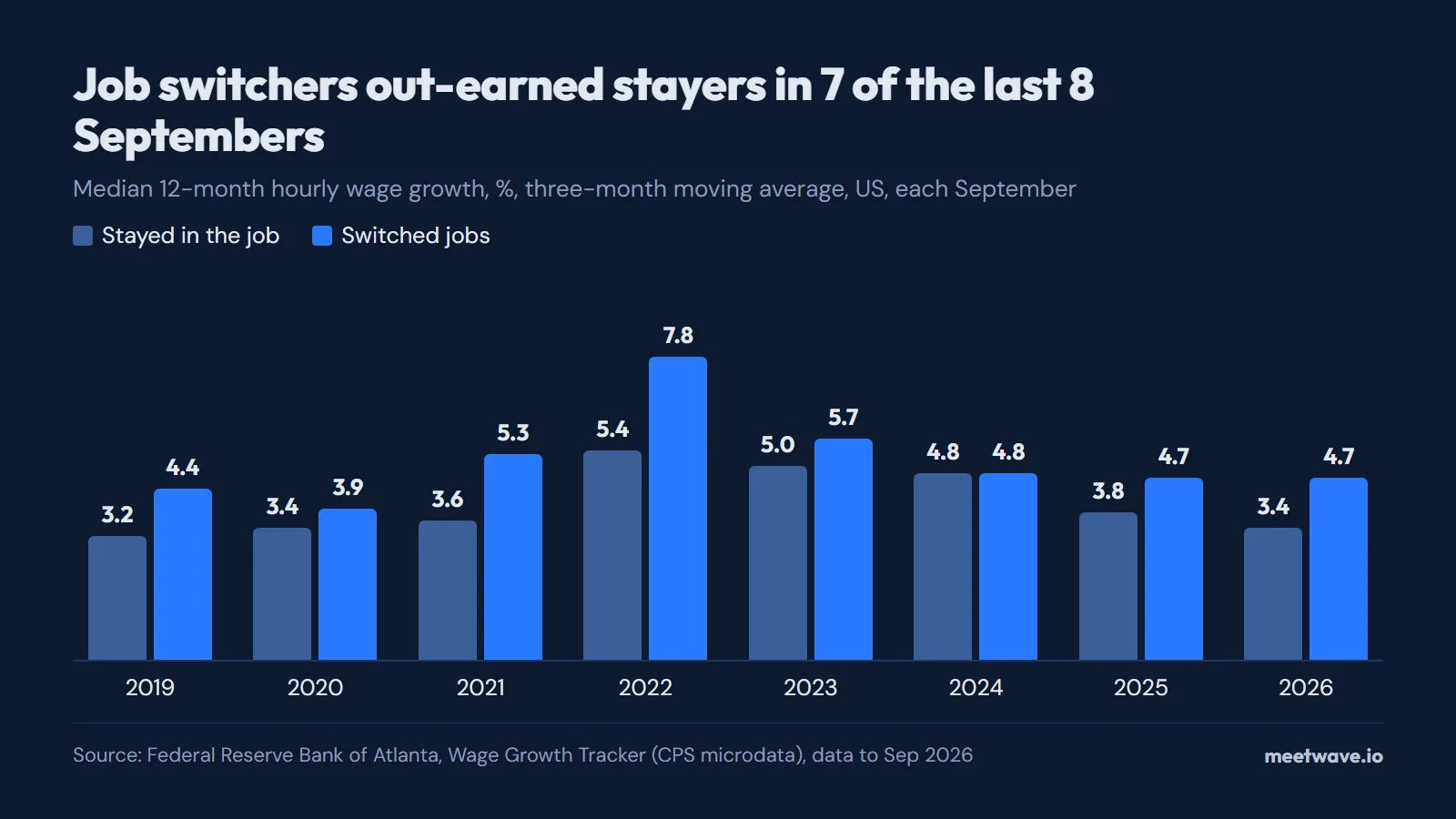 Figure 2. Job switchers out-earned stayers in 7 of the last 8 Septembers. Source: Federal Reserve Bank of Atlanta, Wage Growth Tracker, data to September 2026.
Why the case has to come from your 1:1s
Your manager will not remember what they said in May, and neither will you. In a 2023 experiment, pairs of people talked and were tested a week later: only 4.7% of the conversation's details were recalled by both partners (Brown-Schmidt et al., 2023). The same study found that people who wrote a memo right after the talk recalled more, with the same accuracy.
The 1:1 is where the evidence is said out loud: "that's senior-level work", "let's look at comp in Q3", "can you take this on". A request built on those sentences, with dates, is a request your manager already half agreed to. A request built on "I feel underpaid" starts from zero.
What to keep from every 1:1
Keep four things from each meeting, on the same day:
- Results your manager acknowledged, in their words, with the number behind them: days saved, money found, customers kept.
- Results you mentioned only in passing: the fix nobody asked for, the "small thing", the "we" that was you. These get lost first.
- Promises about pay, title or scope: who promised, what, and by when.
- Feedback with its example, including the gap they named, and what you did about it since.
If you take notes by hand, the one-on-one meeting template has a field for each.
The win said in passing: a demo case
The strongest line in your case is often one you already said and let go. Here is a series of three demo 1:1s between an analytics manager, Nadia, and her analyst, Sam, in May, July and September 2026. MeetWave's Raise Coach read each one for Sam: every result he mentioned without its impact, with the minute, and the line to use instead.
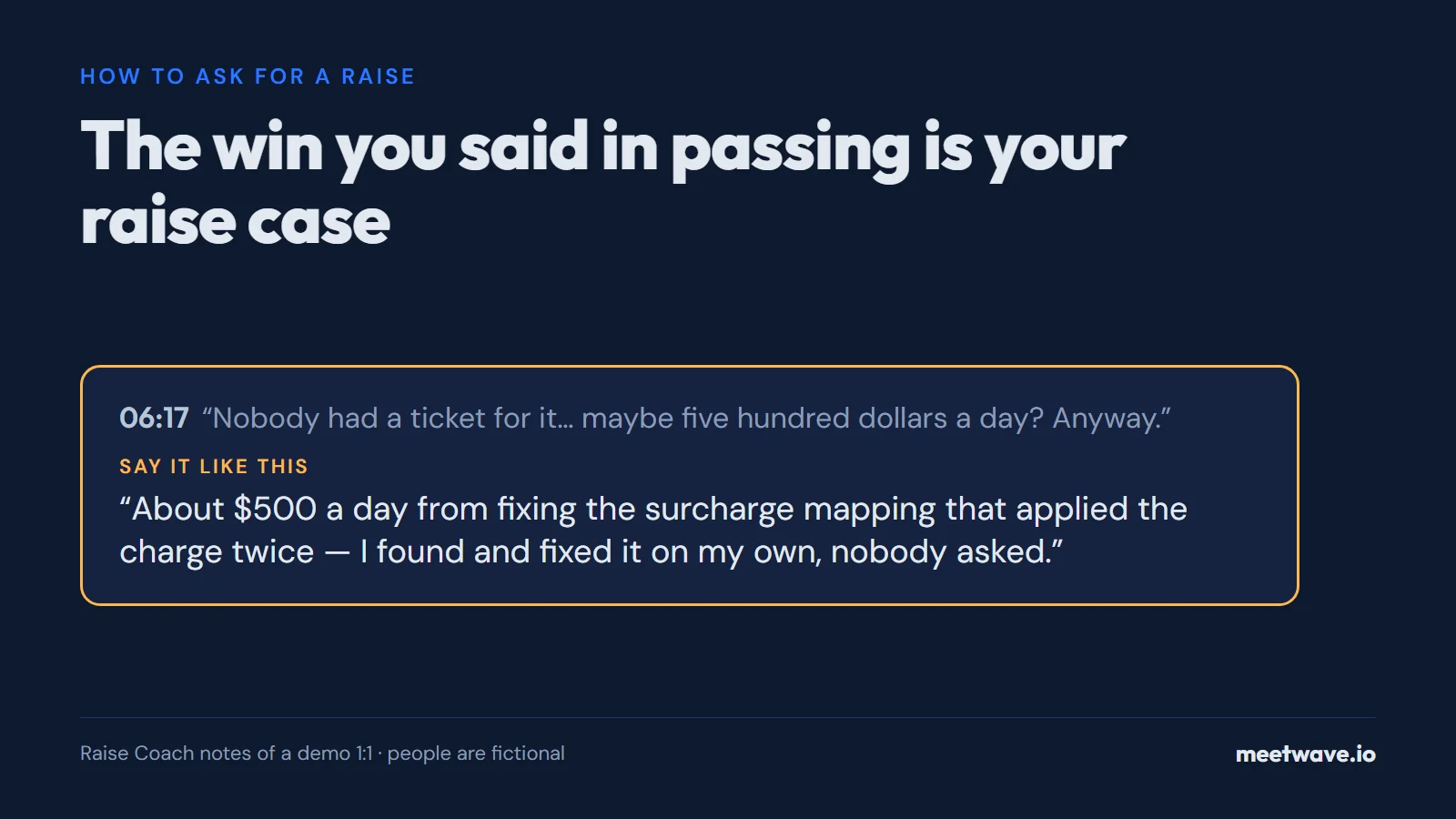
At 06:17 in May, right after Nadia praised his chart, Sam said in passing that he had found a mapping error that charged the fuel surcharge twice on some regional carriers: "Nobody had a ticket for it, I just saw it in the chart and fixed it last week. It was, I don't know, maybe five hundred dollars a day? Anyway." The talk moved on to a query review that sat for three days, and nobody came back to it.
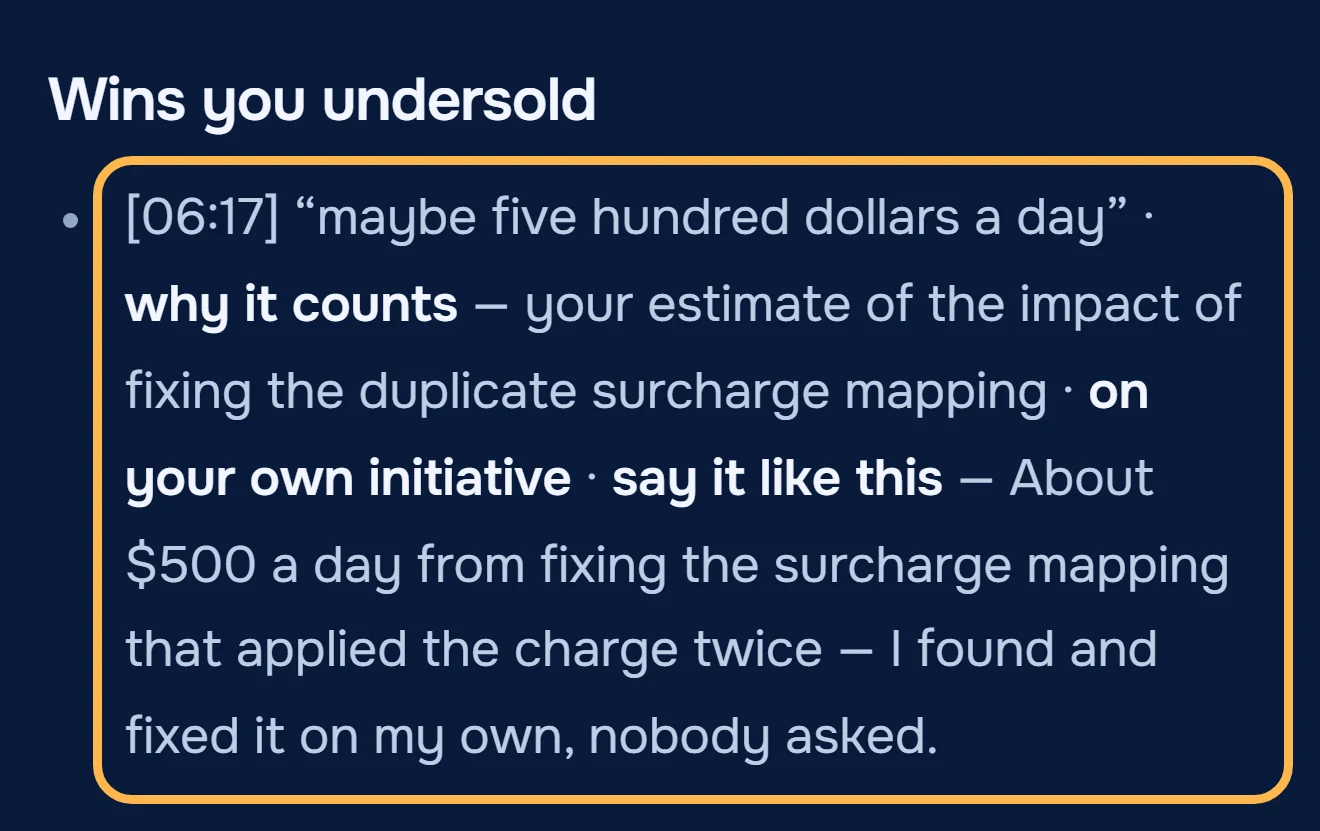 Figure 3. Demo meeting, people are fictional. May 1:1: a fix Sam made unasked, about $500 a day, said in passing at 06:17. Source: demo 1:1 series, May Raise Coach notes, October 2026.Analyzed with MeetWaveSee the full notesTry it on your next 1:1
That is a raise lever: a loss nobody had seen, found and closed on his own initiative, with a number per day. Build the line from four parts, each a fact that was said:
What it saved or earned per period · what I did · that nobody asked · who saw it
| What Sam said at 06:17 | What to say in the pay conversation |
|---|---|
| "Nobody had a ticket for it, I just saw it in the chart and fixed it last week. It was, I don't know, maybe five hundred dollars a day? Anyway." | "About $500 a day of double payments stopped: I found the surcharge mapping that charged some regional carriers twice and fixed it. Nobody asked me to; there was no ticket. It came out of the chart you saw at the pricing review." |
Source: demo 1:1 series, May recording.
The rewrite adds no new fact. It drops the hedges, puts the number in, and says out loud that nobody asked, which is what makes it more than doing the job.
The words that shrink your work
The same notes list the phrases that made Sam's work smaller than it was, each with the minute and a stronger version:
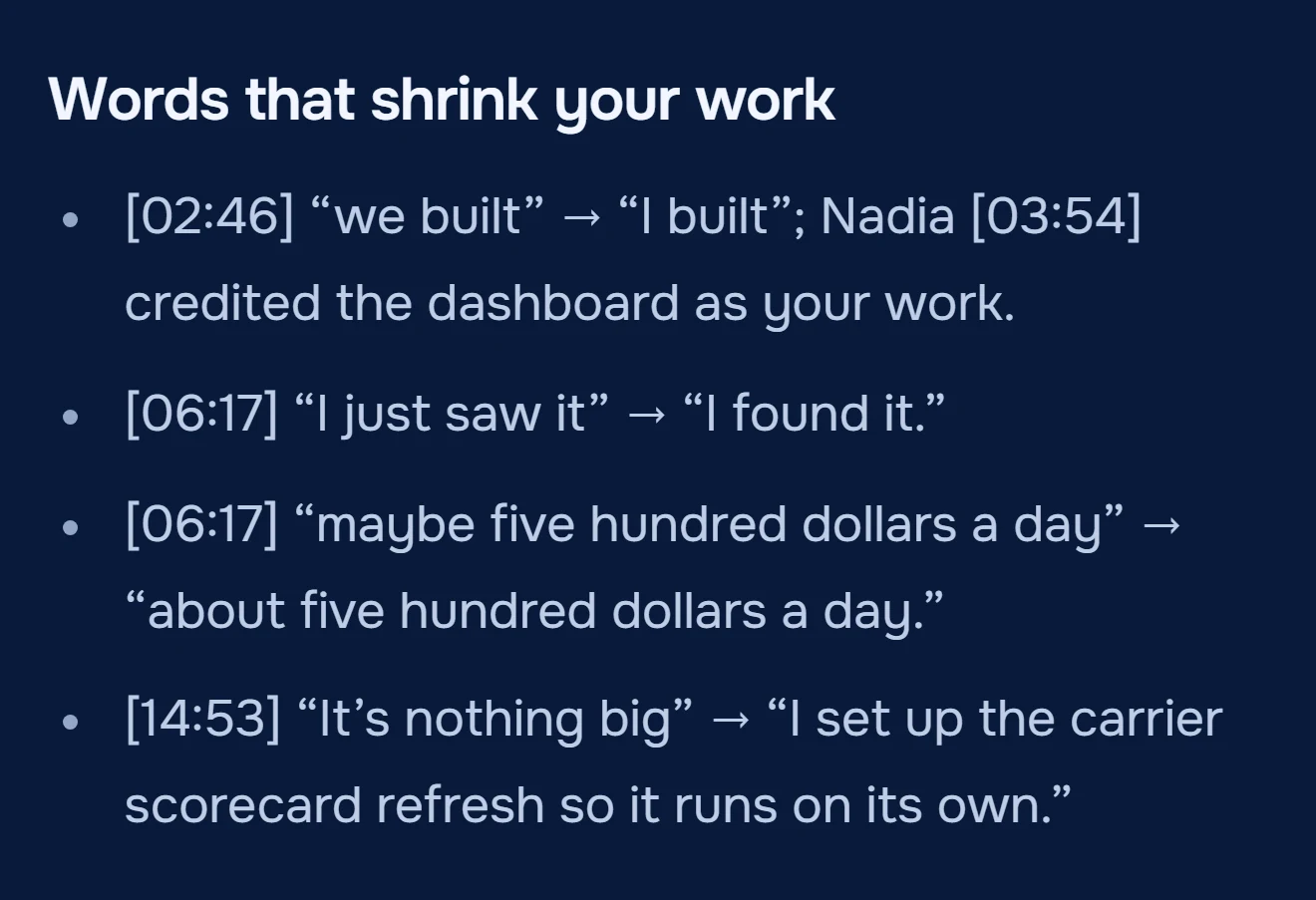 Figure 4. Demo meeting, people are fictional. May 1:1: four phrases that shrank Sam's work, with the minute. Source: demo 1:1 series, May Raise Coach notes, October 2026.Analyzed with MeetWaveSee the full notesTry it on your next 1:1
Listen for them in your own 1:1s:
- "We built" for work you did alone. Nadia said it herself at 03:54: "You scoped it, you built the matching." Say "I built".
- "Just", as in "I just saw it" or "I just fixed it". Drop the word, keep the verb.
- "Nothing big", "It's nothing", "Kind of a small thing": say what changed instead, and for whom. Sam's "nothing big" at 14:53 was a scorecard Ines no longer rebuilds by hand every Monday morning.
- "Anyway" after a number: stop at the number and let it land.
September: one win used well, one still undersold
By September Sam had learned half of it. Asked to own the Q4 forecast, at 05:52 he named the dashboard's numbers himself: month-end close from six days to four and $41,000 of duplicate invoices caught in its first month. At 02:21 he had called the two carriers he added to the matching "kind of a small thing", and they had flagged about $6,000 of duplicates in their first month (demo series).
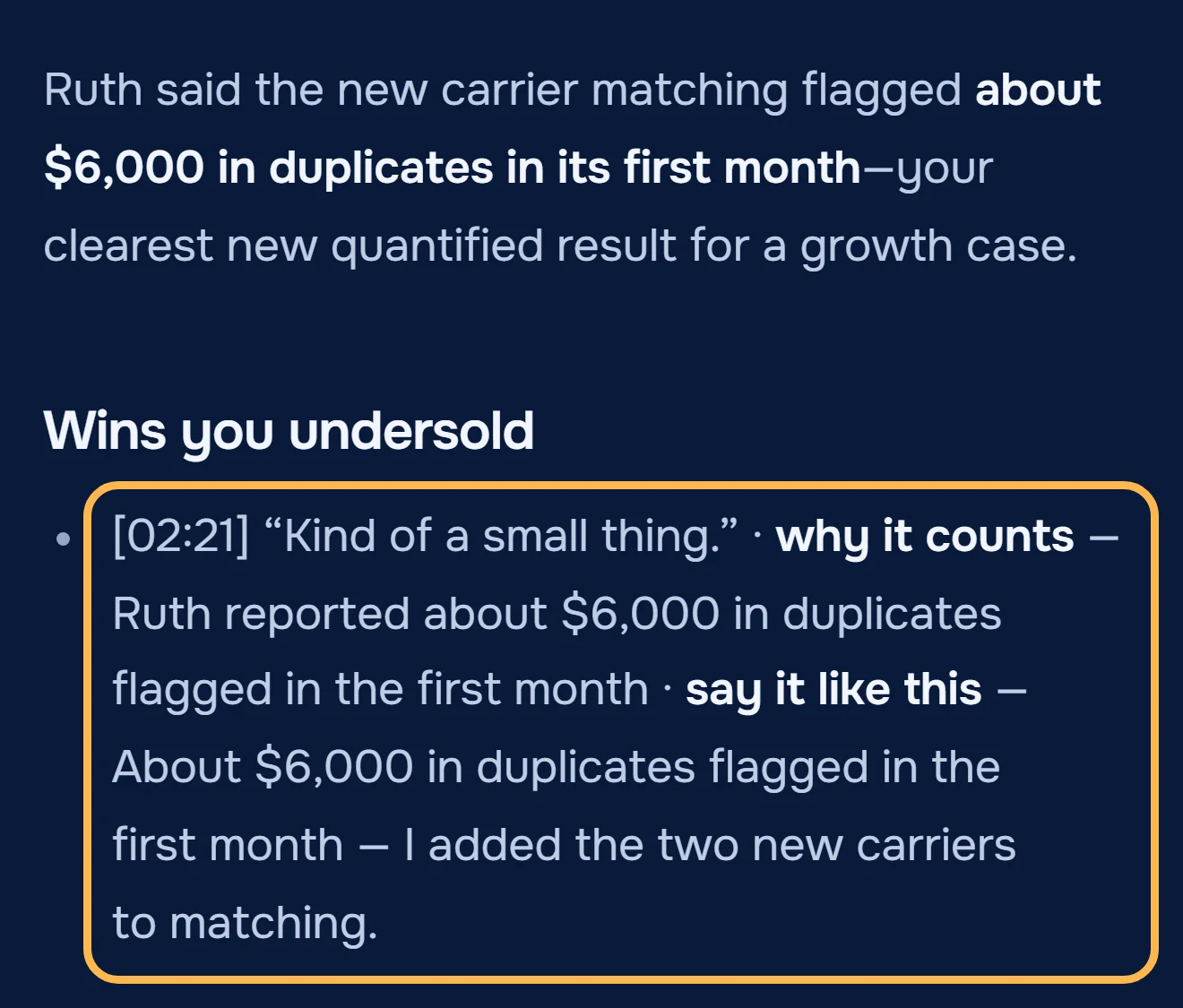 Figure 5. Demo meeting, people are fictional. September 1:1: the $6,000 he still called a small thing, as his strongest new card. Source: demo 1:1 series, September Raise Coach notes, October 2026.Analyzed with MeetWaveSee the full notesTry it on your next 1:1
The same notes put the oldest open promise first. Read with the May and July 1:1s as context, they list Nadia's May promise to put Sam's case into the Q3 window: still open, 13 days left, and not mentioned in September.
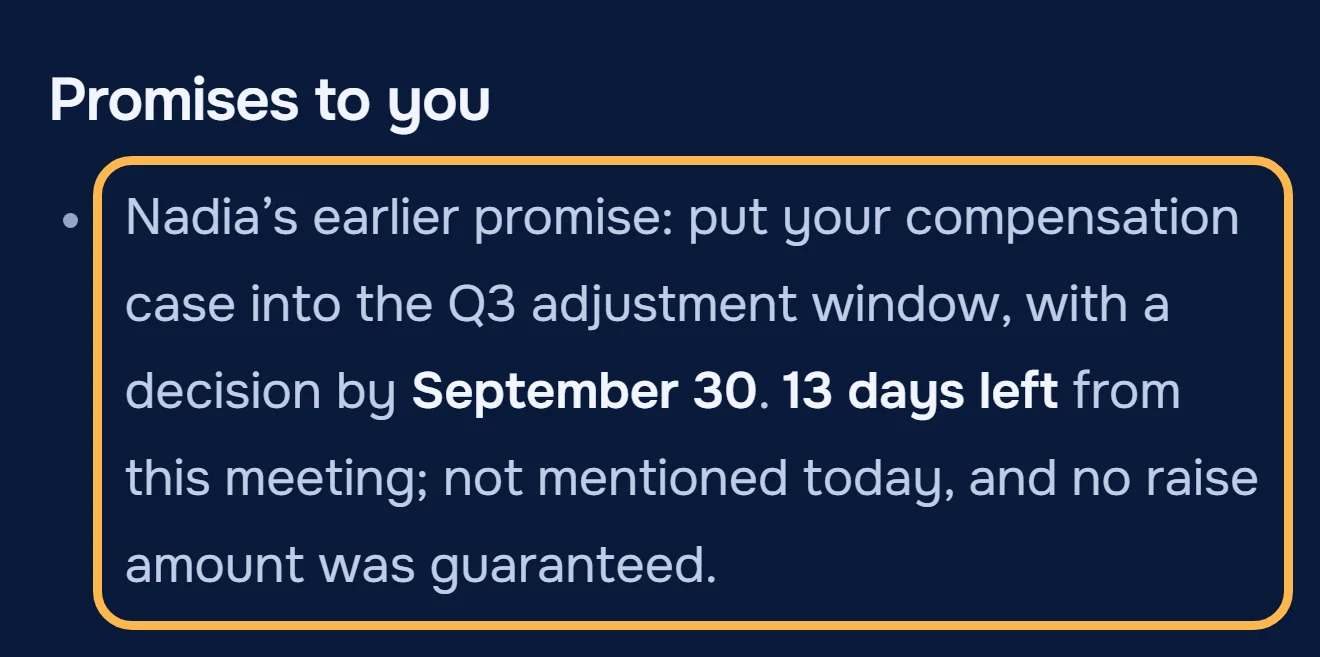 Figure 6. Demo meeting, people are fictional. September 1:1: the May pay promise flagged as still open. Source: demo 1:1 series, September Raise Coach notes, October 2026.Analyzed with MeetWaveSee the full notesTry it on your next 1:1
The evidence list
Fill one block per 1:1, then read it top to bottom before you ask. Copy the template:
1:1 on [date]
- Result my manager acknowledged, in their words: "[quote]"
- The number behind it: [days saved / money / customers / hours]
- Win I mentioned in passing: [what I did] · [nobody asked / who asked] · [saved or earned per day, week, month] · [who saw it]
- Promise about pay, title or scope: [who] will [what] by [date]
- Feedback and its example: [what they said] — [the example]
- Gap they named, and what I have done about it since: [gap] — [what changed]
Sam's May block, filled in after September:
- Result Nadia acknowledged: "That dashboard is your work"; carrier close from six working days to four, about $41,000 of duplicate invoices in April (demo series).
- Win he mentioned in passing: fixed the surcharge mapping that charged some regional carriers twice · no ticket, nobody asked · about $500 a day · found with the chart Nadia saw at the pricing review (demo series).
- Promise: Nadia puts his case into the Q3 window, decision by the end of September.
- Gap: he let Nadia present his work to leadership. In June he presented the dashboard at the ops review himself.
Ask for the meeting by email
Ask for a separate meeting about pay, not the last five minutes of a regular 1:1. Name the promise and its date in the request, so the meeting starts from it:
Subject: Time to talk about my compensation before [date]

Hi [manager's name],

On [date of the 1:1] you said we would look at my compensation in [cycle or quarter]. That window closes on [date], so I would like 30 minutes this week or next to go through it.

I'll bring a short list of what I've delivered since [month], with the numbers.

Thanks,
[your name]
The conversation: a script in the order of the evidence
Lead with the promise, then the results your manager already agreed with, then the win nobody asked for, then the new scope, then one number. Stop talking after the number.
1. The promise
"In our 1:1 on [date] you said we would look at my pay in [cycle]. I'd like to do that today."

2. The results you already agreed on, oldest first
"In [month] you called [result] [their words]. Since then it has [number: days saved, money, customers]."
"In [month], [second result]. You said [their words]."

3. The win nobody asked for
"In [month] I found [problem] and fixed it. Nobody had asked me to. It saves [amount] a [day / week / month]."

4. The scope since then
"Since [month] I also own [new responsibility]."

5. The ask, as one number
"I'm asking for [amount or percent], effective [date]."

6. Stop and wait for the answer.
Sam's third step would be: "In May I stopped about $500 a day of double payments: I found the surcharge mapping that charged some regional carriers twice and fixed it. Nobody had asked me to." In the 1:1 it took one sentence and an "anyway"; here it gets its own step (demo series).
Ask for a number above the default. A raise at the 2026 mean of 3.4% falls short of the 3.7% rise in prices (Mercer, 2026; BLS, 2026), and a case built on senior-level results is a case for more than the default.
If the answer is "not now"
Turn "not now" into criteria and a date, and write both into the notes of the same 1:1. A promise with a date is what you bring back next time; Sam's May promise had one, which is why September could show it as missed.
I understand it can't happen today. Two things, so we can close this:
1. What exactly would you need to see from me to say yes?
2. By what date can we decide?
I'll put both in the notes of this 1:1 and bring them back on [date].
Asking for a raise by email
Ask in writing when you and your manager rarely meet, or when a written record matters more than the conversation. The email carries the whole case, so it follows the same order: the promise, the results, the scope, the number.
Subject: Compensation review: [your name]

Hi [manager's name],

On [date] you said we would look at my compensation in [cycle]. Here is what I've delivered since then:

- [Result 1], which you described as "[their words]": [number]
- [Result 2]: [number]
- [A win nobody asked for]: [what it saves, per day, week or month]
- Since [month] I also own [new responsibility].

Based on this, I'm asking for [amount or percent], effective [date]. Could we decide by [date]? I'm happy to talk it through in our next 1:1.

Thanks,
[your name]
Recording a 1:1: consent first
Record a 1:1 only after your manager agrees, and say it at the start of the call. US federal law lets a party to a conversation record it (18 U.S.C. § 2511(2)(d)), but some states, Washington among them, require the consent of everyone in a private conversation (RCW 9.73.030), and your employer may have its own rule. This is not legal advice.
If recording is not on the table, the method works the same with your own notes: write the three things down within the hour and send your manager a two-line recap of any promise ("as discussed, you'll look at my pay in the Q3 window, decision by September 30"). People who wrote a memo right after a conversation recalled more of it a week later (Brown-Schmidt et al., 2023).
Key numbers
- US workers who stayed in their job had median hourly wage growth of 3.4% in the 12 months to September 2026; job switchers had 4.7% (Federal Reserve Bank of Atlanta, Wage Growth Tracker, 2026).
- US consumer prices rose 3.7% in the 12 months to September 2026 (US Bureau of Labor Statistics, CPI, 2026).
- 756 US employers paid a mean merit increase of 3.1% and a mean total increase of 3.4% in 2026, zeros included (Mercer QuickPulse survey, March 2026).
- Private-industry wages and salaries rose 3.1% in the 12 months to June 2026 (US Bureau of Labor Statistics, Employment Cost Index, 2026).
- A week after a conversation, both partners recalled only 4.7% of its details in a preregistered experiment with 21 pairs (Brown-Schmidt et al., Cognitive Science, 2023).
- Women rated their own performance on a math and science test 13 points lower out of 100 than men with the same score, even when the rating went to nobody; 3,892 adults online, no gap on a female-typed task (Exley and Kessler, Quarterly Journal of Economics, 2022).
How we calculated
The gap between switchers and stayers is the Atlanta Fed's September 2026 values subtracted: 4.7 minus 3.4 is 1.3 percentage points. "7 of the last 8 Septembers" compares the two series' September values for 2019 to 2026, three-month moving averages, read from the tracker's published chart data on 2026-10-26; in 2024 both were 4.8 (Atlanta Fed).
Stayers' 3.4% and prices' 3.7% are different measures over the same 12 months: the median change in one person's hourly wage, and a price index (BLS CPI). We say one grew less than the other, not that real wages fell by a given amount.
The demo 1:1s are fictional meetings written for this article. Figures 3 to 6 are MeetWave's Raise Coach notes in the recording card, generated on 2026-10-26; the September notes were generated with the May and July 1:1s as series context. The minutes in the figures are the minutes of the demo recordings.
The 13-point gap is the published figure of Exley and Kessler: women's answers on a 0 to 100 scale to "I performed well on the test", compared with men who had the same test score (QJE, 2022). It is a gender gap on a lab task, not a measure of how everyone talks about their work.
FAQ
How much of a raise should I ask for?
Ask for more than the default: employers paid a mean total increase of 3.4% in 2026 (Mercer, 2026), below the 3.7% rise in prices (BLS, 2026). Tie the number to results your manager acknowledged, and name one figure, not a range.
How do I ask for a raise via email?
Send the promise, the results with numbers, the new scope and one figure, in that order, and ask for a decision date. The full email template above is ready to copy.
How do I ask for a raise when I'm underpaid?
Lead with evidence, not with the feeling: what your manager said about your work and what it changed. If you know what switching pays, the market data backs you: switchers' median pay grew 4.7% against 3.4% for stayers in the year to September 2026 (Atlanta Fed, 2026).
Is switching jobs better than asking for a raise?
In pay growth it usually is: switchers were ahead of stayers in 7 of the last 8 Septembers, level in 2024 (Atlanta Fed, 2026). That is a median across workers, not a promise for one person, and the tracker counts a new role at the same employer as a switch.
Can I record my 1:1 to remember what my manager promised?
Only with your manager's consent, and some states, Washington among them, require it from everyone in the conversation (RCW 9.73.030). Notes written right after the meeting and a short recap email work with the same method.
Sources
- Federal Reserve Bank of Atlanta — Wage Growth Tracker (2026, data to September 2026). Accessed 2026-10-26.
- US Bureau of Labor Statistics — Consumer Price Index, September 2026 (2026). Accessed 2026-10-26.
- US Bureau of Labor Statistics — Employment Cost Index, June 2026 (2026). Accessed 2026-10-26.
- Mercer — 2026 actual increase budgets, US, QuickPulse Compensation Planning Survey (2026). Accessed 2026-10-26.
- Brown-Schmidt, Jaeger, Evans and Benjamin — MEMCONS: How Contemporaneous Note-Taking Shapes Memory for Conversation, Cognitive Science 47(4) (2023). Accessed 2026-10-26.
- Exley and Kessler — The Gender Gap in Self-Promotion, The Quarterly Journal of Economics 137(3) (2022). Accessed 2026-10-26.
- Legal Information Institute — 18 U.S. Code § 2511 (2026). Accessed 2026-10-26.
- Washington State Legislature — RCW 9.73.030 (2026). Accessed 2026-10-26.
Still comparing tools?
See how MeetWave stacks up against the tools most teams evaluate alongside it.
- MeetWave vs Fireflies.aiSee how MeetWave compares to Fireflies.ai for meeting intelligence
- MeetWave vs tl;dvSee how MeetWave compares to tl;dv for meeting intelligence
- MeetWave vs FathomFree AI meeting assistant and note taker focused on sales teams
More on this: Meeting minutes template