
The Science Behind Why You Can't Remember Meetings
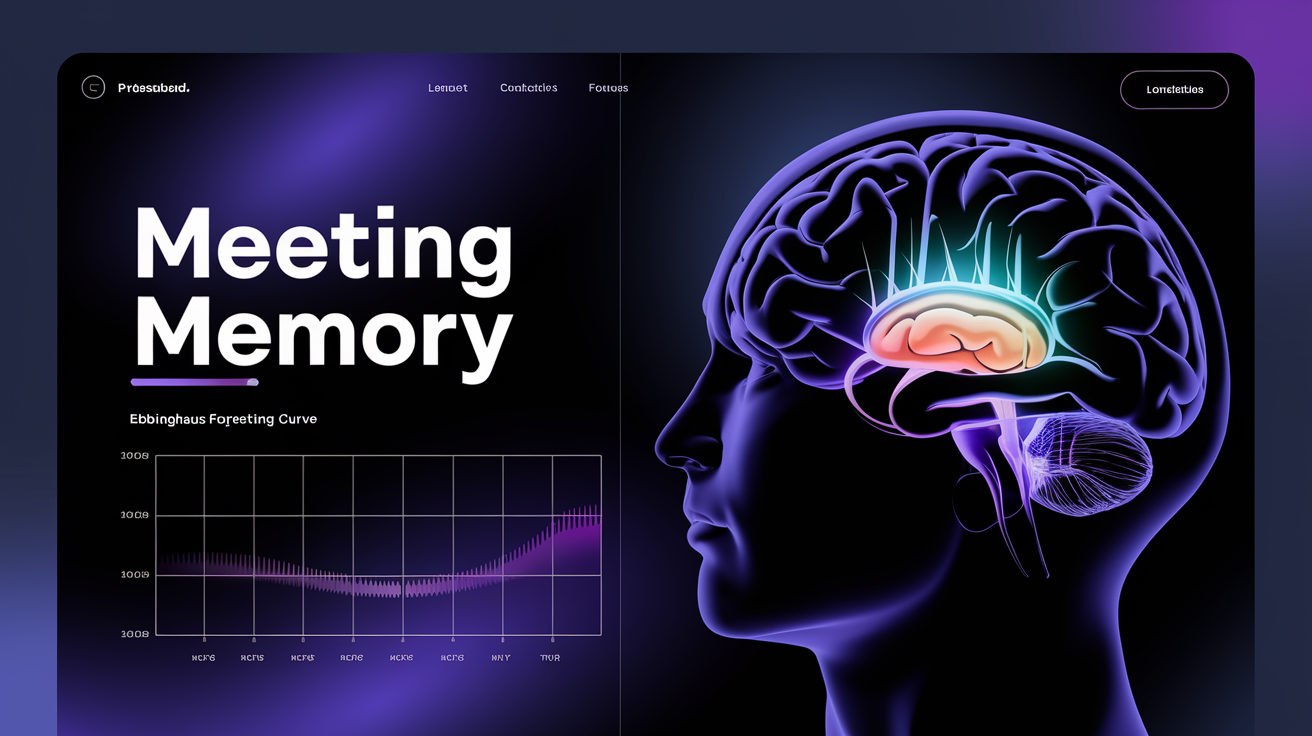
You can't remember your meetings because memory decays faster than you think. Ebbinghaus showed we lose roughly 50% of new information within an hour and 70% within a day. Meeting content sits at the worst end of that curve — spoken, unstructured, rapid-fire, with no headings to anchor it. Taking notes doesn't rescue it, since writing competes for the attention you need to listen. The fix is an external record.
Without looking at your calendar, name the three main points from your last meeting yesterday afternoon. The specific decisions made. The action items assigned. The concern someone raised near the end.
Most people can't do this. Not even close. And if you're beating yourself up about it — stop. This isn't a personal failing. It's how human memory works, and meetings happen to be the worst possible format for retention.
The Forgetting Curve Is Not on Your Side
In 1885, a German psychologist named Hermann Ebbinghaus ran a series of experiments on himself to understand how quickly we forget new information. What he found was brutal: we lose roughly 50% of new information within an hour. Within 24 hours, that number climbs to 70%. After a week, we're left with maybe 20% of what we originally learned.
This decay follows a predictable exponential curve — steep at first, then gradually leveling off. The information that survives tends to be emotionally charged, personally relevant, or deliberately rehearsed. Everything else fades.
Now think about meeting content. It's spoken, unstructured, and often rapid-fire. Multiple topics get covered in quick succession. There are no chapter headings, no bold text, no visual hierarchy to anchor your memory. Meeting content sits at the absolute worst end of the forgetting curve.
Why Meetings Are Uniquely Hard to Remember
The forgetting curve alone doesn't explain why meetings are so problematic. Several cognitive factors compound the problem.
Dual-task interference. During a meeting, you're not just listening. You're simultaneously processing what someone said, formulating your response, reading facial cues, evaluating whether you agree, thinking about that email you need to send, and monitoring the chat for side conversations. Your brain can't encode memories effectively while juggling all of this. Attention is a bottleneck, and meetings demand it in six directions at once.
No encoding cues. When you read a book, you can picture where on the page you saw something. You might remember it was near a diagram, or at the top of a left-hand page. These spatial and visual cues act as memory anchors. Meetings offer nothing comparable. Speech is ephemeral — it enters your ears and immediately begins to fade. There's no physical artifact to "picture" when trying to recall what was said.
Context switching and retroactive interference. This is the back-to-back meeting killer. Each new meeting doesn't just add information to your memory — it actively interferes with the information from the previous meeting. The neural traces from meeting one get overwritten by meeting two. By the time you've finished your fourth meeting of the morning, the first one might as well have happened last week.
Your Working Memory Has a Hard Limit
Cognitive load theory tells us that your working memory — the mental scratchpad you use to process incoming information — holds roughly four items at a time. Not four topics. Not four meetings. Four chunks of information, period.
A typical 30-minute meeting surfaces dozens of topics, decisions, tangents, action items, and open questions. You're asking a system designed to hold four things to track forty. The overflow doesn't get stored somewhere else — it simply doesn't get encoded at all.
This is why you walk out of a meeting with a vague sense of what was discussed but can't recall specifics. Your working memory was overwhelmed, and the excess information never made it into long-term storage.
The Note-Taking Paradox
Here's where it gets counterintuitive. You'd think taking notes during a meeting would solve this. It doesn't — and in many cases, it makes things worse.
When you take notes, you divide your attention between listening and writing. Research on divided attention consistently shows that trying to do both means you do neither well. You miss nuances in the conversation because you're focused on capturing the last point. You write incomplete fragments because you're trying to keep up with the speaker.
Studies comparing manual note-takers to people who simply listened found that note-takers often recalled less of the meeting's substance. They had a written record, yes — but it was fragmented, sometimes inaccurate, and focused on what was easy to capture rather than what was important. Meanwhile, they missed the forest for the trees because their attention was on transcription, not comprehension.
The fundamental problem is that writing and deep listening compete for the same cognitive resources. You can't fully understand a complex argument while simultaneously deciding how to abbreviate it in your notebook.
What Actually Helps You Remember
If brute-force memorization fails and real-time note-taking backfires, what does work?
Spaced retrieval. Reviewing information at increasing intervals — an hour later, a day later, a week later — dramatically improves long-term retention. The forgetting curve isn't a death sentence; it's a curve you can flatten with well-timed review. But this requires having something to review.
Structured summaries over raw notes. Your brain retains organized information far better than unstructured streams. A list of key decisions, action items with owners, and open questions gives your memory anchoring points that raw meeting audio or scattered notes cannot.
External memory systems. This is the big one. Instead of trying to make your brain do something it's not designed for — perfectly recording hours of spoken information — you offload the storage to a reliable system. Your brain is freed up to do what it's actually good at: thinking, connecting ideas, making decisions, and engaging with other humans.
AI as an External Memory System
This is where meeting intelligence tools enter the picture — not as a nice-to-have, but as a cognitively sound solution to a real biological limitation.
When a tool automatically captures and transcribes a meeting, you eliminate the divided-attention problem entirely. You don't need to write anything down. You can listen, think, respond, and engage fully — knowing that nothing is being lost.
When that tool generates a structured summary afterward — organized into decisions, action items, discussion points, and open questions — it provides exactly the encoding cues your brain needs to form lasting memories. Reading a well-organized summary is dramatically more effective for retention than trying to reconstruct one from your own fading recollection.
And when that tool maintains a searchable archive of past meetings, it enables spaced retrieval on your terms. You can revisit what was discussed last Tuesday, or three weeks ago, or before the holidays — without relying on your own memory or digging through a chaotic Slack history.
Let Your Brain Do What It's Good At
Your brain is a remarkable thinking machine. It's just a terrible recording device. The science is clear on this — and it's been clear since 1885. Fighting the forgetting curve with willpower and note-taking discipline is a losing battle.
The smarter approach is to stop asking your brain to be a tape recorder and start giving it the structured external support it needs.
MeetWave captures your meetings through system audio — no bots, no interruptions — and generates AI-powered structured summaries so you can focus on the conversation, not on remembering it. Your brain does the thinking. MeetWave does the remembering. Try it free at meetwave.io.
Planned the meeting. Now keep what's said in it.
Free plan: 600 minutes a month. No card.
Still comparing tools?
See how MeetWave stacks up against the tools most teams evaluate alongside it.
- MeetWave vs KrispSee how MeetWave compares to Krisp for meeting notes
- MeetWave vs JamieSee how MeetWave compares to Jamie AI for bot-free meeting notes
- MeetWave vs Otter AISee how MeetWave compares to Otter AI for meeting intelligence