Performance Improvement Plan: What to Write Down After Every Check-In
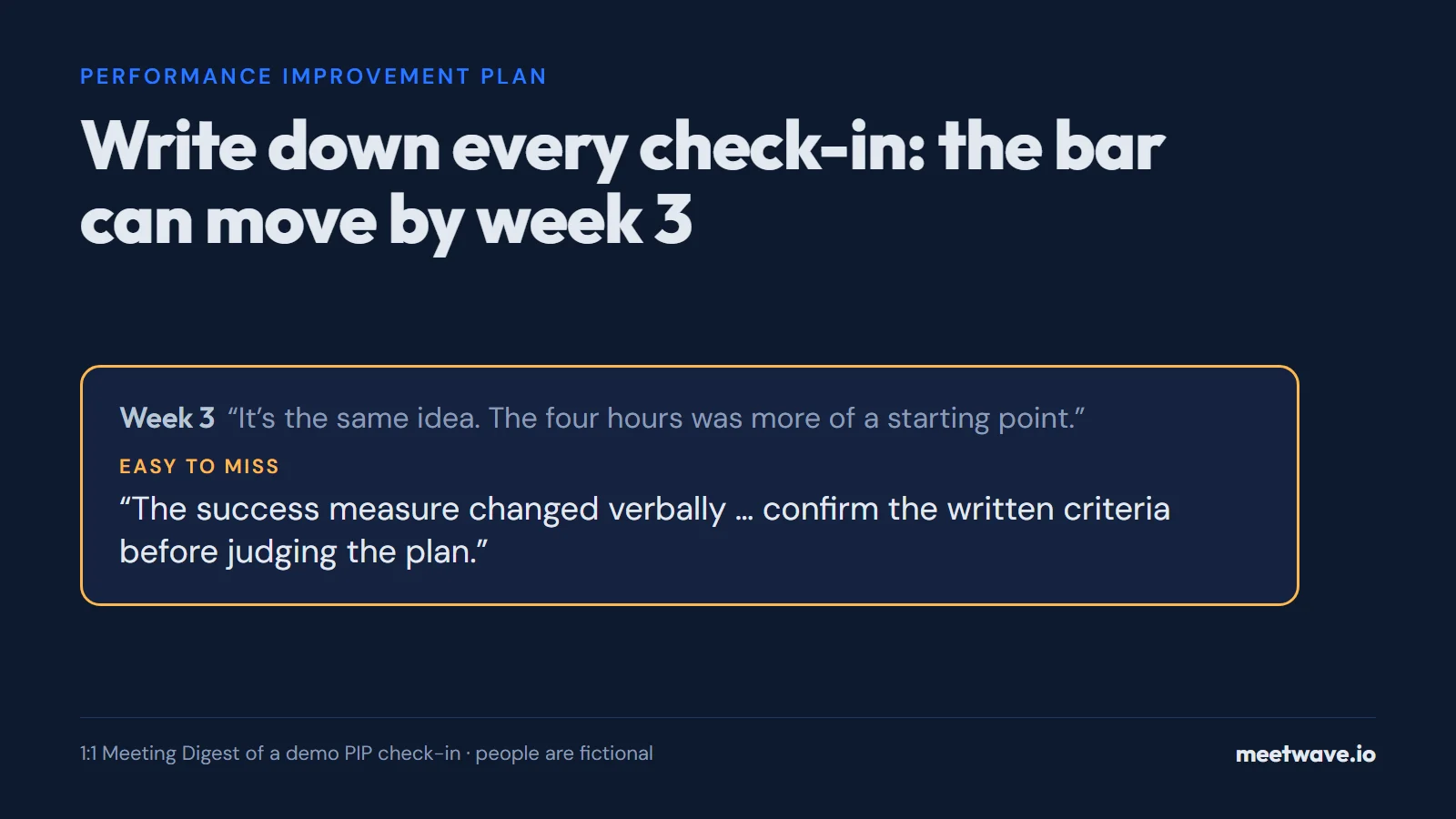
A performance improvement plan (PIP) is a written plan that names the performance gap, the success criteria, the support you will get and the end date; US federal agencies typically give 30 business days. Whichever side of it you are on, write each check-in down the same day: the criteria as they were said, the support promised and whether it happened, and feedback with its example. A week after a conversation, both people recalled only 4.7% of its details, so a criterion restated in week 3 leaves no trace unless someone wrote down week 1.
What a fair PIP contains
A fair PIP is a document both sides can check the end against. The US Office of Personnel Management lists seven parts of a written PIP: the unacceptable performance, the job elements involved, specific examples, the duration (typically 30 business days), the expectations and success criteria, the support to be provided, and the consequences of not improving (OPM, 2025).
| Part of the plan | What it looks like when it is fair |
|---|---|
| The gap | Specific examples, not "be more proactive" |
| Success criteria | A number or an observable result, and where it is measured |
| Support | Named: a mentor, a training, a lighter workload, with dates |
| Duration and check-ins | An end date and a fixed check-in day |
| Consequences | Written, so nobody is surprised at the end |
Source: OPM, Performance Improvement Plan – A Supervisor's Quick Guide, 2025.
The end is judged against what was written at the start. OPM's guidance for federal supervisors says to "compare with standards and expectations outlined in the opportunity period notice" (OPM). Those rules bind US federal agencies; a private employer sets its own process, and OPM's guide is the clearest public description of a fair one.
Why every check-in needs a written record
Neither side will remember the check-ins accurately by week 6. In a 2023 experiment, pairs of people talked and were tested a week later: only 4.7% of the conversation's details were recalled by both partners, and those who wrote a memo right after the talk recalled more (Brown-Schmidt et al., 2023).
A PIP is a series of short meetings in which most of what matters is said, not written: "that's real progress", "I'll set up the mentor by Friday", "the bar for the end is something else now". The plan document does not change when those sentences are said. A record made the same day is what shows them later, to the employee, the manager or HR.
If you run a PIP: the documentation checklist
Document every check-in, including the support you gave. OPM tells supervisors that "all communication and support provided should be documented" and to "be objective, specific, and consistent" (OPM, 2025). After each check-in, the record holds:
- The criteria, in the plan's words, and this week's number against each.
- The support promised and its status: done on a date, moved to a date, or not done. OPM: "once assistance is offered, be sure to follow through with it in the opportunity period" (OPM).
- Progress you acknowledged, in the words you used.
- Feedback with its example: the ticket, the project, the meeting.
- Any change to a criterion, written into the plan and sent to the employee and HR the same day, not said in passing.
The fifth point is the one that breaks plans. If a criterion has to change, change the document, tell the employee what replaces what, and give the remaining weeks to the new number. A bar that moves only in conversation is the record a manager cannot defend (OPM).
If you are on a PIP: what to write down after each check-in
Write down the same five things, on the same day, and send a short recap email. Keep the criteria in the plan's exact words next to this week's number, every promise made to you with its date, and every piece of feedback with the example it was about. The one-on-one meeting template has a field for each if you take notes by hand.
Three habits do most of the work:
- Ask for the criteria in writing on day one if the plan's wording is vague: "Could you send me the two criteria word for word?" A vague criterion is the easiest one to restate later.
- Send a recap after every check-in. Two or three lines: where you are, the feedback, what each side will do by when. Ask to be corrected if you got anything wrong.
- When a criterion is said differently, ask which one counts, by email, the same day, quoting both versions. The template below does it without accusing anyone.
Three check-ins, one plan: a demo series
Here is a demo PIP between a support team lead and a support specialist, Devin, in October 2026: a six-week plan with two written criteria and a promised mentor, and three weekly check-ins. MeetWave's 1:1 Meeting Digest wrote notes after each one; the week 3 notes were written with weeks 1 and 2 as context.
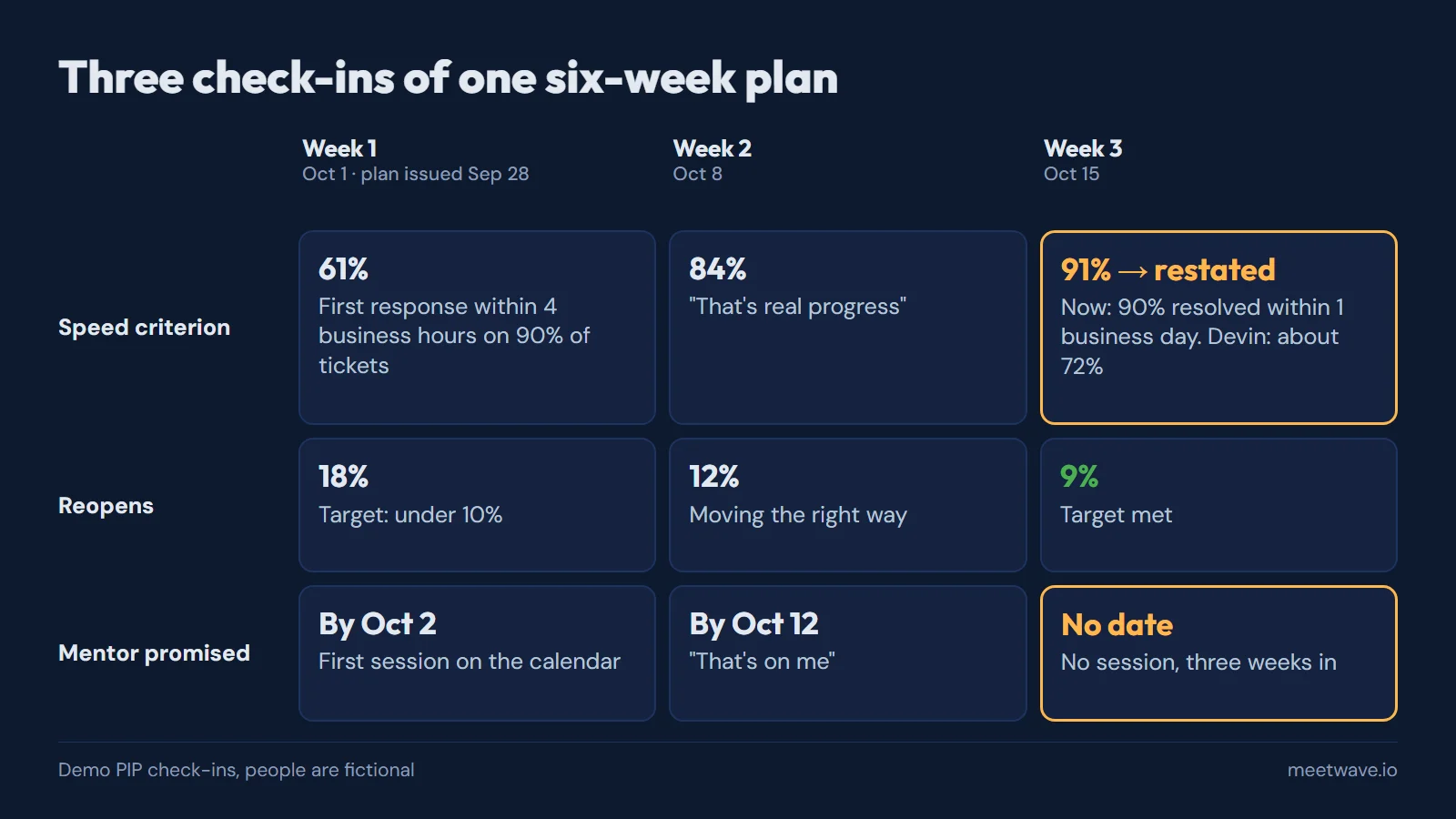 Figure 1. The demo plan week by week: by week 3 both written targets are met, the speed criterion is restated and the mentor still has no date. Source: MeetWave demo PIP series, October 2026.
In short: in week 1 the plan sets first response within four business hours on 90% of tickets (Devin was at 61%) and reopens under 10% (18%), and the mentor is promised by October 2. In week 2 both numbers improve, to 84% and 12%, and the mentor slips to October 12. In week 3 Devin is at 91% and 9%, both written targets met, and the speed criterion is restated as 90% resolved within one business day, where he is at about 72% (demo series).
Week 1: write the promise down with its date
At 04:48 the manager promised the support half of the plan: "I'll talk to her and get the first session on your calendar by Friday. So tomorrow." The notes put it in the table of what was agreed, with the date.
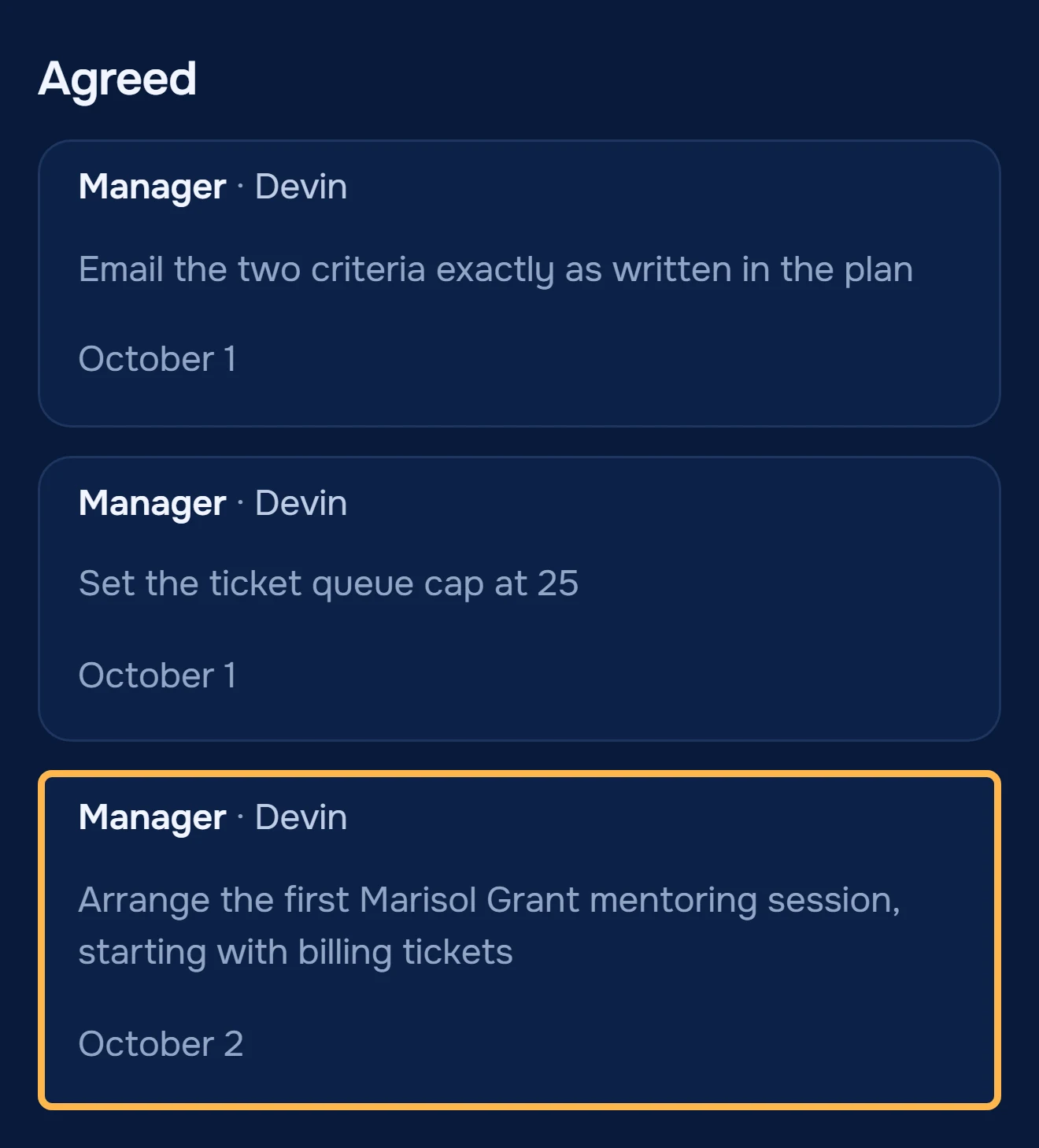 Figure 2. Demo meeting, people are fictional. Week 1: the mentor promised by October 2, next to the criteria email and the queue cap. Source: demo PIP series, week 1 notes, October 2026.Analyzed with MeetWaveSee the full notesTry it on your next 1:1
That row is the start of a trail. Write every promise to you as who · what · by when · in which check-in, so the next one can be compared with it. At 03:40 Devin also asked for the two criteria by email, word for word. That email is what makes week 3 visible.
Week 2: the same promise, a new date
At 02:29 the manager owned the slip: "No, that's on me. I didn't get to her." The new date was Monday, October 12. The notes list it again and, under Easy to miss, connect it to Devin's slowest tickets.
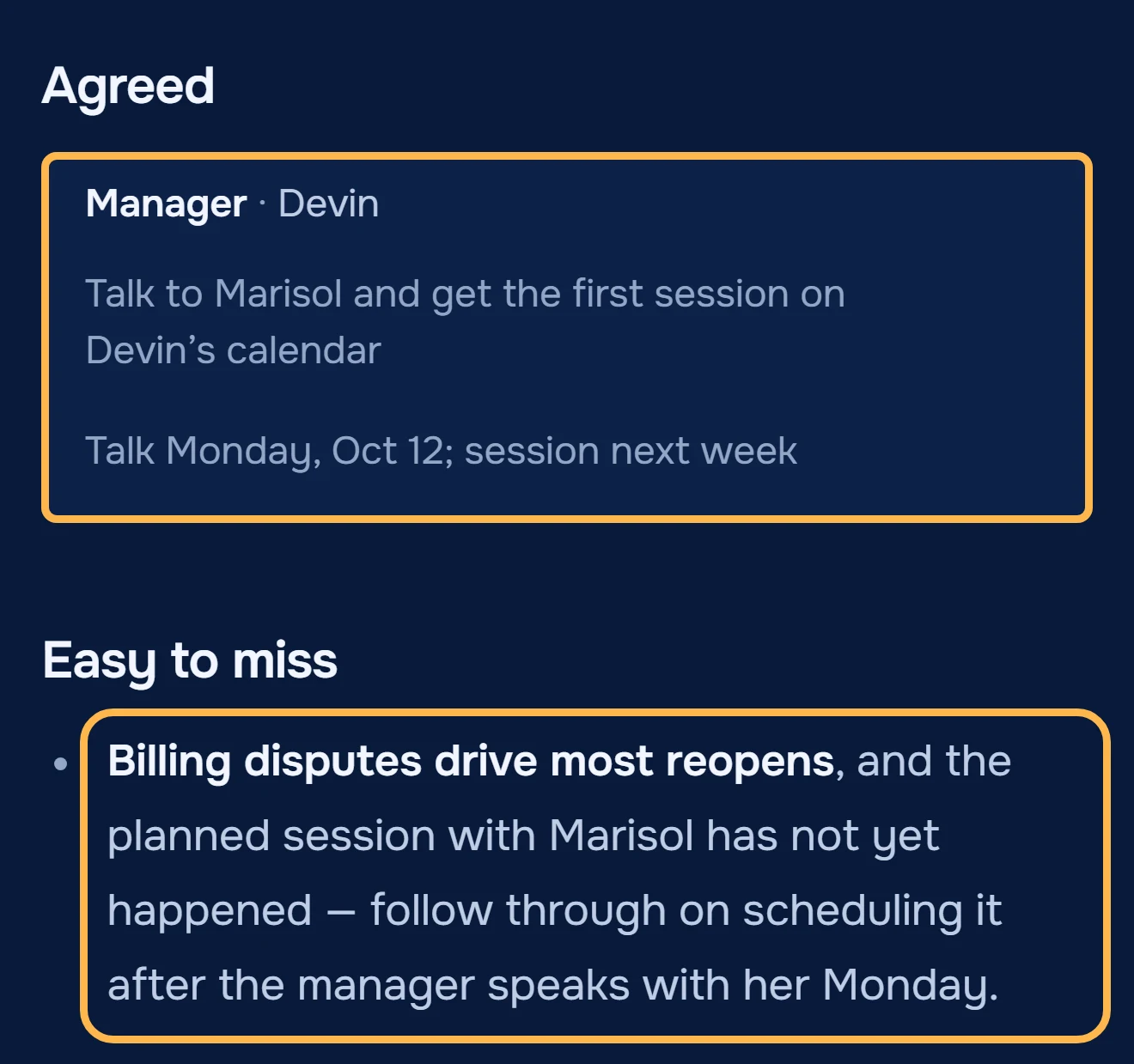 Figure 3. Demo meeting, people are fictional. Week 2: the mentor promise moves to October 12, and the notes tie it to where the reopens come from. Source: demo PIP series, week 2 notes, October 2026.Analyzed with MeetWaveSee the full notesTry it on your next 1:1
A promise moved once is normal. Add the new date to the same line, not a new line: mentor · promised Oct 1 for Oct 2 · moved Oct 8 to Oct 12. The same check-in also has the sentence to keep: at 01:05, "That's real progress, Devin. In one week. I want it written down that I said that."
Week 3: the bar moves, and the mentor has no date
At 01:07 the manager restated the end of the plan: "So the bar I need for the end of the plan is: ninety percent of your tickets resolved within one business day." At 01:46 Devin asked, "Is that replacing the four-hour one?" At 02:01: "It's the same idea. It's speed. The four hours was more of a starting point."
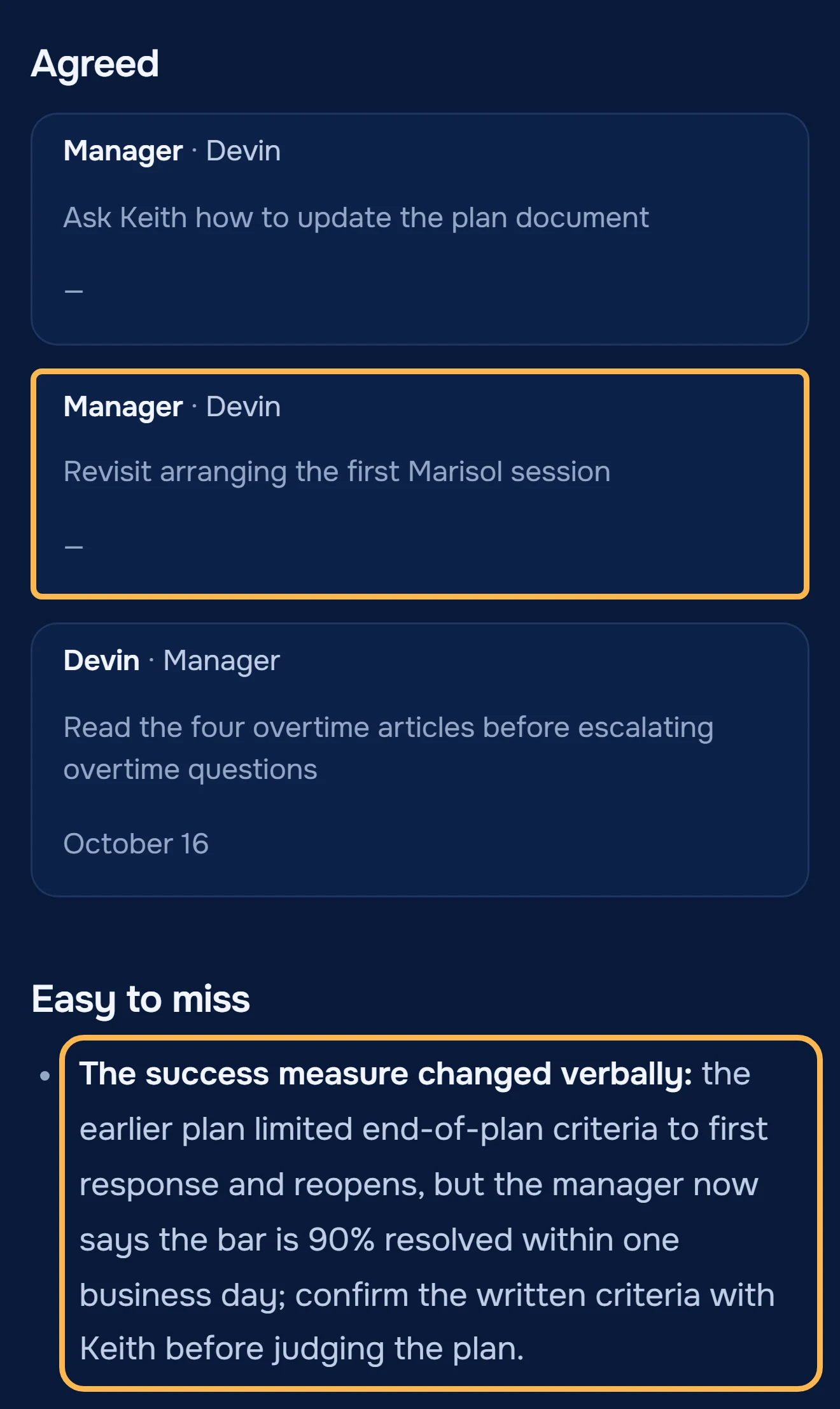 Figure 4. Demo meeting, people are fictional. Week 3: the notes flag that the success measure changed verbally, and the mentor is a promise with no date. Source: demo PIP series, week 3 notes, October 2026.Analyzed with MeetWaveSee the full notesTry it on your next 1:1
The notes caught the moved bar: "the earlier plan limited end-of-plan criteria to first response and reopens, but the manager now says the bar is 90% resolved within one business day". The mentor appears as "Revisit arranging the first Marisol session" with a dash for the date. The notes do not say it was promised twice before; that comes from putting the week 1 and week 2 rows next to it, which is why the trail matters (week 3 notes).
What to do with week 3, for each side:
| Moment in week 3 | Employee: send the same day | Manager: before the next check-in |
|---|---|---|
| 01:07, the bar restated as resolution within one business day | "The plan says first response within four business hours; today you said 90% resolved within one business day. Which one will I be measured on?" | Decide which criterion counts. If it is the new one, rewrite the plan, send it to Devin and HR, and count the weeks left from that day |
| 03:31, the mentor with no date | "The mentor in the plan was due October 2, then October 12. Can we set a date for the first session?" | Book the session or replace it with support that can start this week, in writing |
Source: demo PIP series, week 3 notes.
Recording a check-in: consent first
Record a check-in only after the other side agrees, and say it at the start, as the demo team lead did each week. US federal law lets a party to a conversation record it (18 U.S.C. § 2511(2)(d)), but some states, Washington among them, require the consent of everyone in a private conversation (RCW 9.73.030), and your employer may have its own rule.
If recording is not agreed, the method works the same with notes: write the five things down within the hour and send the recap email. People who wrote a memo right after a conversation recalled more of it a week later (Brown-Schmidt et al., 2023).
Your rights, briefly
This section is not legal advice; for your situation, ask an employment lawyer or the agency. The US Equal Employment Opportunity Commission says the EEO laws "prohibit punishing job applicants or employees for asserting their rights to be free from employment discrimination including harassment", and its examples of retaliation include a "performance evaluation that is lower than it should be" and increased scrutiny (EEOC).
Protected activity includes complaining to a manager about discrimination, filing or being a witness in a charge, and asking about pay to uncover discriminatory wages. The same page is clear that this "does not shield an employee from all discipline or discharge" (EEOC). Retaliation was alleged in 54,350 of the 88,201 charges filed with the EEOC in fiscal 2025, 61.6% (EEOC, Table E1a; our arithmetic); a charge is an allegation, not a finding.
US federal employees have a rule of their own: before a performance-based removal or demotion, the agency "shall afford the employee a reasonable opportunity to demonstrate acceptable performance" and "shall offer assistance" (5 CFR § 432.104). Dated notes of what was offered and what happened are the evidence either side will reach for.
Templates
Copy the log for every check-in, for either side of the plan:
Check-in [number] on [date] · plan ends [date]
- Criterion 1, as written in the plan: "[exact words]" · this week: [number] · target: [number]
- Criterion 2, as written in the plan: "[exact words]" · this week: [number] · target: [number]
- A criterion said differently today, in the speaker's words: "[quote]" (or: none)
- Support promised in the plan: [mentor / training / workload] · first promised for [date] · status: [done on date / moved to date / no date]
- Progress acknowledged, in their words: "[quote]"
- Feedback with its example: [what was said] · [the ticket, project or meeting it was about]
- What the employee agreed to do: [task] by [date]
- What the manager agreed to do: [task] by [date]
- Recap email sent: [date and time]
The recap, sent the same day:
Subject: Notes from our check-in on [date]

Hi [name],

Thanks for the check-in today. So that we both have the same notes, here is what I took away:

- Where things stand this week: [criterion 1: number], [criterion 2: number].
- Feedback: [what was said], about [the example].
- I'll [what I agreed to do] by [date].
- You'll [what you agreed to do: the mentor, the training, the document] by [date].

If I got anything wrong, please tell me and I'll correct my notes.

Thanks,
[your name]
When a criterion is vague or said differently:
Subject: Question about the criteria in my plan

Hi [manager's name],

At our check-in on [date] you said the bar for the end of the plan is "[the new words]". The plan from [date] says "[the written criterion]".

Could you confirm which one I will be measured on at the end, and if it is the new one, send me the updated plan? I'd like to work toward the right number for the remaining [number] weeks.

Thanks,
[your name]
Key numbers
- US federal agencies typically set a PIP's duration at 30 business days (US Office of Personnel Management, 2025).
- OPM's guide lists 7 parts of a written PIP, from the unacceptable performance and specific examples to the support to be provided and the consequences (US Office of Personnel Management, 2025).
- A week after a conversation, both partners recalled only 4.7% of its details in a preregistered experiment with 21 pairs (Brown-Schmidt et al., Cognitive Science, 2023).
- Retaliation was alleged in 54,350 of 88,201 charges filed with the EEOC in fiscal 2025, 61.6% (US EEOC, Table E1a, 2026).
How we calculated
The 61.6% is EEOC's fiscal 2025 "Retaliation - All Statutes" row divided by its "Total Charges" row: 54,350 / 88,201 = 0.616. A charge can allege several bases, so the shares of all bases add up to more than 100% (EEOC, Table E1a).
The demo PIP check-ins are fictional meetings written for this article. Figures 2 to 4 are MeetWave's 1:1 Meeting Digest notes, generated on 2026-10-26; the week 3 notes were generated with the week 1 and week 2 notes as series context, weeks 1 and 2 without context. The minutes in the text are the minutes of the demo recordings, and the percentages are the ones said in them (full notes, week 3).
FAQ
What does PIP mean at work?
PIP stands for performance improvement plan: a written plan that names a performance gap, the criteria for closing it, the support offered and an end date (OPM, 2025). It usually comes with weekly or regular check-ins until the end date.
Is there a performance improvement plan template?
A plan document needs OPM's seven parts, from the gap and specific examples to the support and the consequences (OPM, 2025). For the weeks after it is signed, copy the check-in log and the two emails above.
How long is a performance improvement plan?
US federal agencies typically set 30 business days (OPM, 2025); private employers set their own length. The plan's own end date is the one that counts, so check that it is written in the document.
Can you survive a PIP?
Yes, and OPM's guide names successful completion as the first of three outcomes: the plan is closed and the employee returns to the regular review (OPM, 2025). We found no primary source for the share of PIPs that succeed, so we do not quote one.
What should I do when I'm put on a PIP?
Get the criteria in writing, word for word, and ask what support you will get and by when. Then write every check-in down the same day and send a short recap, using the templates above; your own notes are the record of what was said (Brown-Schmidt et al., 2023).
Can my manager change the PIP goals partway through?
The plan is judged against what it says: OPM tells federal supervisors to compare the result "with standards and expectations outlined in the opportunity period notice" (OPM). If a criterion is said differently in a check-in, ask by email which one counts and for the updated document.
Sources
- US Office of Personnel Management — Performance Improvement Plan – A Supervisor's Quick Guide (2025). Accessed 2026-10-26.
- US Office of Personnel Management — Providing an Opportunity to Improve (2012). Accessed 2026-10-26.
- Legal Information Institute — 5 CFR § 432.104, Addressing unacceptable performance (2022). Accessed 2026-10-26.
- US Equal Employment Opportunity Commission — Retaliation (2026). Accessed 2026-10-26.
- US Equal Employment Opportunity Commission — Table E1a, Charge Receipts by Basis or Statute, FY 1997 – FY 2025 (2026). Accessed 2026-10-26.
- Brown-Schmidt, Jaeger, Evans and Benjamin — MEMCONS: How Contemporaneous Note-Taking Shapes Memory for Conversation, Cognitive Science 47(4) (2023). Accessed 2026-10-26.
- Legal Information Institute — 18 U.S. Code § 2511 (2026). Accessed 2026-10-26.
- Washington State Legislature — RCW 9.73.030 (2026). Accessed 2026-10-26.
Still comparing tools?
See how MeetWave stacks up against the tools most teams evaluate alongside it.
- MeetWave vs FathomFree AI meeting assistant and note taker focused on sales teams
- MeetWave vs FellowSee how MeetWave compares to Fellow for meeting notes and AI summaries
- MeetWave vs GranolaSee how MeetWave compares to Granola for bot-free meeting notes
More on this: Meeting minutes template