AI Notetaker Lawsuits: What Otter, Fireflies and Granola Are Accused Of
No court has found Otter, Fireflies or Granola liable in any filing we could open as of 30 October 2026; all three have been sued in proposed class actions built on allegations. The one ruling we read came on 13 August 2026, when a federal judge let wiretap, California privacy and Illinois biometric claims against Otter go forward without deciding whether they are true. The Granola complaint alleges that recording with no bot is itself the problem, so skipping the bot does not replace telling people. In a 2023 Pew survey of 5,101 US adults, 73% felt they had little to no control over data companies collect.
Status checked on 30 October 2026. This is not legal advice. Every claim below is an allegation unless we say a court decided it, and a new ruling means an update.
The three cases on 30 October 2026
Otter has one order on the pleadings, and the two newer cases have no ruling we could find. The Otter record is current to 29 October. The Fireflies and Granola dockets could not be opened, so their status stops at the last dated source.
| Case | What is alleged | Status |
|---|---|---|
| In re Otter.AI Privacy Litigation, No. 5:25-cv-06911, N.D. Cal., filed 15 Aug 2025 | The notetaker joins as a "silent participant", keeps conversations and voiceprints, and trains speech recognition on them | 13 Aug 2026: motion to dismiss granted in part. 29 Oct 2026: Otter's amended answer filed. No liability finding |
| Fricker v. Fireflies.AI Corp., No. 1:26-cv-02675, N.D. Ill., filed 10 Mar 2026 | Once a host enables it, it stores voiceprints of all participants, non-users included | No ruling found. Docket could not be opened on 30 Oct 2026. Last dated source, 12 Aug 2026: no merits ruling |
| Chamberlain v. Granola, Inc., No. 3:26-cv-07926, N.D. Cal., filed 30 Jul 2026 | It captures meeting audio with no notice to other participants, by design | No ruling found. Docket could not be opened on 30 Oct 2026. Last dated source, 12 Aug 2026: no response on the merits |
Source: Otter case page, N.D. Cal., Otter order, Dkt. 68, Fricker complaint, Chamberlain complaint, Barnes & Thornburg alert, 12 August 2026.
Fireflies has been named in other voiceprint complaints too: Cruz, No. 3:25-cv-03399 (C.D. Ill.), Martinez, No. 1:26-cv-03512 (N.D. Ill.) and Parrinello, No. 3:26-cv-02479 (N.D. Cal.). We read those complaints as filed. We did not read their current status, so we state none.
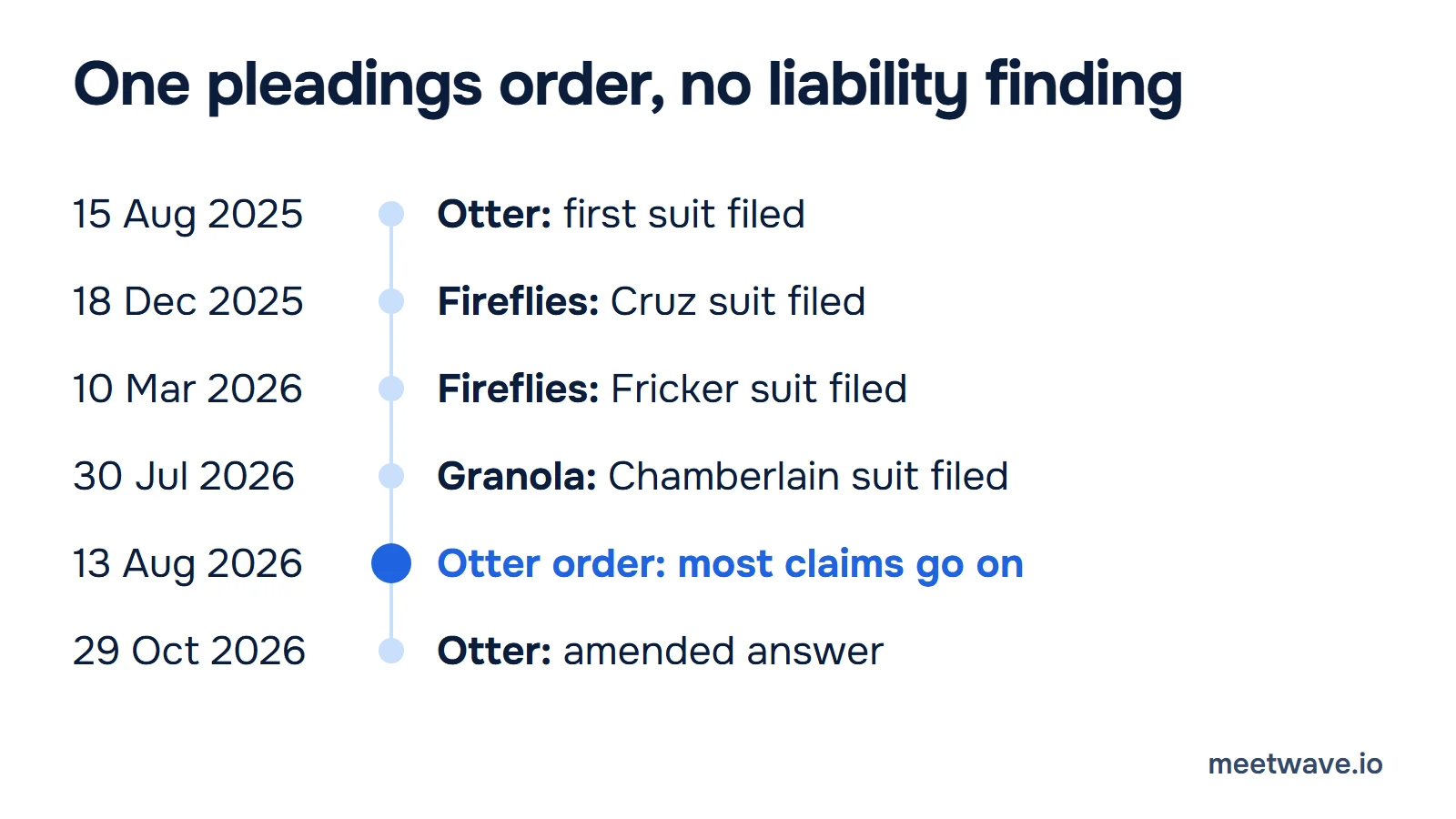
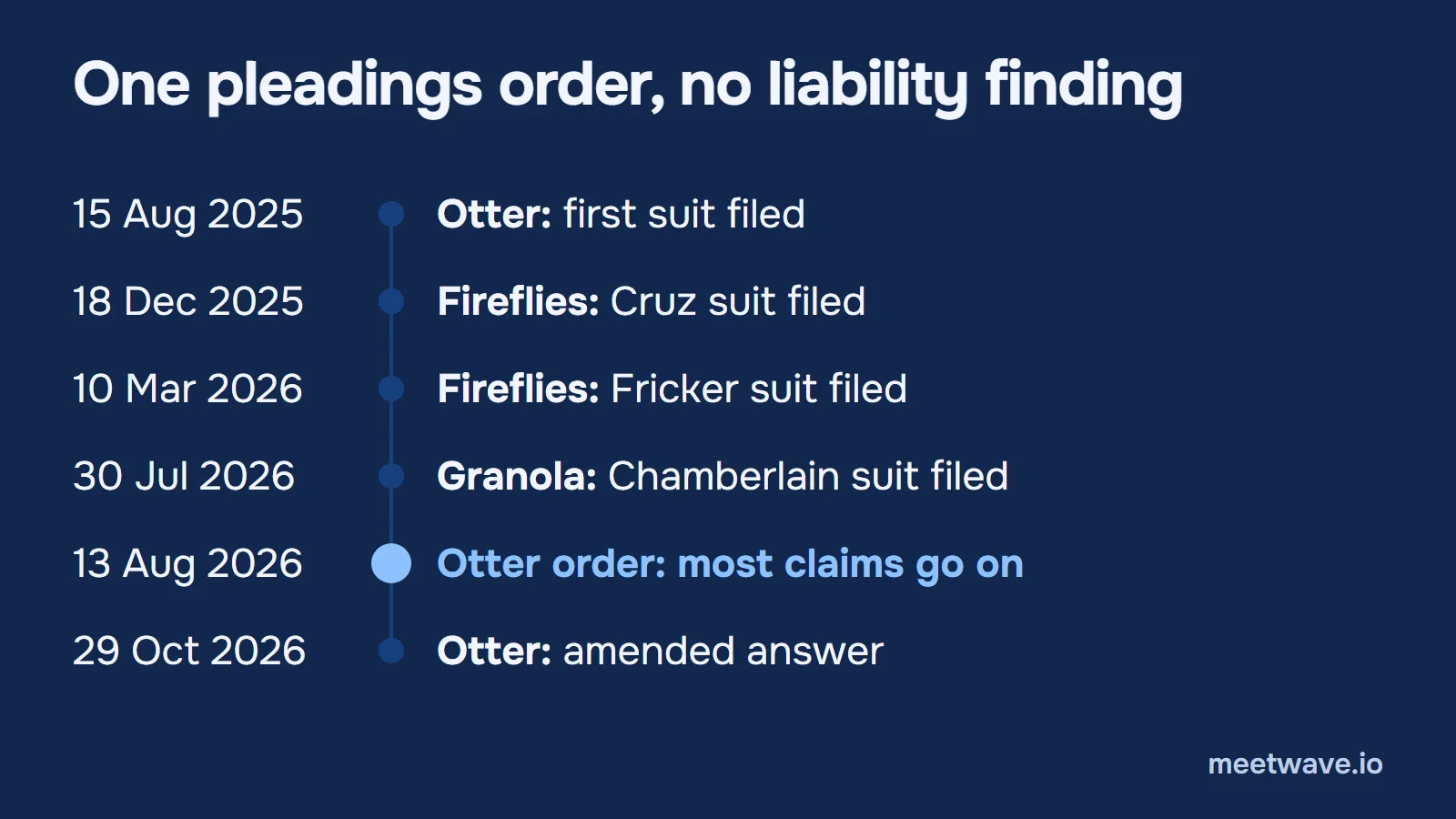 Figure 1. One order on the pleadings, and no liability finding in anything we read. Source: court filings and the N.D. Cal. case page, checked 30 October 2026.
What the Otter order decided
The order decided that the claims may proceed, not that they are true. At this stage a court generally accepts the factual allegations in the complaint (order, p. 3). Judge Eumi K. Lee granted the motion in part and denied it in part on 13 August 2026.
Of 17 counts, 7 survive, 2 survive for some plaintiffs, 3 were dismissed with leave to amend, and 5 were withdrawn (tally). The federal wiretap count, the California privacy count and both Illinois biometric counts are among the 7. Otter's amended answer followed on 29 October 2026 (case page).
The hinge is whose tool the notetaker is. Otter argued that it joins as an invited participant and works as the host's recording tool. The court agreed that "software providers acting only as an extension of a user or client are not considered third-party interceptors" (order, p. 16). But the plaintiffs allege Otter keeps the conversations and uses them to improve its own models, and that was enough at this stage for the claim to go on.
What is being argued
Four questions run through the filings: who was listening, whose consent counts, whether a voice is biometric data, and what the vendor does with audio afterwards.
Wiretap law. The federal act lets one party consent, unless the interception is for a "criminal or tortious" purpose. The Otter plaintiffs allege such a purpose, training models without consent, and the court let the count go on (order, pp. 10-11). Barnes & Thornburg calls one-party consent a "significant structural hurdle" for the federal count against Granola (alert, 12 August 2026).
All-party laws. California Penal Code §631 reaches interception "without the consent of all parties", and the order reads Washington's Privacy Act as requiring the consent of all parties too (order, pp. 16, 21-22). The Washington claim was dismissed with leave to amend. The Granola complaint pleads both §631 and §632 (complaint, pp. 24-37).
Voiceprints. Illinois BIPA §15(a) concerns a retention policy, and §15(b) concerns notice and written consent. The Fireflies complaints allege that the product builds voiceprints of every participant, non-users included (Fricker, ¶¶1-3, 7). The Otter court let both BIPA counts proceed (order, pp. 6-9).
Training on audio. The Otter plaintiffs allege their conversations train its speech recognition. The Granola complaint quotes the vendor: "[b]y default on Free and Business plans, anonymised data may be used for Granola's own model improvements" (¶89).
Who has to get consent. The same complaint quotes Granola saying customers "remain responsible for determining what notice or consent is required" and alleges this shifts the duty onto them (¶59).
Figure 2 shows the amounts these statutes name. Federal law sets the greater of actual damages plus profits or statutory damages of the greater of $100 a day or $10,000, and says the court "may assess" them (18 U.S.C. §2520). California sets the greater of $5,000 per violation or three times actual damages (§637.2). Illinois sets $1,000 for negligence and $5,000 for recklessness or intent, or actual damages if higher, with one recovery per person for the same identifier and method (740 ILCS 14/20). These are statutory amounts, not a forecast of any case.
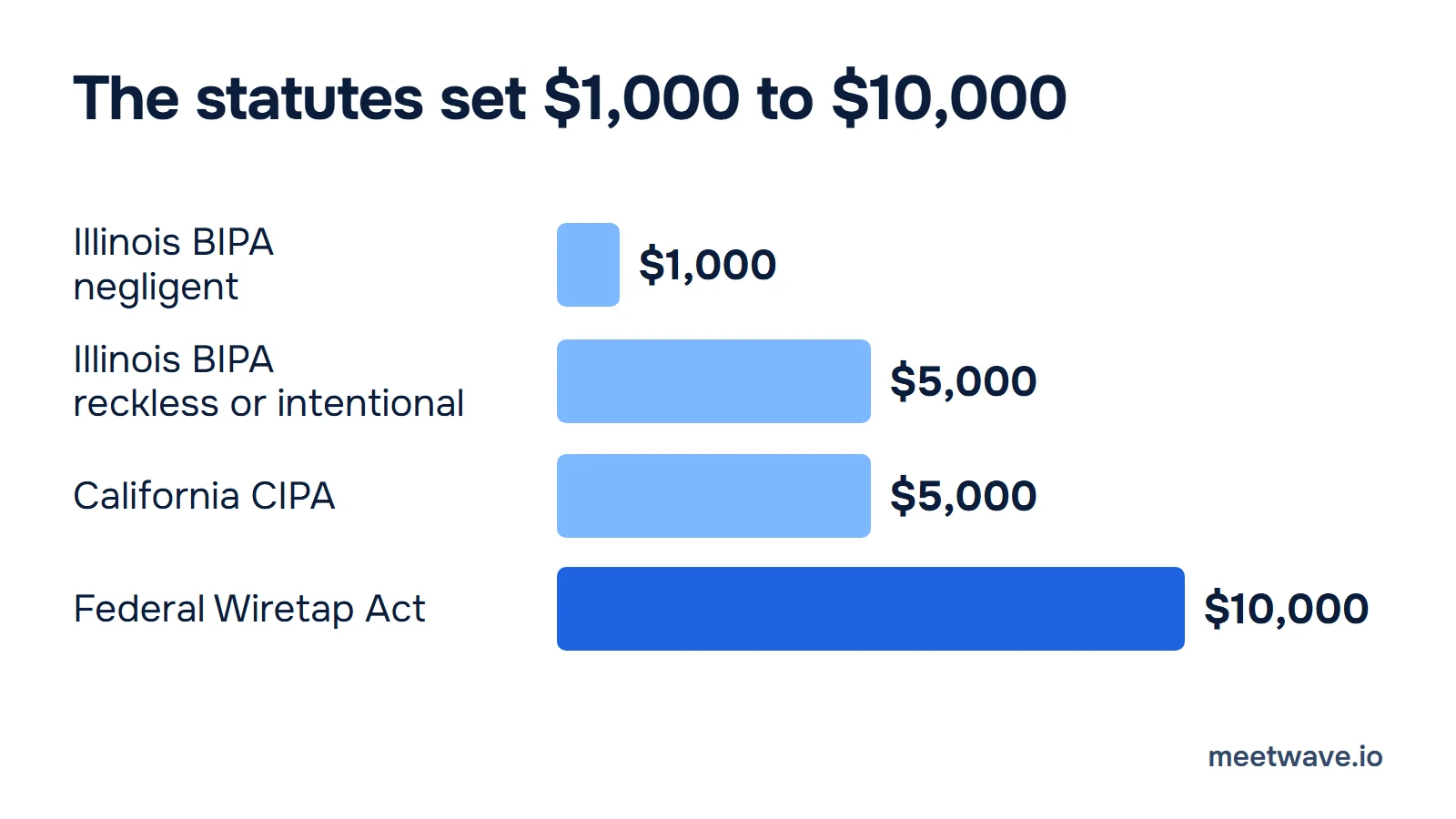
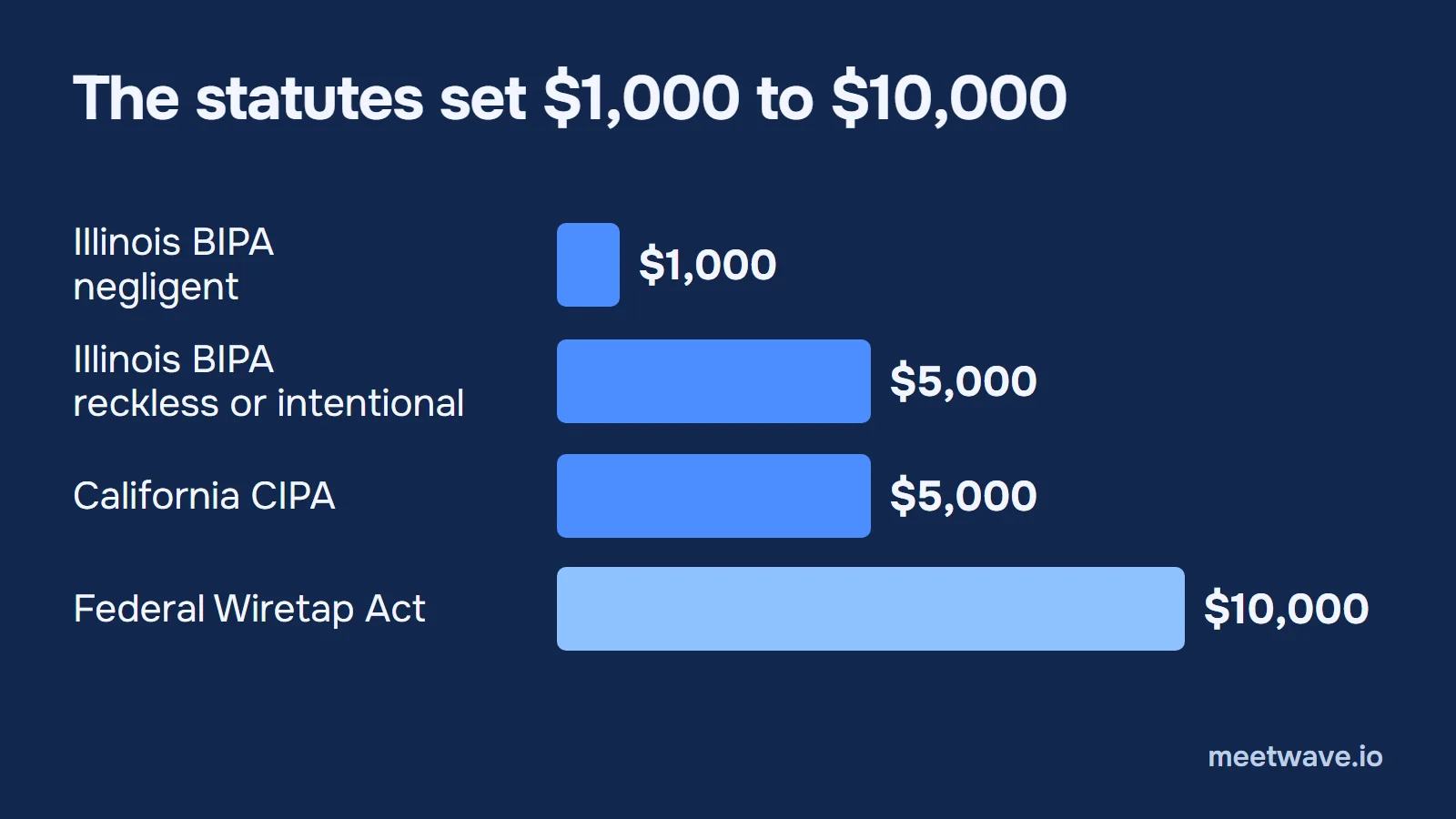 Figure 2. The amounts named in the statutes behind the suits, not a prediction. Source: 740 ILCS 14/20; Cal. Penal Code 637.2; 18 U.S.C. 2520(c)(2), read 30 October 2026.
No bot is not consent
Removing the bot removes the visible signal, and the Granola complaint treats that as the wrong itself. It alleges the product was designed so that it "need not be disclosed" (¶2). It quotes the marketing line "No bot joins the call. No notification appears." and "[o]ther people in the room won't know it's there" (¶¶44-45).
The complaint also goes after notice that is optional. Users "can enable one or both" of a chat message and a watermark, and it alleges that neither is a regular part of transcription (¶¶60-62). A bot does not settle consent either: the Otter complaint describes a notetaker that joins as a participant, and its plaintiffs still allege they never agreed. Telling people stays with the user in both designs.
Barnes & Thornburg writes that the product's "competitive positioning is itself the alleged violation", and that "an Otter.ai win would not necessarily save Granola" (alert, 12 August 2026). The same reasoning, if it holds, reaches every no-bot recorder, ours included (what we do). The concern is broad: 73% of 5,101 US adults felt little to no control over data companies collect (Pew Research Center, 2023).
Who can be exposed
Every suit we read names only the vendor, and no filing we read holds a host or an employer liable. One Fireflies plaintiff says meetings were recorded by "his boss's Fireflies' account", and the boss is not a defendant (Fricker, ¶10). The Cruz complaint also leaves out the host organisation (¶¶11-12).
That does not settle the question for a company. Vendor terms can put consent on the customer, as the complaint alleges at ¶59. California §631 as pleaded also reaches a person who "aids, agrees with, employs, or conspires" with another (¶148). Barnes & Thornburg addresses "companies that build, deploy, or tolerate these tools" and advises an inventory of tools in use, blocking unapproved ones, a written policy and a contractual right to require deletion (alert, 12 August 2026).
What to check in your tool
Each question below comes from an allegation in the filings, so a vendor's answer tells you where you stand on that point. Copy it, fill it in for your tool, and keep the date.
AI notetaker check — tool: ________  date: ________

1. WHO IS TOLD
[ ] What do other participants see or hear by default?
[ ] Is any notice on by default, or does someone have to enable it?
[ ] Who tells people in our meetings, and when?
[ ] What do we do when someone objects?

2. TRAINING ON AUDIO
[ ] Is meeting audio or text used to train models?
[ ] Is that on by default on our plan?
[ ] Can each user opt out, or only an admin?

3. RETENTION
[ ] How long are audio and transcripts kept?
[ ] Can we delete them, and does deletion reach the vendor's copies?
[ ] Does the contract give us the right to require deletion?

4. VOICEPRINTS
[ ] Does the tool identify speakers by voice?
[ ] Is a voice profile stored or matched across meetings?
[ ] Are non-users covered? Is there a published retention policy?

5. DEFAULT SHARING
[ ] Who can open a transcript or summary by default?
[ ] Do share links work for anyone who has them?
[ ] Who else can see notes in the workspace?
The law where each participant sits decides what you owe them, so check it, and record only with consent. If someone objects, stop recording and paste your own notes into the action items extractor after the meeting.
What MeetWave does
MeetWave records without a bot, which is the design the Granola complaint attacks. The extension takes the meeting tab and, if you enable it, your microphone, and the Windows app takes system audio and your microphone. By default MeetWave tells participants nothing. The extension can post a message in the meeting chat, off by default, the same optional shape the complaint criticises at ¶¶60-62, and the Windows app has no such message or reminder. Telling people is your job, and our terms say so.
On training, our privacy policy says meeting data is not used to train AI models without your explicit consent. Recordings stay as long as the account is active, you can delete them at any time, and closing the account removes them within 30 days unless the law requires otherwise. Speakers are told apart inside one recording, and no voice profile is kept or matched across meetings, though the Fireflies complaints allege that telling speakers apart captures a voiceprint (Fricker, ¶¶4, 11). A share link exists only when the owner turns it on.
FAQ
Is Otter AI safe?
No court has answered that. On 13 August 2026 a judge let most claims go forward without deciding whether they are true (order). Use the checklist to judge it for your meetings.
Is Granola AI safe or legal?
No court has decided that in any filing we could open. The complaint of 30 July 2026 makes allegations, and on 12 August 2026 Granola had not responded on the merits (Barnes & Thornburg).
Is Fireflies AI safe?
No court has answered that in anything we could open. The complaints allege voiceprint capture (Fricker), and on 30 October 2026 we could not open the current docket.
Can my company be sued for using an AI notetaker?
We read no filing that holds a host liable, and the suits we read name the vendors. A law firm still warns companies that "deploy, or tolerate" these tools (Barnes & Thornburg). Ask your own counsel.
Are AI notetakers legal?
It depends on who is on the call and where they are. Federal law allows one party to consent, while California §631 speaks of "all parties" (order, pp. 10, 16). The rule that applies to a call across states is a question for your counsel; the state map shows each state's default.
Did Otter lose its lawsuit?
No. It lost part of a motion to dismiss on 13 August 2026 and won part of it (order). The claims that remain have not been decided.
Key numbers
- 17 counts were before the court in the Otter case on 13 August 2026: 7 survive, 2 survive for some plaintiffs, 3 were dismissed with leave to amend and 5 were withdrawn (order, tally).
- California sets the greater of $5,000 per violation or three times actual damages, as read on 30 October 2026 (Cal. Penal Code §637.2).
- Illinois sets $1,000 per negligent violation and $5,000 per reckless or intentional one, as read on 30 October 2026 (740 ILCS 14/20).
- Federal law lets a court assess the greater of $100 a day or $10,000, as read on 30 October 2026 (18 U.S.C. §2520).
- 73% of 5,101 US adults felt little to no control over data collected by companies in 2023 (Pew Research Center).
How we calculated
The count tally is ours, read from the sections and the conclusion of the 13 August 2026 order, pp. 22-23. Denied: Counts 1, 5, 6, 8, 14, 15 and 16. Survive for some plaintiffs: Counts 3 and 13. Dismissed with leave to amend: Counts 2, 11 and 17. Withdrawn: Counts 4, 7, 9, 10 and 12. That makes 17. The damages figures are read directly from the statutes on 30 October 2026, with no calculation of our own.
Sources
- U.S. District Court, N.D. Cal. — In re Otter.AI Privacy Litigation, order on motion to dismiss, Dkt. 68 (2026). Accessed 2026-10-30.
- U.S. District Court, N.D. Cal. — In re Otter.AI Privacy Litigation, case page (2026). Accessed 2026-10-30.
- Chamberlain v. Granola, Inc. — Class action complaint, No. 3:26-cv-07926 (2026). Accessed 2026-10-30.
- Fricker v. Fireflies.AI Corp. — Class action complaint, No. 1:26-cv-02675 (2026). Accessed 2026-10-30.
- Martinez v. Fireflies.AI Corp. — Class action complaint, No. 1:26-cv-03512 (2026). Accessed 2026-10-30.
- Parrinello v. Fireflies.AI Corp. — Class action complaint, No. 3:26-cv-02479 (2026). Accessed 2026-10-30.
- Cruz v. Fireflies.AI Corp. — Class action complaint, No. 3:25-cv-03399 (2025). Accessed 2026-10-30.
- Barnes & Thornburg LLP — What the Granola class action means for companies building and deploying conversation capture tools (2026-08-12). Accessed 2026-10-30.
- Legal Information Institute — 18 U.S.C. §2520 (2026). Accessed 2026-10-30.
- FindLaw — Cal. Penal Code §637.2 (2026). Accessed 2026-10-30.
- FindLaw — 740 ILCS 14/20 (2026). Accessed 2026-10-30.
- Pew Research Center — How Americans View Data Privacy (2023). Accessed 2026-10-30.
Still comparing tools?
See how MeetWave stacks up against the tools most teams evaluate alongside it.
- MeetWave vs Otter AISee how MeetWave compares to Otter AI for meeting intelligence
- MeetWave vs Fireflies.aiSee how MeetWave compares to Fireflies.ai for meeting intelligence
- MeetWave vs GranolaSee how MeetWave compares to Granola for bot-free meeting notes
More on this: AI notetaker bots