Follow-Up Email After a Sales Call: Write It From What the Buyer Said
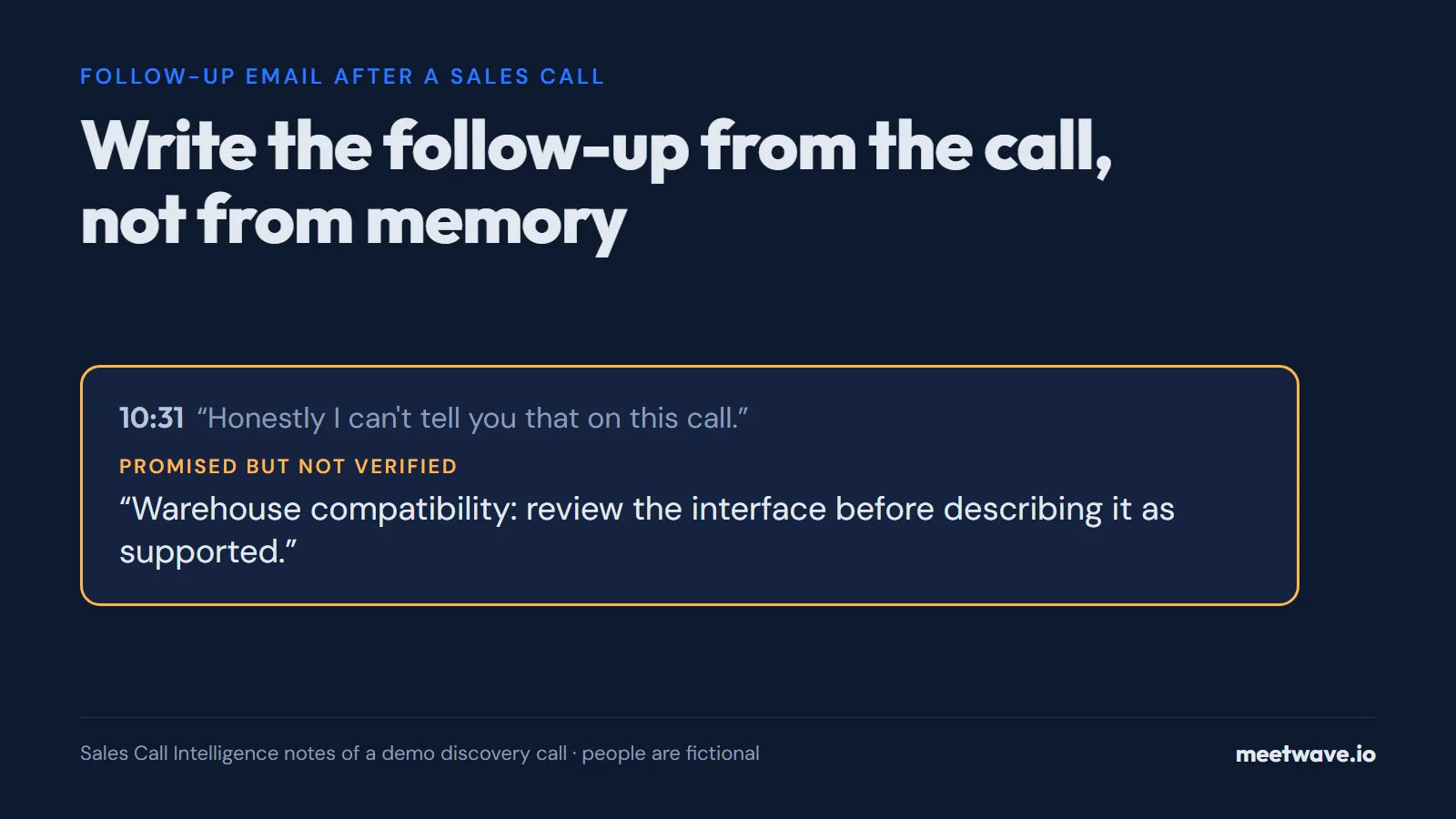
Write the follow-up email after a sales call from the call itself, the same day: the next step with its date, the buyer's priorities in the buyer's own order, what you promised and by when, and anything you could not confirm, marked as still open. Leave out every promise the call did not verify. Memory is the weak link: in a preregistered experiment, a week after a conversation both partners recalled only 4.7% of its details. On our demo discovery call, five things a seller would naturally put in the email were never confirmed.
What a follow-up after a sales call must contain
A follow-up after a sales call has one job: to make the next step happen without giving the buyer a reason to doubt you. Five slots do that, in this order:
- The next step with its date and owner. If a meeting was set on the call, the email confirms it; it does not ask "when works for you?"
- The buyer's priorities in the buyer's words and order. If the buyer corrected you on the call, the email uses the corrected version.
- What you promised, by when. Proposal, case study, documentation: each with a day.
- What is still open. Anything you said you would check goes in as "we'll confirm", never as a fact.
- The people who were not on the call. The signer, the user who will judge the tool: each gets what they need, often as a separate note.
What does not go in: anything the call did not confirm, a discount the buyer did not ask for, and a feature claim the buyer already pushed back on.
Why write it from the call, not from memory
You leave a good call with a feeling and a few facts, and a week later even the facts are mostly gone. In a preregistered experiment with 21 pairs, a week after a conversation both partners recalled only 4.7% of its details (Brown-Schmidt et al., Cognitive Science, 2023). What survives in memory is the version you hoped for: the integration that "should be fine", the rollout that "can be done by March".
The buyer remembers differently. A follow-up that promises what your own engineer refused to promise on the call tells the buyer that nobody on your side was listening.
There is no good study of how soon to send it. The research usually quoted on response time is about inbound web leads, not about emails after a meeting, so we give no number. Send it the same day, while you can still check it against the call.
A demo discovery call, and what the notes said not to promise
Here is a demo call: Routewise, a route-planning vendor, and Halverson Logistics, a 140-truck fleet with depots in Hamburg, Bremen and Kiel. On the call: Mia, the account executive; Ben, the solutions engineer; Ingrid, Halverson's head of operations; Dev, its IT manager. The people and companies are fictional; the call was written as a real one. MeetWave's Sales Call Intelligence read it for the seller. Every frame below is cut from those notes, and every caption links to the full notes.
Promised but not verified
At 10:31, asked whether the connector works with Halverson's on-premise warehouse system, Ben said: "Honestly I can't tell you that on this call." He would check the TrackPoint tracking boxes after getting the model number. Mia said she would check whether the case-study fleet had older drivers. At 32:40, asked whether all three depots could be live by March, Ben said: "Tight, but possible… I wouldn't promise it today, though."
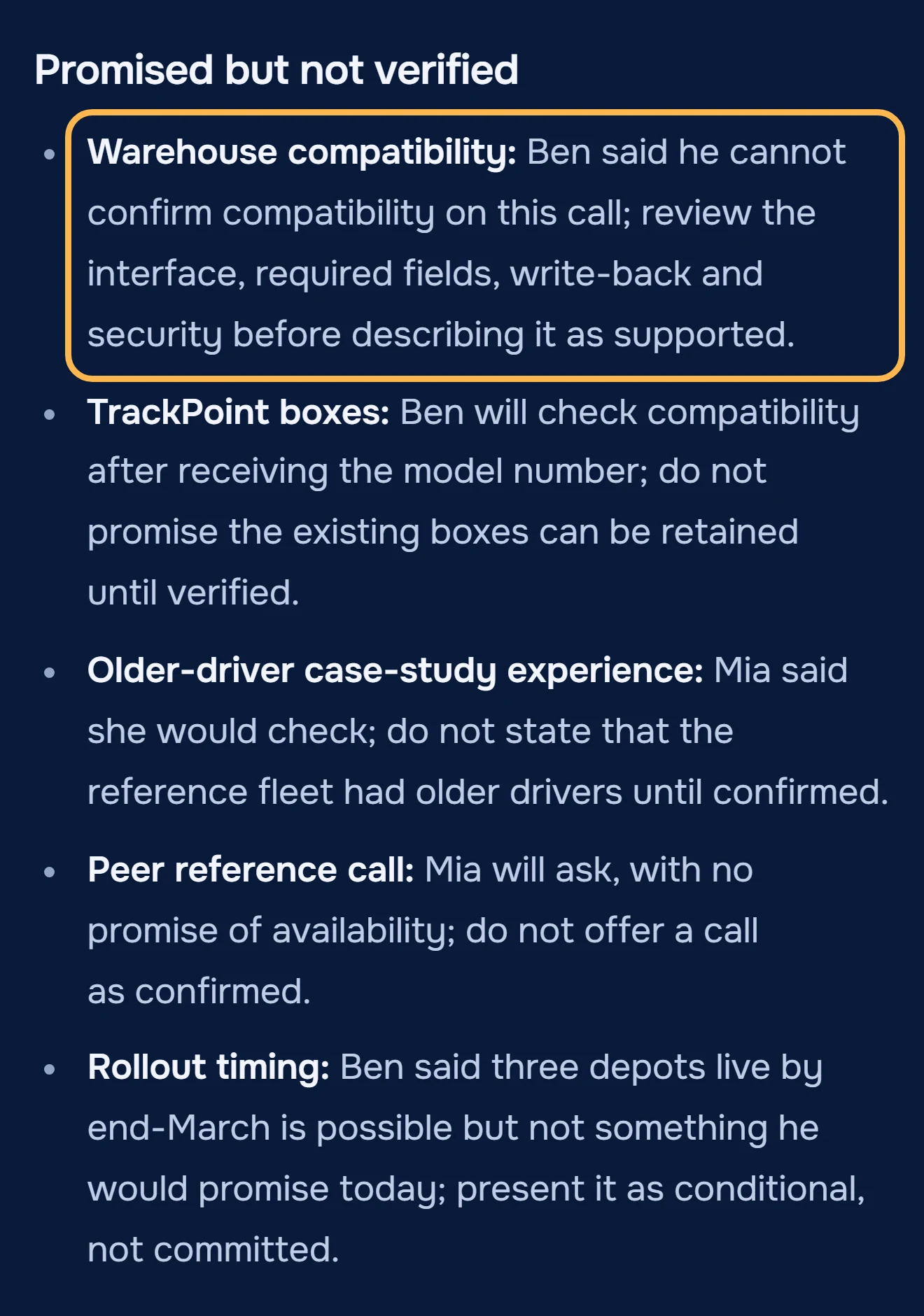 Figure 1. Demo meeting, people are fictional. Five things said on the call that the follow-up must not state as facts. Source: demo discovery call, Sales Call Intelligence notes, October 2026.Analyzed with MeetWaveSee the full notesTry it on your next sales call
Each of those five is a sentence a seller writes from memory: "connects to your warehouse system", "works with your existing boxes", "live by March". Each one the buyer heard being refused.
The buyer corrected the seller
At 33:53 Mia summed up the priorities as warehouse integration, driver adoption, then price. Ingrid: "Actually no — drivers and warehouse are equal. Price is third." Earlier, at 13:23, Mia had said "my mum uses apps that are way more complicated than this", and Ingrid answered with a Bremen driver who has driven for 31 years and does not want a phone in his cab. At 19:29 Mia started on a two-year discount; Ingrid stopped her: "I'd rather not hear a discount before I even understand what I'm paying for."
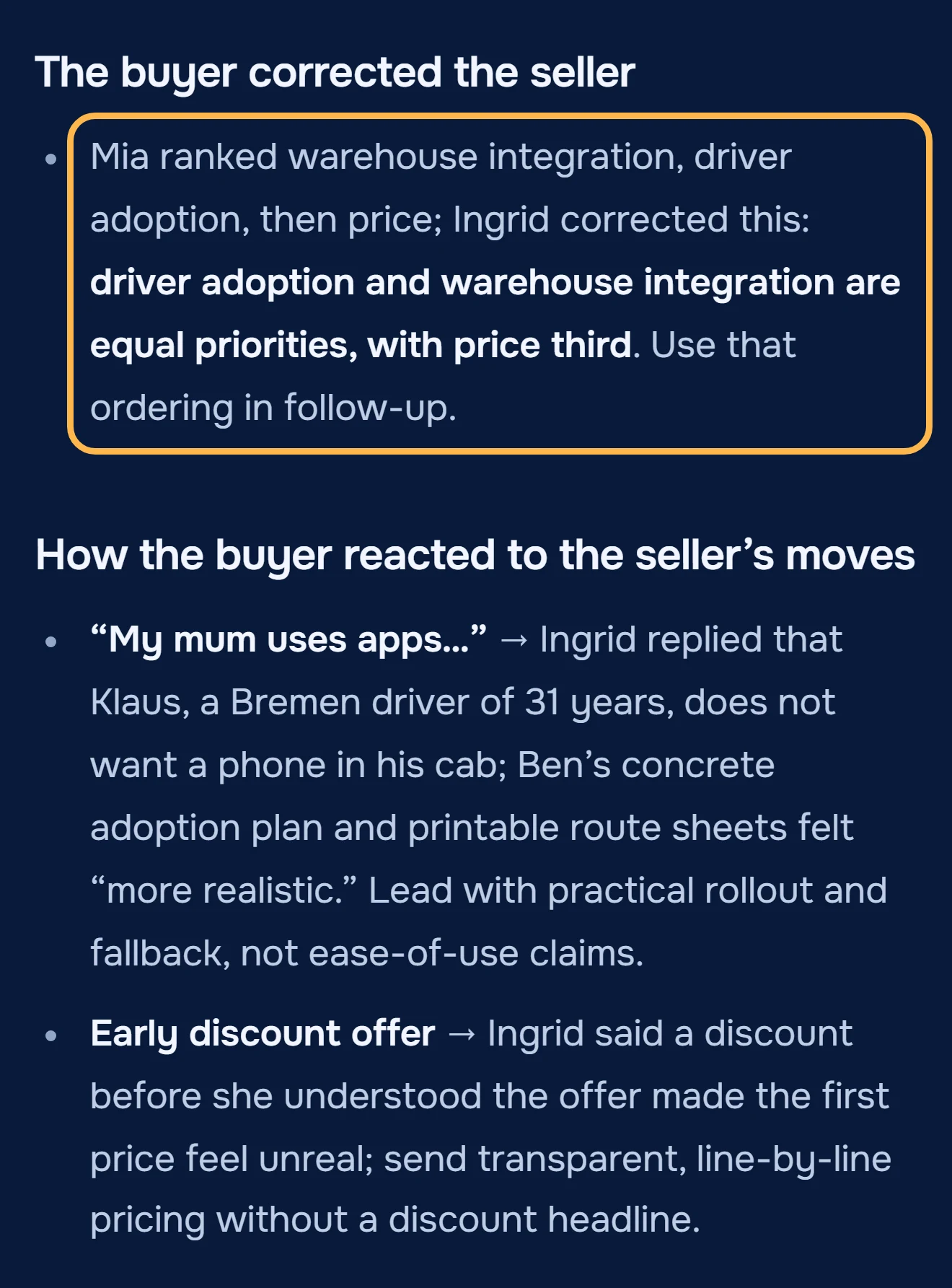 Figure 2. Demo meeting, people are fictional. The buyer's own order of priorities, and the two lines she pushed back on. Source: demo discovery call, Sales Call Intelligence notes, October 2026.Analyzed with MeetWaveSee the full notesTry it on your next sales call
Those three moments decide the tone of the email: her order, no ease-of-use claim, no discount headline.
People who were not on the call
Ingrid chooses the tool, but anything over €50,000 needs the signature of Marit Olsen, the CFO. In Ingrid's words, "hidden costs are the thing Marit will look for first." Henrik, the Hamburg dispatcher who built the spreadsheet, will judge whether the routes are as good as his: "If Henrik says it's good, the others will follow." (demo notes)
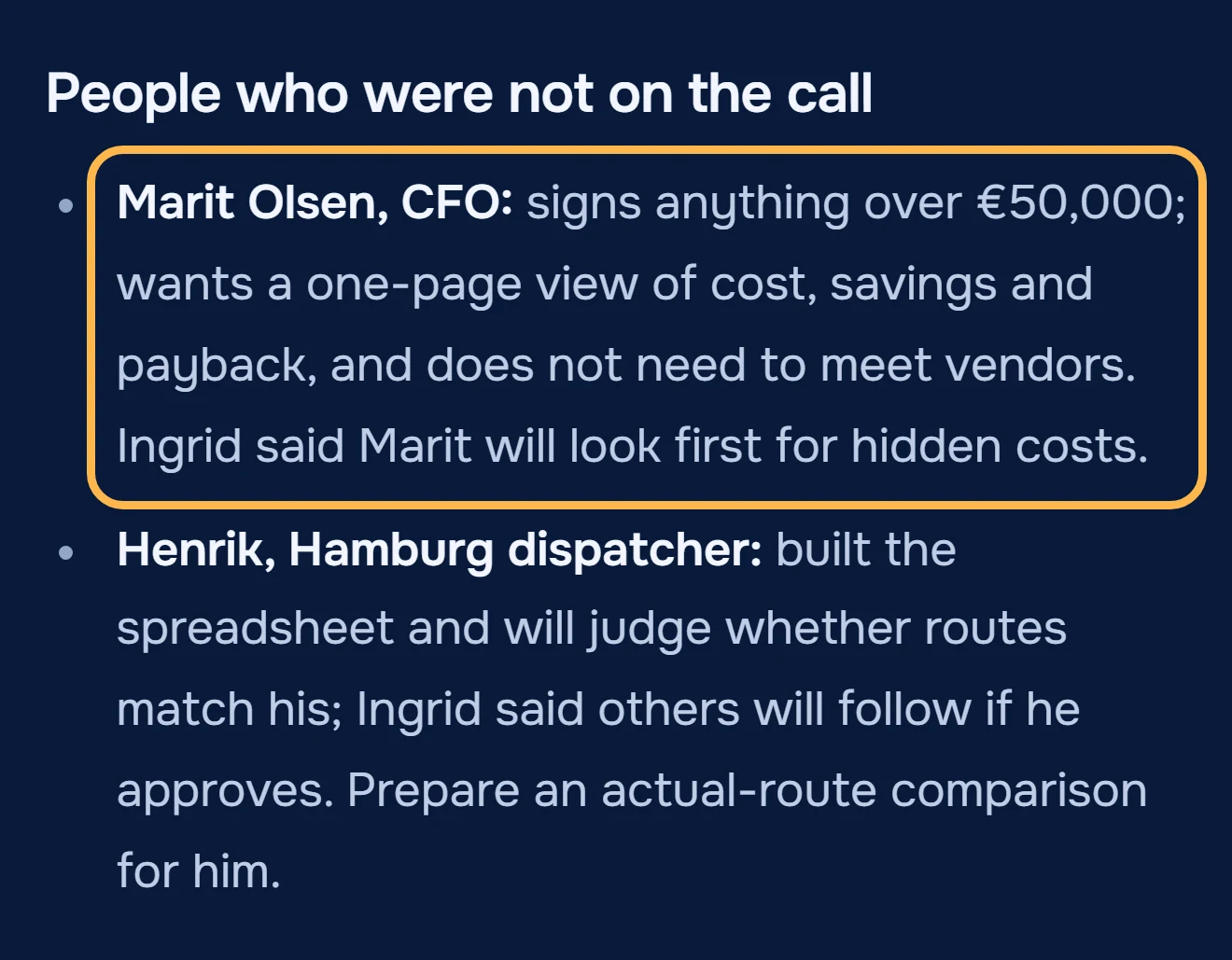 Figure 3. Demo meeting, people are fictional. The signer and the user who will judge the tool, neither of them on the call. Source: demo discovery call, Sales Call Intelligence notes, October 2026.Analyzed with MeetWaveSee the full notesTry it on your next sales call
The follow-up to Ingrid is not enough. Marit needs a one-page view of cost, savings and payback; Henrik needs a route comparison on a week he already planned.
Before and after: the same email, from memory and from the call
| Written from memory | Why it fails | Written from the call |
|---|---|---|
| "Routewise connects to your warehouse system and works with your TrackPoint boxes." | Neither was verified (10:31) | "Thursday, Oct 15, 2:00 p.m. Hamburg time: Ben and Dev review the warehouse interface. Until then we don't call it supported." |
| "Our app is super intuitive — drivers pick it up in a day." | The buyer pushed back on exactly this (13:36) | "Your order, not ours: driver adoption and warehouse integration equally, price third." |
| "If you sign for two years we can get close to FleetLoop's price." | She asked for no discount before the price (19:40) | "By Friday, Oct 9: a line-by-line proposal for 140 vehicles and the German fleet case study." |
| "All three depots can be live by March." | "I wouldn't promise it today" (32:40) | "Still open, we'll confirm: whether your TrackPoint boxes can be read, and whether the case-study fleet had older drivers." |
| "Let me know a good time to talk next week!" | The next step was already set | "For Marit: a one-page view of cost, savings and payback, every cost on it." |
Source: demo discovery call, Sales Call Intelligence notes.
Here is the whole email, as Mia could send it:
Subject: Oct 15 integration review + what we owe you by Friday

Hi Ingrid,

Thanks for the time today. Here is where we are:

Next step: Thursday, October 15, 2:00 p.m. Hamburg time — Ben and Dev look at the warehouse interface together. Whether the connector works with your version is the first thing we answer; we won't call it supported before then.

Your priorities, in your order: driver adoption and warehouse integration equally, price third.

By Friday, October 9, from me: a line-by-line proposal for 140 vehicles (no discount headline, every cost on it) and the German fleet case study.

Still open — we'll confirm, not assume:
- whether your existing TrackPoint boxes can be read (Ben, once Dev sends the model number);
- whether the case-study fleet had older drivers (me, by Friday);
- whether a call with that customer is possible (I'll ask).

For Marit: I'll add a one-page view of cost, savings and payback, so she can see every cost without a meeting. If it helps, a sample week Henrik already planned would let us show him a route comparison on his own data.

Mia
Five follow-up emails by how the call went
Each template keeps the five slots. Fill the brackets only with things that were said on the call; delete a line rather than guess it.
1. The discovery call went well
Subject: [date] [next meeting] + what we owe you by [day]

Hi [name],

Thanks for today. Next step: [day, date, time, time zone] — [who] and [who] [what they will do].

What you told us matters most, in your order: [1], [2], [3].

From us by [day, date]: [document], [document].

Still open, we'll confirm: [what you said you'd check] ([who], by [day]).

[Signer's name] will want [what they need]; I'll send it [as a separate one-pager / with the proposal].

[Your name]
2. A demo with open objections
Subject: The two questions from today's demo

Hi [name],

Thanks for the demo time. Two things you raised that we didn't settle:

1. [Objection, in their words] — what we'll do: [specific action], by [day]. Until then I won't call it solved.
2. [Objection, in their words] — [what you showed / what you'll send].

What you liked, in your words: "[short quote]".

Next step: [day, date, time] with [who], if the two answers hold.

[Your name]
3. A pricing call
Subject: Proposal for [scope], line by line

Hi [name],

As promised, the proposal for [number] [units], each line priced separately: [link / attachment].

What's included and what isn't: [one line each]. Nothing else is billed.

You compared us with [competitor] at [their number, as the buyer said it]. The difference: [one fact from the call, not a claim].

[Signer] signs above [threshold]; the one-page summary for [them] is on page [n].

Next step: [day, date] — [what happens].

[Your name]
4. The buyer went quiet after the call
Subject: [The thing they cared about], before [their deadline]

Hi [name],

On [date] you said [their deadline or event, in their words]. That is [n] weeks away, so one short question:

Is [the next step you agreed] still the right next step, or has something changed on your side?

Either answer helps. If it's a no for now, I'll stop writing and leave [the document] with you.

[Your name]
5. A decision maker was missing
Subject: For [missing person]: [what they decide], on one page

Hi [buyer's name],

You mentioned [missing person] [decides / signs / will judge] [what]. So they don't need a meeting, here is a one-page view for them: [cost / savings / payback / the comparison they care about].

If you'd rather forward it yourself, it's attached as [file]. If a 15-minute call with them would help, I'll fit their calendar.

[Your name]
No recording of the call? The free follow-up email generator drafts one from your notes; the same five slots apply.
Subject lines by outcome
- After a good discovery call: "[date] [next meeting] + what we owe you by [day]"
- After a demo with objections: "The two questions from today's demo"
- With a proposal: "Proposal for [scope], line by line"
- After silence: "[The thing they cared about], before [their deadline]"
- For a missing decision maker: "For [name]: [what they decide], on one page"
A good subject line names something from the call. We give no open-rate numbers: we found none with a published method for follow-ups after a meeting.
Recording sales calls: consent first
Record a sales call only when everyone on it agrees, and say so at the start; in some US states every party must consent, and in the EU a recording of a person is personal data under the GDPR. If the buyer says no, write your notes within an hour of the call and build the email from them with the same five slots. This is not legal advice.
Key numbers
- A week after a conversation, both partners recalled only 4.7% of its details, in a preregistered experiment with 21 pairs (Brown-Schmidt et al., Cognitive Science, 2023).
- On our demo discovery call (October 2026), 5 things were said and not verified, the buyer corrected the seller 1 time, and 2 people who decide were not on the call (demo notes).
- On the same call the buyer named a budget of about €60,000 a year for 140 trucks, and a competitor quote of about €32 per truck per month (demo notes, October 2026).
How we calculated
- The demo call is a fictional 35-minute discovery call written for MeetWave's test set; the moments it should contain were written before the transcript. MeetWave's Sales Call Intelligence read it once; the frames and the linked notes are that run, unedited.
- 5 not verified counts the bullets of the "Promised but not verified" block; 1 correction the bullets of "The buyer corrected the seller"; 2 not on the call the people in "People who were not on the call".
- No timing number: the response-time studies we found measure replies to inbound web leads, not follow-ups after a meeting, so we do not quote them.
FAQ
How soon should I send a follow-up email after a sales call?
The same day. We found no study with a method on follow-up timing after a sales meeting, so there is no honest number to quote. The practical reason is memory: a week after a conversation, both partners recalled only 4.7% of its details in a 2023 experiment (Brown-Schmidt et al.), so write it while you can check it against the call.
What should I say in a follow-up email after a sales call?
Five things: the next step with its date and owner, the buyer's priorities in their own order, what you promised and by when, what is still open, and what the people who were not on the call need. Leave out anything the call did not confirm.
How do I follow up after a sales call with no response?
Ask one short question tied to something the buyer said: their deadline, their event, the next step you agreed. Offer an easy no ("if it's a no for now, I'll stop writing"). Template 4 above does this.
Should I offer a discount in the follow-up email?
Not unless the buyer asked. In the demo call, the buyer stopped an early discount because it made the first price seem unreal. Send the price line by line first.
Who should get the follow-up email?
Everyone who was on the call, plus a separate short note for anyone who decides but was not there: the signer, or the person who will judge the tool in daily use. Ask the buyer whether to send it directly or let them forward it.
Sources
- Brown-Schmidt, S., et al. (2023). Cognitive Science. https://doi.org/10.1111/cogs.13271 , accessed 2026-10-26.
- Oldroyd, J. B., McElheran, K., & Elkington, D. (2011). The Short Life of Online Sales Leads. Harvard Business Review, 89(3). https://hbr.org/2011/03/the-short-life-of-online-sales-leads , accessed 2026-10-26 (about inbound web leads; not quoted for timing).
- Regulation (EU) 2016/679 (GDPR), Article 4(1). https://gdpr-info.eu/art-4-gdpr/ , accessed 2026-10-26.
Still comparing tools?
See how MeetWave stacks up against the tools most teams evaluate alongside it.
- MeetWave vs Fireflies.aiSee how MeetWave compares to Fireflies.ai for meeting intelligence
- MeetWave vs tl;dvSee how MeetWave compares to tl;dv for meeting intelligence
- MeetWave vs FathomFree AI meeting assistant and note taker focused on sales teams
More on this: Meeting minutes template