How to Document Retaliation at Work, and Prove It
To document retaliation at work, keep three dated records: the complaint you made, what was done to you afterwards, and the dates and words that tie the two together, because those are the three parts of a retaliation claim in the EEOC's guidance. Write each conversation down the same day and confirm it by email; in a lab study, only 4.7% of the details were recalled by both people a week later. Retaliation was alleged in 61.6% of EEOC charges in fiscal 2025, and a charge is due within 180 days, or 300 where a state or local agency enforces a law (age claims: state only).
What counts as retaliation
Retaliation is punishment for asserting a right. The US Equal Employment Opportunity Commission puts it as "the EEO laws prohibit punishing job applicants or employees for asserting their rights" to be free from discrimination and harassment (EEOC). It is also the most common claim the agency receives: in fiscal 2025, retaliation was alleged in 54,350 of 88,201 charges, 61.6% (EEOC, Table E1a; our arithmetic).
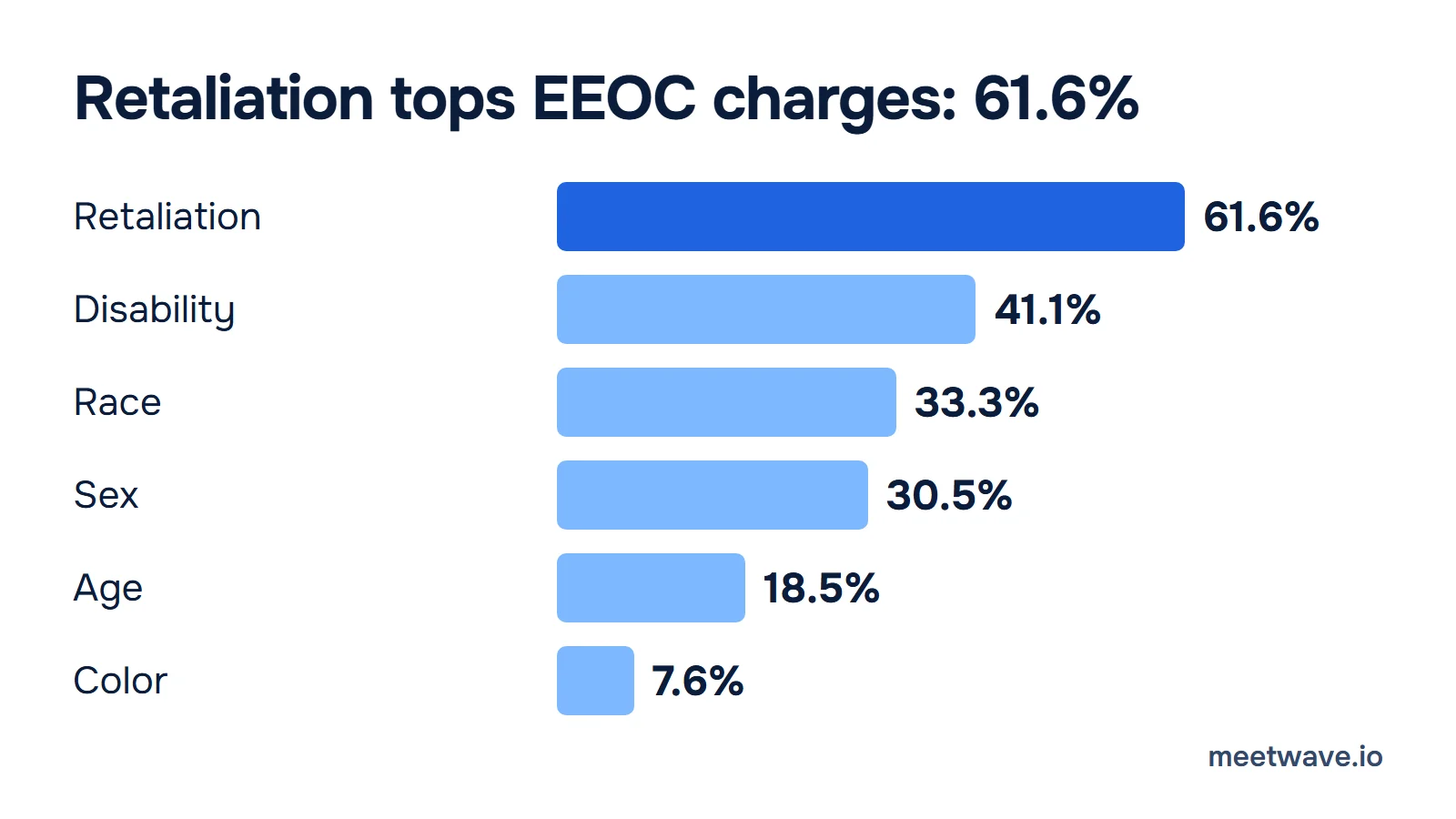
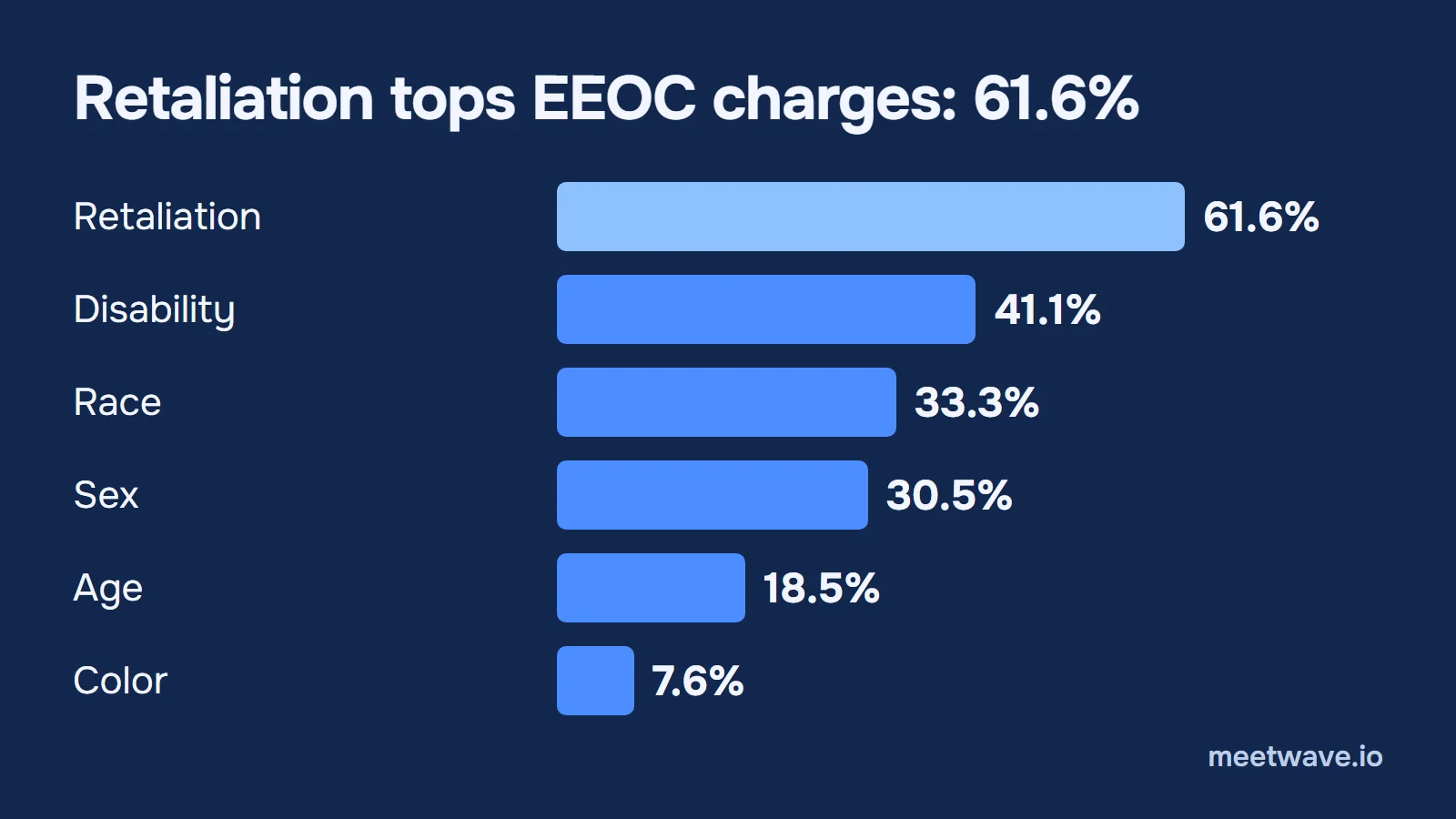 Figure 1. Share of the 88,201 charges filed with the EEOC in fiscal 2025 that allege each basis. A charge can allege several, so the shares add up to more than 100%; a charge is an allegation, not a finding. Source: US EEOC, Table E1a, 2026.
Figure 1 shows how far ahead it is: retaliation was alleged in more charges than disability, race or sex discrimination (EEOC, Table E1a).
The protected step comes first. The EEOC names two kinds: taking part in a charge, complaint, investigation or lawsuit, which is "protected from retaliation under all circumstances", and opposing discrimination, which is protected "as long as the employee was acting on a reasonable belief" (EEOC). Its guidance adds that "complaining to management about discrimination against oneself or coworkers, likely constitutes protected activity" (EEOC Enforcement Guidance, 2016).
What follows the complaint is the second part. The EEOC's examples include a reprimand or "a performance evaluation that is lower than it should be", a transfer "to a less desirable position", and making "the person's work more difficult" (EEOC). The test is an action that "might well deter a reasonable person" from complaining; "petty slights, minor annoyances, and simple lack of good manners" usually do not count (EEOC Enforcement Guidance, 2016).
How to prove retaliation: three parts, three records
A retaliation claim has three elements in the EEOC's guidance: protected activity, a "materially adverse action taken by the employer", and a "causal connection" between them (EEOC Enforcement Guidance, 2016). Each one needs its own record, made when it happened.
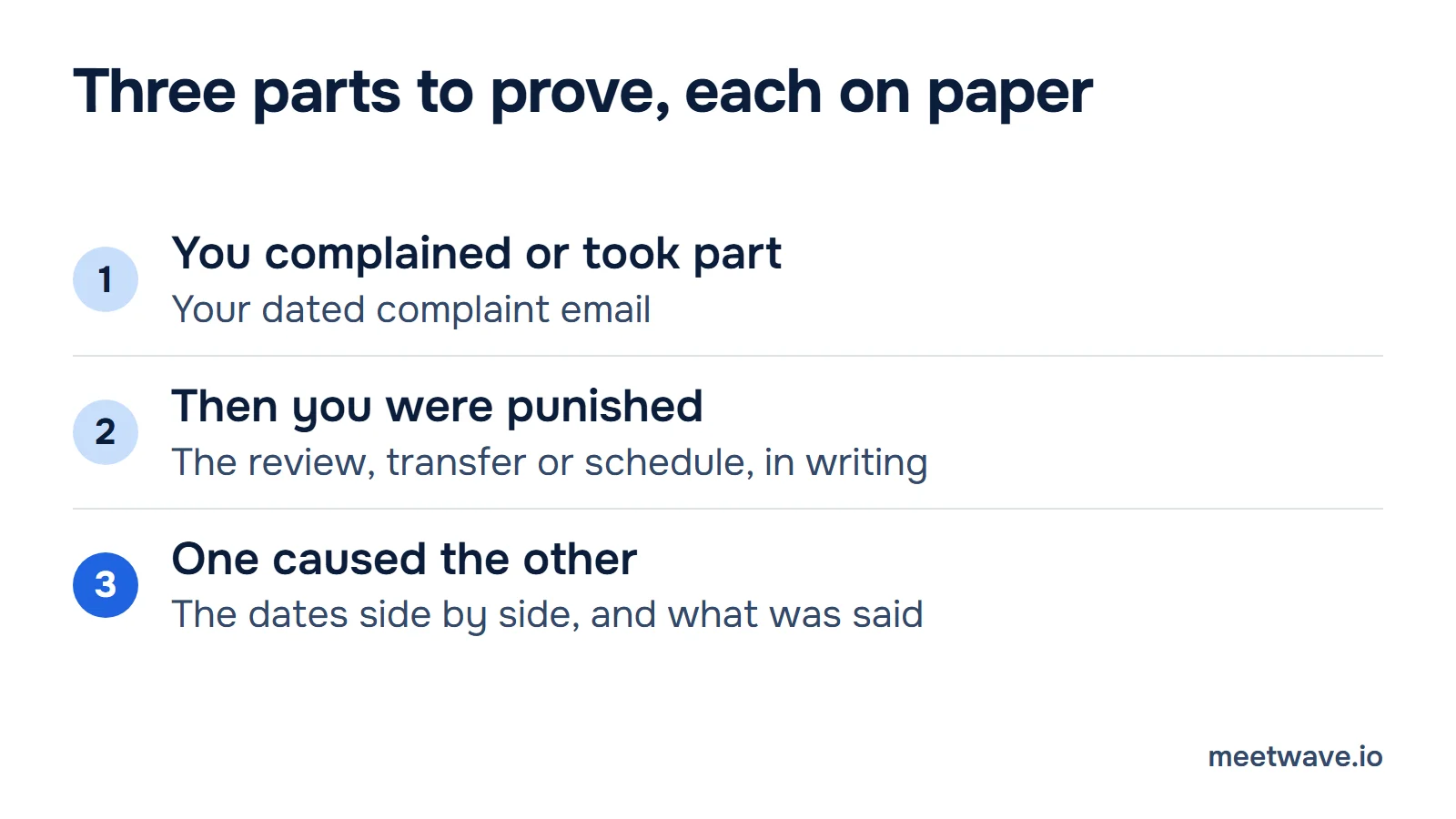
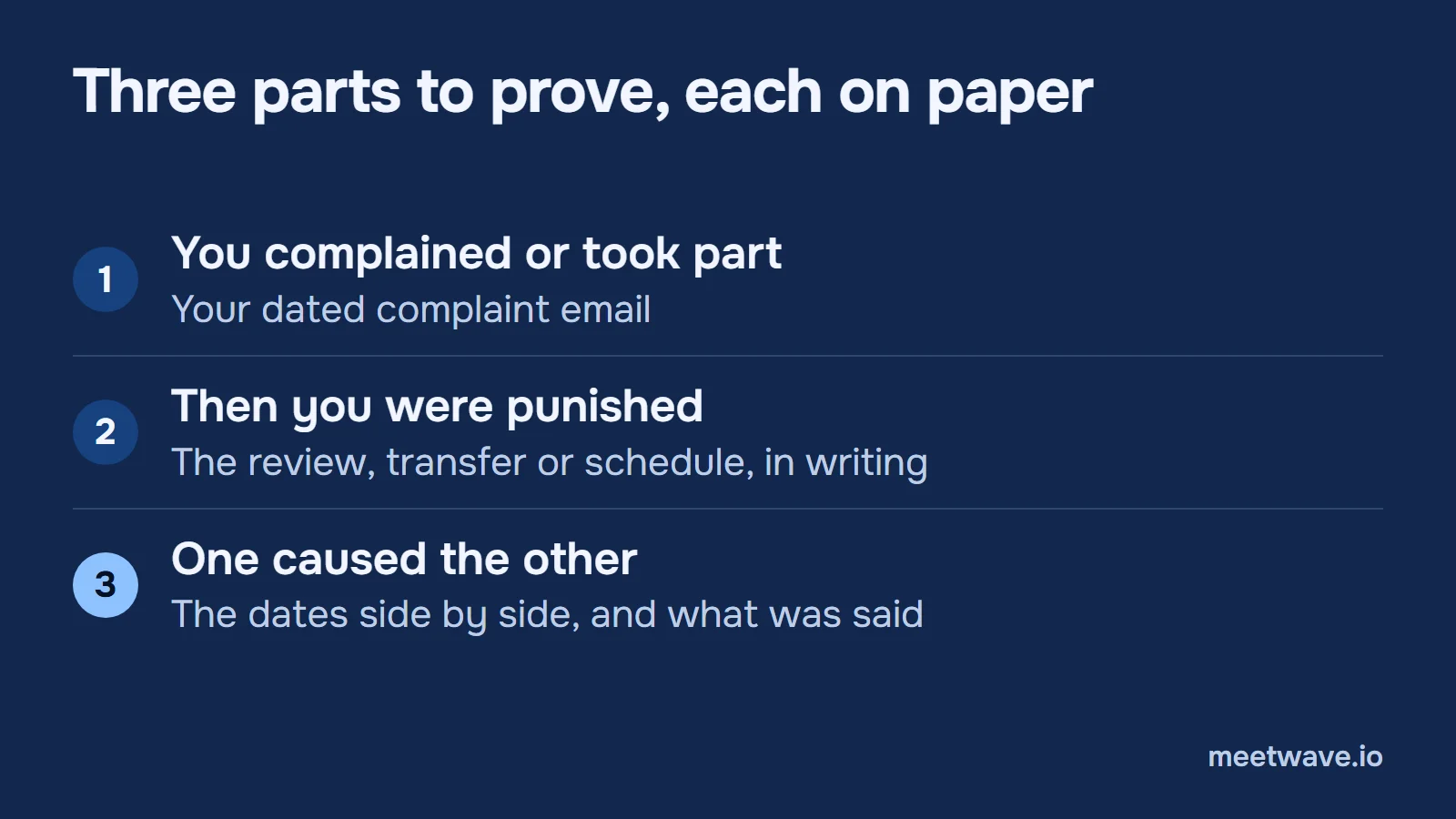 Figure 2. The three elements of a retaliation claim and the record that shows each. Source: US EEOC, Enforcement Guidance on Retaliation and Related Issues, 2016.
The third part is the hard one, and Figure 2 marks it. The guidance lists the kinds of evidence that can show the link, and each has a record you can start today (EEOC Enforcement Guidance, 2016):
| Evidence the EEOC names | The record that shows it |
|---|---|
| Suspicious timing | Your complaint and the action against you, both dated |
| Oral or written statements | What was said, in their words, written down that day |
| A comparable colleague who did not complain and was treated better | What they did and what happened to them |
| Inconsistent or shifting explanations | Each reason you were given, with its date |
| A reason that does not hold up | The facts the reason contradicts: reviews, metrics, praise |
Source: EEOC, Enforcement Guidance on Retaliation and Related Issues, section II.C.3, 2016.
Timing alone is not required: "temporal proximity is not necessary to establish a causal link" (EEOC Enforcement Guidance, 2016). And the protection has a limit the EEOC states plainly: complaining "does not shield an employee from all discipline or discharge" (EEOC). That is why the record of your work before the complaint matters as much as the record after it.
Put your complaint in writing first
A complaint that exists only as a conversation is the easiest of the three parts to dispute. Email it to your manager or HR, with the date, what happened and who was there, and keep the sent copy. The EEOC's guidance says such a complaint "may be informal" (EEOC Enforcement Guidance, 2016); writing it down only fixes the date and the words.
Subject: Concern I raised on [date]

Hi [manager's or HR contact's name],

On [date] I told you about [what happened, in one or two plain sentences: who, what, where]. I'm writing it down so we both have the same record.

Others who were there: [names, or "nobody else"].

I'd like to know what the next step is and who will follow up with me.

Thanks,
[your name]The CYA email: confirm every conversation the same day
A CYA email ("cover your ass") is a short note sent after a conversation to confirm what was said, so that a later "I never said that" meets a dated record. Send it the same day, while both people remember. That is our advice, not a finding: in a 2023 lab experiment on casual conversations, only 4.7% of a conversation's details were recalled by both partners a week later (Brown-Schmidt et al., 2023).
Three rules keep it from reading as a threat:
- Facts, not feelings. What was said, the date, the task. No adjectives about the other person.
- Their words in quotes where the exact phrasing matters.
- A question at the end, so the reply confirms or corrects the record.
A changed deadline:
Subject: New date for [project]

Hi [name],

Thanks for the time today. To confirm: the deadline for [project] moves from [old date] to [new date], because [the reason you were given].

I'll plan the work to the new date. Could you let me know if I got any of this wrong?

Thanks,
[your name]
A task reassigned to you:
Subject: Taking over [task]

Hi [name],

Following our conversation today, I'm taking over [task] from [person or team], due [date].

To fit it in, [other task] moves to [date] — is that right, or should I keep both dates?

Thanks,
[your name]
A verbal promise, such as a raise or a new role:
Subject: Following up on our conversation about [raise / role]

Hi [name],

Thanks for talking with me today about [the raise / the role]. My notes say you'll [what was promised] by [date], and that the next step is [who does what].

Could you confirm that's right, or correct anything I got wrong?

Thanks,
[your name]
Feedback given only out loud:
Subject: Your feedback on [project]

Hi [name],

Thanks for the feedback today on [project]. So I work on the right thing: you said "[their words]", about [the example: the ticket, the meeting, the document].

I'll [what you will change] starting [date]. Is there anything else you'd like me to focus on?

Thanks,
[your name]
A request you were told to keep "off the record":
Subject: Checking on today's request

Hi [name],

Today you asked me to [the request, in neutral words], and said it should stay between us.

Before I do it, could you confirm it in writing, or tell me who else should approve it?

Thanks,
[your name]
The last one is the most uncomfortable to send, and the most useful when the request is the problem. If it cannot be confirmed in writing, that is worth knowing before you act on it.
The log: one entry per conversation
Keep a dated log next to the emails: the emails show what the other side saw, the log shows what you heard. In the same lab study, people who wrote a memo right after a conversation recalled more of it a week later than people who did not, though not more accurately (Brown-Schmidt et al., 2023). Write the entry within the hour, and never edit an old one: add a new dated line instead.
[Date] [time] · [where: 1:1, team meeting, chat, hallway]
- Who was there: [names and roles]
- What was said, in their words: "[quote]"
- What I said: [one line]
- What changed for me: [task, deadline, schedule, review, access] (or: nothing)
- Link to my earlier complaint, if any: [date of complaint] · [days since]
- Witnesses: [names] (or: none)
- Documents: [email sent at time, file, screenshot]
- What happened next: [filled in later, dated]
Keep the log and copies where you can reach them after you lose a work login, and only of what you are allowed to keep: check the handbook before forwarding company files to a personal address. Your own notes and the emails you sent and received are the core of the record; confidential company data is not.
From a meeting to the email: a demo
Here is a demo check-in between a manager and Devin, a support representative on a written improvement plan, from the series behind our performance improvement plan article. MeetWave's 1:1 Meeting Digest wrote the notes. In this week the manager stated a new end-of-plan target out loud, and two promises came out with no date.
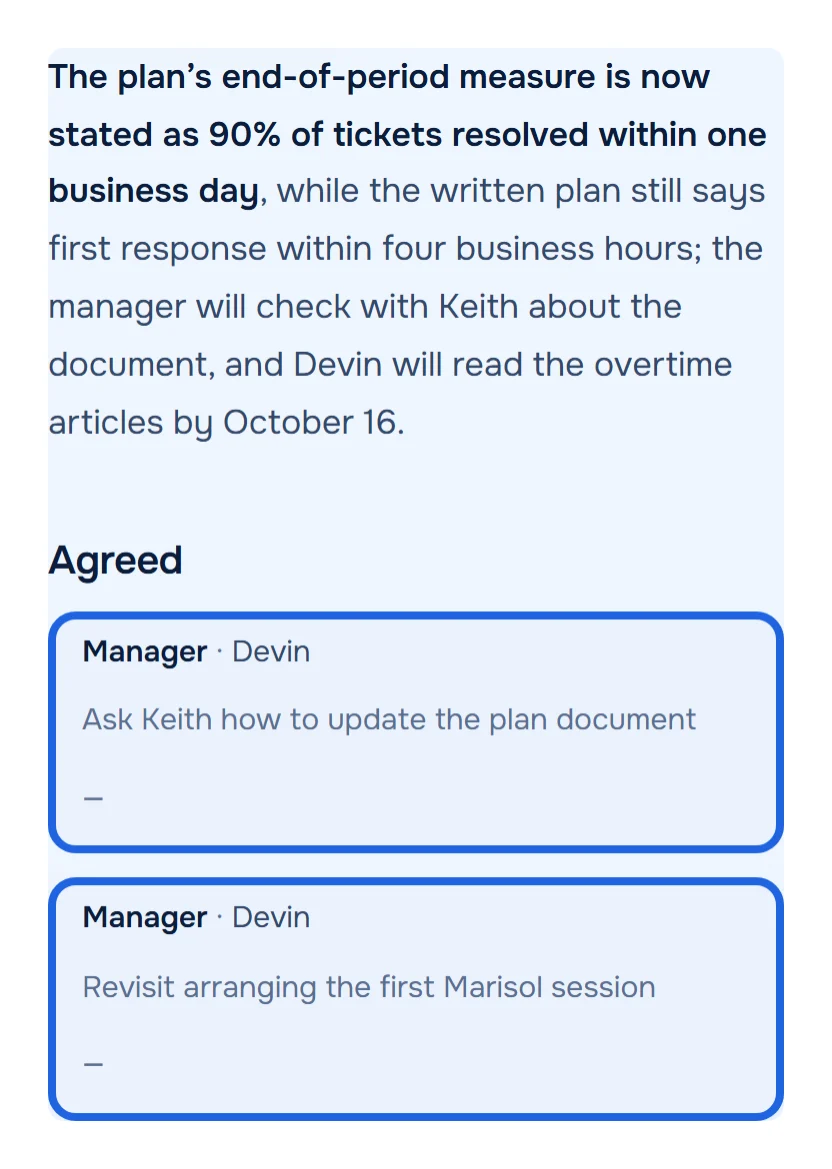
 Figure 3. Demo meeting, people are fictional. Two promises from the manager, both without a date. Source: demo 1:1, week 3 notes, October 2026.Analyzed with MeetWaveSee the full notesTry it on your next 1:1
Figure 3 is where an email starts: a promise with a dash instead of a date is one to confirm in writing the same day (week 3 notes).
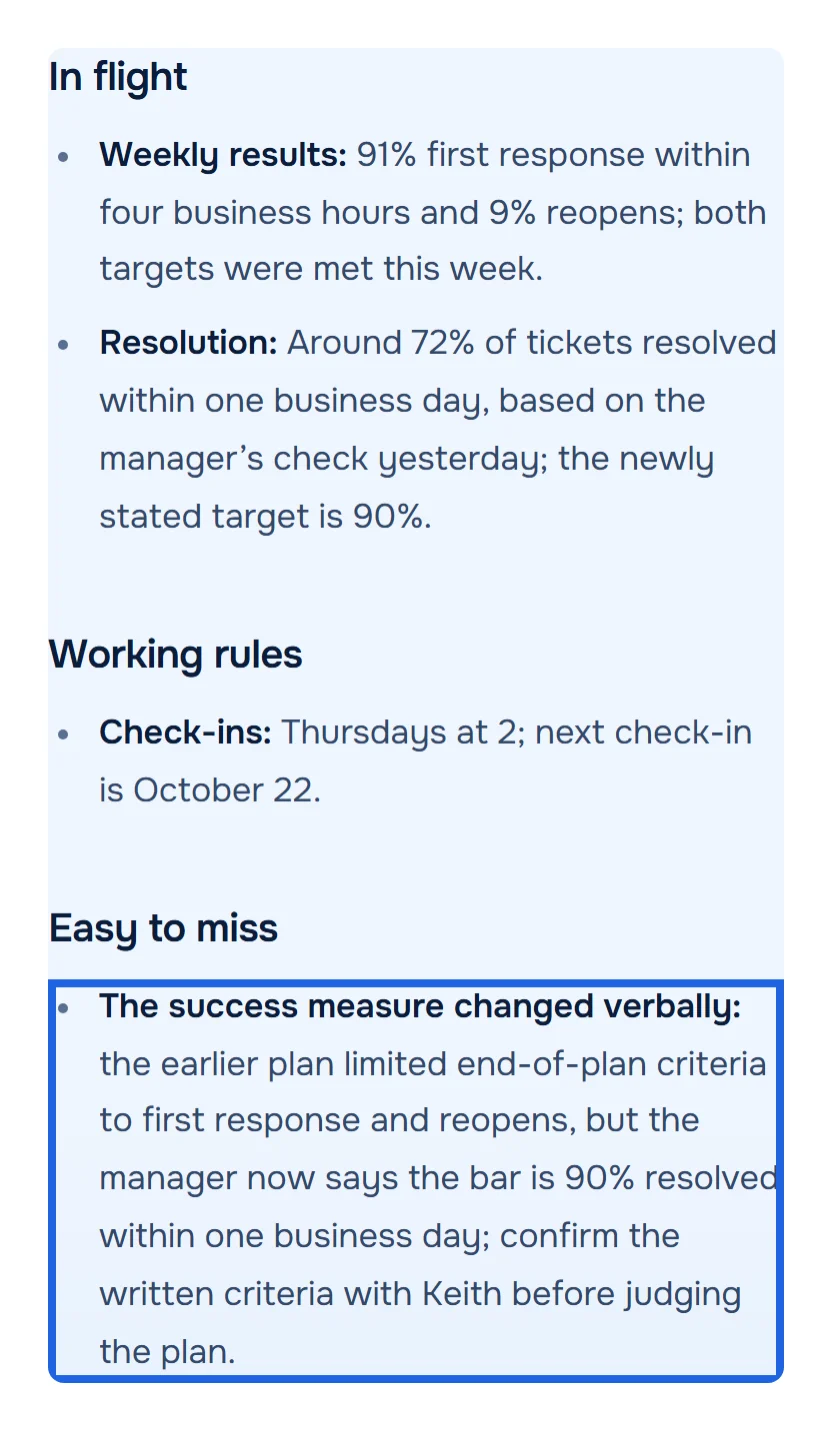
 Figure 4. Demo meeting, people are fictional. The notes flag a target that changed only in conversation. Source: demo 1:1, week 3 notes, October 2026.Analyzed with MeetWaveSee the full notesTry it on your next 1:1
Figure 4 gives the rest of the email: this week's numbers, the next check-in and the target that changed in conversation. Every line below traces to one line of the notes (week 3 notes):
| Line of the notes | Line of the email |
|---|---|
| Easy to miss: the success measure changed verbally | The plan says first response; today you said 90% resolved within one business day |
| In flight: 91% first response, 9% reopens | Both written targets met this week |
| In flight: around 72% resolved within one business day | I'm at about 72% on the new measure, by your check yesterday |
| Agreed: ask Keith how to update the plan document, no date | When will the updated plan be ready? |
| Agreed: revisit arranging the first Marisol session, no date | When is the first session with Marisol? |
| Working rules: next check-in October 22 | Before our check-in on October 22 |
Source: demo 1:1, week 3 notes, October 2026.
The email Devin could send that afternoon:
Subject: Notes from today's check-in

Hi [manager's name],

Thanks for the check-in today. So we have the same notes:

- Both written targets were met this week: 91% first response within four business hours and 9% reopens.
- You said the bar for the end of the plan is 90% of tickets resolved within one business day. The plan says first response within four business hours. Which one will I be measured on?
- By your check yesterday, I'm at about 72% on the new measure.
- You'll ask Keith how to update the plan document, and revisit the first session with Marisol. When can I expect each?

Could you reply before our check-in on October 22?

Thanks,
Devin
Recording instead of notes
Whether you may record a conversation with your manager depends on your state's consent rule and your company's policy, and the state-by-state answer is in Can I record my boss?. Without a recording, the same-day email and the log above are the method, and in a lab study memos written right after a conversation led to more recall, though not more accuracy (Brown-Schmidt et al., 2023).
When it becomes a charge: deadlines and what to bring
This section is not legal advice; for your situation, ask an employment lawyer or the agency. A charge with the EEOC must be filed within "180 calendar days from the day the discrimination took place", extended to 300 calendar days "if a state or local agency enforces a law" against the same kind of discrimination; for age claims, only a state law enforced by a state agency counts (EEOC). Weekends and holidays count; a deadline that lands on one moves to the next business day (EEOC).
Three more rules from the same page change what you do this week (EEOC):
- An internal complaint generally does not pause the clock. The limits "generally will not be extended while you attempt to resolve a dispute through another forum".
- Harassment counts from the last incident. The charge is due "within 180 or 300 days of the last incident of harassment", and the EEOC "will look at all incidents" when it investigates.
- US federal employees generally have 45 days to "contact an agency EEO Counselor".
A charge can be started through the EEOC Public Portal, at one of 53 EEOC offices (as of November 2026), or by mail; the agency answers questions at 1-800-669-4000 but does "not take charges over the phone" (EEOC). A charge by mail holds "a short description of the actions you believe were discriminatory", "when the discriminatory actions took place" and why you believe it was discrimination (EEOC). The log above answers all three. These are the EEOC's deadlines: retaliation for complaints under other laws (safety, wages, whistleblowing, state law) has its own limits, some shorter, so check the agency that enforces that law.
To turn your notes into the same-day email faster, paste them into the follow-up email generator; it needs no recording.
Key numbers
- Retaliation was alleged in 54,350 of 88,201 charges filed with the EEOC in fiscal 2025, 61.6% (US EEOC, Table E1a, 2026).
- In fiscal 1997 the same share was 22.6%: 18,198 of 80,680 charges (US EEOC, Table E1a, 2026).
- In a 2023 lab experiment, only 4.7% of a conversation's details were recalled by both partners a week later (Brown-Schmidt et al., Cognitive Science, 2023).
- An EEOC charge is due within 180 calendar days, or 300 where a state or local law is enforced by an agency (for age claims, only a state law and agency count), as read in 2026 (US EEOC).
- A retaliation claim has 3 elements in the EEOC's 2016 guidance: protected activity, a materially adverse action and a causal connection (US EEOC, 2016).
How we calculated
Each share is a row of EEOC's Table E1a divided by its "Total Charges" row for the same fiscal year: for 2025, retaliation 54,350 / 88,201 = 61.6%, disability 36,256 / 88,201 = 41.1%, race 29,338 / 88,201 = 33.3%, sex 26,941 / 88,201 = 30.5%, age 16,353 / 88,201 = 18.5%, color 6,738 / 88,201 = 7.6%; for 1997, retaliation 18,198 / 80,680 = 22.6%. A charge can allege several bases, so the shares add up to more than 100% (EEOC, Table E1a).
The demo check-in is a fictional meeting written for our performance improvement plan article. Figures 3 and 4 are MeetWave's 1:1 Meeting Digest notes of it, generated on 2026-10-26; the demo email uses only lines of those notes (full notes).
FAQ
What is a CYA email?
A short email sent after a conversation that confirms what was said, with the date, so the record does not depend on memory. Memory is the weak part: in a 2023 lab experiment, only 4.7% of a conversation's details were recalled by both people a week later (Brown-Schmidt et al., 2023). Five copyable versions are above.
What is considered retaliation at work?
Punishment for complaining about discrimination or harassment, or for taking part in a complaint or investigation: for example a reprimand, a lower evaluation than you earned, a transfer to a worse position, or work made more difficult (EEOC). Petty slights and bad manners usually are not (EEOC Enforcement Guidance, 2016).
How do I document a hostile work environment?
Log every incident the same day with the date, the words used, who was there and what changed for you, using the log above. The EEOC deadline runs from the last incident of harassment, and the agency looks at all the incidents when it investigates (EEOC).
Can I record my boss?
It depends on your state's consent rule and your company's policy; the state-by-state answer is in Can I record my boss?. Unlike recording, sending an email does not depend on your state's consent rule. In a lab study, writing a memo right after a conversation led to more recall, though not more accuracy (Brown-Schmidt et al., 2023).
How long do I have to file a retaliation claim?
With the EEOC, 180 calendar days from the action, or 300 where a state or local law is enforced by an agency (for age claims, only a state law and agency count); US federal employees generally contact an agency EEO Counselor within 45 days (EEOC). An internal complaint generally does not pause either clock.
Sources
- US Equal Employment Opportunity Commission — Retaliation (undated page). Accessed 2026-11-03.
- US Equal Employment Opportunity Commission — Enforcement Guidance on Retaliation and Related Issues (2016). Accessed 2026-11-03.
- US Equal Employment Opportunity Commission — Time Limits for Filing a Charge (2026). Accessed 2026-11-03.
- US Equal Employment Opportunity Commission — How to File a Charge of Employment Discrimination (2026). Accessed 2026-11-03.
- US Equal Employment Opportunity Commission — Table E1a, Charge Receipts by Basis or Statute, FY 1997 – FY 2025 (2026). Accessed 2026-11-03.
- Brown-Schmidt, Jaeger, Evans and Benjamin — MEMCONS: How Contemporaneous Note-Taking Shapes Memory for Conversation, Cognitive Science 47(4) (2023). Accessed 2026-11-03.
Still comparing tools?
See how MeetWave stacks up against the tools most teams evaluate alongside it.
- MeetWave vs FathomFree AI meeting assistant and note taker focused on sales teams
- MeetWave vs FellowSee how MeetWave compares to Fellow for meeting notes and AI summaries
- MeetWave vs GranolaSee how MeetWave compares to Granola for bot-free meeting notes
More on this: Meeting minutes template