How to Write a Self-Evaluation for a Performance Review: 18 Before-and-After Examples
Write each result in one line: what you did, that nobody asked you to, what it saved or earned per period, and who saw it. Do not write from memory: in an experiment with pairs of people, only 4.7% of the details of a conversation were recalled by both partners a week later, so a form written in November holds the last two months of the year. Pull the rest from your calendar, sent mail, tickets and 1:1 notes, and state results at full size: in a study of over 4,000 online workers, women described their performance to potential employers less favorably than equally performing men.
Why the form you write in November is wrong
The form is due when your memory is shortest. Interest in "performance review" in US Google searches averages 9 (on a 0 to 100 scale) in October and 18 in November, and stays between 15 and 24 until July (Google Trends, 2021 to 2026). Figure 1 shows the jump.
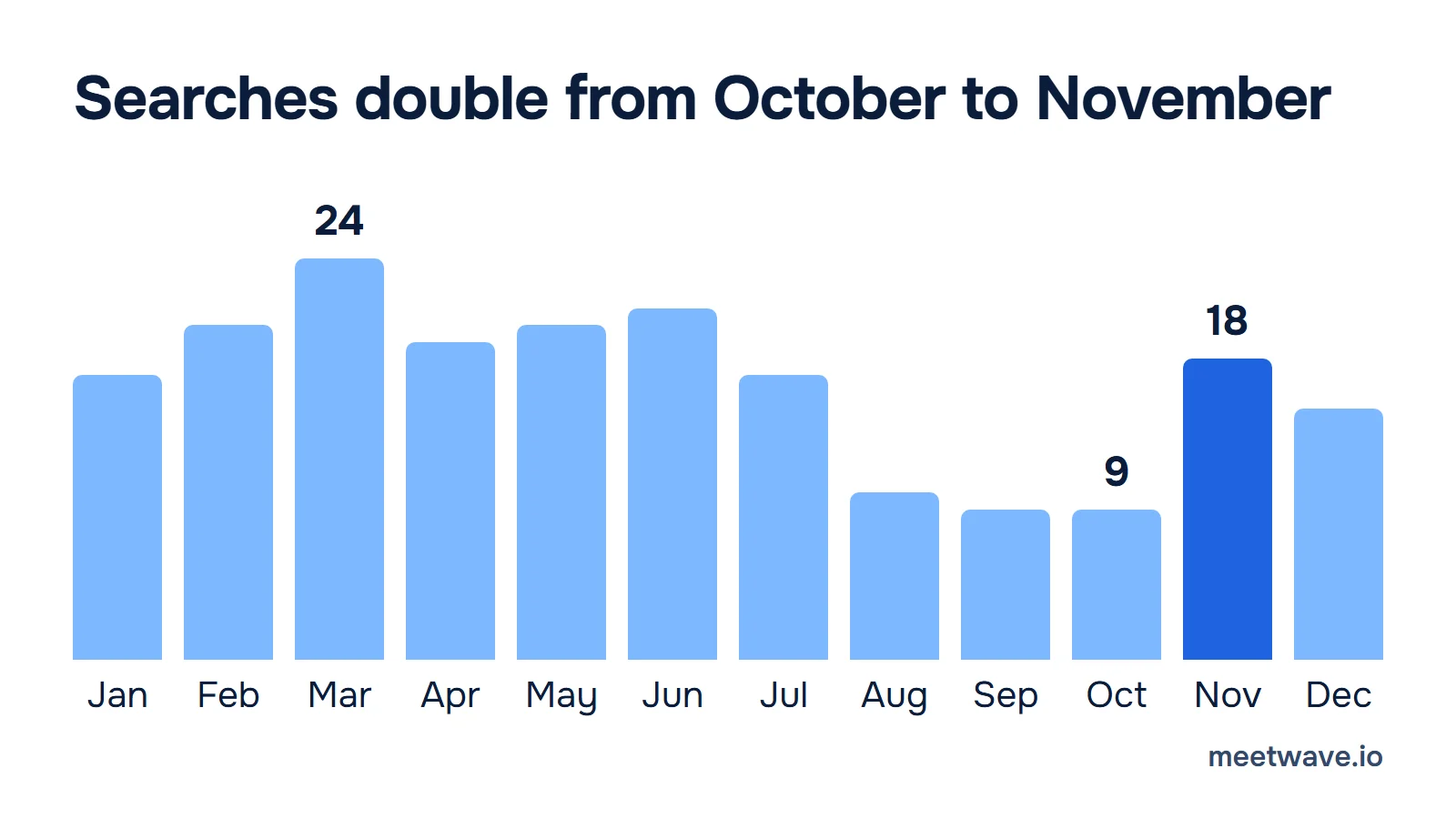
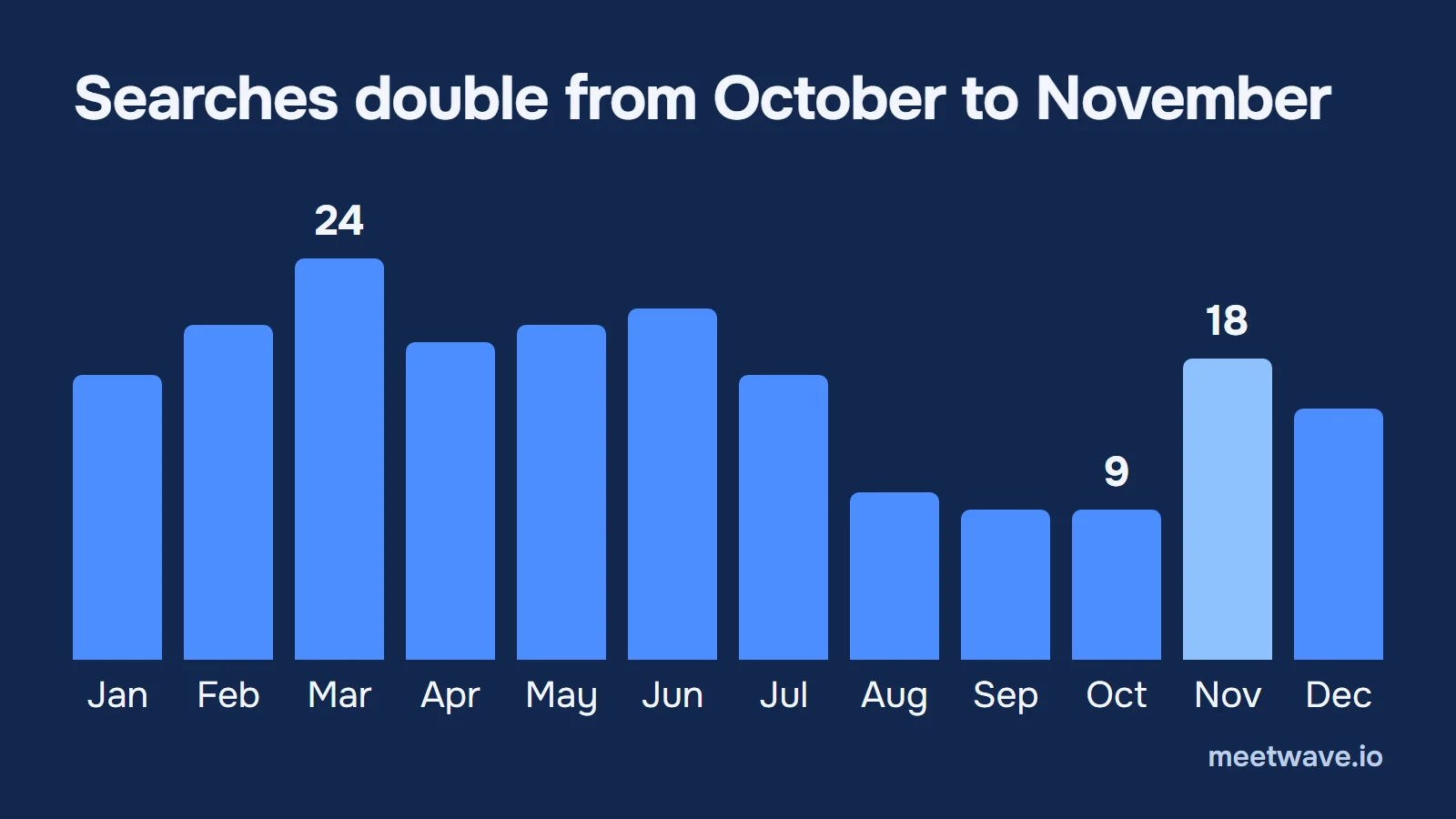 Figure 1. Searches for performance review double from October to November. Source: Google Trends, US, weekly values averaged by calendar month, October 2021 to October 2026.
Memory loses most of what happened. In an experiment, pairs of people held a conversation and were tested after a week: only 4.7% of its details were recalled by both partners (Brown-Schmidt et al., 2023). People who wrote a record right after the talk remembered more, with the same accuracy. A year of work is 12 months of such conversations, so what you remember is the last two months and one or two loud events.
The other failure is saying too little of what you remember. In a study of over 4,000 participants from online labor markets, women described their ability and performance to potential employers less favorably than equally performing men, and the gap remained when all incentives to promote were removed (Exley and Kessler, NBER, 2019). It is a result about one task and one group; the habit it points to is general: people round their own work down.
Reviews are not trusted to catch it for you. In a Gallup report, 14% of employees strongly agreed that the reviews they receive inspire them to improve, 29% that they are fair and 26% that they are accurate (Gallup, 2017). The report does not state its sample, so read it as a signal, not a measurement. Your self-evaluation is the one input to the review that you control.
The formula: one line per result
A strong line has four parts, each a fact you can show. They are the same four parts we use for a raise case in how to ask for a raise:
what I did · that nobody asked · what it saved or earned per period · who saw it
Put the number first if you have it. "Stopped about $500 a day of double payments" (Sam's case) starts a reader's attention better than "I worked on invoice quality". Two parts are optional by case: "nobody asked" only fits work you started yourself, and "who saw it" only fits where there was a witness. A line with an action and a number already beats an adjective.
[What I did, as a verb: found / built / cut / moved / wrote] · [it was not asked: nobody had a ticket / I proposed it] · [what changed, per day, week or month: number and unit] · [who saw it: name, role, or where it was said]The rest of this article is that formula applied: 18 pairs, a method to find the facts, and a prompt that does not invent them.
Before and after: examples by competency
Each "before" below is a line people really write. Each "after" uses the formula. The cases marked "Sam" come from the demo series later in this article; every other number is illustrative, so replace it with yours. If you cannot produce the number, write how you would measure it, which is a stronger line than an adjective (the formula).
Quality of work
| Before | After | What changed |
|---|---|---|
| "I consistently produce high-quality work." | "I shipped 14 billing reports this year. Two needed a correction after release, against nine of 12 last year. Finance stopped re-checking them in March." | An adjective became a count, a comparison and a witness. |
| "I have strong attention to detail." | "In May I saw that the fuel surcharge was mapped twice for some regional carriers and fixed it. Nobody had asked and there was no ticket. About $500 a day of double payments stopped." (Sam) | The detail is the proof: what was caught, by whom, at what cost. |
| "I met all my deadlines." | "Ten of 11 deadlines were met on the day. The late one, the vendor audit, slipped three days; I flagged the risk two weeks earlier in the Monday update." | A perfect claim is not believed; one owned miss makes the other ten credible. |
Source: illustrative lines; the cases marked Sam are from the demo 1:1 series, October 2026.
Communication
| Before | After | What changed |
|---|---|---|
| "I communicate well with my team." | "In February I started a five-line Friday update to sales ops. Their status questions to me fell from about eight a week to one or two, by my count of Slack threads." | It names the mechanism and the measurable effect on other people. |
| "I explain things clearly." | "I wrote the runbook for the forecast model. In August sales ops reran it themselves twice without calling me, and in September my manager asked me to be the onboarding buddy for the new analyst because of how I explain things to ops." (Sam) | Two events show the skill; nobody needs to take your word. |
| "I keep stakeholders informed." | "I send a decision note within a day of every pricing review. In the six reviews since March, nobody has reopened a decision because they had not heard it." | A habit with a date, and an outcome that is an absence of a problem. |
Source: illustrative lines; the cases marked Sam are from the demo 1:1 series, October 2026.
Leadership
| Before | After | What changed |
|---|---|---|
| "I took the lead on the carrier dashboard." | "I scoped, built and presented the carrier dashboard. Month-end close went from six working days to four, and about $41,000 of duplicate invoices were flagged in April. Nadia: 'That dashboard is your work.'" (Sam) | "I took the lead" says nothing about size; the number does. Their words are the witness. |
| "I mentor junior colleagues." | "I onboarded two analysts. Both ran their first query review without me by week five. The six-page onboarding doc I wrote is now the team's default." | Mentoring is shown by what the mentees did and what is left behind. |
| "I show leadership by example." | "I own the Q4 forecast end to end, and ops plans its quarter around it. My manager called owning work that another team plans around 'what a senior owns here'." (Sam) | Leadership without a title is ownership others depend on; say who depends. |
Source: illustrative lines; the cases marked Sam are from the demo 1:1 series, October 2026.
Teamwork
| Before | After | What changed |
|---|---|---|
| "I am a team player." | "When two teammates were out in March, I covered their six on-call shifts and wrote a handover note. The next cover took half a day to learn instead of two." | A sacrifice with a count, and what it left for others. |
| "I work well with other departments." | "I worked with Ruth's finance team to understand the close before I built the matching. The close now takes four working days instead of six." (Sam) | The effort that makes cross-team work is time spent before building, and the result is theirs as much as yours. |
| "I support my coworkers." | "The carrier scorecard used to be rebuilt by hand every Monday. I set up a refresh so it runs on its own; [hours per week] returned to Ines." (Sam) | He called it "nothing big"; the missing number is hours, which his colleague can give. |
Source: illustrative lines; the cases marked Sam are from the demo 1:1 series, October 2026.
Customer service and goals
| Before | After | What changed |
|---|---|---|
| "I provide excellent customer service." | "My 212 rated tickets scored 4.6 of 5, the team average was 4.3. Three customers asked for me by name." | An average against the team's, plus the strongest signal of all: people asking for you. |
| "I achieved my goals this year." | "Goal 1, cut onboarding from 14 days to 10: reached 9 in Q3. Goal 2, launch the partner portal by June: shipped in August, two months late because the legal review moved." | Goals go one by one, with the number reached and the reason for the miss. |
Source: illustrative lines; the cases marked Sam are from the demo 1:1 series, October 2026.
Where the facts come from: a year in a week
You do not need a diary to rebuild a year. Five sources already hold it, and each answers a different part of the formula. Spend an hour on each, in this order.
| Day | Source | What to pull | Which part of the line it answers |
|---|---|---|---|
| Monday | Calendar | Every launch, review, presentation and one-off meeting you led, month by month | What I did, and when |
| Tuesday | Sent mail and chat | Search for "thanks", "great", "appreciate" and "nice work"; save each message with its date | Who saw it |
| Wednesday | Tickets, pull requests, documents | Everything closed, shipped or written; count it per quarter | What it changed |
| Thursday | 1:1 notes and last year's review | What your manager said about your work, and the goals you were set | Who saw it, and the goals to answer |
| Friday | Colleagues | For each result with no number, ask the person who felt it: hours saved, errors avoided | The number |
Source: MeetWave method, built on the memory experiment above.
Do not skip Friday. A colleague who can say "that saved me about four hours a week" gives you a number you could not have written yourself.
Keep a log from now on, so next November takes an hour. Add a line each Friday, and a line after every 1:1:
[Date] · [Result, as a verb] · [Unasked? yes / no] · [Number: saved or earned per day, week or month] · [Who saw it, or the link] · [Competency: quality / communication / leadership / teamwork]

Example:
[2026-05-14] · Fixed the surcharge mapping that charged some carriers twice · yes, no ticket · about $500 a day · Nadia, pricing review
If you take 1:1 notes by hand, the one-on-one meeting template has a field for each part of the formula.
Your 1:1s already hold it: a demo case
The wins are often said out loud and then lost. Here is a series of demo 1:1s between an analytics manager, Nadia, and her analyst, Sam, in May, July and September 2026. MeetWave's Raise Coach reads each one for Sam: what his manager said that counts, with the minute, and what to bring next.
The May notes list five things Nadia said about Sam's work, each with the minute. They are the "who saw it" of his self-evaluation, and he did not have to remember them: "That dashboard is your work" at 03:54, "That's senior-level impact" at 04:39.
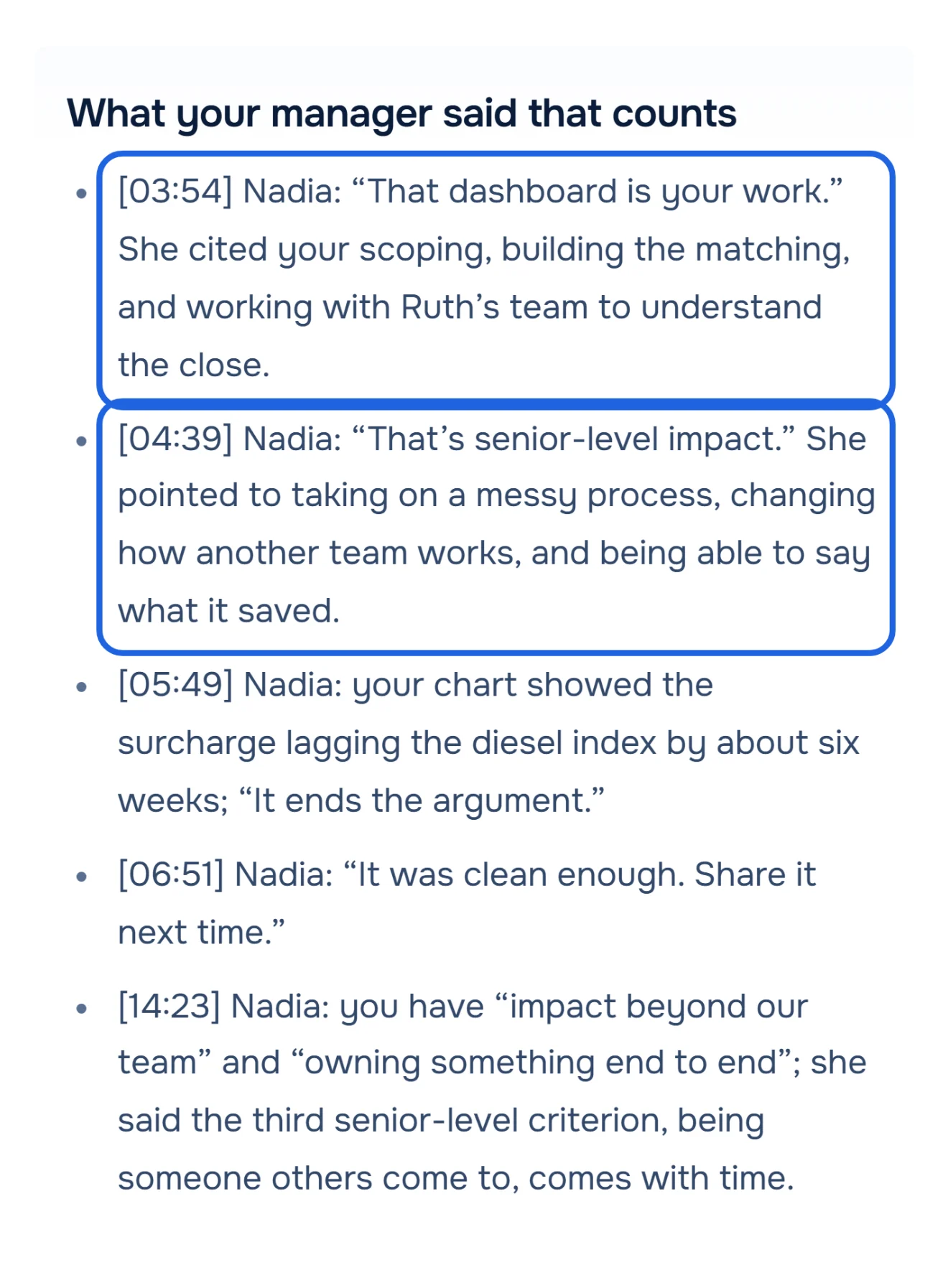
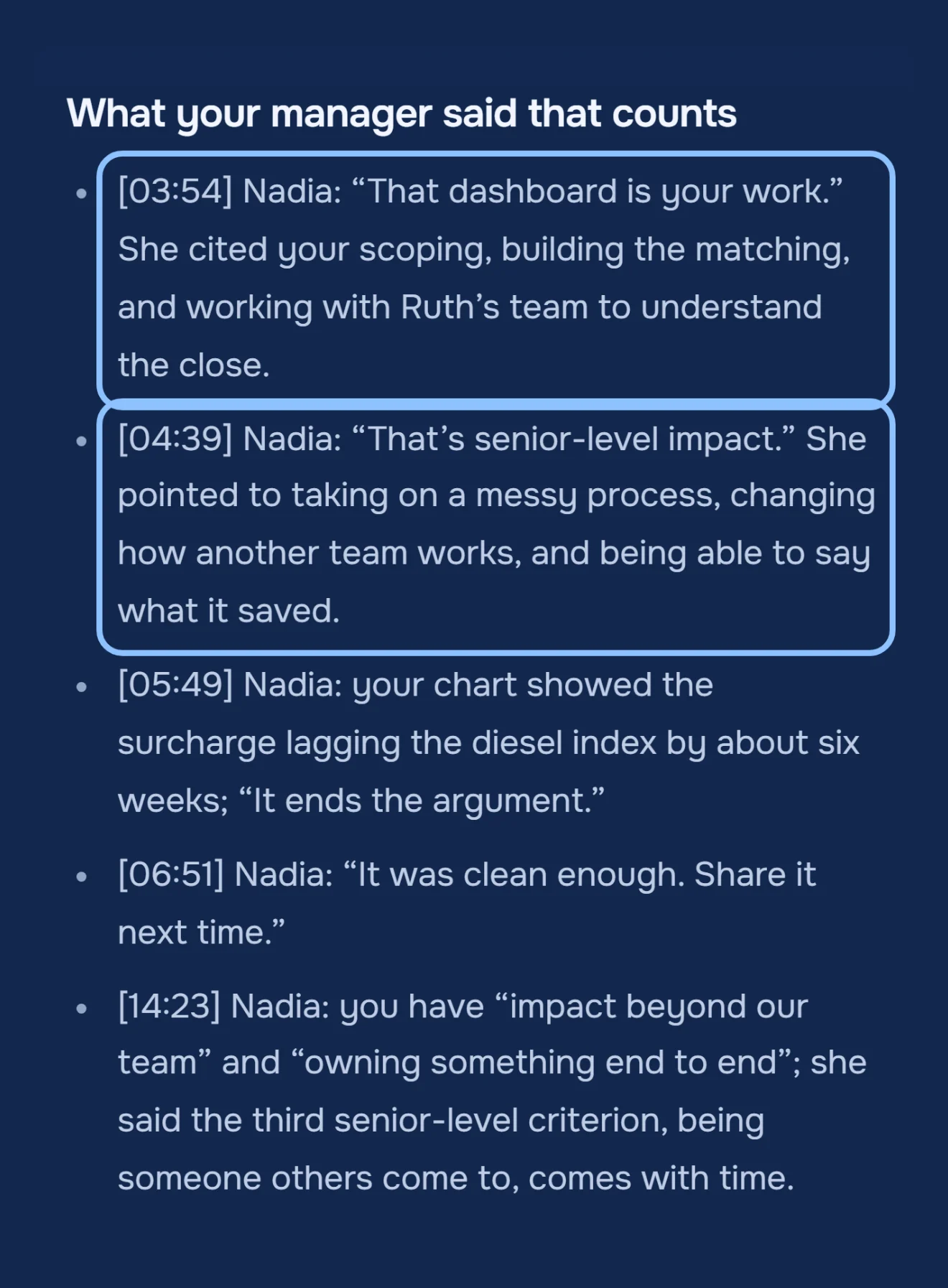 Figure 2. Demo meeting, people are fictional. May 1:1: five things the manager said that count, with the minute. Source: demo 1:1 series, May Raise Coach notes, October 2026.Analyzed with MeetWaveSee the full notesTry it on your next 1:1
Read the two highlighted lines as evidence, not praise. At 03:54 Nadia cited his scoping, the matching he built and the time he spent with Ruth's team: that is a teamwork line and a leadership line from one sentence. At 04:39 she pointed to a messy process he took on, how it changed another team's work, and his being able to say what it saved: that is the formula's "what it saved" part, named by her. His self-evaluation line is one of the pairs above, with her quote as the witness.
The September notes show the other half: a win he undersold at 02:21, and what to carry forward. At 02:21 Sam called adding two carriers to the matching "kind of a small thing", while Ruth had reported about $6,000 in duplicates flagged in its first month. The notes start from that number.
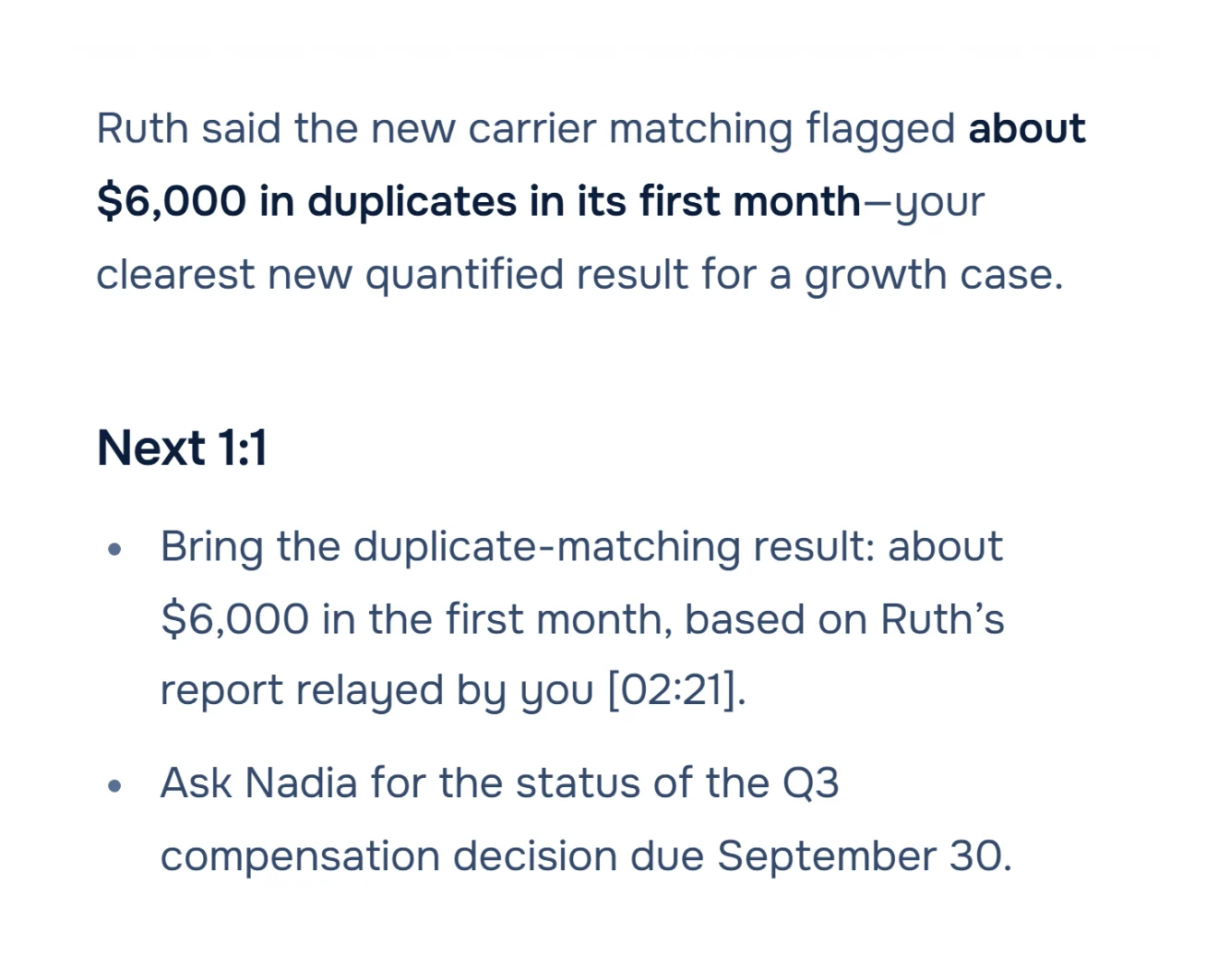
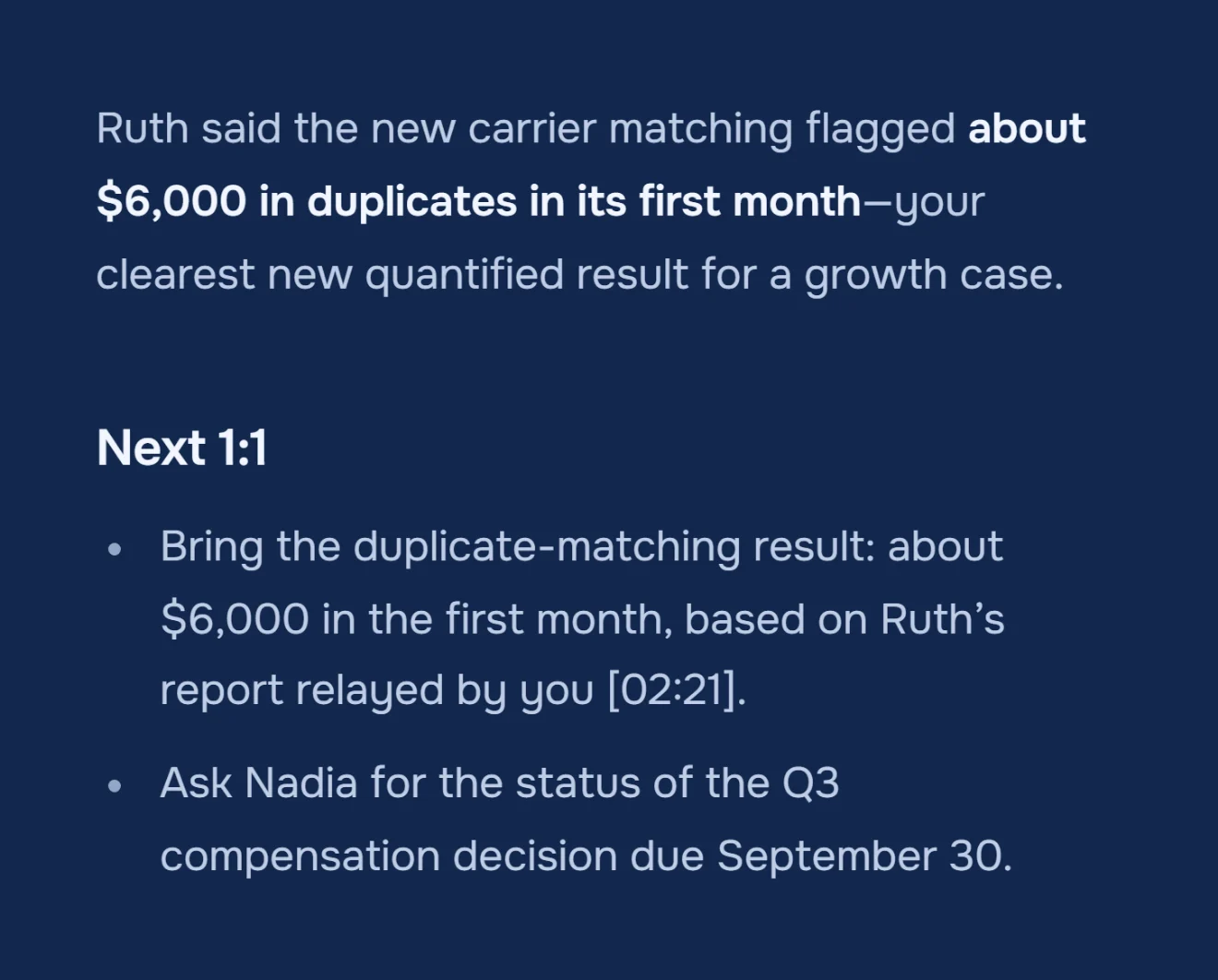 Figure 3. Demo meeting, people are fictional. September 1:1: the result he called a small thing, carried into the next 1:1. Source: demo 1:1 series, September Raise Coach notes, October 2026.Analyzed with MeetWaveSee the full notesTry it on your next 1:1
| What Sam said at 02:21 | What goes into the self-evaluation |
|---|---|
| "Kind of a small thing." | "I added the two new carriers to our duplicate matching. In their first month it flagged about $6,000 in duplicates (reported by Ruth's team)." |
Source: demo 1:1 series, September notes.
The rewrite adds no fact. It drops "kind of a small thing", states the action, puts the number in and names who reported it. The same method works for any year: re-read each 1:1, find the sentence where you waved a result away, and rewrite it with the formula.
Recording a 1:1 for this needs your manager's consent, and some states, Washington among them, require it from everyone in a private conversation (RCW 9.73.030). Federal law lets a party to a conversation record it (18 U.S.C. § 2511(2)(d)), and your employer may have its own rule; this is not legal advice. Notes written within the hour work with the same method.
Areas of improvement: honest, and not a reason for a low score
Name one gap that is real, show what you did about it, and give the next step with a date. The manager reads an area of improvement as a prediction: a vague one predicts more of the same, a closed one predicts growth. Three rules.
- Pick a gap that costs you something, not a strength in disguise. "I'm a perfectionist" and "I work too hard" are read as a dodge.
- Give the evidence in the same line: the case, and the number it cost.
- End with what changed since, and what comes next, with a date.
| Before | After | What changed |
|---|---|---|
| "I'm a perfectionist." | "I polish internal reports too long: the March report took three days for a day's value. Since June I time-box them to half a day and ask for review at draft stage. The last four went out the same week." | The gap is real, costs time, and is closed by a rule you can check. |
| "I could improve my communication." | "In May my manager still presented my work to leadership. In June I presented the dashboard at the ops review myself. Next: one cross-team presentation per quarter." (Sam) | The gap is named by the situation, not by a trait, and the next step has a number. |
| "I need to be more organized." | "Three of my five estimates this year slipped by over a week, all on work that depends on another team's data. Now I get one line of confirmation from the data owner before I commit a date." | One pattern, with its cause, and the habit that breaks it. |
| "I don't have any weaknesses I can think of." | "I say yes to requests before checking my own plan: I took six side requests in Q2, and two of my goals moved. Now I answer 'I'll check my plan and reply by tomorrow'." | Having no gap reads as not looking; a gap with a fix reads as judgment. |
Source: illustrative lines; the cases marked Sam are from the demo 1:1 series, October 2026.
If the year went badly, the structure holds. State the miss in one sentence without a cause that blames someone, then give what you changed and the first result since. A form that explains is read; a form that excuses is graded.
Using AI without sounding like AI
A model can tighten your lines, but only if it works from your evidence. Without it, it produces what any reader recognizes at once: "Spearheaded cross-functional initiatives, using data-driven insights to drive operational excellence." It has no name, number or date. Managers see the same sentence in a dozen forms in a week.
| Before (flat) | After (from evidence) |
|---|---|
| "Spearheaded cross-functional initiatives, using data-driven insights to drive operational excellence." | "I built the carrier dashboard with Ruth's finance team. Close went from six working days to four; about $41,000 of duplicate invoices were flagged in April." |
Source: illustrative lines; the cases marked Sam are from the demo 1:1 series, October 2026.
Use the model as an editor, not an author. Give it your wins log, forbid it from adding numbers, and make it ask when something is missing:
You are editing my self-evaluation for a performance review. Work only from the evidence below.

Rules:
1. Write one result per line: what I did, that nobody asked (only if the evidence says so), what it saved or earned per period, and who saw it.
2. Use only facts and numbers that appear in my evidence. Never add, round up or estimate a number. If a result has no number, write [NUMBER NEEDED] and tell me who could give it.
3. Keep my own words where they are specific. Do not use: spearheaded, drove, synergy, passionate, proven track record.
4. Maximum 45 words per result. Start lines with a verb in the past tense.
5. For areas of improvement: one real gap from my evidence, what I did about it, the next step with a date.
6. At the end, list every result that has no number or no witness.

My goals from last year: [paste]
My wins log, calendar items and 1:1 notes: [paste]
Praise I received, with dates: [paste]
The review form's questions: [paste]
Read the output once against your log. Every number must be in the log; any that is not goes out. Then read it aloud: a line you cannot say in a meeting does not belong in the form.
Key numbers
- In an experiment, both partners recalled only 4.7% of a conversation's details after a one-week delay (Brown-Schmidt et al., Cognitive Science, 2023).
- In a study of over 4,000 participants from online labor markets, women described their ability and performance to potential employers less favorably than equally performing men, and the gap remained with all incentives to promote removed (Exley and Kessler, NBER Working Paper 26345, 2019).
- 14% of employees strongly agreed that the performance reviews they receive inspire them to improve, 29% that they are fair and 26% that they are accurate; sample not stated (Gallup, 2017).
- US search interest in "performance review" averages 9 in October and 18 in November, on a 0 to 100 relative scale (Google Trends, October 2021 to October 2026, our averages).
How we calculated
Figure 1 is the weekly US Google Trends series for "performance review" from 2021-10-24 to 2026-10-18 (261 weeks, pulled 2026-10-30), averaged by calendar month: each bar is the mean of the weekly values that fall in that month, rounded to a whole number. Trends values are relative interest on a 0 to 100 scale, not search counts. We use the single term "performance review"; the longer phrases ("self evaluation for performance review") are too small in Trends to chart.
The demo 1:1s are fictional meetings written for the spec 108 article on raises. Figures 2 and 3 are MeetWave's Raise Coach notes from them, generated on 2026-10-26; the minutes are the minutes of the demo recordings. All examples not marked "Sam" are invented for illustration; their numbers are not data.
FAQ
How do I write a self-evaluation for a performance review?
Write one line per result: what you did, that nobody asked, what it saved or earned per period, and who saw it. Build the list from your calendar, sent mail, tickets and 1:1 notes, not from memory, which holds only a few percent of a year's details (Brown-Schmidt et al., 2023).
What do you write in a self-evaluation for a performance review?
Results with numbers, by the competencies on your form, then one real area of improvement and your goals for next year. Use the before-and-after pairs above and replace the numbers with yours.
How do I answer areas of improvement honestly without hurting my rating?
Pick a gap that has a cost, show the case, and end with what you changed and the next step with a date. Avoid "I'm a perfectionist": it reads as a dodge. The four examples above show the shape.
What if I cannot remember what I did this year?
Rebuild it in a week from five sources: calendar, sent mail, tickets, 1:1 notes and colleagues, using the table above. Start a wins log today, so the next form takes an hour.
Can I use ChatGPT for a self-evaluation?
Yes, as an editor of your own evidence, not as an author. The prompt above forbids new numbers and asks for the missing ones. Women's self-descriptions were less favorable than equally performing men's in a study of over 4,000 online workers, so check that your edit did not shrink your results (Exley and Kessler, 2019).
Sources
- Brown-Schmidt, Jaeger, Evans and Benjamin — MEMCONS: How Contemporaneous Note-Taking Shapes Memory for Conversation, Cognitive Science 47(4); abstract on PubMed (2023). Accessed 2026-10-30.
- Exley and Kessler — The Gender Gap in Self-Promotion, NBER Working Paper 26345; published in The Quarterly Journal of Economics 137(3) in 2022 (2019). Accessed 2026-10-30.
- Gallup — Why Your Performance Management Is Broken (2017). Accessed 2026-10-30.
- Google Trends — Interest over time for "performance review", United States (2026). Accessed 2026-10-30.
- Legal Information Institute — 18 U.S. Code § 2511 (2026). Accessed 2026-10-30.
- Washington State Legislature — RCW 9.73.030 (2026). Accessed 2026-10-30.
Still comparing tools?
See how MeetWave stacks up against the tools most teams evaluate alongside it.
- MeetWave vs Fireflies.aiSee how MeetWave compares to Fireflies.ai for meeting intelligence
- MeetWave vs tl;dvSee how MeetWave compares to tl;dv for meeting intelligence
- MeetWave vs FathomFree AI meeting assistant and note taker focused on sales teams
More on this: Meeting minutes template