What Is Scope Creep, and How Much Do You Give Away on Client Calls?
Scope creep is work added to a project without a matching change in price or time, and on client projects it arrives on calls, one "quick" ask at a time. In our three-call demo series, an agency said yes to seven small asks worth 29 hours, $4,350 at $150 an hour, more than the $3,900 change order it priced. Memory will not keep the tally: a week after a conversation, only 4.7% of its details were recalled by both people. Catch each ask in the meeting and answer it in writing, with a price.
Where scope creep starts
Scope creep starts on the call, not in the contract. PMI defines it as "the uncontrolled expansion of product or project scope without adjustments to time, cost, and resources" (PMI, Pulse of the Profession 2018). On a client project, the expansion is rarely one big request. It is a page, a badge, a training session, each said in passing and each answered with "sure".
The big asks are not the problem. Teams price them, because the number is large enough to feel. The small ones slip through, and nobody writes them down. A week later, the two sides share very little of what was said: in a lab study, pairs of people recalled only 4.7% of a conversation's details in common after one week (Brown-Schmidt et al., Cognitive Science, 2023).
Three calls, one client
To count what slips through, we wrote a fictional client project and ran its calls through MeetWave's Client Briefing, the notes a project lead reads after a client call. Fernhill Digital, a small agency, is relaunching the website of Oakridge Dental, a group of six clinics. Three weekly calls, October 7, 14 and 21, with the owner and the marketing manager on the client side. The briefing has a "Decisions and their cost" table, a "Given away free" list and an "Internal — not for the client" block for what the team said after the client left (how we calculated).
Call 1, October 7: one ask priced, one given away
The client asks for a Spanish version of the site. The agency prices it properly: the full site at $8,400, or five key pages at $3,900, and the client picks five pages with a written change order (demo notes, call 1).
In the middle of that negotiation, at 20:27, the owner says Eastside patients should know the clinic speaks Spanish. The developer answers at 20:40: "That's tiny, that's basically a, it's a label. We can throw that in." The account director adds at 20:54: "Yeah, we'll include that, no charge." A week later the team logs that "tiny label" at two hours.
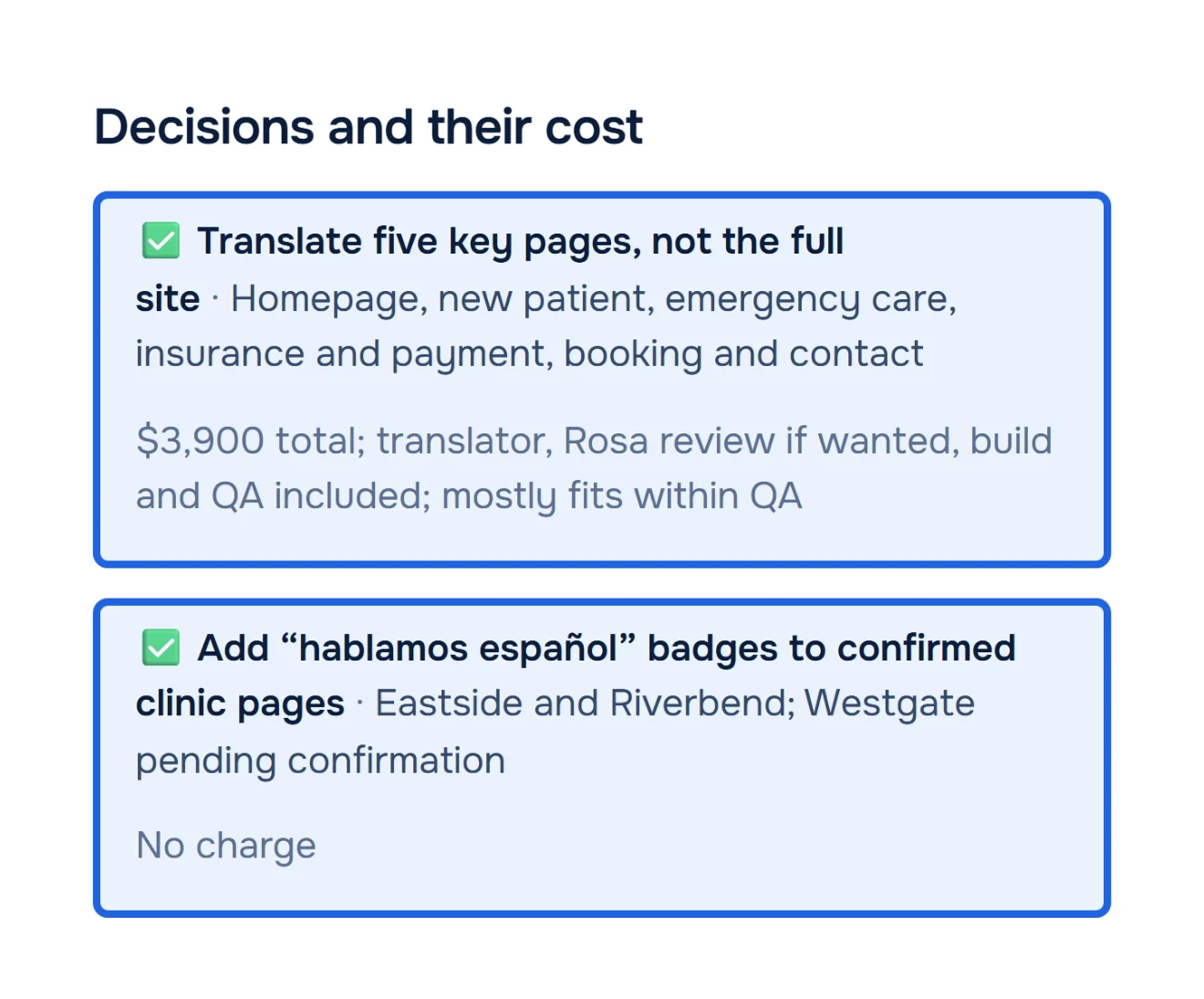
 Figure 1. Demo meeting, people are fictional. Call 1: the big ask carries a price, the small one says No charge. Source: demo client call, October 7 notes, October 2026.Analyzed with MeetWaveSee the full notesTry it on your next client call
The formula: the call where you price the big ask is the call where the small one slips through. "Tiny" and "throw that in" mean the price is missing, not small (Figure 1).
Call 2, October 14: "It's one page"
The marketing manager asks for a careers page with a resume upload (02:59). The developer sizes it on the call: "about a day. Eight hours or so" (03:25). The account director answers: "We'll fit it in, Megan, don't worry about it. It's one page" (03:51). Then the owner asks the agency to fix the Google listings of all six clinics, about three hours, and hears: "No need to put it on paper, it's small" (04:54) (demo notes, call 2).
After the client leaves, the project manager asks whether it goes on a change order. The answer at 06:33: the client signed $3,900 on Monday, "He'd feel nickel-and-dimed." So the team logs the work and does not bill it. The briefing adds the logged hours: 17 hours, about $2,550 (demo notes, call 2).
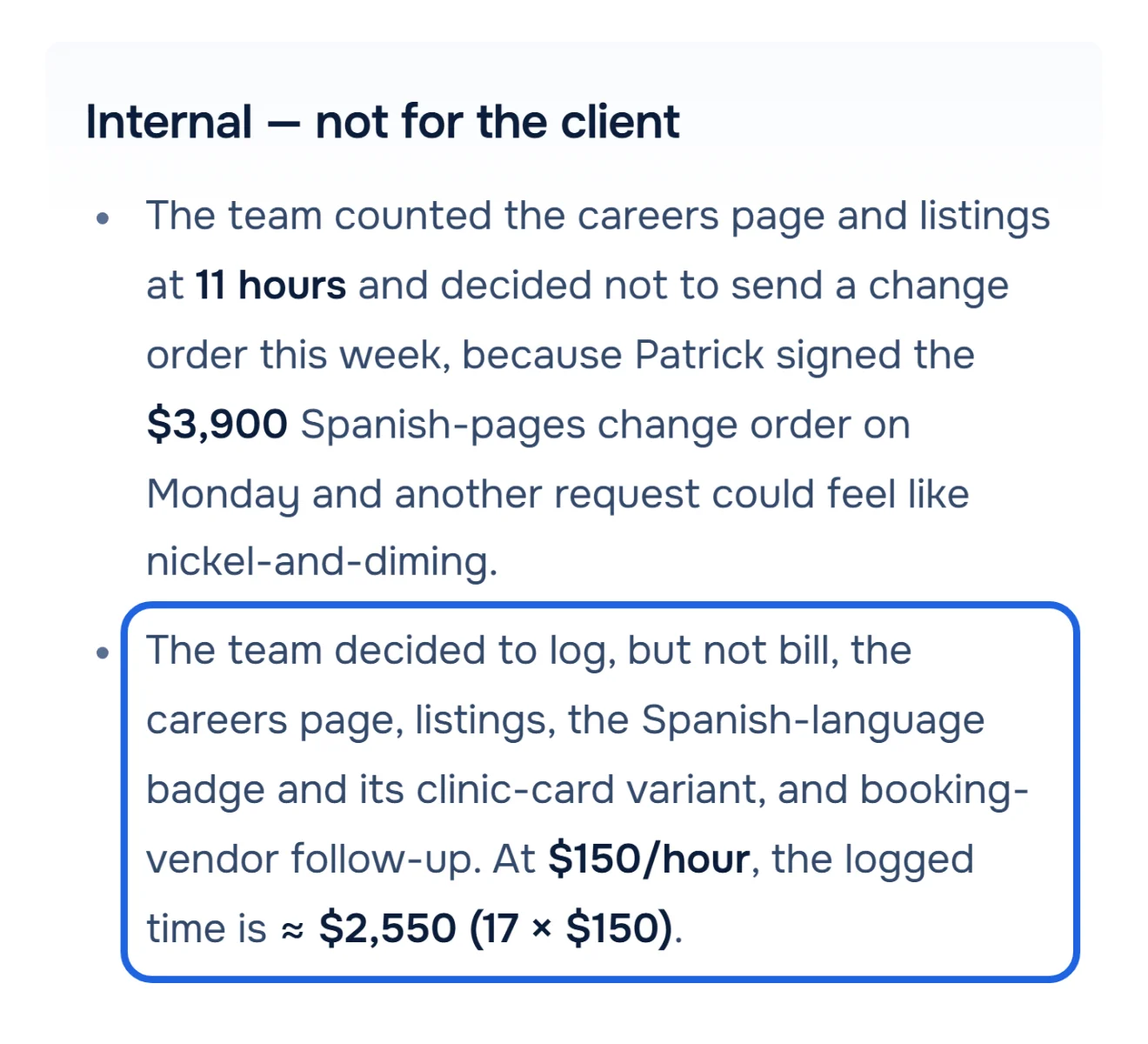
 Figure 2. Demo meeting, people are fictional. Call 2: what the team said after the client left, with the hours added up. Source: demo client call, October 14 notes, October 2026.Analyzed with MeetWaveSee the full notesTry it on your next client call
What to say at 03:51 instead, from the same call's facts: "Yes. It's about eight hours, so $1,200 at our rate. I'll send a one-line change request today, and if you approve it by Friday it ships with the launch." The reason not to bill ("we just sent one") is the reason the free work compounds (Figure 2).
Call 3, October 21: the signed change order grows
The front desks are nervous about online booking, so the client asks for a training session. The developer sizes it at three hours, and the account director says "Happy to include that" (02:21). Then the owner asks for the Eastside clinic page in Spanish too, about five hours: "Can't we just fold it into the Spanish set? I don't want my accountant reading another change order for one page" (03:39). At 03:52: "Okay, we'll fold it in. Six pages instead of five, same thirty-nine hundred" (demo notes, call 3).
After the client leaves, the project manager adds one more: two texts arrived as phone photos and took an intern four hours to type up, "I didn't say anything on the call" (05:55). The account director: "Okay, honestly, I've lost track" (06:09).
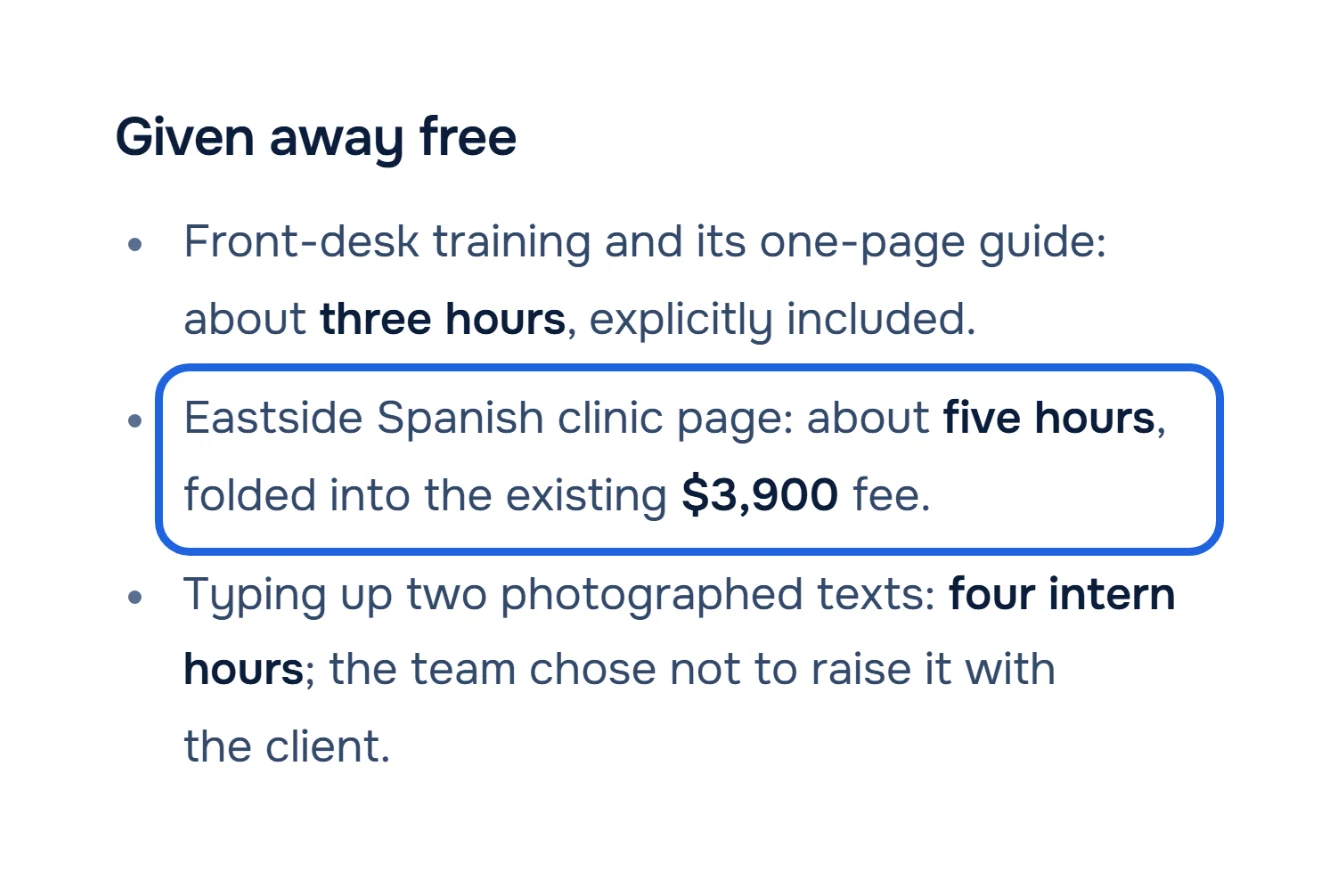
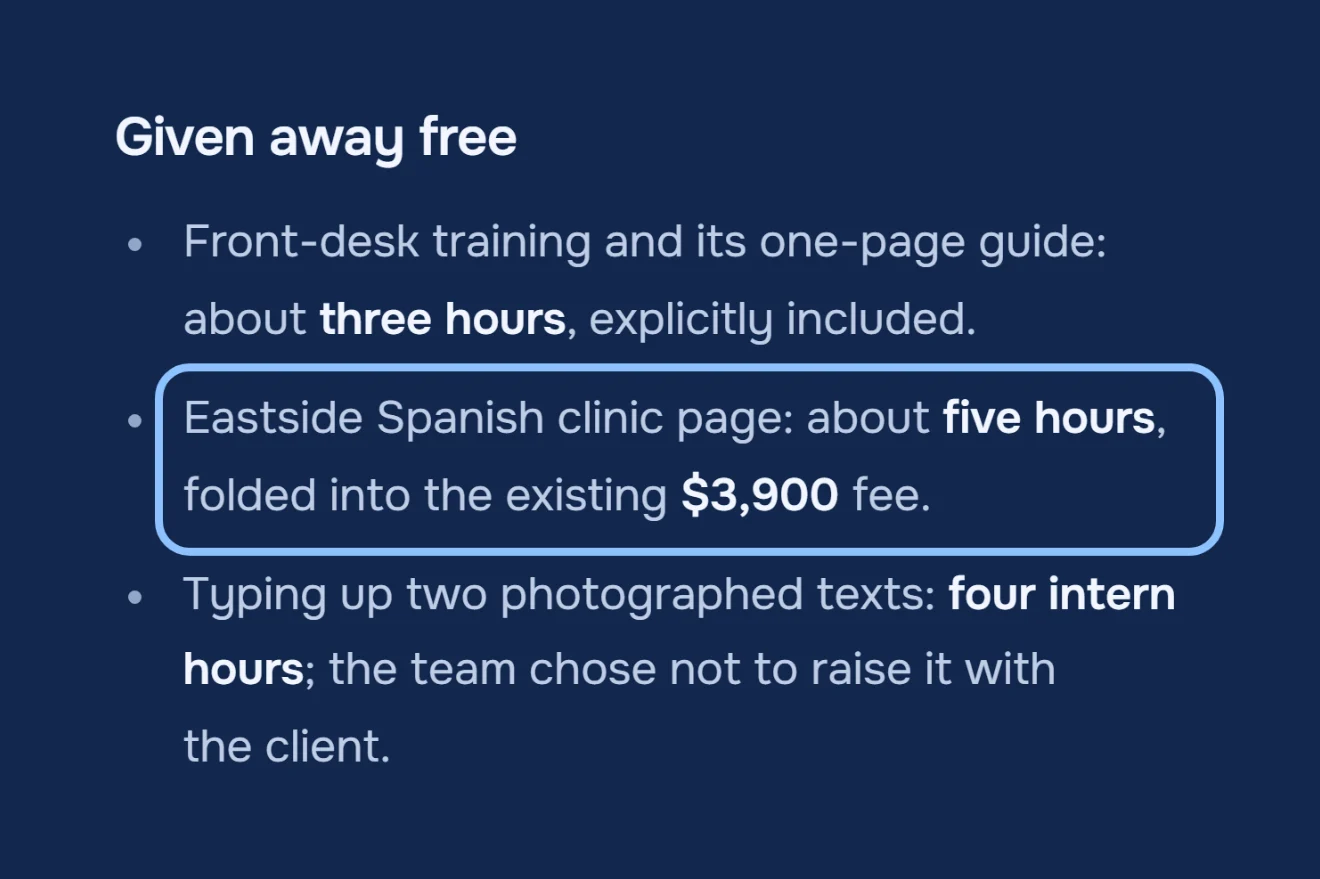 Figure 3. Demo meeting, people are fictional. Call 3: a signed change order takes one more page at the same price. Source: demo client call, October 21 notes, October 2026.Analyzed with MeetWaveSee the full notesTry it on your next client call
What to say at 03:52 instead: "Six pages is $750 more, five hours at our rate. Same document, one added line; I'll send it today." The call-3 notes carry the earlier items as context but do not add them up; the bill below does (how we calculated).
The bill: seven asks, 29 hours, $4,350
Fifty minutes of client calls produced 29 hours of unpriced work. At the team's own rate of $150 an hour, said on the calls, that is $4,350, more than the one change they priced at $3,900 (how we calculated).
| # | Ask | Call | Minute | Hours | At $150/h |
|---|---|---|---|---|---|
| 1 | "Hablamos español" badge on clinic pages | Oct 7 | 20:27 | 2 | $300 |
| 2 | Chasing the client's booking vendor for keys | Oct 7 | 34:09 | 4 | $600 |
| 3 | Careers page with resume upload | Oct 14 | 02:59 | 8 | $1,200 |
| 4 | Google listings for six clinics | Oct 14 | 04:20 | 3 | $450 |
| 5 | Front desk training and cheat sheet | Oct 21 | 01:44 | 3 | $450 |
| 6 | Eastside clinic page added to the Spanish set | Oct 21 | 02:54 | 5 | $750 |
| 7 | Typing up two texts sent as phone photos | Oct 21 | 05:55 | 4 | $600 |
| Total | 29 | $4,350 |
Source: demo client calls, hours as said on the calls; how we calculated.
Figure 4 shows the free work passing the priced change after the third call.
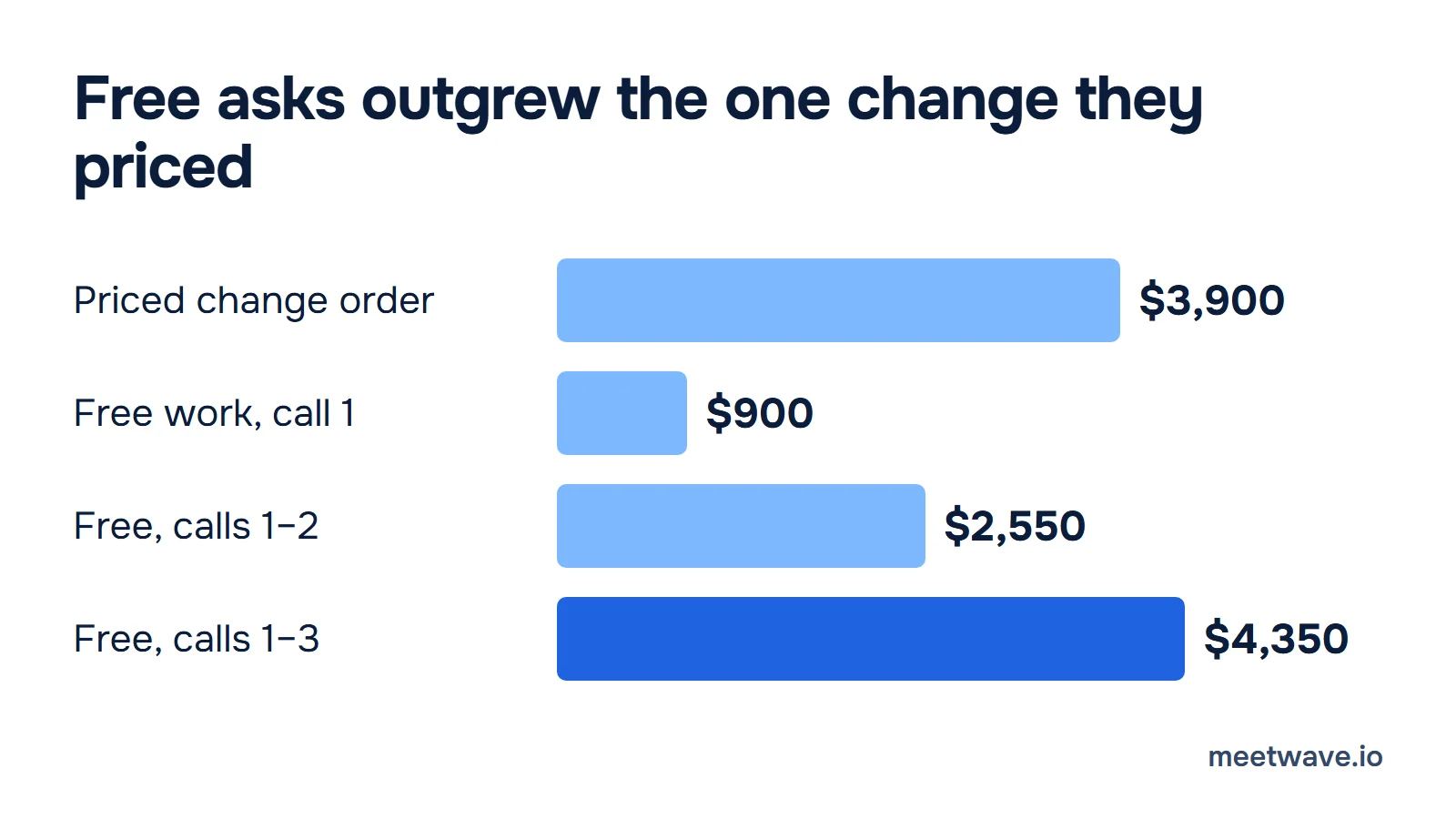
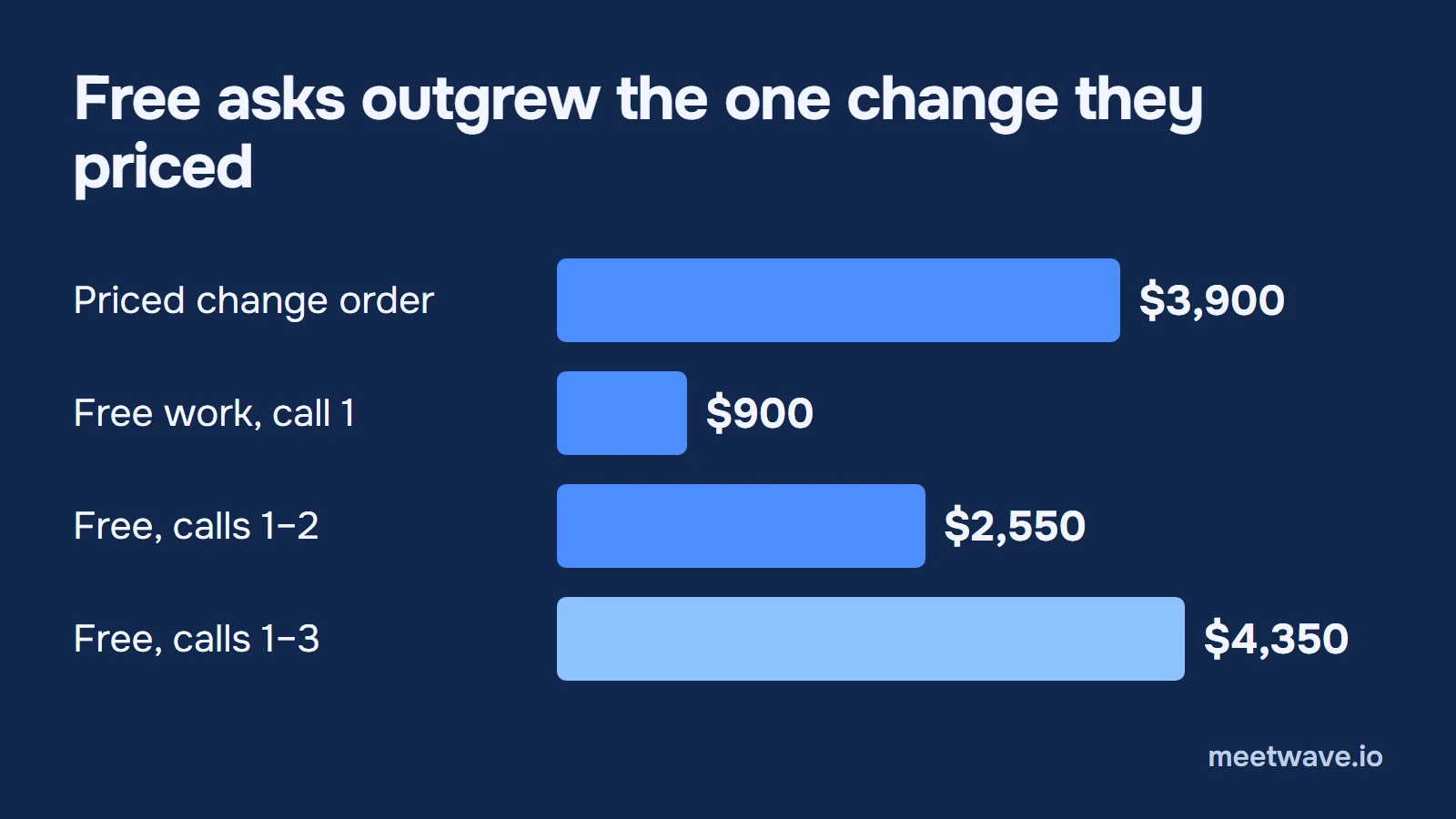 Figure 4. Unpriced asks in the fictional demo series, added up call by call, against the one change order the agency priced. Source: MeetWave demo client calls, hours as said, $150 an hour, October 2026.
Two of the seven were never said to the client at all: the vendor chasing and the typing. They show up only in what the team said after the client left the call (how we calculated).
What to say on the call
Saying yes is fine. Saying yes without a number is the leak. Each phrase below keeps the yes and adds the price, in the call, while both sides still remember the ask (Brown-Schmidt et al., 2023):
- "Yes, and here is what it changes: about eight hours, $1,200, no change to the date." (call 2, 03:25)
- "Happy to. Do you want it in this phase, or right after launch at the same rate?"
- "Let me price it and send it to you today. Nothing starts until you approve."
- "It's small to ask and real to build. I'd rather give you the number now than surprise you on the invoice."
- "We can include it if the whitening page moves to phase two. Which one matters more?"
The fifth one is a trade, not a charge. It keeps the client's budget and the agency's hours in balance, and it makes the cost visible either way (PMI, 2018).
Change request template
A change request is one page: what was asked, when, what it costs in hours, money and days, and by when the client decides. Here it is, filled from ask 6 of the bill (demo notes, call 3). Copy it and replace the brackets with yours.
CHANGE REQUEST CR-02 — Oakridge Dental website relaunch
Date: October 21, 2026   Requested by: Patrick Doyle (Owner)   Prepared by: Kwame Mensah (Project Manager)

The ask: Translate the Eastside clinic page into Spanish and add it to the Spanish page set (asked on the weekly call, October 21, at 02:54).

Not in the current scope: Change order CR-01 (signed October 12) covers five Spanish pages: homepage, new patient, emergency dental care, insurance and payment, booking and contact.

Effort: 5 hours (medical translation, build, QA).
Price: $750 (5 hours × $150). Same payment terms as the main contract.
Date impact: none. Launch stays December 4 if approved by Friday, October 23; later approval moves this page to after launch.

Decision: [ ] Approve   [ ] Decline   [ ] Move to after launch
Signed: ________________   Date: __________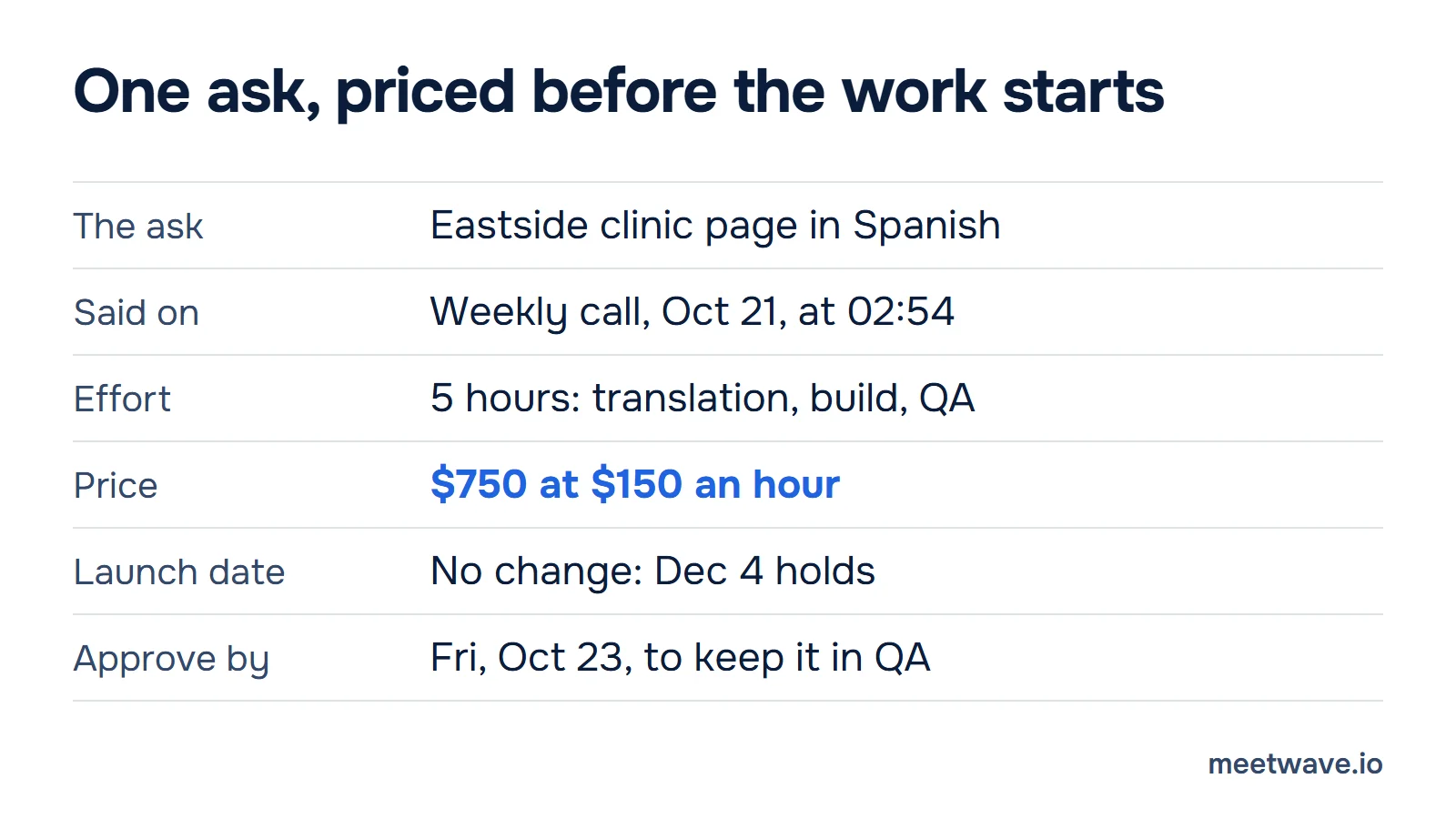
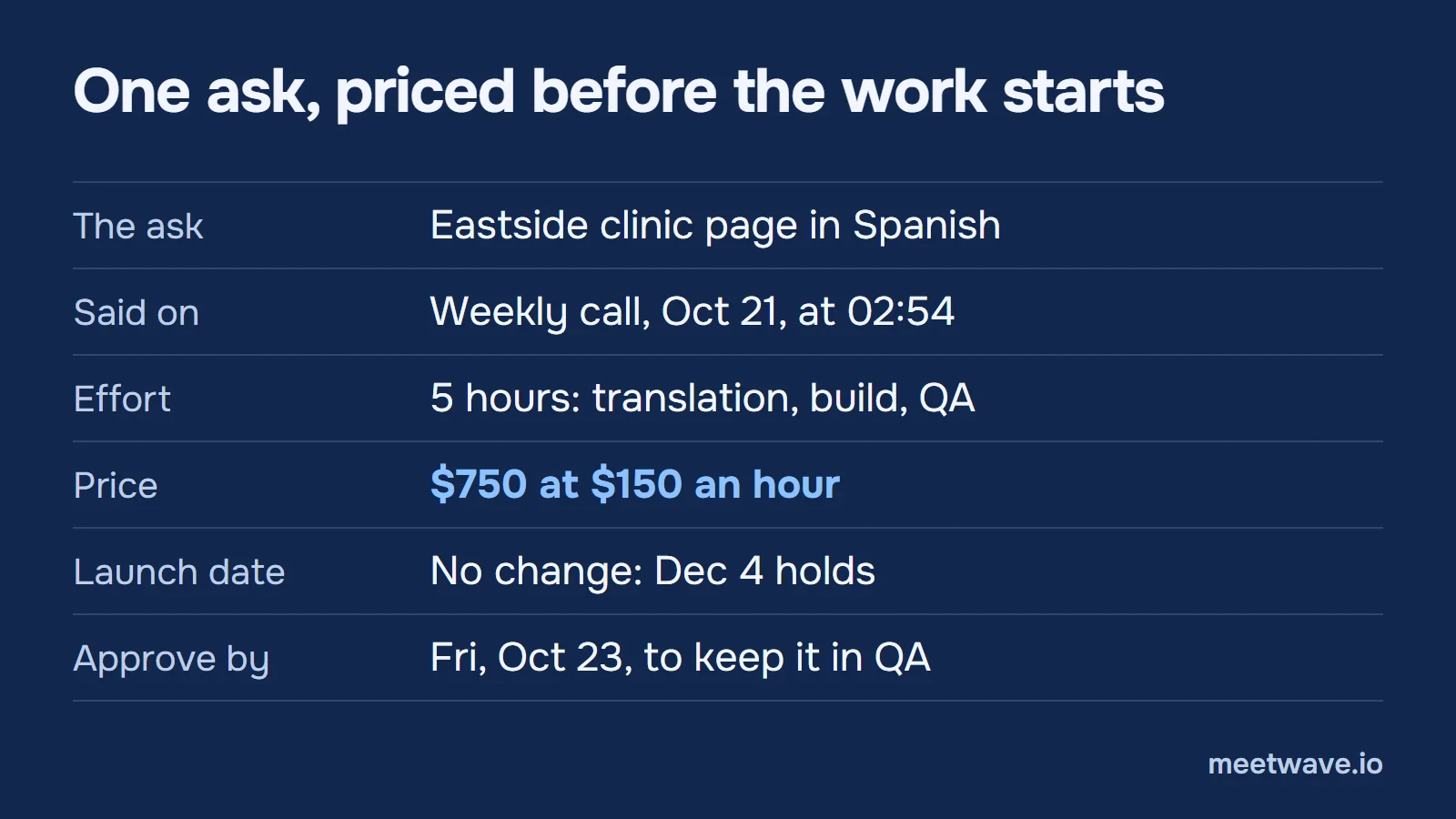 Figure 5. The change request above, as the client sees it. Source: MeetWave demo client call, October 21, 2026; the $150 rate as said on the call.
The recap email after the call
The recap goes out the same day and lists every ask with its status: priced, declined, or included on purpose. "Included at no charge" written down is a decision; "sure" on a call is a habit (Brown-Schmidt et al., 2023). For a recap from your own notes, the free follow-up email after a meeting generator writes the draft from your notes.
Subject: Oakridge website: what we agreed today (Oct 21) and two new asks

Hi Patrick, hi Megan,

Thanks for today. What we agreed:
- Launch stays December 4. All five texts are in; translation is about halfway.
- Front desk training: Thursday, October 29, before clinic hours, with a one-page cheat sheet. Included at no charge, as a launch courtesy.
- Megan sends the invite to the six front desk leads.

New ask, priced (needs your OK):
- Eastside clinic page in Spanish: 5 hours, $750. Change request CR-02 attached. Approve by Friday, October 23 to keep it in the launch.

Already in scope, for the record:
- The new patient checkbox label fix is QA, no change.

If anything here differs from what you heard, reply today and I'll correct it.

Kwame
How common scope creep is
Scope creep is the normal case, not the exception. In PMI's 2018 survey, 52% of projects completed in the prior 12 months had scope creep or uncontrolled changes to scope, up from 43% five years earlier (PMI, Pulse of the Profession 2018). The best-run organizations reported it on 33% of projects, the worst on 69%. The survey covered 4,455 project practitioners, 447 senior executives and 800 PMO directors across industries and regions; it is self-reported, and not agencies only.
For agencies, the only dollar figures come from a vendor. In a 2025 survey by Ignition, which sells billing software, 57% of 273 US agency managers and executives said they lose $1,000 to $5,000 a month to unbilled work, 30% said more than $5,000, and 78% said they rarely or only sometimes charge for out-of-scope work (Ignition, 2025). The report does not publish its method or question wording, so read these as one vendor's survey.
People who live it put it more plainly. A freelance developer wrote that one project "cost me roughly 6 extra weeks of work. Unpaid." (DEV Community). Another freelancer budgets "20% set aside for any changes or scope creep" in every quote (Hacker News, 2020).
Recording client calls: ask first
Tell the client you are recording and ask, at the start of every call, the way the demo calls open ("Recording as usual, is that okay with everybody?"). In California, recording a confidential communication requires "the consent of all parties" (Penal Code § 632), and other states have similar rules. Without a recording, the method still works: write each ask, its minute and its hours within an hour of the call, and send the recap the same day. This is not legal advice.
Key numbers
- 52% of projects completed in the prior 12 months had scope creep or uncontrolled scope changes in 2018, up from 43% five years earlier; 33% at the best-run organizations and 69% at the worst (PMI, Pulse of the Profession 2018).
- One week after a conversation, only 4.7% of its details were recalled by both people in a lab study of conversation pairs (Brown-Schmidt et al., Cognitive Science, 2023).
- 57% of 273 US agency managers and executives said they lose $1,000 to $5,000 a month to unbilled work, and 78% rarely or only sometimes charge for out-of-scope work, in a 2025 vendor survey (Ignition, 2025).
- In our three-call demo series (October 2026), seven unpriced asks added up to 29 hours, $4,350 at $150 an hour, more than the $3,900 change order the agency priced (how we calculated).
How we calculated
- The demo series is three fictional weekly client calls of 35, 8 and 7 minutes (October 7, 14 and 21, 2026), written for MeetWave's test set; the asks and their hours were written before the transcripts. Fernhill Digital, Oakridge Dental and everyone in them are invented (call 1 notes).
- The notes are MeetWave's Client Briefing, one run per call, the third with the first two as context, generated once each on November 9, 2026. Figures 1–3 and the linked notes (call 1, call 2, call 3) are those runs, unedited. Every ask in the bill appears in the notes of its call; the call-3 notes did not total the series, so the total is ours.
- Hours are the hours said on the calls: on the call for asks 3–6, after the client left for asks 1, 2 and 7 (the badge and the vendor chasing were logged on October 14, at 06:45). The rate, $150 an hour, is the team's, said on October 14 at 07:08 and October 21 at 06:34. Cost = hours × $150; 29 × $150 = $4,350. After call 1: 2 + 4 = 6 hours, $900; after call 2: 17 hours, $2,550 (call 2 notes).
- Minutes are the transcripts' timestamps,
[mm:ss]from the start of each call. Fifty minutes is 35 + 8 + 7, rounded call lengths. - The change request and recap email use only facts said on the October 21 call; the $750 is 5 hours × $150 (call 3 notes).
FAQ
What is scope creep?
Scope creep is work added to a project without a matching change in price, time or resources; PMI calls it "uncontrolled expansion" of scope (PMI, 2018). On client work it usually arrives as small asks on calls, each answered with "sure".
How do you prevent scope creep?
Catch each ask in the meeting, size it before the call ends, and confirm it in writing the same day with a price or an explicit "included at no charge". See what to say on the call and the change request template.
What goes in a change request template?
The ask, the call and minute it was made, why it is outside the current scope, the hours, the price, the effect on the date and a decision box with a deadline. A filled example is in the change request template above.
How do you say no to scope creep without losing the client?
Do not say no; say yes with a number. "Yes, and here is what it changes" keeps the relationship, and a trade ("we can include it if X moves to phase two") keeps the budget. In our demo, the asks that were priced on the spot never became free work (how we calculated).
Is all scope creep bad?
No. A small extra can be a deliberate gift to the client. It only stops being scope creep when it is written down as one, with its hours, so both sides know what was given (Figure 2).
Sources
- Project Management Institute — Pulse of the Profession 2018: Success in Disruptive Times (2018). Accessed 2026-11-09.
- Brown-Schmidt, S., Jaeger, C. B., Evans, M. J. & Benjamin, A. S. — MEMCONS: How Contemporaneous Note-Taking Shapes Memory for Conversation. Cognitive Science 47(4), e13271 (2023). Accessed 2026-11-09.
- Ignition — 2025 Agency Pricing and Cash Flow Report, announcement (2025). Accessed 2026-11-09.
- California Penal Code — § 632, Eavesdropping on or recording confidential communications. Accessed 2026-11-09.
- DEV Community — I did 2 months of work for a 2-week price. Accessed 2026-11-09.
- Hacker News — comment on quoting freelance projects (2020). Accessed 2026-11-09.
Still comparing tools?
See how MeetWave stacks up against the tools most teams evaluate alongside it.
- MeetWave vs Otter AISee how MeetWave compares to Otter AI for meeting intelligence
- MeetWave vs Fireflies.aiSee how MeetWave compares to Fireflies.ai for meeting intelligence
- MeetWave vs tl;dvSee how MeetWave compares to tl;dv for meeting intelligence
More on this: Meeting minutes template