
How Much Does a Meeting Cost in 2026?
How Much Does a Meeting Cost in 2026?
An hour-long meeting with five US professionals costs their employer about $394 in 2026. That is five people at $78.88 an hour, the average cost of a management or professional employee in US private industry, wages plus benefits, as measured in June 2026. Held every week, the same meeting costs $20,509 a year. A salary-only calculator reports $270.30 for that hour, because wages are only 68.5% of what an employer pays.
Key numbers
- US employers paid $78.88 per hour worked for a management, professional or related employee in private industry in June 2026 (BLS, Employer Costs for Employee Compensation).
- Wages and salaries were $54.06 of that hour, 68.5% of the total; benefits added $24.82, of which $7.37 was paid leave, in June 2026 (BLS, ECEC table 4).
- The mean annual wage across all US occupations was $69,770 in May 2025 (BLS, Occupational Employment and Wage Statistics).
- In the EU, hourly labour costs averaged €34.9 across the whole economy in 2025, and non-wage costs were 24.8% of that total (Eurostat, 31 March 2026).
- 57% of meetings are ad hoc calls with no calendar invite, and meetings after 8 pm were up 16% year over year, in Microsoft 365 telemetry through 15 February 2025 (Microsoft, Breaking down the infinite workday).
What one meeting costs
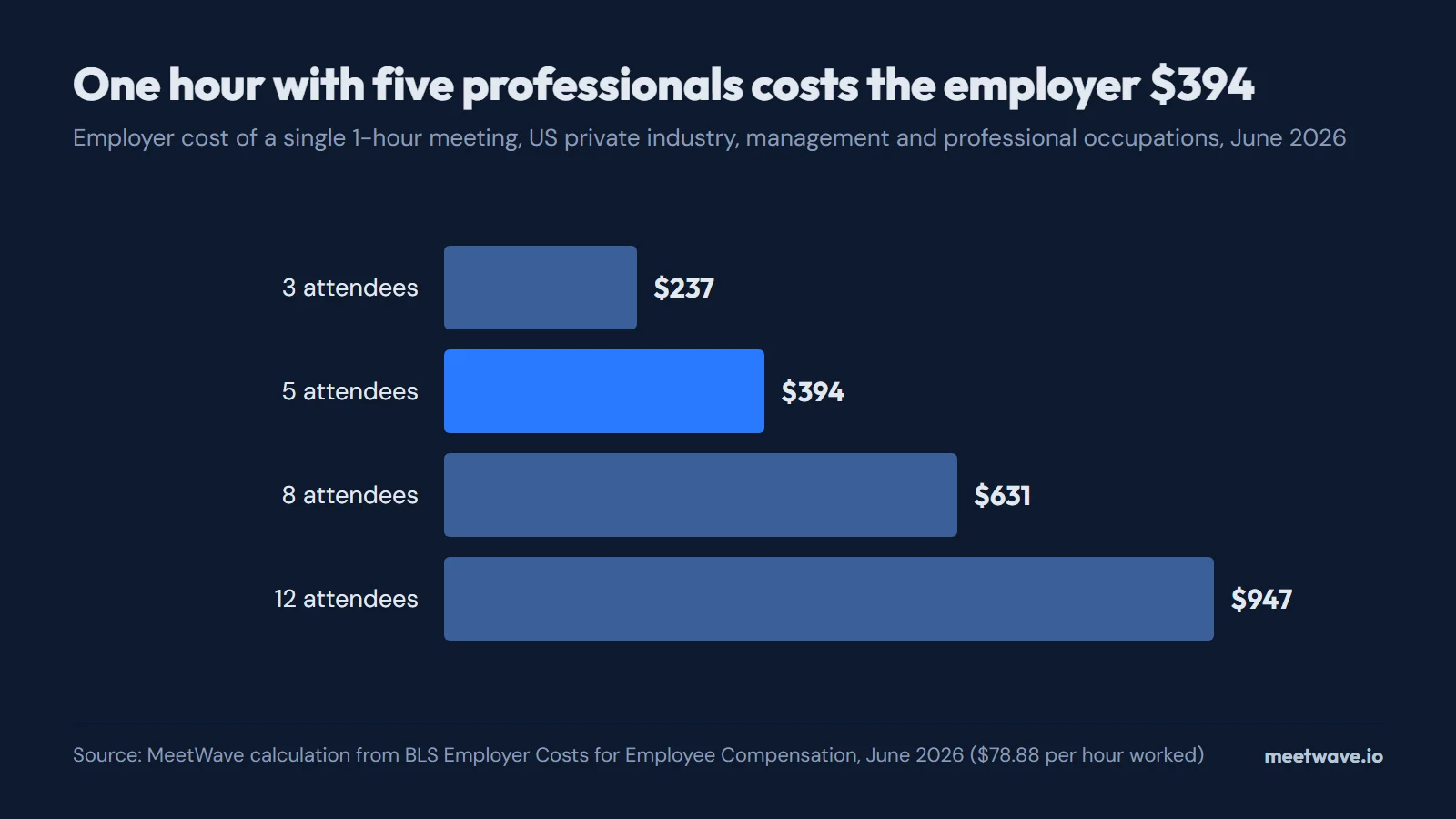
Multiply the people in the room by what an hour of their time costs their employer. The Bureau of Labor Statistics measures that hour directly: $78.88 for management, professional and related occupations in US private industry in June 2026, wages plus benefits (BLS). Five people for one hour is $394. Figure 1 runs the same arithmetic at four headcounts.
Figure 1. Employer cost of a single 1-hour meeting by headcount. Source: MeetWave calculation from BLS Employer Costs for Employee Compensation, June 2026.
Who sits in the room moves the number more than the agenda does. The same hour costs $394 with five professionals and $119 with five service workers, because the underlying rate differs by a factor of three (BLS).
| Occupational group, US private industry | Employer cost per hour worked | One hour, 5 attendees |
|---|---|---|
| Management, professional, and related | $78.88 | $394 |
| All private industry workers | $46.89 | $234 |
| Sales and office | $36.34 | $182 |
| Service | $23.73 | $119 |
Source: BLS, Employer Costs for Employee Compensation, June 2026.
An hour, by the size of the room
Headcount is the one input still open while the invite is being written. Each attendee adds $78.88 to the hour, and each repeat multiplies the whole row (BLS). The last column counts 261 working days a year.
| Attendees | One hour, once | Weekly, ×52 | Every workday, ×261 |
|---|---|---|---|
| 2 | $158 | $8,204 | $41,175 |
| 5 | $394 | $20,509 | $102,938 |
| 8 | $631 | $32,814 | $164,701 |
| 12 | $947 | $49,221 | $247,052 |
| 20 | $1,578 | $82,035 | $411,754 |
Source: calculated from BLS, Employer Costs for Employee Compensation, June 2026. Re-run a row: 2 attendees, 8 attendees, 20 attendees.
The salary is two thirds of the bill
A calculator that divides an annual salary by 2,080 hours returns the wage, not the cost. Wages and salaries were $54.06 of the $78.88 hour in June 2026, 68.5% of it; the remaining $24.82 was benefits (BLS). Five people for one hour on the wage line alone is $270.30, a quarter of a thousand dollars lower than the employer's actual outlay.
Paid leave is the part people forget. It cost $7.37 per hour worked for the same group, and it already sits inside that hour: the BLS spreads vacation and holidays over the hours employees actually work, so dividing a salary by 2,080 counts days nobody was at their desk (BLS). To convert a salary-based meeting cost into the employer's cost, multiply by 1.46.
What an hour of each role costs
Job title moves the number as far as headcount does. Each row below takes the BLS median annual wage for the occupation, divides it by 2,080 hours and prices one hour with five people of that kind. These are wages, so multiply by 1.46 for what the employer pays (BLS).
| Occupation, US median, May 2025 | Annual wage | Per hour | One hour, 5 attendees |
|---|---|---|---|
| Marketing managers | $166,790 | $80.19 | $401 |
| Software developers | $134,040 | $64.44 | $322 |
| Top executives | $108,780 | $52.30 | $261 |
| Project management specialists | $102,320 | $49.19 | $246 |
| Accountants and auditors | $83,680 | $40.23 | $201 |
| Sales representatives, wholesale and manufacturing | $76,460 | $36.76 | $184 |
| Human resources specialists | $75,940 | $36.51 | $183 |
| Graphic designers | $62,960 | $30.27 | $151 |
Source: BLS Occupational Outlook Handbook, 2025 median pay — marketing managers, software developers, top executives, project management specialists, accountants and auditors, sales representatives, human resources specialists, graphic designers.
The spread between the top and the bottom row is 2.6-fold. A review hour with five graphic designers costs $151; the same hour with five marketing managers costs $401 (BLS Occupational Outlook Handbook).
A recurring meeting is a subscription
A weekly meeting is not one $394 decision. It is 52 of them, signed once. At the June 2026 rate, one recurring hour with five people costs $20,509 a year; drop two attendees and it costs $12,305 (BLS). Figure 2 compares the frequencies.
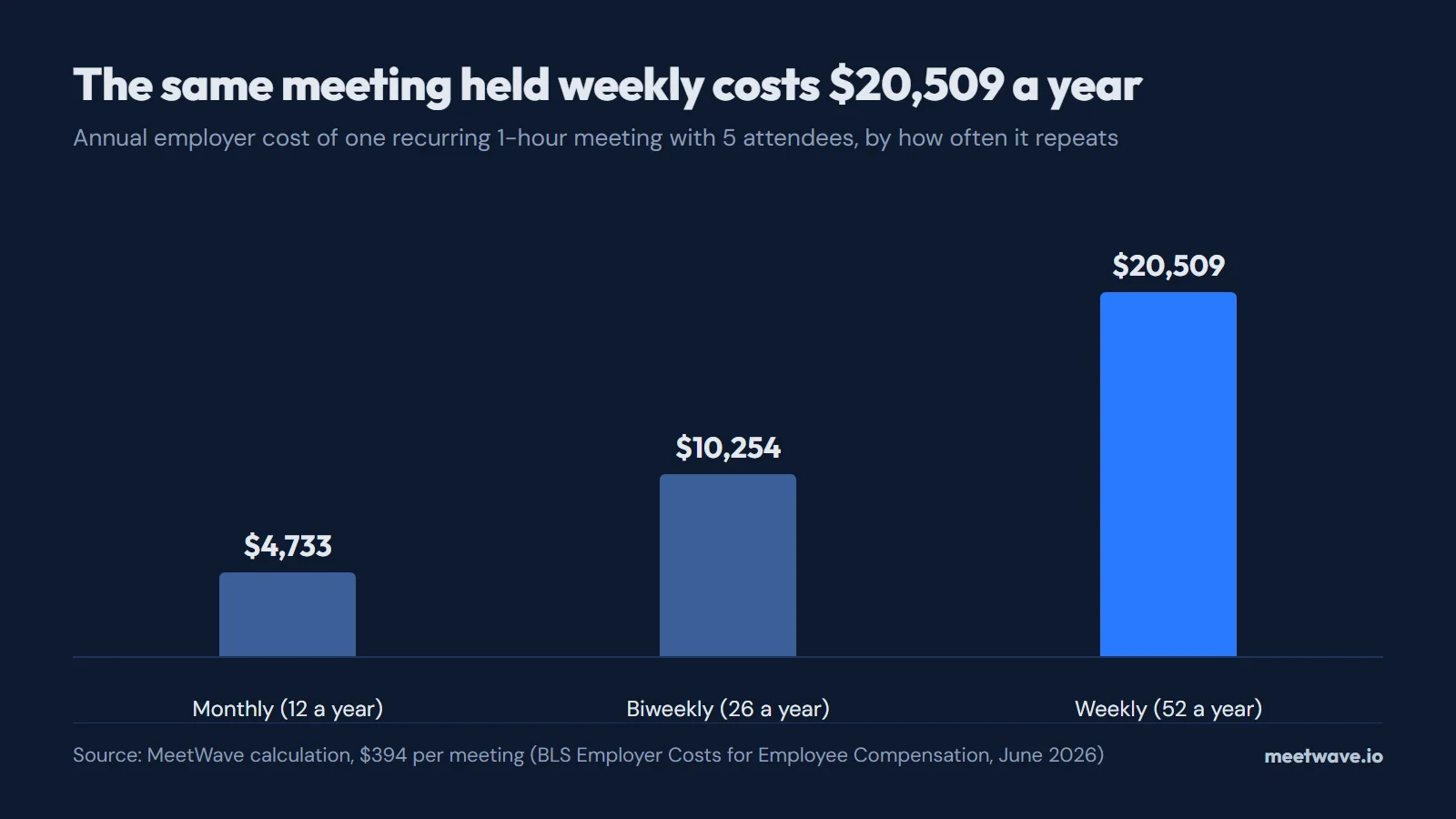 Figure 2. Annual employer cost of one recurring 1-hour meeting with 5 attendees. Source: MeetWave calculation from BLS Employer Costs for Employee Compensation, June 2026.
Short and frequent beats long and rare only until you multiply. A daily 30-minute standup with eight engineers runs 261 times a year and costs $82,351, four times the weekly hour (BLS).
Three standing meetings, priced
Most calendars carry the same three shapes. At $78.88 an hour worked they cost this much a year (BLS).
| Standing meeting | Per occurrence | Times a year | Per year |
|---|---|---|---|
| Weekly 1-hour status, 8 people | $631 | 52 | $32,814 |
| Daily 30-minute standup, 6 people | $237 | 261 | $61,763 |
| Monthly 1-hour board review, 12 people | $947 | 12 | $11,359 |
Source: calculated from BLS, Employer Costs for Employee Compensation, June 2026. Open a row: weekly status, daily standup, monthly board review.
The shortest meeting on the list is the most expensive one. Half an hour with six people costs $237 against the status meeting's $631, and $61,763 a year against its $32,814, because it happens five times as often (BLS).
Europe starts from €34.9 an hour
The method travels; the input changes. Eurostat puts average hourly labour costs for the whole economy at €34.9 in the EU and €38.2 in the euro area in 2025, with non-wage costs at 24.8% of the EU figure (Eurostat, 31 March 2026). Five people for an hour is therefore about €175 at the EU average.
That average covers every occupation and every member state, from €12.0 an hour in Bulgaria to €56.8 in Luxembourg (Eurostat). A meeting of senior engineers in Amsterdam and one of support agents in Sofia are not the same meeting, and the spread between them is wider than any agenda change.
The meetings your calendar cannot show you
An audit of recurring invites misses most of the load. In Microsoft 365 telemetry through 15 February 2025, 57% of meetings were ad hoc calls placed without a calendar invite, and meetings after 8 pm had risen 16% year over year (Microsoft, 2025). The same dataset counts an interruption — a call, a message, a notification — every two minutes of the working day.
Price those calls at the same rate. Three people pulled into an unplanned 20-minute call cost exactly one person-hour, $78.88, and nothing in the calendar records that it happened (BLS).
Work out your own number
The arithmetic is short enough to do in your head, but MeetWave's free meeting cost calculator keeps the inputs and the per-year multiplier in one place: attendees, average salary, duration, frequency. It reports the cost per meeting, per minute, per attendee and per year.
To make it report the employer's cost rather than the wage, enter the hourly compensation figure multiplied by 2,080 working hours: $78.88 × 2,080 = $164,070.40, entered as $164,070 because the salary field takes whole dollars (BLS). Figure 3 shows what comes back for five attendees and a weekly hour.
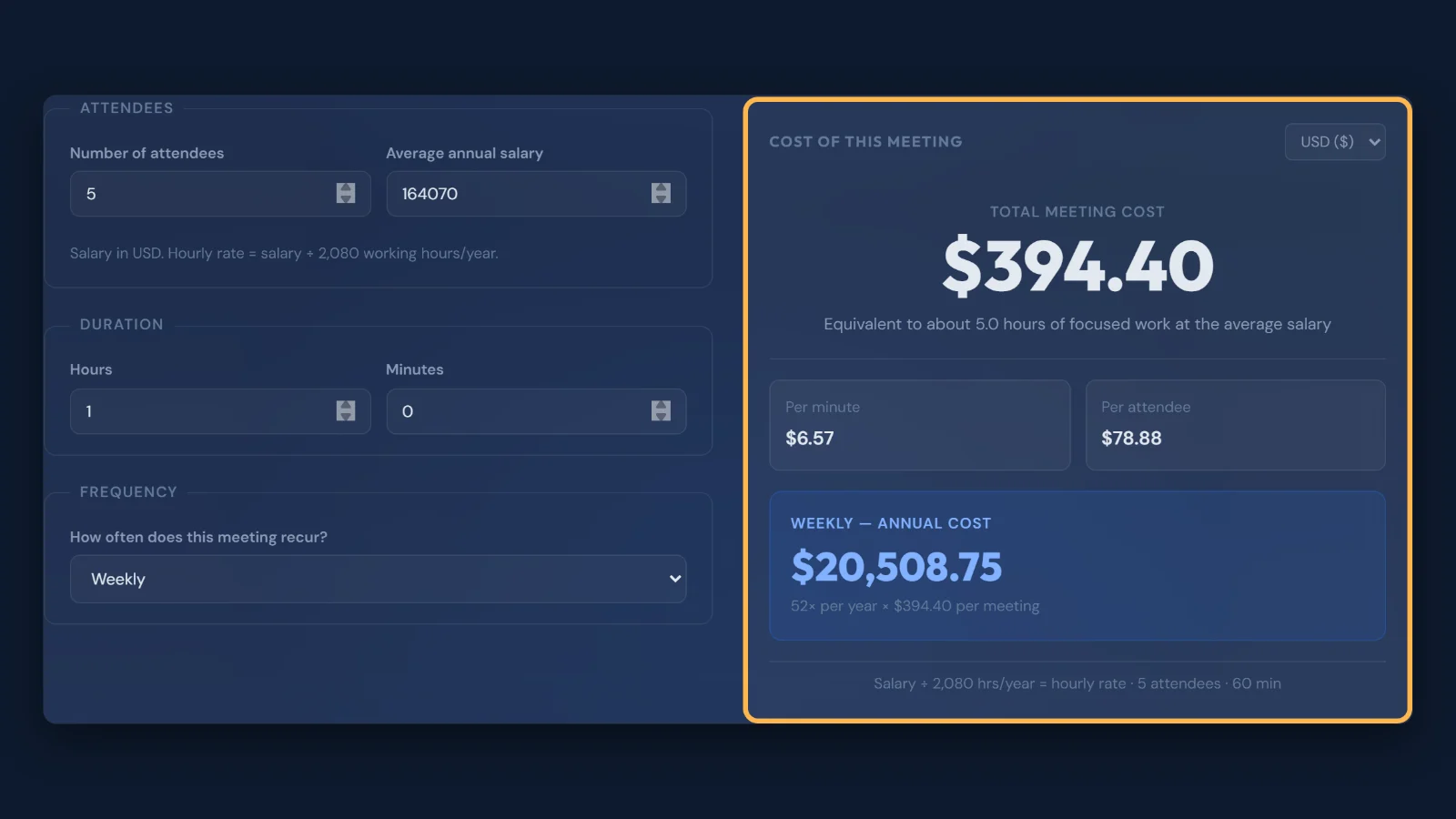 Figure 3. Five attendees, a $164,070 compensation-equivalent salary and a weekly hour return $394.40 per meeting. Source: meetwave.io/tools/meeting-cost-calculator, September 2026.
How we calculated
Method. Hourly rate = annual wage ÷ 2,080 hours (52 weeks × 40 hours); the employer-cost rate is published per hour worked and needs no division. Meeting cost = attendees × hourly rate × duration, then × occurrences a year. Wage data: BLS Employer Costs for Employee Compensation, June 2026 and Occupational Outlook Handbook 2025 medians, United States. Last recomputed: 2026-09-23.
Inputs in full: $78.88 per hour worked for management, professional and related occupations in US private industry, June 2026 (BLS); 12 occurrences a year for monthly, 26 for biweekly, 52 for weekly and 261 for daily, the same multipliers the calculator uses. Figures are rounded to whole dollars. The calculator's salary field takes whole dollars, so it runs $164,070 rather than $164,070.40 — 0.02 cents an hour low, which is invisible in a single meeting and reaches one dollar only in the largest yearly cell, 20 attendees every workday. The page is recomputed once a year, when BLS publishes the next release.
One divisor is worth stating. The wage route divides by 2,080 hours, while US federal payroll divides by 2,087, the average number of work hours in a calendar year across its 28-year cycle (OPM).
What this does not include
Four costs sit outside every number on this page. Office space, licences and equipment are paid whether the meeting happens or not, and the compensation series does not carry them (BLS). Preparation and follow-up are billed to other hours. The output lost during the call is on top, because these are payroll figures: the hour is paid either way.
The fourth is the interruption around the meeting, and it is the hardest to price. Microsoft 365 telemetry through 15 February 2025 counts an interruption every two minutes of the working day, and a call dropped into the middle of an afternoon is one of them (Microsoft, 2025). Every figure above is a floor, not an estimate of the total damage.
FAQ
How much does a 30-minute meeting with eight people cost?
$316 at June 2026 US rates: 8 × $78.88 × 0.5 (BLS). Run every workday, that standup costs $82,351 a year.
Should I use salary or total compensation?
Total compensation, if the question is what the meeting costs the employer. Wages were 68.5% of compensation in US private industry in June 2026 (BLS), so a salary-only figure understates the bill by about a third.
How do I calculate a meeting cost in euros?
Multiply attendees by the hourly labour cost. The EU whole-economy average was €34.9 in 2025, which puts an hour with five people near €175 (Eurostat). Use a national figure where you can; the country spread is four-fold.
Does the number include the work that did not get done?
No. These are payroll figures: the hour is paid whether or not the meeting happens, so the output lost during it is on top. Treat the result as a lower bound, not an estimate of total damage.
Why 2,080 hours and not 2,087?
2,080 is 52 weeks × 40 hours, and it is what most calculators use, including ours. US federal payroll uses 2,087, the 28-year average of work hours per calendar year (OPM). The choice moves an hourly rate by 0.3%.
Sources
- U.S. Bureau of Labor Statistics — Employer Costs for Employee Compensation, June 2026, table 4 (2026). Accessed 2026-09-22.
- U.S. Bureau of Labor Statistics — Occupational Employment and Wage Statistics, May 2025 (2026). Accessed 2026-09-22.
- Eurostat — EU hourly labour costs ranged from €12 to €57 in 2025 (2026). Accessed 2026-09-22.
- Microsoft — Breaking down the infinite workday (2025). Accessed 2026-09-22.
- U.S. Office of Personnel Management — Computing hourly rates of pay using the 2,087-hour divisor, per 5 U.S.C. 5504(b) as amended in 1986. Accessed 2026-09-22.
- U.S. Bureau of Labor Statistics — Occupational Outlook Handbook, 2025 median pay by occupation (2026). Accessed 2026-09-23.
Ready to try AI meeting summaries?
Try MeetWave free — no credit card required.
Still comparing tools?
See how MeetWave stacks up against the tools most teams evaluate alongside it.
- MeetWave vs KrispSee how MeetWave compares to Krisp for meeting notes
- MeetWave vs JamieSee how MeetWave compares to Jamie AI for bot-free meeting notes
- MeetWave vs Otter AISee how MeetWave compares to Otter AI for meeting intelligence