
How Many Working Hours Do Two Time Zones Share? 30 City Pairs in 2026
Six of 30 common distributed-team city pairs share no working hour at all in 2026, counting a 9:00–18:00 day in each city: San Francisco and Bangalore, New York and Singapore, London and Sydney among them. The median pair shares 2 hours. For 22 of the 30 pairs the number changes during the year. New York and London share 4 hours, and 5 hours for 28 days in March and October 2026, when the US has changed its clocks and Europe has not.
Key numbers
- 6 of 30 common city pairs share no 9:00–18:00 working hour on any day of 2026, and the median pair shares 2 hours (MeetWave calculation, IANA tzdata 2026a).
- New York and London share 4 working hours for 337 days of 2026 and 5 hours for 28 days, 8–28 March and 25–31 October, because US clocks change on the second Sunday of March and the first Sunday of November (15 U.S.C. § 260a) and UK clocks on 29 March and 25 October 2026 (GOV.UK).
- San Francisco and Sydney share 4 hours in January 2026 and 2 hours in July, with 3 hours for 56 days in between, because Sydney's daylight saving ends on 5 April 2026 (IANA tzdata) and starts again on 4 October 2026 (NSW Government).
- A one-hour increase in time-zone distance cut synchronous communication by 11.0% among 12,038 employees of a Fortune 100 firm in 2017 (Chauvin, Choudhury and Fang, Organization Science, 2024).
- 30% of meetings in Microsoft 365 spanned multiple time zones by February 2025, up 8 percentage points since 2021 (Microsoft Work Trend Index, 2025).
Working-hours overlap for 30 city pairs in 2026
The table counts the hours when both cities are inside a 9:00–18:00 local day. January and July stand for the two halves of the year; the fourth column lists every other value 2026 produces. "Next day" means the shared hour falls on the following calendar day in the second city. For 22 of the 30 pairs the number changes at least once during 2026 (MeetWave calculation).
| Pair | Jan, h | Jul, h | Other values in 2026 | Planner |
|---|---|---|---|---|
| San Francisco – New York | 6 | 6 | — | open |
| San Francisco – London | 1 | 1 | 2 h: 8–28 Mar, 25–31 Oct | open |
| San Francisco – Berlin | 0 | 0 | 1 h: 8–28 Mar, 25–31 Oct | open |
| San Francisco – Kyiv | 0 | 0 | — | open |
| San Francisco – Bangalore | 0 | 0 | — | open |
| San Francisco – Manila | 1 (next day) | 0 | — | open |
| San Francisco – Singapore | 1 (next day) | 0 | — | open |
| San Francisco – Tokyo | 2 (next day) | 1 (next day) | — | open |
| San Francisco – Sydney | 4 (next day) | 2 (next day) | 3 h: 8 Mar–3 Apr, 3–31 Oct | open |
| New York – London | 4 | 4 | 5 h: 8–28 Mar, 25–31 Oct | open |
| New York – Berlin | 3 | 3 | 4 h: 8–28 Mar, 25–31 Oct | open |
| New York – Kyiv | 2 | 2 | 3 h: 8–28 Mar, 25–31 Oct | open |
| New York – Tel Aviv | 2 | 2 | 3 h: 8–26 Mar, 25–31 Oct | open |
| New York – Bangalore | 0 | 0 | — | open |
| New York – Manila | 0 | 0 | — | open |
| New York – Singapore | 0 | 0 | — | open |
| New York – Sydney | 1 (next day) | 0 | — | open |
| New York – São Paulo | 7 | 8 | — | open |
| New York – Mexico City | 8 | 7 | — | open |
| London – Berlin | 8 | 8 | — | open |
| London – Dubai | 5 | 6 | — | open |
| London – Bangalore | 3.5 | 4.5 | — | open |
| London – Singapore | 1 | 2 | — | open |
| London – Sydney | 0 | 0 | — | open |
| London – Lagos | 8 | 9 | — | open |
| Berlin – Bangalore | 4.5 | 5.5 | — | open |
| Berlin – Singapore | 2 | 3 | — | open |
| Berlin – São Paulo | 5 | 4 | — | open |
| Bangalore – Sydney | 3.5 | 4.5 | — | open |
| Singapore – Sydney | 6 | 7 | — | open |
Source: MeetWave calculation, IANA tzdata 2026a.
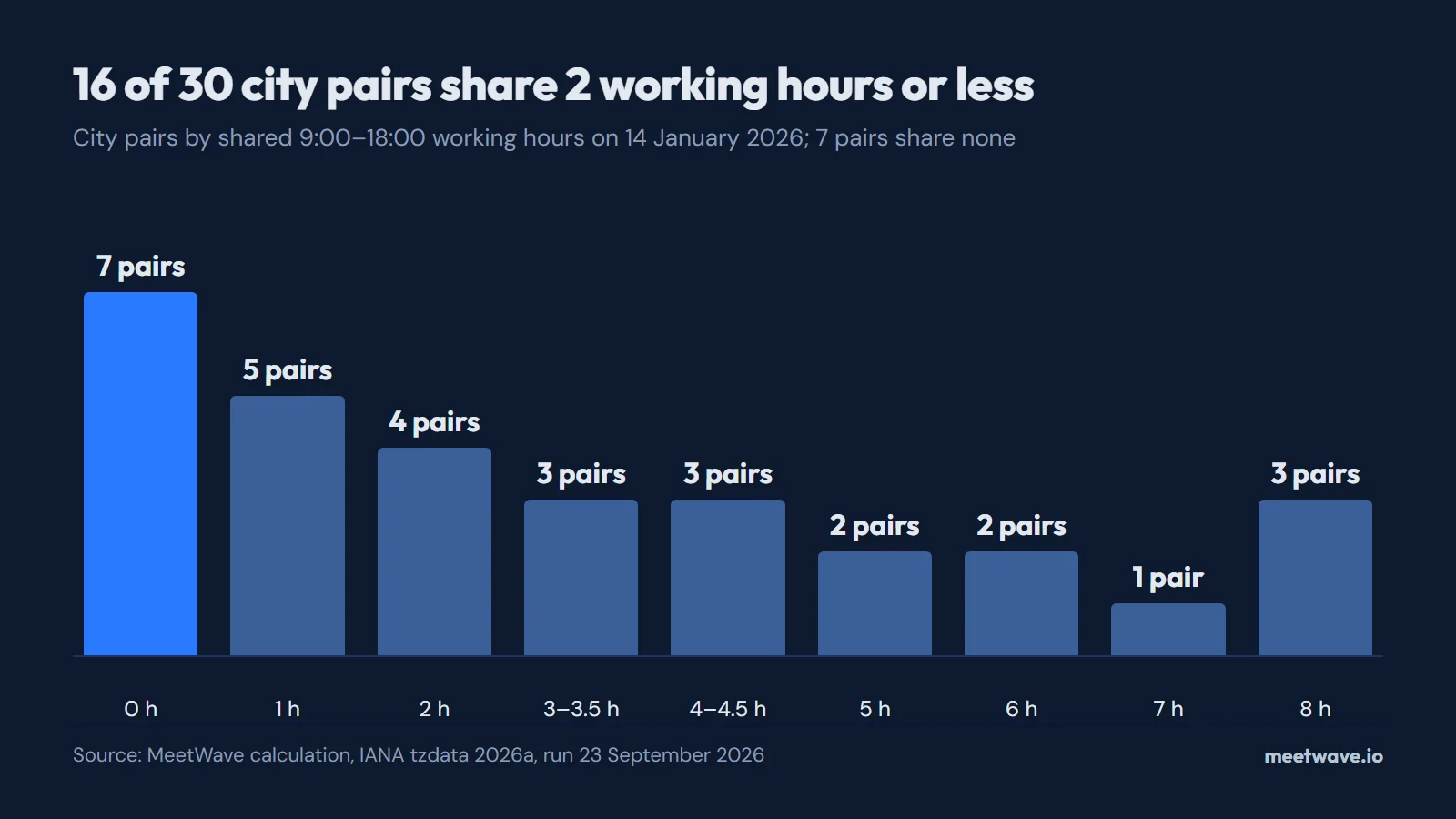
Where January and July differ and the fourth column is empty, the number switches on the clock-change dates below: 8 March and 1 November for pairs with a US city, 29 March and 25 October for Europe, 5 April and 4 October for Sydney (MeetWave calculation). On 14 January, 16 of the 30 pairs share 2 hours or less and 7 share none, as Figure 1 shows (method).
Figure 1. Shared 9:00–18:00 working hours per city pair, 14 January 2026. Source: MeetWave calculation, IANA tzdata 2026a.
Six pairs never meet inside working hours
Six pairs share no working hour on any day of 2026: San Francisco–Kyiv, San Francisco–Bangalore, New York–Bangalore, New York–Manila, New York–Singapore and London–Sydney (MeetWave calculation). For them there is no slot to find, only a least-bad one.
| Pair | Least-bad slot, January 2026 | Least-bad slot, July 2026 |
|---|---|---|
| San Francisco – Kyiv | 9:00 San Francisco = 19:00 Kyiv | 9:00 San Francisco = 19:00 Kyiv |
| San Francisco – Bangalore | 9:00 San Francisco = 22:30 Bangalore | 9:00 San Francisco = 21:30 Bangalore |
| New York – Bangalore | 8:30 New York = 19:00 Bangalore | 8:30 New York = 18:00 Bangalore |
| New York – Manila | 9:00 New York = 22:00 Manila | 9:00 New York = 21:00 Manila |
| New York – Singapore | 9:00 New York = 22:00 Singapore | 9:00 New York = 21:00 Singapore |
| London – Sydney | 9:00 London = 20:00 Sydney | 9:00 London = 18:00 Sydney |
Source: MeetWave calculation, IANA tzdata 2026a.
At zero overlap one side always works late or early, so what works is rotating the bad hour between the two sides and moving status updates to an asynchronous handoff. New York and Bangalore come closest: 8:30 in New York is 18:00 in Bangalore from 8 March to 31 October 2026 and 19:00 the rest of the year (MeetWave calculation). The side that sleeps through the call still needs what was said; a recording with a summary and action items, which MeetWave produces without a bot joining the call, covers that side.
Five pairs overlap on different calendar days
San Francisco with Manila, Singapore, Tokyo and Sydney, and New York with Sydney, share their hour across midnight: the second city is already on the next calendar day (MeetWave calculation). Friday 15:00 in San Francisco is Saturday 10:00 in Sydney, so these pairs have four shared working days a week, not five. The table and the planner ignore weekdays, so check Mondays and Fridays by hand.
The 2026 clock changes that move the numbers
Seven of the 15 cities change their clocks in 2026, and each change moves every pair that includes the city by one hour for part of the year (MeetWave calculation). Each date below was checked against its rule.
| City | Clocks forward | Clocks back | Offset from UTC | Rule |
|---|---|---|---|---|
| San Francisco, New York | 8 March | 1 November | −8/−7, −5/−4 | 15 U.S.C. § 260a |
| London | 29 March | 25 October | 0/+1 | GOV.UK |
| Berlin, Kyiv | 29 March | 25 October | +1/+2, +2/+3 | EU rule in IANA tzdb |
| Tel Aviv | 27 March | 25 October | +2/+3 | Israeli rule in IANA tzdb |
| Sydney | 4 October | 5 April | +10/+11 | NSW Government, IANA tzdb |
| Mexico City, São Paulo, Lagos, Dubai, Bangalore, Manila, Singapore, Tokyo | — | — | no change in 2026 | MeetWave calculation |
Source: rules linked in each row; dates found by MeetWave calculation, IANA tzdata 2026a.
The US moves three weeks before Europe in spring and one week after it in autumn, and Figure 2 shows what that does to one pair (15 U.S.C. § 260a, GOV.UK).
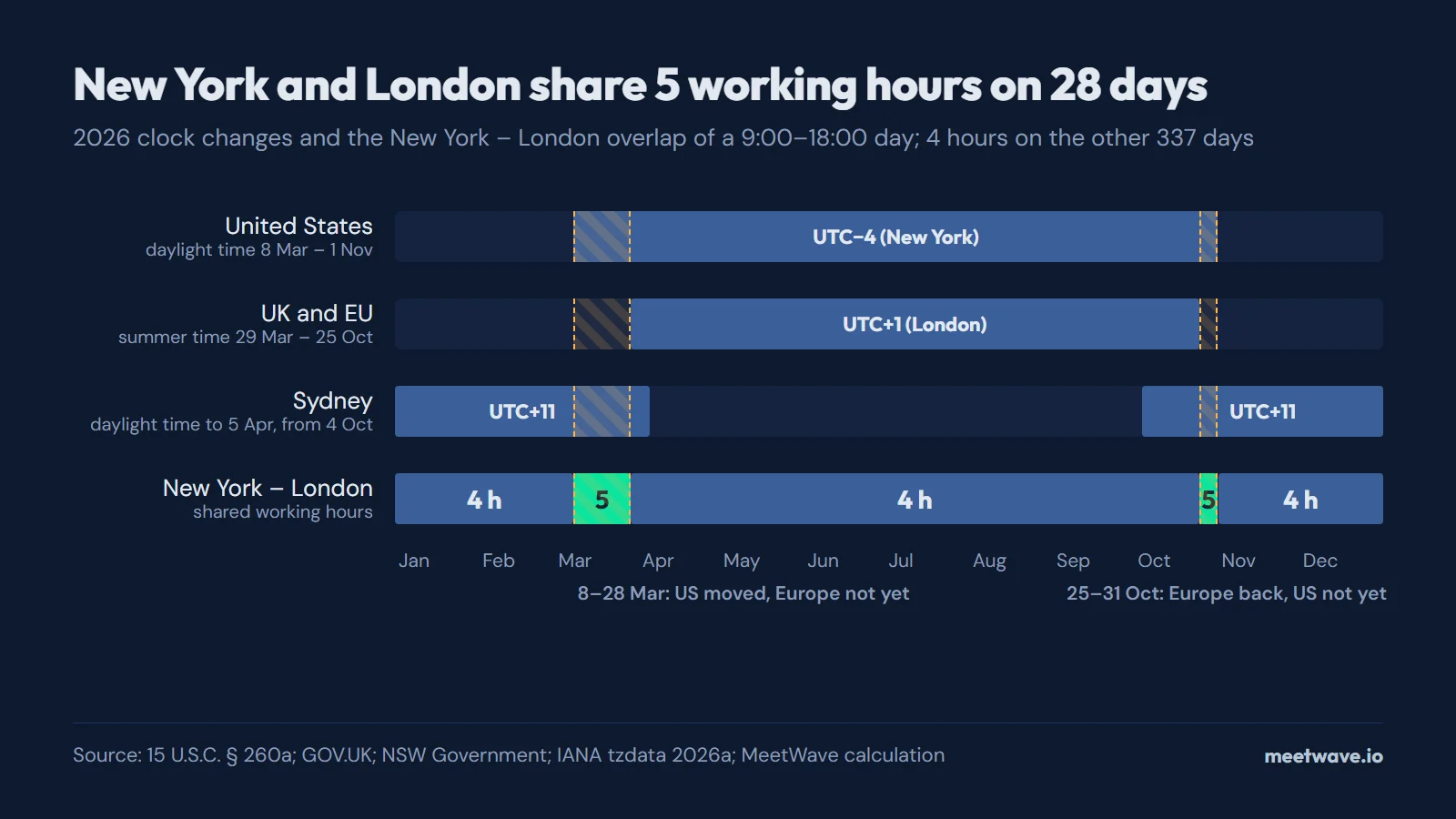 Figure 2. 2026 clock changes and the New York–London working-hours overlap. Source: 15 U.S.C. § 260a; GOV.UK; NSW Government; IANA tzdata 2026a.
US and Europe: 28 days with one more shared hour
From 8 to 28 March and from 25 to 31 October 2026, the gap between New York and London shrinks from 5 hours to 4, and the shared working time grows from 4 hours to 5 (MeetWave calculation). Every US–Europe pair moves the same way: New York and Berlin go from 3 hours to 4, San Francisco and Berlin from none to 1. A recurring meeting fixed to New York time arrives in London one hour earlier on those 28 days. Tel Aviv differs: Israel moves on the Friday before the last Sunday of March, 27 March 2026, so its window with New York is 26 days (IANA tzdb).
Sydney pairs move three times a year
Sydney changes its clocks in the opposite season, so a pair of Sydney and a US city passes through three values: San Francisco and Sydney share 4 hours until 7 March, 3 hours until 3 April, 2 hours until 2 October, 3 hours until 31 October and 4 hours after that (MeetWave calculation). London and Sydney share nothing all year, while Singapore and Sydney share 6 hours in the southern summer and 7 in the southern winter.
India's half hour
India does not change its clocks, and its UTC+5:30 offset leaves a half hour in every pair with a whole-hour zone (IANA tzdb). London and Bangalore share 3.5 hours in winter and 4.5 in summer; Berlin and Bangalore 4.5 and 5.5 (MeetWave calculation). Only the European side moves, on 29 March and 25 October.
The meeting time zone planner colours an hour green only when the whole hour fits inside every participant's working day. For London and Bangalore on 14 January 2026 it shows 3 green hours starting 9:00, 10:00 and 11:00 London time; the half hour from 12:00 to 12:30 completes the 3.5 hours (Figure 3, method).
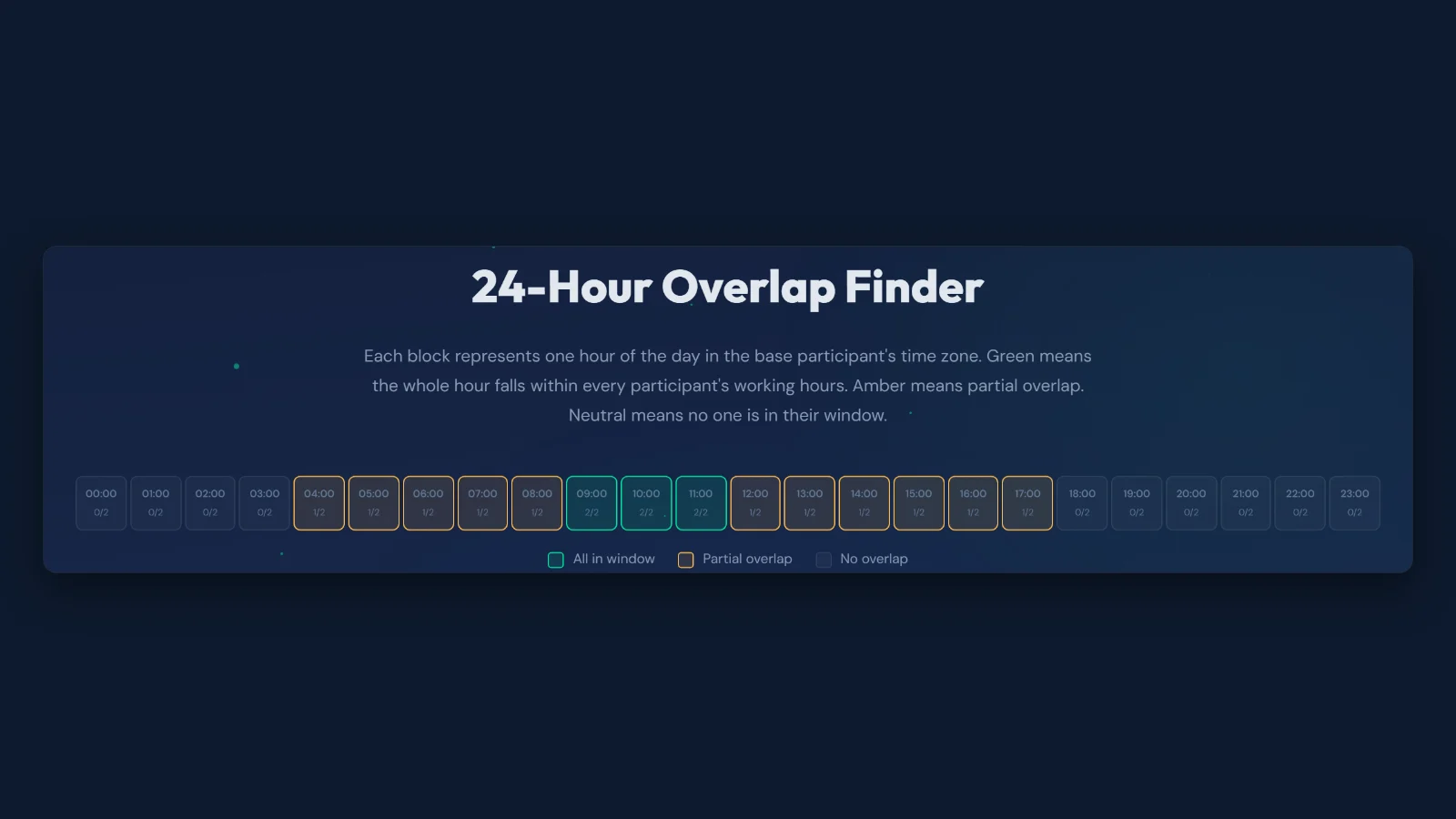 Figure 3. The planner's 24-hour overlap strip for London and Bangalore, 14 January 2026, 9:00–18:00 window. Source: meetwave.io/tools/meeting-time-zone-planner, September 2026.
What one lost hour of overlap costs
A lost hour of overlap does not disappear; it moves to someone's evening. In a study of 12,038 employees of a Fortune 100 firm from 10 September to 30 November 2017, a one-hour increase in time-zone distance cut synchronous communication by 11.0% (95% CI 6.2–15.5%) (Chauvin, Choudhury and Fang, 2024). The average pair lost 1.1 hours of a mean 5.7-hour overlap, 19.3% of it, so communication fell by less than the overlap did.
The rest was time-shifted. In that sample 43% of synchronous communication happened when at least one person was outside 8:00–18:00 local business hours (Chauvin et al., 2024). Employees with 2 hours or less of overlap with their manager did 24.6% of it outside business hours, against 11.9% for those with full overlap. Across Microsoft 365, meetings after 8 pm rose 16% year over year to February 2025 (Microsoft, 2025); the cost of a meeting in 2026 puts a price on those hours.
For a 9-to-5 day, subtract one hour
With a 9:00–17:00 day, every non-zero value in the table drops by exactly 1 hour, never below zero (method). The rule is exact: two windows of length L offset by g hours overlap for max(0, L − g) hours. With the shorter day, 10 of the 30 pairs share no hour all year and the median is 1 hour; London and Bangalore share 2.5 and 3.5 hours, San Francisco and Sydney 3, 2 and 1.
How we calculated
We took 15 cities with distributed teams and 30 pairs between them. For every day of 2026 we intersected a 9:00–18:00 window in the first city with the second city's windows on the previous, same and next calendar day, converting local time to UTC with each city's IANA time zone through the JavaScript Intl API, as the planner does in the browser. January means 14 January 2026, July means 15 July 2026, and the fourth column lists every run of days with a third value. The run used IANA tzdata 2026a in Node 22.23 (ICU 78.2) on 23 September 2026; releases 2026b to 2026d changed only Canadian and Moroccan rules (IANA NEWS).
Weekdays are ignored, as in the planner. Vancouver is left out on purpose: British Columbia made its 8 March 2026 change its last one (tzdata 2026b), and browsers with older time zone data will show it an hour off from 1 November (IANA NEWS). The script runs in any browser console or Node 22; the planner applies the same rules for any date.
FAQ
What is the best time for a meeting between the US and India?
Neither New York nor San Francisco shares a 9:00–18:00 hour with Bangalore on any day of 2026 (method). The least bad slot is 8:30 in New York: 18:00 in Bangalore from 8 March to 31 October 2026 and 19:00 from 1 November, when US clocks go back (15 U.S.C. § 260a).
What is 9 am PST in IST?
9:00 PST is 22:30 IST, a 13.5-hour difference. In summer California is on PDT, and 9:00 PDT is 21:30 IST, 12.5 hours apart; PST applies from 1 November 2026 to 14 March 2027 (15 U.S.C. § 260a).
How many hours do EST and CET working days overlap?
3 hours: 9:00–12:00 in New York is 15:00–18:00 in Berlin. From 8 to 28 March and 25 to 31 October 2026 the overlap is 4 hours (method).
When do the clocks change in 2026 in the US, UK and Australia?
The US moves forward on 8 March and back on 1 November (15 U.S.C. § 260a); the UK on 29 March and 25 October (GOV.UK). Sydney moved back on 5 April and moves forward on 4 October 2026 (NSW Government).
How much time zone overlap does a team need?
No primary source sets a threshold. In the Chauvin et al. sample the mean overlap was 5.7 hours, and losing 1.1 hours of it cut synchronous communication by 11.0% (Organization Science, 2024).
Sources
- Chauvin, J., Choudhury, P. and Fang, T. P. — Working Around the Clock: Temporal Distance, Intrafirm Communication, and Time Shifting of the Employee Workday, Organization Science 35(5):1660–1681 (2024); open copy at LSE Research Online. Accessed 2026-09-23.
- Microsoft WorkLab — Breaking down the infinite workday, Work Trend Index (2025). Accessed 2026-09-23.
- Legal Information Institute, Cornell Law School — 15 U.S. Code § 260a, Advancement of time or changeover dates (2005). Accessed 2026-09-23.
- GOV.UK — When do the clocks change? (2026). Accessed 2026-09-23.
- NSW Government — Daylight saving (2026). Accessed 2026-09-23.
- IANA — tz database, file australasia, file europe and file asia, release 2026d (2026). Accessed 2026-09-23.
- IANA — tz database NEWS, releases 2026a to 2026d (2026). Accessed 2026-09-23.
Ready to try AI meeting summaries?
Try MeetWave free — no credit card required.
Still comparing tools?
See how MeetWave stacks up against the tools most teams evaluate alongside it.
- MeetWave vs TactiqSee how MeetWave compares to Tactiq for meeting transcripts
- MeetWave vs NottaSee how MeetWave compares to Notta for meeting transcription
- MeetWave vs KrispSee how MeetWave compares to Krisp for meeting notes