
Do Meeting Agendas Actually Work?
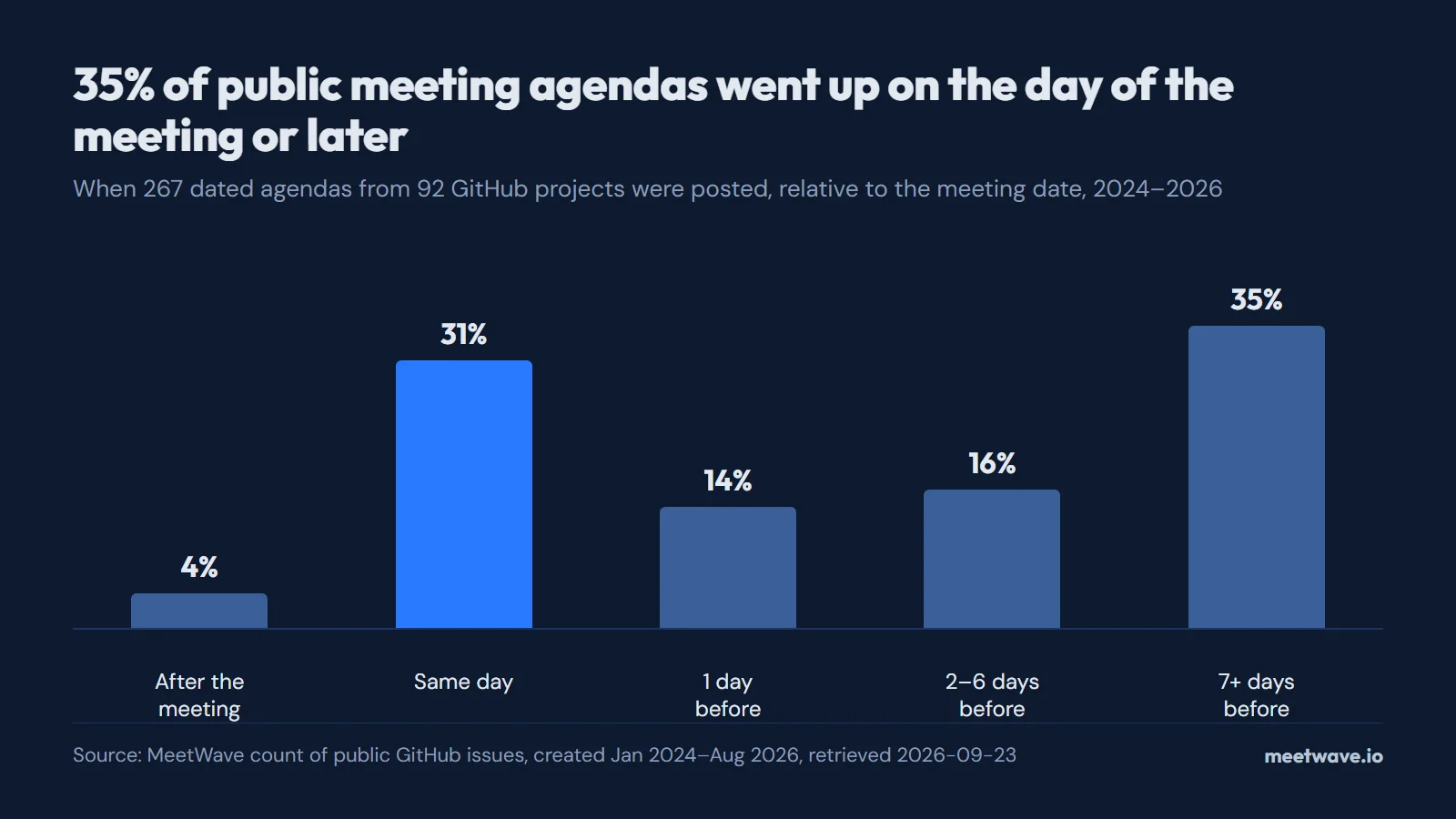
Yes, but only when people see the agenda before the meeting. In a 2011 survey of 367 employees, staff meetings whose formal agenda was available beforehand were rated higher in quality, while an agenda first seen in the room scored no better than no agenda at all. A 2009 study of 958 employees tied written agendas, and getting through them, to meetings rated effective. Yet of 267 dated public meeting agendas posted on GitHub in 2024–2026, 35% went up on the day of the meeting or later.
Key numbers
- Staff meetings whose formal agenda was available beforehand were rated higher in quality than meetings with no agenda or an agenda seen only at the meeting, in a 2011 survey of 367 working adults (Cohen et al., Group Dynamics).
- Working through the agenda (β = .31) and a written agenda sent in advance (β = .28) each predicted how effective employees rated their last meeting of the day, in a 2009 study of 292 employees (Leach et al., Journal of Business and Psychology).
- Only 53 of the 214 employees who answered reported a written agenda sent before their last meeting, and 61 reported no agenda of any kind, in the same 2009 study (Leach et al.).
- 54.6% of 656 recommendations for better meetings, from employees in 41 countries, concerned meeting structure and organization, in a 2015 study (Geimer et al., Journal of Business Research).
- 35% of 267 dated public meeting agendas posted on GitHub between January 2024 and August 2026 went up on the day of the meeting or later (MeetWave count, 2026).
What the research actually measured
Agenda research is survey research, not experiments. Leach and colleagues asked 958 employees about their typical meetings and 292 about their last meeting of the day; Cohen and colleagues asked 367 employees to rate one staff meeting within 48 hours of attending it (Leach et al., 2009; Cohen et al., 2011). Both measure how features of a meeting line up with how the people in it rated it.
Neither design can show cause. Leach and colleagues write that their studies "do not provide a strong basis on which to establish causality" and call for measurements before and after a change, such as a more comprehensive agenda (Leach et al., 2009). Cohen and colleagues name the same limit (Cohen et al., 2011). Read every finding below as "an agenda goes with a better-rated meeting", not "an agenda makes a meeting X% better".
A larger dataset points the same way. Microsoft researchers surveyed 4,425 employees at one technology company, kept 3,290 responses after filtering, and found that including an agenda and sending a pre-meeting communication were both positively correlated with meeting effectiveness (Cutler et al., 2021).
An agenda nobody saw beforehand does nothing
The agenda helps through preparation, not through existing. Cohen and colleagues compared three groups among the 367 attendees of regular staff meetings: no formal agenda, a formal agenda without prior access, and a formal agenda they could see before the meeting (Cohen et al., 2011). The three groups rated meeting quality differently, F(2, 359) = 4.19, p < .05.
| Staff meeting had… | Rated meeting quality |
|---|---|
| No formal agenda | Baseline |
| A formal agenda, first seen at the meeting | Not significantly different from no agenda |
| A formal agenda available before the meeting | Significantly higher than both other groups |
Source: Cohen, Rogelberg, Allen & Luong, Group Dynamics: Theory, Research, and Practice, 2011, Tukey HSD tests, p < .05.
The authors put it in one line: "having an agenda without premeeting access is no better than not having an agenda at all" (Cohen et al., 2011). The study does not say how early is early enough. It separates "before the meeting" from "at the meeting"; the common advice to send an agenda 24 hours ahead is a working norm, not a finding.
Finishing the agenda matters as much as having one
An agenda the meeting never gets through buys little. In the 2009 study of 292 employees' last meeting of the day, a written agenda sent before the meeting predicted rated effectiveness (β = .28), and so did completing the agenda (β = .31) (Leach et al., 2009). When the design features were tested together, agenda completion kept its significant link with effectiveness.
Length only hurt when the agenda was left unfinished. Meeting duration on its own had no significant relationship with rated effectiveness; the one significant interaction was between duration and agenda completion (β = .16, p < .05), with long meetings rated worse only when the agenda was not completed (Leach et al., 2009). An unfinished hour also has a price: see what an unfinished hour costs.
The agenda is one lever among several. Across the 958 employees' typical meetings, each design feature tested on its own went with higher ratings, and a written agenda (β = .20) ranked below good facilities (β = .33), ending on time (β = .31) and starting on time (β = .27) (Leach et al., 2009). Figure 1 shows all seven.
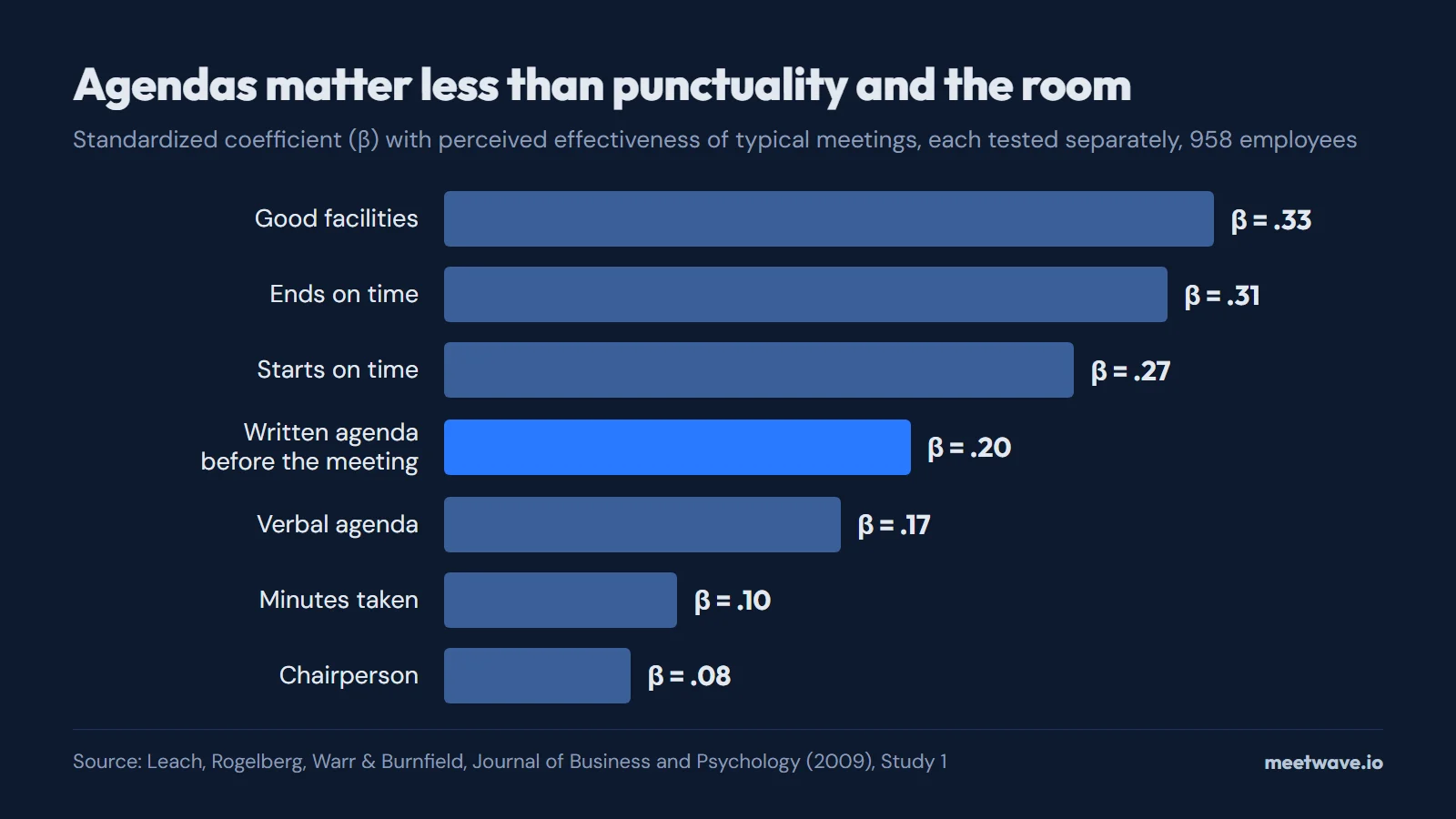 Figure 1. A written agenda goes with better-rated meetings, but less strongly than good facilities and punctuality. Source: Leach, Rogelberg, Warr & Burnfield, Journal of Business and Psychology, 2009, Study 1.
What people say about agendas
People ask for agendas more often than they get them. In Atlassian's survey of 5,000 knowledge workers, 79% said an agenda leads to more productive meetings, and 62% said they often attend meetings that did not state a goal in the invite (Atlassian, 2024). In Doodle's 2019 survey of 6,026 professionals in the UK, Germany and the USA, 67% named setting a clear agenda as a key to an effective meeting (Doodle, 2019).
Asked what would fix their meetings, employees point at structure. Geimer and colleagues coded 656 recommendations from employees in 41 countries; 358 of them, 54.6%, concerned meeting structure and organization (Geimer et al., 2015). These are opinions, not measurements of what agendas do.
How real agendas look: 2024–2026 data
A third of the agendas that can be timed arrive too late to prepare from. Of 267 dated meeting agendas that 92 open-source projects and communities posted as GitHub issues between January 2024 and August 2026, 35% were created on the day of the meeting or after it, and the median agenda went up 2 days ahead (MeetWave count, 2026). Figure 2 splits them by lead time.
Figure 2. 35% of dated public meeting agendas on GitHub went up on the day of the meeting or later. Source: MeetWave count of GitHub issues created January 2024 to August 2026, retrieved 2026-09-23.
Nearly half of these agendas gave attendees one day or less. Adding the 14% posted the day before, 49% went up no more than a day ahead; 35% arrived a week or more early (MeetWave count, 2026). That is the gap the 2011 study points to: an agenda opened in the room is, by its measure, no agenda (Cohen et al., 2011).
Few agendas carry the details that let a meeting finish them. Among the 229 agendas with at least one list item, 27.5% gave at least one item a time box and 26.6% named a person for at least one item; the median agenda had 11 items (MeetWave count, 2026). The time-box share depends on which projects dominate the sample, so treat it as a rough figure.
Statistics about agendas that have no source
Two agenda numbers circulate widely without a study behind them. The table lists where they appear and what a search for the original found; as of 2026-09-23, neither has a primary source with a method (Flowtrace; CornerStone Dynamics).
| Claim | Where it appears | What we found |
|---|---|---|
| "Only 37% of meetings use an agenda" | Flowtrace statistics roundup; CornerStone Dynamics | Credited to Harvard Business Review or to a Highfive blog post; no study, sample or method found |
| "A detailed agenda cuts meeting time by up to 80%" | CornerStone Dynamics and other roundups | Credited to a Highfive blog post; no study, sample or method found |
| "64% of recurring and 60% of one-off meetings lack a structured agenda" | Flowtrace statistics roundup | Vendor data from 1.3 million meetings; how an agenda was detected is not published |
Source: Flowtrace, Meeting Statistics 2026 and CornerStone Dynamics, both accessed 2026-09-23.
An agenda that matches the evidence
Three properties have support. Send it before the meeting, because an agenda first seen in the room was rated no better than none (Cohen et al., 2011). Give each item a time estimate, so the meeting can finish it; Rogelberg, Scott and Kello recommend exactly that, and inviting attendees to add items (MIT Sloan Management Review, 2007).
The third is to size the agenda to the slot, because completion is what the ratings follow (Leach et al., 2009). MeetWave's free meeting agenda maker that totals your time boxes adds up the minutes per item and warns when they run past the meeting length. What happens to the decisions afterwards is a separate problem: see what happens to decisions after the meeting.
How we calculated
Method. GitHub Search API, query
agenda in:title is:issue, run in half-month windows of creation date from 2024-01-01 to 2026-08-31 (64 windows, none over the 1,000-result cap), retrieved 2026-09-23. Lead time = meeting date written in the issue title − the issue'screated_atdate in UTC, in days. The main figure = share of agendas with lead time ≤ 0.
Filters, in order: the title contains "agenda" and a meeting word (meeting, call, sync, standup, sprint, SIG, WG, committee, council, board, office hours, community, weekly, monthly, biweekly, triage, retro, planning, review, TSC, steering); classroom repositories are excluded by name; issues opened by bot accounts are excluded (265); the title carries a parseable meeting date within 120 days of creation; at most 5 agendas per repository, the earliest, so that a few prolific projects do not set the result. That leaves 267 agendas from 92 repositories out of 10,603 issues returned (GitHub Search API).
Stability check. Without the 5-per-repository cap the sample is 992 agendas and the share posted on the day or later is 36.7%, against 34.8% with the cap. Per project, the median agenda went up on the day or later in 29 of 92 repositories (data). The time-box share is not stable: 27.5% with the cap, 40.7% without it.
Manual check. We opened 50 agendas drawn at random from the 267 (fixed seed) and compared them with the classifier: the meeting date was parsed correctly in 50 of 50, the time-box flag was right in 50 of 50, and the owner flag in 48 of 50, after we stopped counting @handles inside URLs. The first pass had missed dates written as 31/03/2026 or "January 9", so the date parser was widened and the count rerun. 49 of the 50 were agendas for a meeting; one was a task to prepare one (MeetWave count, 2026).
Limits. The sample is public agendas of open-source projects and communities, not meetings inside companies. created_at does not change, but an issue can be opened early and filled in later, so the share posted on the day is a lower bound. Bodies are read as they stood on 2026-09-23 and some were extended during or after the meeting, which inflates the time-box and owner shares. The dataset without titles, bodies or names is published as a CSV: one row per agenda with a project code, meeting date, creation time, lead time and the three flags.
FAQ
Why is an agenda important for a meeting?
Because attendees can prepare. In surveys, a written agenda sent before the meeting went with higher effectiveness ratings, β = .20 across typical meetings and β = .28 for a single meeting (Leach et al., 2009). The link is a correlation, not a proven cause.
How long before a meeting should an agenda be sent out?
Before the day of the meeting. Research separates "before" from "at the meeting", not by hours (Cohen et al., 2011); 24 hours is a working norm, the same one behind the minute-taker's 24-hour rule. In our sample, 35% of public agendas missed even that bar (MeetWave count, 2026).
Should you attend a meeting without an agenda?
Ask for the goal and the items first. A meeting whose agenda was shown only in the room was rated no better than one with no agenda (Cohen et al., 2011), and 62% of workers in Atlassian's survey often attend meetings without a stated goal (Atlassian, 2024).
How detailed should a meeting agenda be?
Detailed enough to finish in the slot: a time estimate per item and room for attendees to add their own (MIT Sloan Management Review, 2007). No study sets an item count; the median public agenda in our sample had 11 items (MeetWave count, 2026).
Does an agenda make meetings shorter?
No study has measured that directly. The popular "up to 80% shorter" figure traces back to a blog post, not to research (CornerStone Dynamics).
Sources
- Cohen, Rogelberg, Allen & Luong — Meeting Design Characteristics and Attendee Perceptions of Staff/Team Meeting Quality, Group Dynamics: Theory, Research, and Practice 15(1), 90–104 (2011). Open-access copy: DigitalCommons@UNO. Accessed 2026-09-23.
- Leach, Rogelberg, Warr & Burnfield — Perceived Meeting Effectiveness: The Role of Design Characteristics, Journal of Business and Psychology 24, 65–76 (2009). Accessed 2026-09-23.
- Geimer, Leach, DeSimone, Rogelberg & Warr — Meetings at work: Perceived effectiveness and recommended improvements, Journal of Business Research 68(9) (2015). Accessed 2026-09-23.
- Cutler et al., Microsoft — Meeting Effectiveness and Inclusiveness in Remote Collaboration, arXiv:2102.09803 (2021). Accessed 2026-09-23.
- Rogelberg, Scott & Kello — The Science and Fiction of Meetings, MIT Sloan Management Review 48(2) (2007). Accessed 2026-09-23.
- Atlassian — Workplace Woes: Meetings Edition (2024). Accessed 2026-09-23.
- Doodle — The State of Meetings 2019 (2019). Accessed 2026-09-23.
- MeetWave — GitHub meeting agendas, 2024–2026, derived data, from the GitHub Search API (2026). Accessed 2026-09-23.
Ready to try AI meeting summaries?
Try MeetWave free — no credit card required.
Still comparing tools?
See how MeetWave stacks up against the tools most teams evaluate alongside it.
- MeetWave vs GranolaSee how MeetWave compares to Granola for bot-free meeting notes
- MeetWave vs TactiqSee how MeetWave compares to Tactiq for meeting transcripts
- MeetWave vs NottaSee how MeetWave compares to Notta for meeting transcription