What Is MEDDPICC, and How Do You Fill It From a Sales Call?
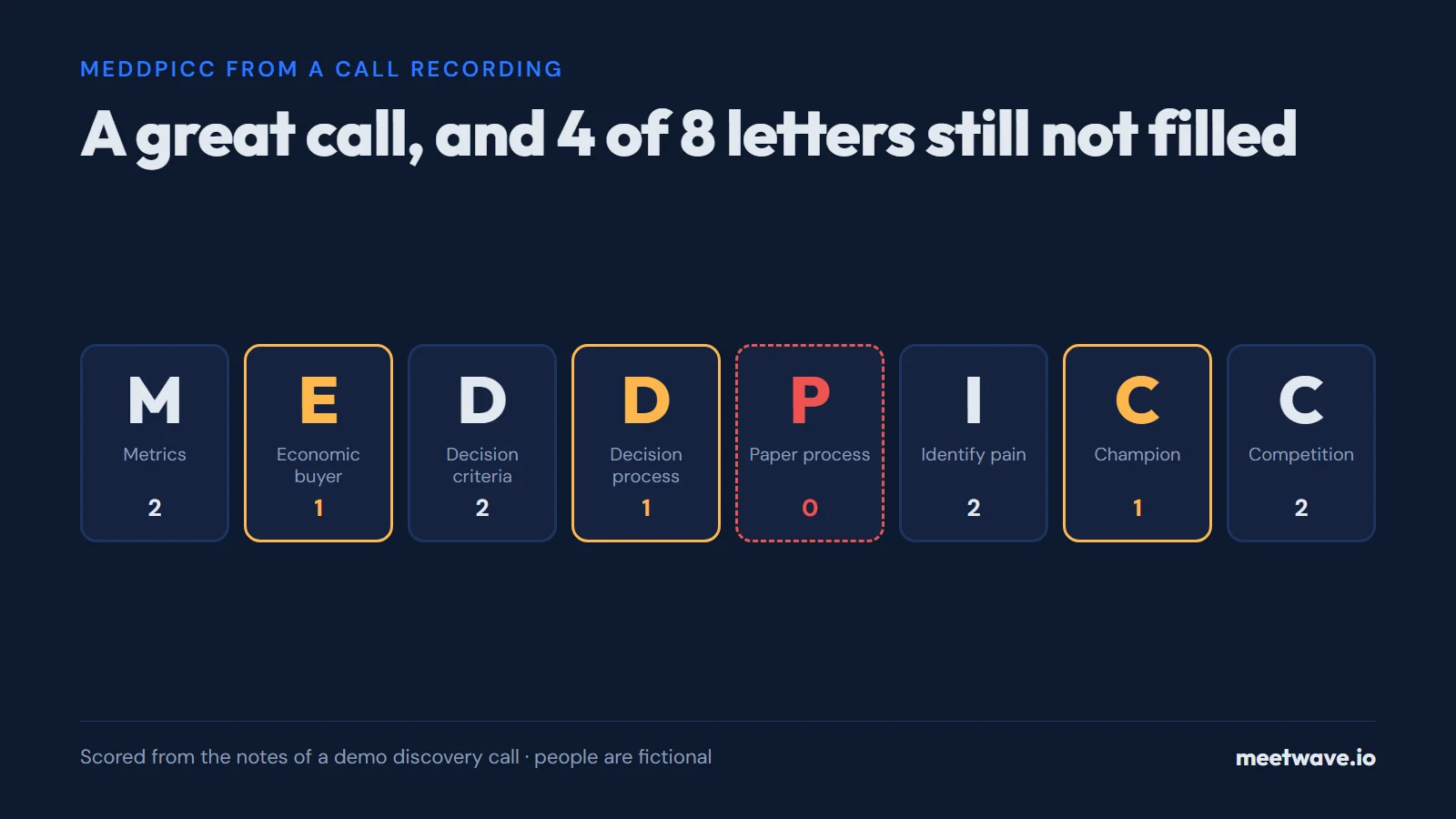
MEDDPICC is a deal-qualification checklist with eight letters: Metrics, Economic buyer, Decision criteria, Decision process, Paper process, Identify pain, Champion and Competition. Fill each letter only from what the buyer said on a call, with the minute it was said. A letter with no buyer sentence behind it is empty, and the empty letters are the agenda of your next call. Memory will not fill them: a week after a conversation, both partners recalled only 4.7% of its details. On our demo discovery call, which felt like a great call, 4 of the 8 letters were still weak or empty.
The eight letters, and what counts as evidence
MEDDIC was created inside PTC in the mid-1990s; Competition and Paper process were added later, which gave MEDDPICC (MEDDICC; MEDDIC Academy). The two sources read the I differently, as Identify pain and as Implicate the pain; the evidence you need is the same. A letter counts as filled when the buyer, not you, said a sentence like the one in the middle column.
| Letter | What counts as evidence on a call | The question that fills it |
|---|---|---|
| Metrics | A number the buyer wants to move, with today's value and the target | "What number has to change for this to be worth it, and from what to what?" |
| Economic buyer | A named person who can say yes to the money, and how they decide | "Who signs, above what amount, and what will they ask first?" |
| Decision criteria | The buyer's own ranking of what matters | "If we are equal on everything else, what decides it?" |
| Decision process | Steps from now to a choice, each with a date and an owner | "What happens between this call and your decision, and when?" |
| Paper process | Steps from the choice to a signature: legal, procurement, security review | "Once you choose, who has to approve the contract, and how long did that take last time?" |
| Identify pain | A cost of not changing, in the buyer's words, with a deadline | "What happens if nothing changes by [date]?" |
| Champion | Someone inside who acts for the deal when you are not there | "What will you take to [the signer], and what would make them say no?" |
| Competition | Who else is in, including doing nothing, and what they offered | "Who else are you talking to, and what did they get right?" |
Source: definitions in our words after MEDDICC and MEDDIC Academy, accessed 2026-10-26.
Score a letter 2 when the buyer said it with a specific (a number, a name, a date), 1 when it was named but second-hand, untested or undated, and 0 when nothing was said. The total matters less than the zeros and ones: they are what will stall the deal.
A real call, scored letter by letter
Here is a demo discovery call: Routewise, a route-planning vendor, and Halverson Logistics, a 140-truck fleet with depots in Hamburg, Bremen and Kiel. On the call: Mia, the account executive; Ben, the solutions engineer; Ingrid, Halverson's head of operations; Dev, its IT manager. The people and companies are fictional; the call was written as a real one. MeetWave's Sales Call Intelligence read it for the seller, and four of its blocks feed MEDDPICC (demo notes).
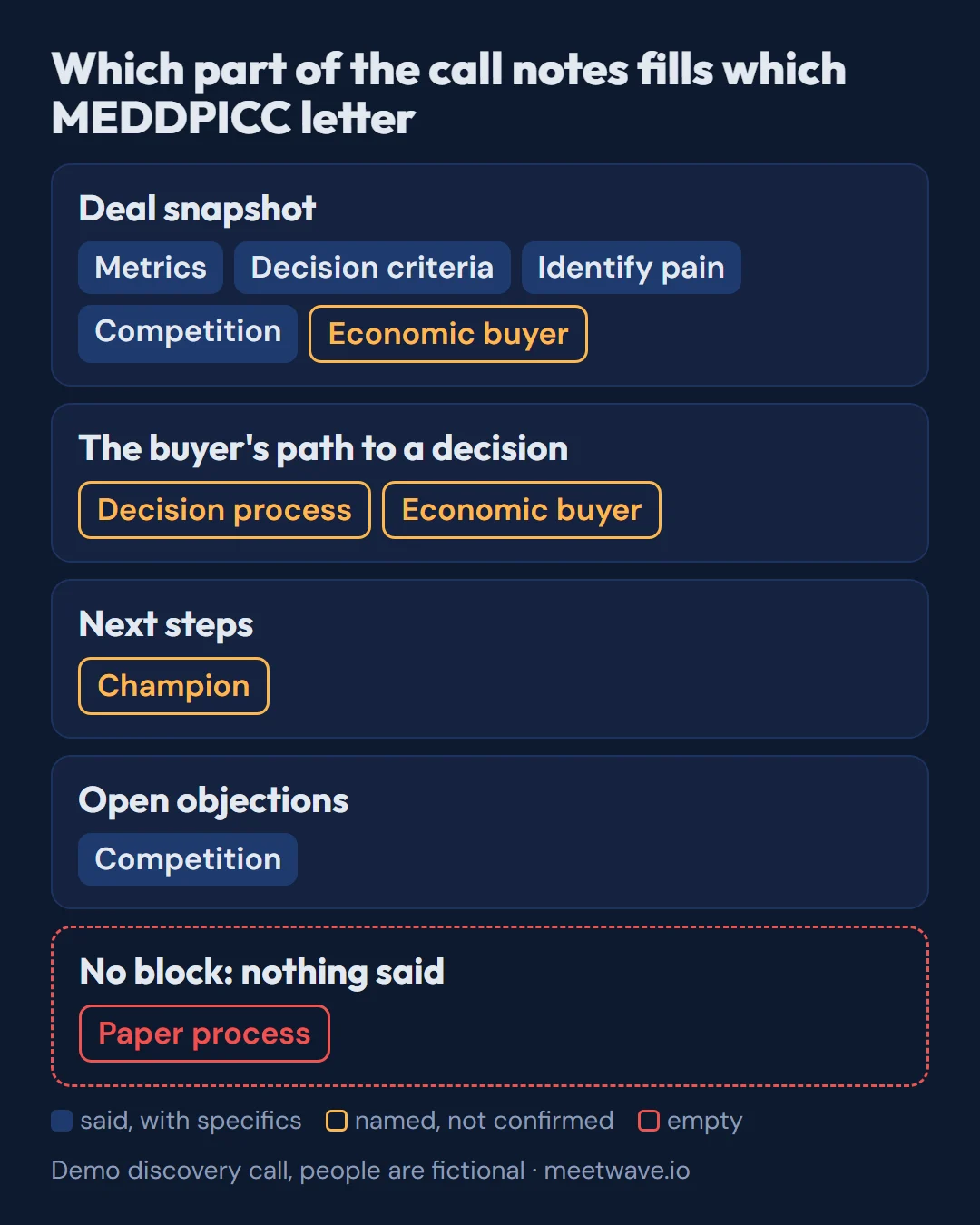 Figure 1. Which block of the call notes fills which letter. Paper process has no block, because nothing about it was said. Source: MeetWave scoring of the demo discovery call, October 2026; method in How we calculated.
In words: the deal snapshot fills Metrics, Decision criteria, Identify pain and Competition, and names the Economic buyer; the buyer's path to a decision gives the Decision process; the next steps show the Champion; the open objections show Competition; nothing fills Paper process (demo notes).
The call ended warmly: a technical deep-dive booked for October 15, a proposal promised by Friday, a buyer who said "That's more realistic" and "Thank you for not promising". Scored, it is 11 of 16.
Deal snapshot: five letters, and one of them is a name
The snapshot gives Metrics, Decision criteria, Pain and Competition with the buyer's own numbers. At 16:12 Ingrid set the targets: "If they spend an hour, I'm happy" about planning that takes three hours a day per depot, and on late deliveries, "eleven percent is not acceptable, I'd like to be under five." At 33:53 she ranked the criteria herself: "Actually no — drivers and warehouse are equal. Price is third." (demo notes)
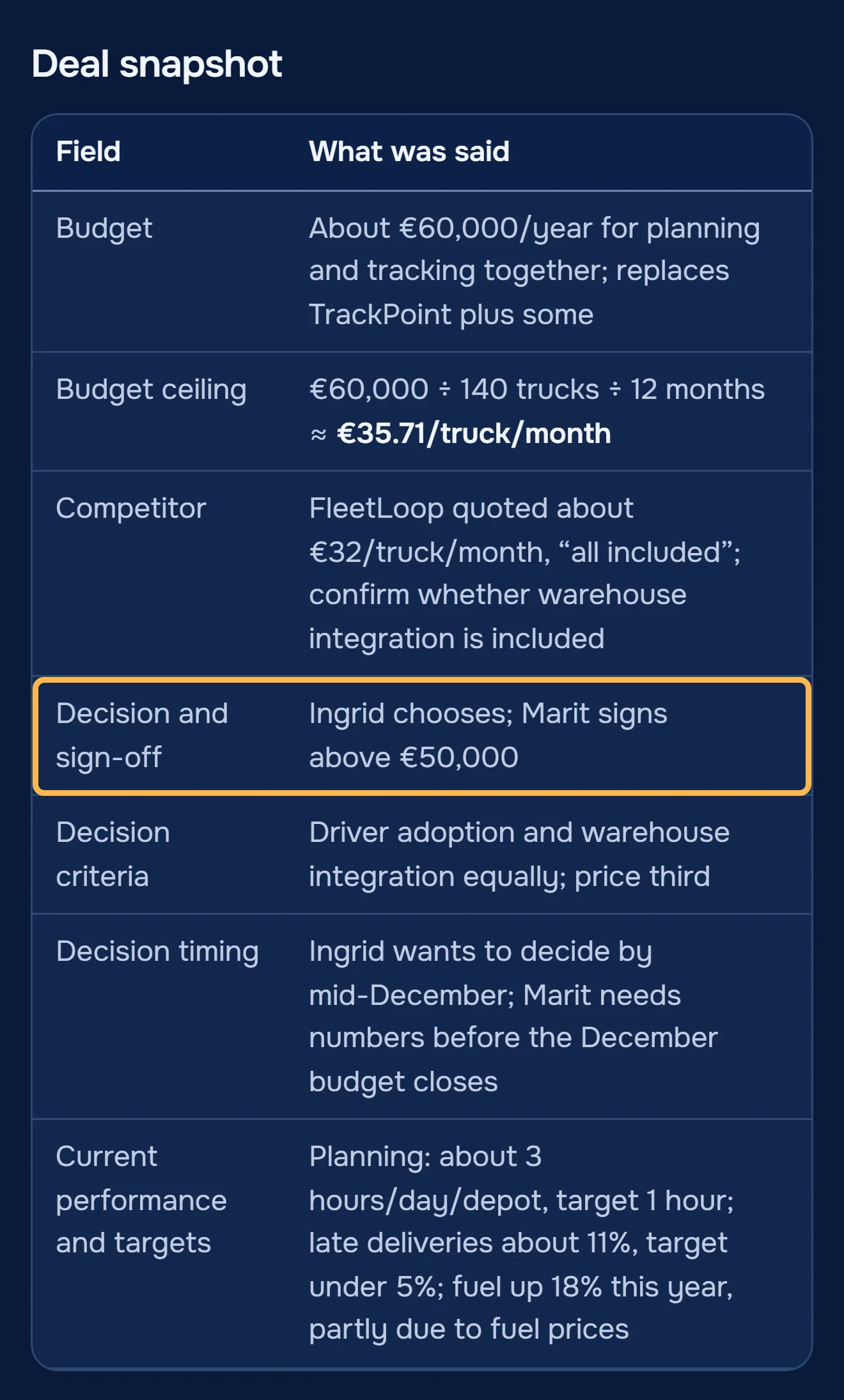 Figure 2. Demo meeting, people are fictional. The ringed row is the Economic buyer: a name and a threshold, and no meeting. Source: demo discovery call, Sales Call Intelligence notes, October 2026.Analyzed with MeetWaveSee the full notesTry it on your next sales call
The ringed row looks complete and is not. At 11:47: "anything over fifty thousand euros needs Marit's signature." At 18:04, asked whether Marit would meet the vendors: "She doesn't need to meet you." The Economic buyer is named, scores 1, and the only thing known about her criteria is second-hand. What to do: ask Ingrid what Marit will ask first, and offer to answer it in 20 minutes with her, after the deep-dive (demo notes).
Metrics scores 2, with one gap: none of the targets is in euros, and Marit, in Ingrid's words, wants "what does it cost, what do we save, when does it pay back" (18:04). The next call turns the hours and the late-delivery penalties into money.
The buyer's path to a decision: a step with no date
The path is the Decision process, and it has a hole in the middle. At 28:41 Ingrid set the order: "first a proper technical session on the warehouse integration … If that looks good, then we do the pricing workshop, and then maybe Marit joins." At 17:03: "We want to decide by the middle of December." (demo notes)
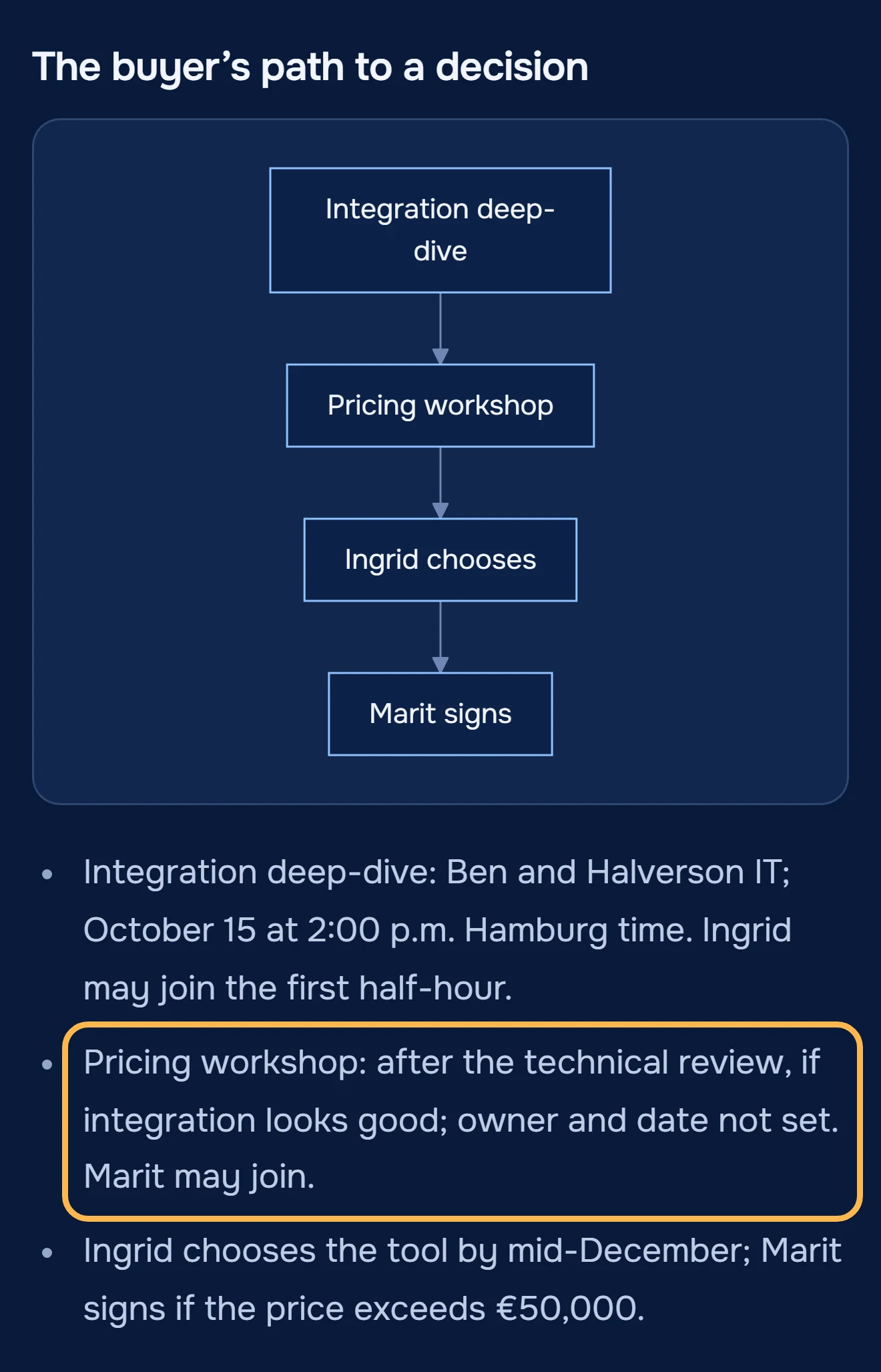 Figure 3. Demo meeting, people are fictional. Four steps; only the first has a date. Source: demo discovery call, Sales Call Intelligence notes, October 2026.Analyzed with MeetWaveSee the full notesTry it on your next sales call
The first step has a date and the last has a month; the workshop between them has neither, and nothing is known about what happens between the workshop and "Ingrid chooses". Score 1. What to do: on October 15, before anyone leaves, put a date on the workshop and ask who else looks at the decision before mid-December.
Next steps and open objections: who acts, and who else is in
The Champion is tested by what the buyer does, not by how warm she sounds. Ingrid took one task herself: an anonymised sample week of delivery data. At 22:11: "I can do that. Not this week, this week is crazy. Next week." At 30:26 she asked for a price before her own meeting with the signer: "Yes, please send me a number. I'd like to have it before I talk to her" (demo notes).
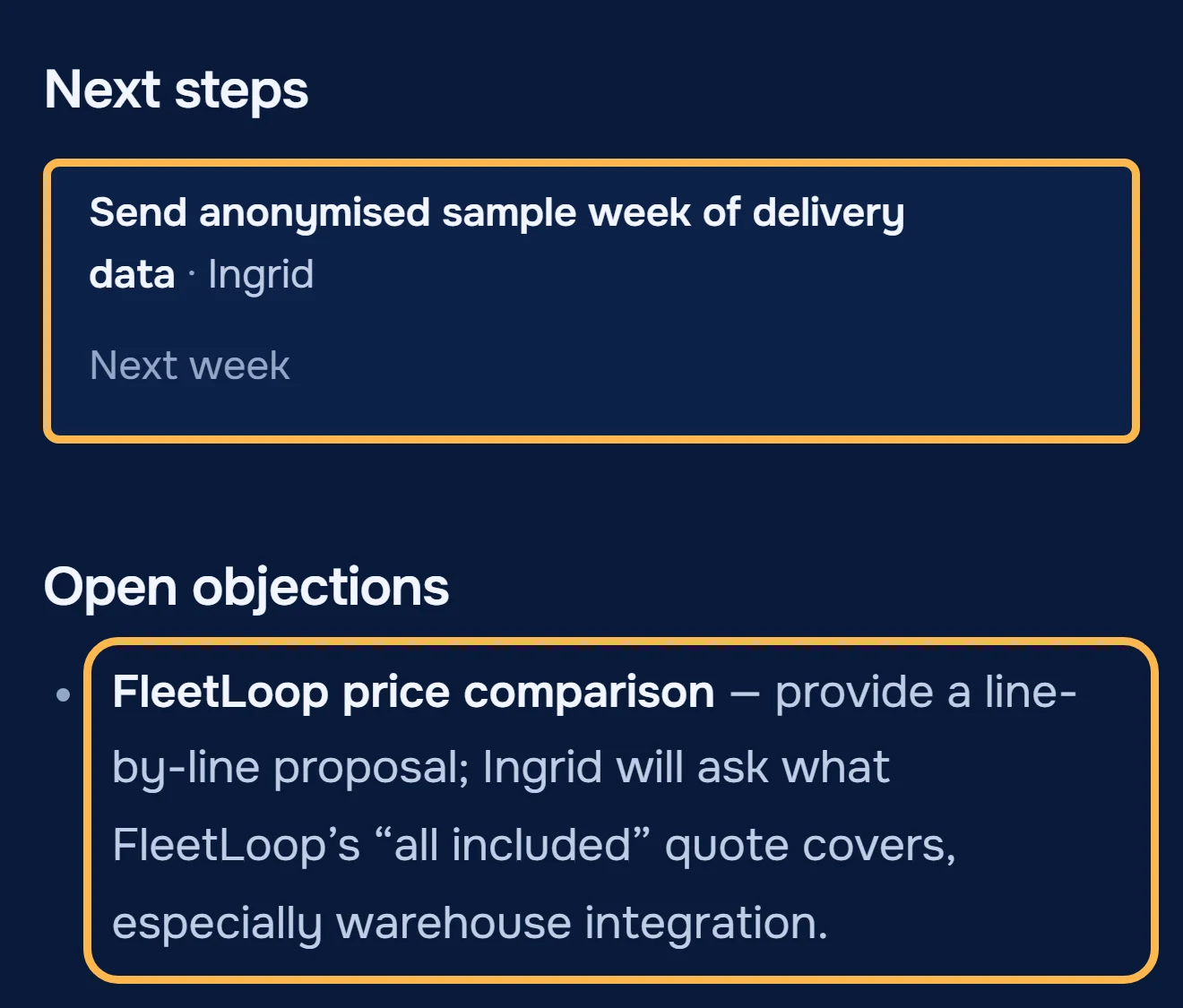 Figure 4. Demo meeting, people are fictional. The one task the buyer took herself, and the competitor's quote she will hold your price against. Source: demo discovery call, Sales Call Intelligence notes, October 2026.Analyzed with MeetWaveSee the full notesTry it on your next sales call
That is a buyer who acts, so Champion scores 1, not 0. It is not yet a 2: nobody asked whether she will argue for this vendor in front of Marit, and against what. Competition scores 2. At 19:18: "They quoted us something like thirty-two euros per vehicle per month, all included." What "all included" covers is open; at 20:21 Dev said of FleetLoop, "They didn't say."
Paper process: nothing at all
No block of the notes covers it, because nobody asked. The only line near it is at 33:01, about the contract length: "That's a Marit question. She doesn't like long contracts with new vendors. Let's talk about it in the workshop." Nobody on the call said who reviews the contract, whether procurement is involved, or how long the signature takes, while the budget for next year "closes in December as well" (17:34). Score 0, and it is the letter that decides whether a mid-December choice is signed before that budget closes (demo notes).
The filled scorecard
| Letter | Score | The buyer's words | Minute | What the next call must get |
|---|---|---|---|---|
| Metrics | 2 | "If they spend an hour, I'm happy." / "I'd like to be under five." | 16:12 | The same targets in euros, for the signer's one page |
| Economic buyer | 1 | "anything over fifty thousand euros needs Marit's signature" / "She doesn't need to meet you." | 11:47, 18:04 | Marit's first question, from Marit |
| Decision criteria | 2 | "drivers and warehouse are equal. Price is third." | 33:53 | — |
| Decision process | 1 | "first a proper technical session … then we do the pricing workshop" | 28:41 | A date and an owner for the workshop |
| Paper process | 0 | — | — | Who approves the contract, and how long it takes |
| Identify pain | 2 | "there are, um, there are penalties in two of the contracts" / "We don't want to be without tracking on the first of April." | 04:55, 06:23 | — |
| Champion | 1 | "please send me a number. I'd like to have it before I talk to her" | 30:26 | What she will say to Marit, and what would make Marit say no |
| Competition | 2 | "thirty-two euros per vehicle per month, all included" | 19:18 | What "all included" covers |
Source: demo discovery call, Sales Call Intelligence notes, and the call's transcript; scores per How we calculated.
Total: 11 of 16. The four strong letters describe the buyer's problem. The four weak ones describe how the money gets spent, and that is where a deal goes quiet.
Why a "great call" stalls: five lines that commit to nothing
A stall usually ends as no decision at all. Matt Dixon, describing his team's analysis of about 2.5 million recorded sales conversations at Tethr: "anywhere between 40 and 60% of all deals are actually lost to the customer doing nothing" (CustomerThink interview, 2022). This is vendor research; the dataset and method are not published. The five lines below from our demo call sound like progress, and each one needs a question that turns it into a commitment (demo notes).
- "Mm. That's more realistic." (14:33, about the driver rollout plan). Agreement with an idea. Ask: "What would you need to see before you tell the Bremen drivers it's coming?"
- "Good. Marit will like that." (27:08, about a German case study). The signer's reaction, guessed by someone else. Ask: "Can we check that with her in 20 minutes after the deep-dive?" (demo notes)
- "She doesn't need to meet you." (18:04). Sounds like one hurdle less; it means no access to the person who signs. Ask: "What will she ask that you would rather we answer?"
- "That would be good, actually. Later, maybe." (31:44, about a call with a peer customer). "Later" has no date. Ask: "Shall we put it in the week after the deep-dive?"
- "Let's talk about it in the workshop." (33:01, about contract length). The workshop has no date. Ask: "When is the workshop, and who from legal or procurement should be in it?"
Next-call plan: one question per weak letter
The next call is already booked: the deep-dive on October 15. Use its last ten minutes for the four weak letters (demo notes).
| Weak letter | The question | Who to invite |
|---|---|---|
| Economic buyer (1) | "What will Marit ask first, and can we answer it with her, in 20 minutes?" | Marit, through Ingrid |
| Decision process (1) | "Which date is the pricing workshop, and who looks at the decision between it and mid-December?" | Ingrid |
| Paper process (0) | "Once you choose, who reviews the contract and the data processing agreement, and how long did that take with TrackPoint?" | Dev for the legal and data side, Ingrid for procurement |
| Champion (1) | "When you take our number to Marit, what would make her say no?" | Ingrid; Henrik, the Hamburg dispatcher, for the sample-week comparison |
Source: demo discovery call, Sales Call Intelligence notes.
Take it with you: the scorecard, as CSV and as a prompt
Paste the CSV into a spreadsheet. Fill the quote and minute columns only from the call; leave a cell empty rather than guess, and the empty cells become your next-call questions.
letter,score_0_1_2,buyer_quote,minute,missing,next_question,who_to_invite
Metrics,,,,,"What number has to change, from what to what?",
Economic buyer,,,,,"Who signs, above what amount, and what will they ask first?",
Decision criteria,,,,,"If we are equal on everything else, what decides it?",
Decision process,,,,,"What happens between this call and your decision, and when?",
Paper process,,,,,"Once you choose, who approves the contract, and how long does it take?",
Identify pain,,,,,"What happens if nothing changes by your deadline?",
Champion,,,,,"What will you take to the signer, and what would make them say no?",
Competition,,,,,"Who else are you talking to, including doing nothing?",
No recording tool? Paste the transcript of your call into ChatGPT or another assistant with this prompt. It asks for quotes and minutes, so you can check every cell against the call.
You are scoring a sales call with MEDDPICC. Below is the transcript, with timestamps. For each letter (Metrics, Economic buyer, Decision criteria, Decision process, Paper process, Identify pain, Champion, Competition), give: a score of 2 if the buyer said it with a specific number, name or date; 1 if it was named but second-hand, untested or undated; 0 if the buyer said nothing about it. Quote the buyer's exact words and the timestamp for every score above 0. Do not use anything the seller said as evidence, and do not infer. Then list the letters scored 0 or 1, with one question for the next call for each and who should be invited. Answer as a table.

Transcript:
[paste here]
We ran this exact prompt once in ChatGPT on the plain transcript of the demo call. It scored the call 14 of 16, against our 11. Every quote and timestamp it gave was real; the extra points came from second-hand lines and from a signer's wish read as a contract step (demo notes, method).
| Letter | ChatGPT | Us | Why it was generous |
|---|---|---|---|
| Economic buyer | 2 | 1 | Scored from Ingrid describing Marit, who was never on the call |
| Decision process | 2 | 1 | The pricing workshop has no owner or date, and Marit's step is "maybe" |
| Paper process | 1 | 0 | Read the CFO's one-page wish, a decision criterion, as a contract step |
Source: one ChatGPT run of the prompt above, October 2026, compared with the scorecard in this article.
The lesson: an assistant follows the rubric loosely, in the buyer's favour. Check every 2 against two questions: who said it, and were they on the call (demo notes).
The sales call notes template is a free page for writing up the call itself when there is no recording.
MEDDIC vs MEDDPICC vs BANT
BANT asks whether a lead is worth a rep's time; MEDDIC and MEDDPICC ask whether a deal will actually close and how.
| BANT | MEDDIC | MEDDPICC | |
|---|---|---|---|
| Letters | Budget, Authority, Need, Timeframe | Metrics, Economic buyer, Decision criteria, Decision process, Identify pain, Champion | MEDDIC plus Paper process and Competition |
| Origin | IBM; its own partner forms still require it | PTC, mid-1990s | Later extension of MEDDIC |
| Best for | Triage: is there a deal at all | Complex deals with several people deciding | Complex deals with a contract review and a competitor |
| What it misses | How the decision and the signature happen | The signature path and the rival | Nothing by design; the gaps are in the call |
Source: IBM, BANT Criteria Template v3.3; MEDDICC; MEDDIC Academy, accessed 2026-10-26.
IBM's form even says who does not count as Authority: "Procurement and Purchasing contacts are not valid executive decision makers" (IBM). The same line is why MEDDPICC splits the Economic buyer from the Paper process: procurement does not choose, but it can still stop the signature.
Recording sales calls: consent first
Record a sales call only when everyone on it agrees, and say so at the start; in some US states every party must consent, and in the EU a recording of a person is personal data under the GDPR. Without a recording, write your notes within an hour and score them the same way: buyer's words, minute, or an empty cell. This is not legal advice.
Key numbers
- A week after a conversation, both partners recalled only 4.7% of its details (Brown-Schmidt et al., Cognitive Science, 2023).
- Matt Dixon puts deals lost to the customer doing nothing at 40–60%, from about 2.5 million recorded sales conversations; vendor research, method not published (CustomerThink interview, 2022).
- Our demo discovery call (October 2026) scored 11 of 16; 4 of the 8 letters were weak or empty, and Paper process scored 0 (demo notes, method).
- The same call, scored once by ChatGPT with the prompt in this article (October 2026), came out at 14 of 16: 3 letters scored higher than ours, each from a second-hand line or a criterion read as a contract step (method).
How we calculated
- The demo call is a fictional 35-minute discovery call written for MeetWave's test set before the notes existed; it was not edited to score better or worse. MeetWave's Sales Call Intelligence read it once; the frames and the linked notes are that run, unedited.
- Scores: 2 = the buyer said it with a specific (number, name, date); 1 = named, but second-hand, untested or undated; 0 = nothing the buyer said. Only the buyer's sentences count; quotes and minutes are copied from the call's transcript, and each matches a line of the notes. Eight letters × 2 = 16 points.
- 4 of 8 counts the letters scored 0 or 1: Economic buyer, Decision process, Paper process, Champion.
- 14 of 16 is one run of the article's prompt in ChatGPT (free account, default model, no settings changed) on the plain transcript of the demo call, on 2026-10-26. We kept its answer and compared each letter with ours; its quotes and timestamps all match the transcript.
FAQ
What does MEDDPICC stand for?
Metrics, Economic buyer, Decision criteria, Decision process, Paper process, Identify (or Implicate) pain, Champion and Competition. It grew out of MEDDIC, created at PTC in the mid-1990s (MEDDICC).
What is the difference between MEDDIC and MEDDPICC?
MEDDPICC adds two letters: Paper process, the steps from the decision to a signature, and Competition, everyone else the buyer could choose, including doing nothing (MEDDICC). On our demo call, Paper process was the one letter with nothing behind it (demo notes).
Is there a MEDDPICC template I can copy?
Yes: the CSV above has one row per letter with a score, the buyer's quote, the minute, what is missing and the next question. Fill it only from what the buyer said on the call (scorecard).
Who is the economic buyer in MEDDPICC?
The person who can say yes to the money: in the demo call, the CFO who signs above €50,000, not the head of operations who chooses the tool. Knowing the name is a 1; hearing their criteria from them is a 2 (demo notes).
Is MEDDPICC better than BANT?
They answer different questions. BANT, which IBM's partner forms still use, checks whether there is a deal; MEDDPICC checks how it will be decided and signed (IBM).
Sources
- Brown-Schmidt, S., Jaeger, C. B., Evans, K., & Benjamin, A. S. — MEMCONS: How Contemporaneous Note-Taking Shapes Memory for Conversation, Cognitive Science (2023). Accessed 2026-10-26.
- MEDDICC — MEDDPICC Sales Methodology: Acronym & Meaning. Accessed 2026-10-26.
- MEDDIC Academy — Official MEDDPICC Site: Definition, Methodology & History. Accessed 2026-10-26.
- IBM — Budget Authority Need Timeframe (BANT) Criteria Template v3.3. Accessed 2026-10-26.
- CustomerThink — The Problem of Customer Indecision and How to Get Over It, interview with Matt Dixon (2022). Accessed 2026-10-26.
- Regulation (EU) 2016/679 (GDPR) — Article 4: Definitions. Accessed 2026-10-26.
Still comparing tools?
See how MeetWave stacks up against the tools most teams evaluate alongside it.
- MeetWave vs GranolaSee how MeetWave compares to Granola for bot-free meeting notes
- MeetWave vs TactiqSee how MeetWave compares to Tactiq for meeting transcripts
- MeetWave vs NottaSee how MeetWave compares to Notta for meeting transcription
More on this: Meeting minutes template