How to Prepare for a Job Interview: Rehearse, Record, Review
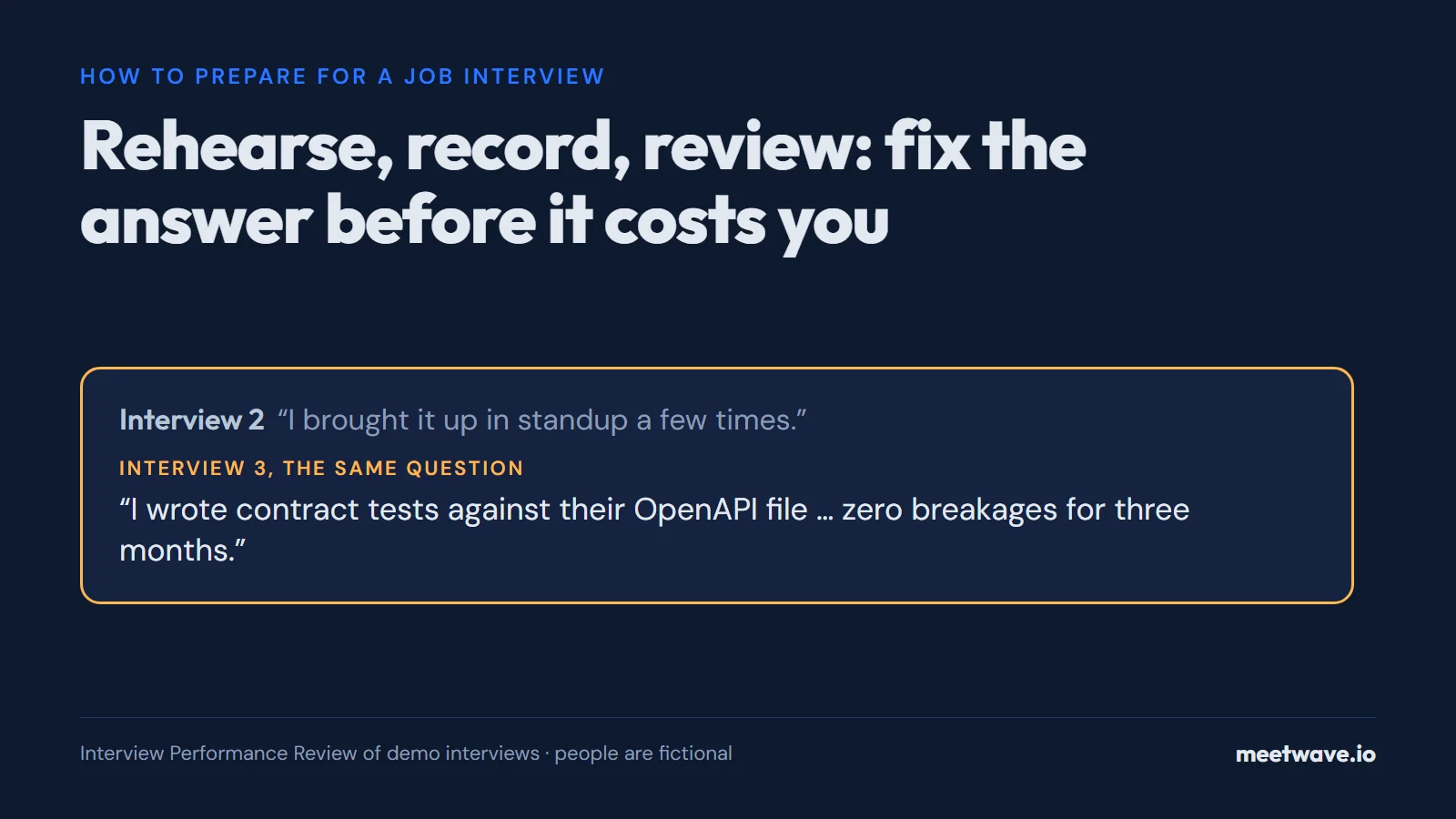
Prepare for a job interview by saying your answers out loud, recording one mock interview with consent, and reviewing it before the real one: the review finds the answer that would have cost you, while it is still practice. In a field study of 213 candidates, those who rehearsed in study groups or role-plays gave better-organized answers and scored higher. Nerves are a smaller factor than they feel: across 30 studies, interview anxiety correlated r = -.19 with the interviewer's rating. Keep the review about the answer, not about you: over a third of feedback made performance worse.
What the research says about preparing for an interview
Preparation that makes you practise answers is linked to higher interview scores, and the link runs through how organized the answers are. Maurer and colleagues followed 213 candidates for police and fire promotions through a situational interview. Candidates who joined study groups or role-played scored higher, beyond what attending a coaching session explained, and coaching and preparation went with answers that were better organized, which in turn went with higher scores.
An earlier study by the same group found that attending a coaching session was related to interview scores in 3 of 4 promotion processes, after the candidates' job knowledge and motivation were taken into account. Neither study was randomized: the people who chose to prepare may differ in ways the researchers did not measure.
Randomized evidence exists, but only in small groups who find interviews hard. In a trial with 32 job seekers with schizophrenia, 21 who practised up to 10 hours of simulated interviews improved their role-play scores (p = .001) and were more likely to have a job offer six months later than 11 who waited (odds ratio 8.73, p = .04). Treat that as proof that practice with feedback can move real outcomes, not as a percentage you can expect.
What nobody has measured is the step this article adds: reviewing a recording of your own mock interview. We found no study that puts a number on it. What feedback research does say is how a review has to be done. Across 607 effects, feedback improved performance on average (d = .41), but over a third of feedback interventions made performance worse, and feedback helped less the more it pulled attention toward the self.
So the review below never says "you are bad at behavioural questions". It points at one answer, one minute, and what to say instead.
The week before: a preparation checklist
Six days are enough, and two of them go to the mock interview and its review. The rest is the usual work, done in an order where each day feeds the next: the job post gives you the skills, the skills give you the stories, the stories get said out loud before anyone records them.
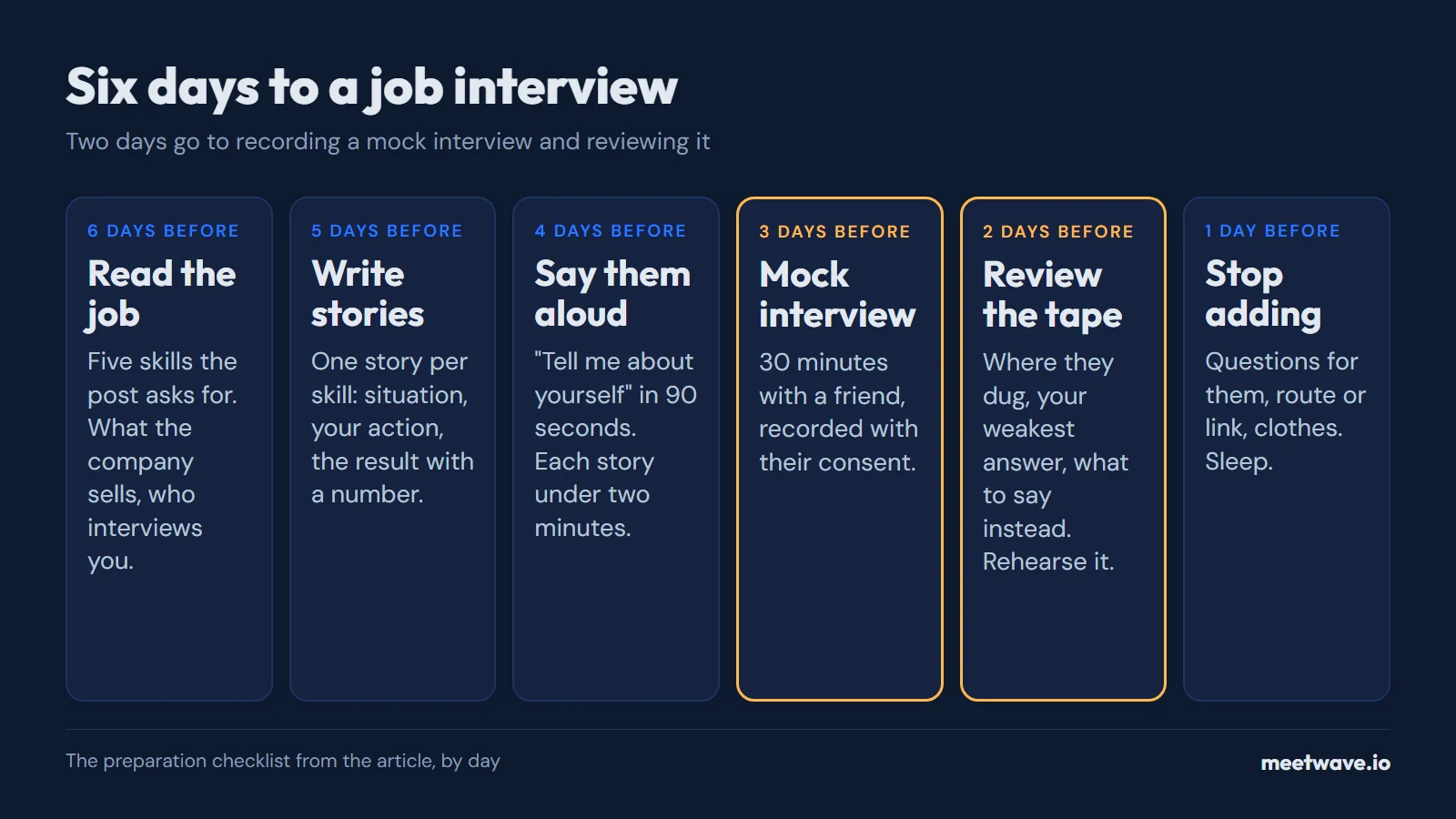 Figure 1. The preparation week, day by day. The same plan is the checklist below. Source: [the checklist in this article](#the-week-before-a-preparation-checklist).
Copy the checklist into your notes and tick it off as you go. It is the same plan as Figure 1, with the details.
JOB INTERVIEW PREPARATION CHECKLIST: [company], [role], interview on [date]

6 days before: read the job
[ ] Five skills the job post asks for, in its own words
[ ] What the company sells, to whom, and one recent change (launch, funding, new market)
[ ] Who interviews me and what they own (from the invite or their profile)

5 days before: write stories
[ ] One story per skill, as situation, task, my action, result with a number
[ ] "Tell me about yourself" in three parts: now, before, why this job
[ ] A mistake story: what broke, how fast I fixed it, what I changed

4 days before: say them aloud
[ ] "Tell me about yourself" in 90 seconds, timed
[ ] Each story under two minutes, out loud, not in my head
[ ] Five questions they are likely to ask, answered out loud once

3 days before: mock interview
[ ] A friend or colleague runs 30 minutes from the real job post
[ ] They agreed to be recorded; the recording is for my review only

2 days before: review the recording
[ ] Where they asked a follow-up, and what I said before and after it
[ ] My weakest answer, rewritten from facts I said elsewhere in the call
[ ] The rewritten answer said out loud three times

1 day before: stop adding
[ ] Three questions for them, built on what the job post or the mock interviewer raised
[ ] Route or call link tested, documents, clothes
[ ] No new stories tonight; sleep

After the interview
[ ] Questions and my answers written down within an hour
[ ] Thank-you email the same day, with one fact from the conversation
If you have less than a week, keep the order and shrink the days: stories, out loud, one mock interview, one review. The free interview notes template is a printable version of the page you fill in after the call.
Answers that work: STAR, with one weak and one strong answer
A behavioural answer works when the interviewer hears what you did and what changed, without having to ask. The STAR structure (situation, task, action, result) is the shortest way to make sure both are there. Here is the same question answered twice by Maya, a frontend engineer in a demo interview series where the people and companies are fictional, 20 days apart (interview 2 notes, interview 3 notes).
| Interview 2, 07:21: weak | Interview 3, 08:48: strong | |
|---|---|---|
| Situation | "the backend team at Copperleaf kept changing the API for the policies endpoint, like every sprint" | "our pages broke after their deploys, like twice a month" |
| Task | not said | "I disagreed with their lead about whether that was a frontend problem." |
| Action | "I brought it up in standup a few times. We talked about it." | "I wrote contract tests against their OpenAPI file, so the frontend build failed as soon as a field we use was renamed or made optional." |
| Result | "eventually it kind of worked out, they got better at it." | "After that we had zero breakages for three months, and he set the same tests up for two other teams." |
Source: demo interviews 2 and 3, transcripts quoted word for word (interview 2 notes, interview 3 notes).
Nothing in the strong answer is new. In interview 2 Maya told the contract tests and the three months a minute later, as an answer to a testing question, without noticing it was her conflict story. That is the weak answer to look for in your own recording: the facts exist, they are just not in the answer where they are scored.
The formula you can apply to any story: one sentence of situation, one of what was at stake for you, then "I" and a verb, then the number that changed and who adopted it. If the result has no number, find it before the interview: a count, a time, a share of users, money.
Fill in one sheet per story. Keep each part to one or two sentences, so the whole answer stays under two minutes when you say it.
STAR ANSWER SHEET: [skill the job post asks for]

Question it answers: [Tell me about a time you … / Give an example of …]

Situation: [where, when, what was going wrong, in one sentence]

Task: [what was yours to solve, or what you disagreed about, in one sentence]

Action: [I + verb + what exactly. Not "we talked about it".]

Result: [the number that changed: before → after, for how many, how long] and [who adopted it or what happened next]

What I learned, in one line: [the lesson, said as a rule you now follow]

Said out loud in: [seconds] (target: under 120)Record a mock interview, then review it
A mock interview gives you the one thing reading about interviews cannot: your own answers, as the interviewer heard them. Run it like this:
- Pick the real job post and give it to your partner a day before. Ask for half an hour: a few minutes of background, one exercise or case if the role has one, two behavioural questions, and time for your questions.
- Ask before you record, at the start of the call, and keep the recording for yourself. The rules are in Recording and consent below.
- Ask your partner to follow up when an answer is vague, the way a real interviewer does: "What did you do about it?", "What does faster mean?"
- Review the same day. Look for three things: where they dug, your weakest answer, and what you could have said instead from facts you said elsewhere in the call.
In MeetWave this review is the Interview Performance Review: it reads the recording and writes it for you. Without it, play the recording back with the three questions above and the STAR sheet open. Here is what the review of Maya's interview 2 showed.
Where they dug: a follow-up marks what is scored
An interviewer who asks a follow-up is telling you which answer they are still scoring. In interview 2, the hiring manager asked "What did you do about it?" at 07:45 and "how did it end with the person you disagreed with?" at 08:01. Two follow-ups on one answer is the signal to look at that answer first.
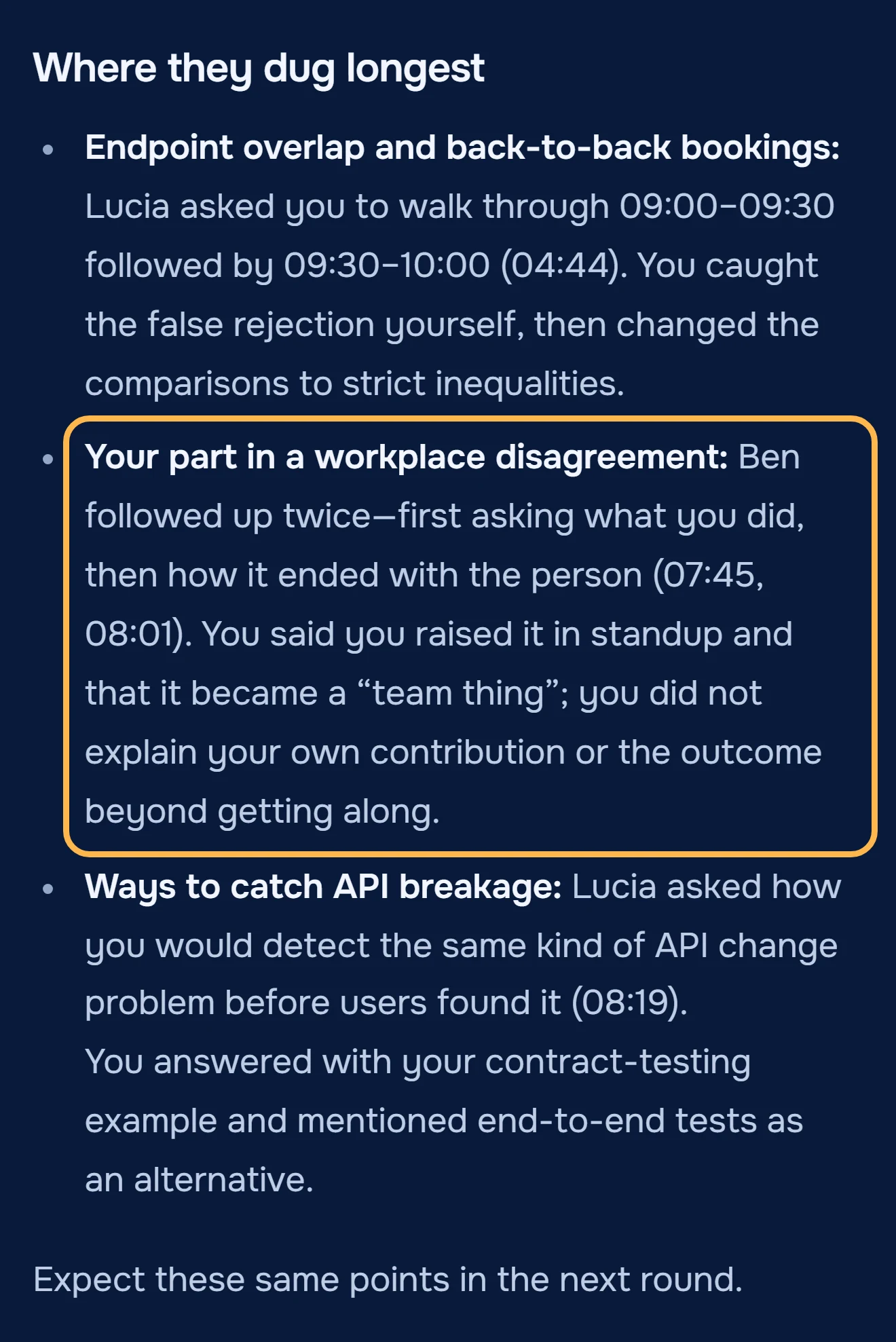 Figure 2. Demo meeting, people are fictional. Interview 2: two follow-ups on one answer, at 07:45 and 08:01, mark the disagreement story as the one to fix. Source: demo interview 2, coding and behavioural notes, October 2026.Analyzed with MeetWaveSee the full notesTry it on your next interview
What the interviewer wrote down
The same call, read from the other side of the table, shows what that answer cost. The Interview Scorecard, the template an interviewer uses, scored the disagreement story 2 out of 5 for ownership: "described API instability and raising it in standup, but gave no specific resolution she drove". In the same scorecard, her technical experience got 4 out of 5 (interview 2 scorecard).
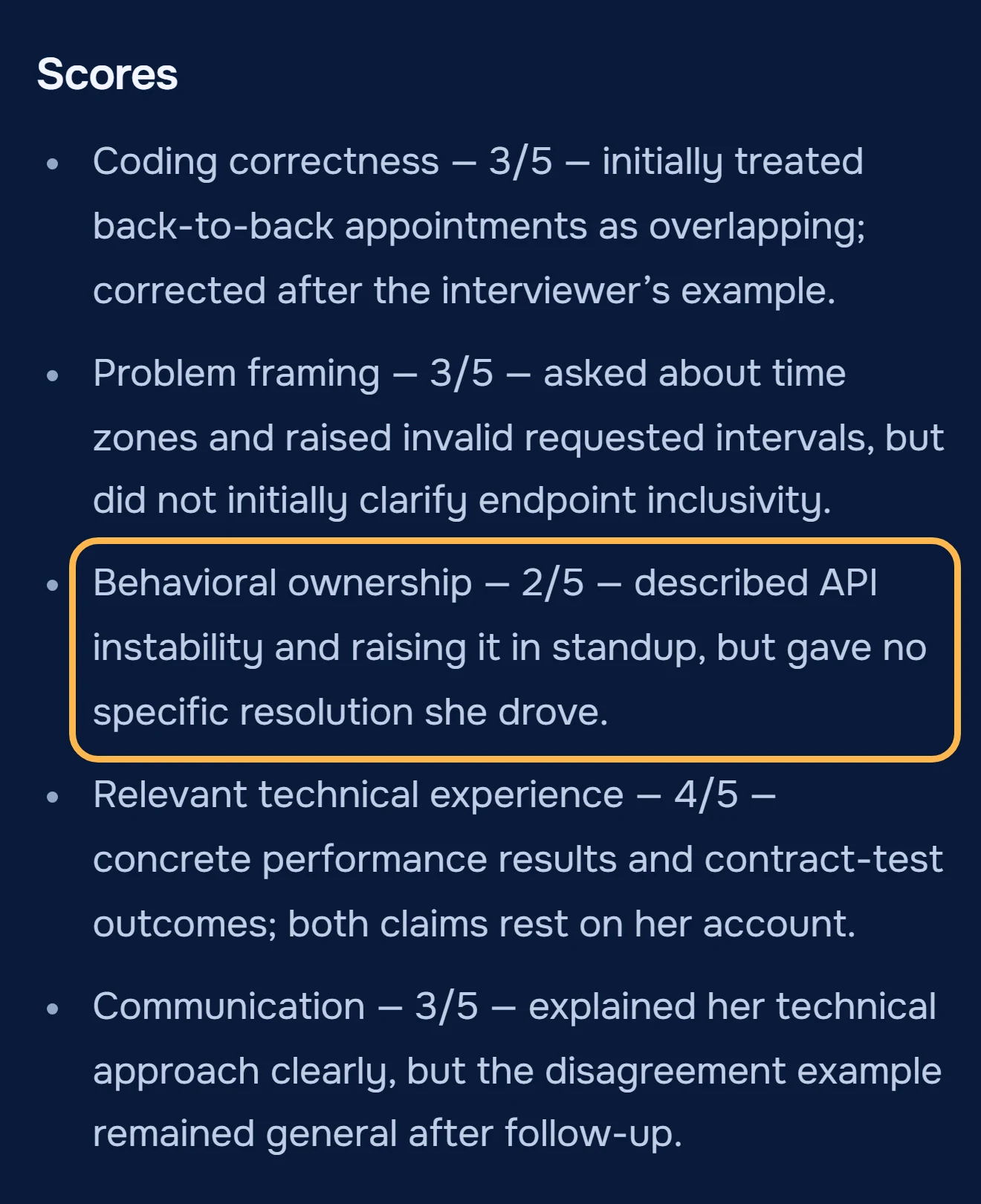 Figure 3. Demo meeting, people are fictional. Interview 2, the interviewer's scorecard: the weak answer is a 2 out of 5, on a question she had the facts to answer. Source: demo interview 2, interviewer scorecard, October 2026.Analyzed with MeetWaveSee the full notesTry it on your next interview
The gap between 2 and 4 is not skill. It is one story told without its action and result, while the same contract tests earned the 4 at the testing question.
Before and after: the same question, two interviews later
The review's timeline marks each part of the interview green, yellow or red. In interview 2, the disagreement question is the only red segment:
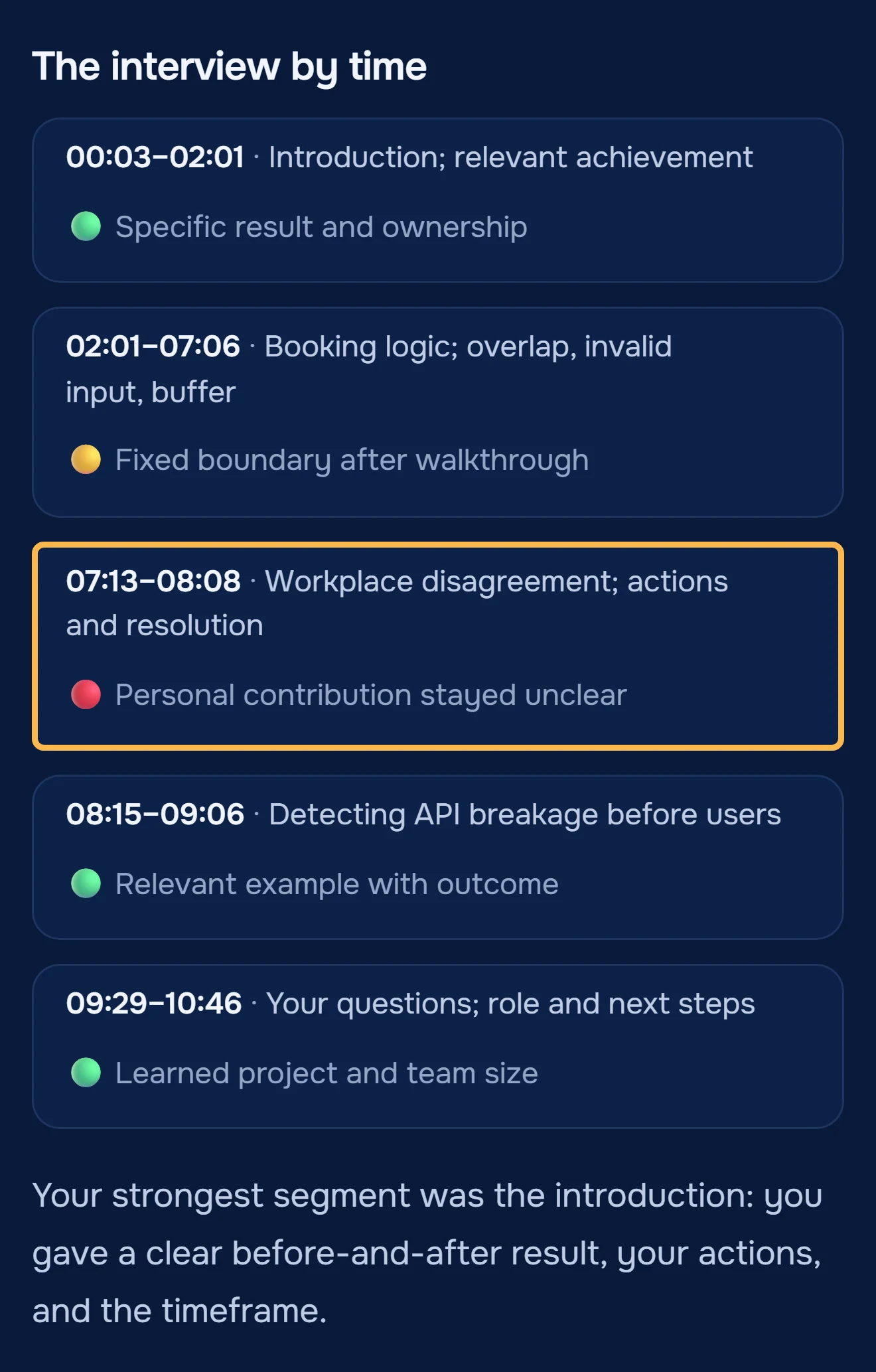 Figure 4. Demo meeting, people are fictional. Interview 2: the disagreement question, 07:13 to 08:08, is the one red segment. Source: demo interview 2, coding and behavioural notes, October 2026.Analyzed with MeetWaveSee the full notesTry it on your next interview
Twenty days later the next interviewer asked the same question. Maya answered with the STAR order from the table above, and the review of that call names it the strongest part of the interview:
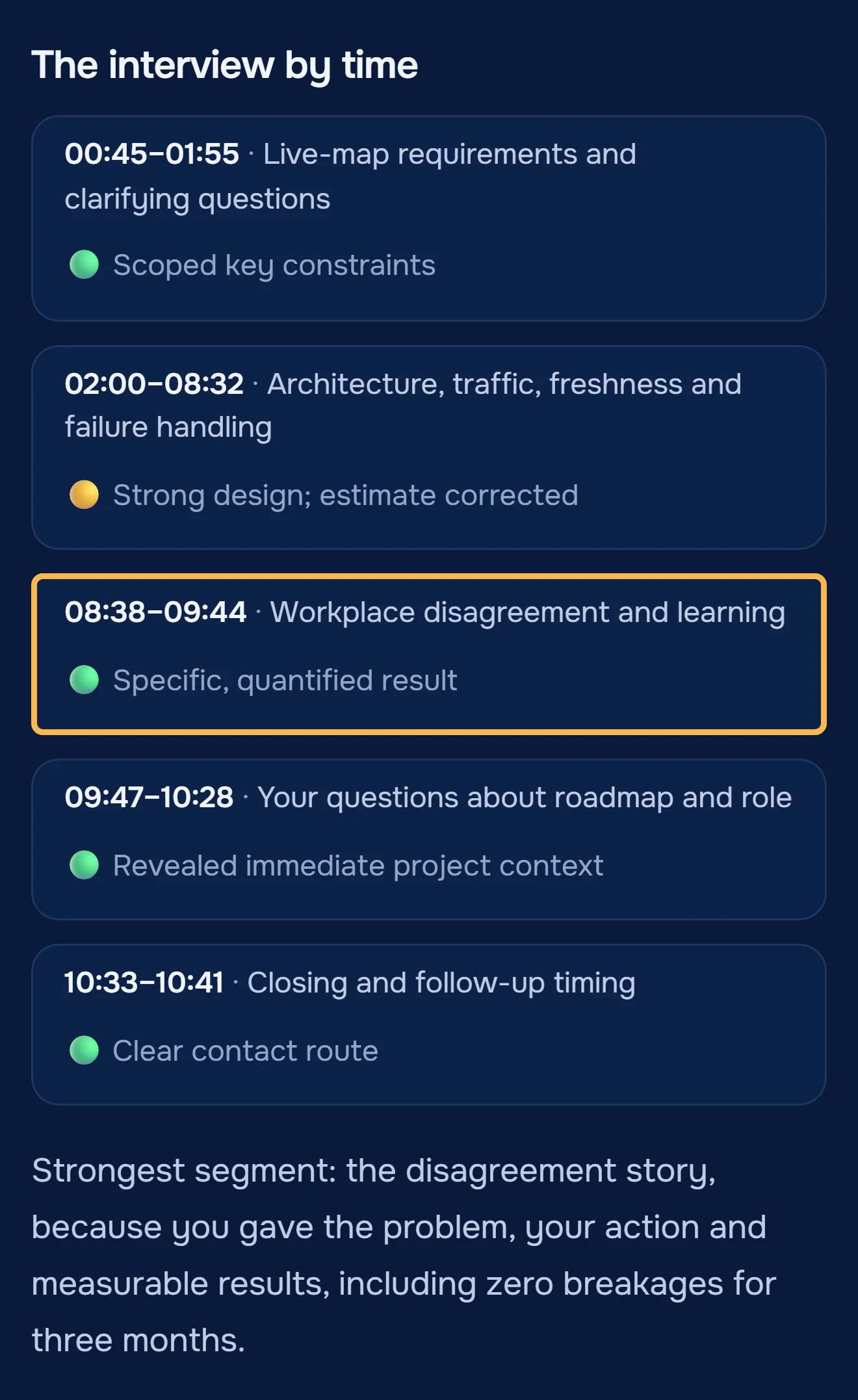 Figure 5. Demo meeting, people are fictional. Interview 3: the same question, now the strongest segment, because the answer has her action and zero breakages for three months. Source: demo interview 3, system design notes, October 2026.Analyzed with MeetWaveSee the full notesTry it on your next interview
One answer, fixed once, stays fixed. The full series of four interviews, with the other habits Maya fixed between them, is in how to get a tech job in 2026.
Interview nerves: what the research says
Anxiety lowers interview scores, but less than it feels like from the inside. Powell, Stanley and Brown pooled 30 studies of self-reported interview anxiety and interviewer-rated performance: the average correlation was -.19. That is a real effect and a modest one: most of what the interviewer rates is not your nerves.
The same researchers, presenting their work to career counsellors, list lack of preparation among the causes of interview anxiety. The anxiety interviewees described in their own words was often about examples: "I would struggle to find strong examples to address the situational questions." Their advice for that kind of anxiety is the method of this article: anticipate the situations you will be asked about, practise concise answers with the STAR method, and audio-record your answers to catch filler words.
That advice comes from slides, not from a trial, so take it as expert guidance. It does fit the field data above: the preparation that helped scores was preparation that made answers organized, and an answer you have already said out loud three times is one you do not have to search for under stress.
After the interview
Write down every question and your answer within an hour, while the wording is still yours. A week later you will remember that it "went fine" and not which answer got a follow-up.
Then send a short thank-you email the same day, with one fact from the conversation that shows you listened: the problem they mentioned, the project you would join. The interview notes template has a section for both. For a technical role, the full series of reviewed interviews is in how to get a tech job in 2026.
Recording a mock interview: consent first
Record an interview only when everyone on the call agrees, and say so at the start. US federal law lets a person who is a party to a conversation record it, but some states require the consent of everyone: Washington makes it unlawful to record a private conversation without first obtaining the consent of all the persons in it, and counts consent as given when the recording is announced. Your partner in a mock interview is the easy case: ask, and they will usually say yes.
A real interviewer may say no, and that is their right. The method still works without a recording: write the questions and your answers down within an hour and review those notes with the same three questions. This is not legal advice.
Key numbers
- Candidates who prepared in study groups or role-plays scored higher in situational interviews, beyond coaching attendance, in a field study of 213 promotion candidates (Maurer et al., 2001).
- Attending an interview coaching session was related to interview scores in 3 of 4 police and fire promotion processes, after job knowledge and motivation (Maurer et al., 1998).
- Self-reported interview anxiety correlated r = -.19 with interviewer-rated performance across 30 studies (Powell, Stanley & Brown, 2018; figure as presented by the authors in their slides).
- In a randomized trial with 32 job seekers with schizophrenia, simulated interview practice raised role-play scores (p = .001); odds of a job offer within six months were 8.73 times those of the waitlist (Smith et al., 2015).
- Feedback improved performance on average by d = .41 across 607 effects, and over a third of feedback interventions made performance worse (Kluger & DeNisi, 1996).
How we calculated
- The demo interviews are fictional: the people, the companies and the transcripts were written for MeetWave's demo series, with the weak disagreement answer in interview 2 and the strong one in interview 3 planted before the transcripts were written. Every quote in this article is taken word for word from those transcripts; the whole series is reviewed in how to get a tech job in 2026.
- The frames are one run of the Interview Performance Review (interviews 2 and 3) and Interview Scorecard (interview 2) on October 26, 2026, unedited; each caption links the full notes of that run (interview 2 notes).
- The research numbers were read in the study abstracts on October 26, 2026. The -.19 for interview anxiety is the figure the authors present in their own slides; the published abstract was not open to us (Powell & Bonaccio slides).
FAQ
How do I prepare for a job interview?
Read the job post for the five skills it asks for, write one story per skill with a number in its result, and say each story out loud. Then run one 30-minute mock interview, recorded with consent, and fix the answer that drew the most follow-ups. Candidates who rehearsed in role-plays scored higher in a field study of 213 people.
What should I say in a job interview?
What you did and what changed, with a number, for every question about your experience. Say "I" for your own work, put the result in the first or last sentence, and keep each answer under two minutes. In the demo interview above, the same story scored 2 of 5 without its action and result.
How do I answer "Tell me about yourself"?
In 90 seconds and three parts: what you do now, with one result and its number; what you did before that led here; why this job. In the demo interview 2, Maya opened with her role, the reports page going from 6.2 to 1.8 seconds, and "I did it on my own over two sprints", and the review marked the introduction green.
What is the STAR method?
A way to tell a work story so the interviewer hears everything they score: situation, task, action, result. Most weak answers drop the action or the result; the table above shows both versions of one answer.
How do I calm interview nerves?
Prepare the examples you are afraid of not finding. Across 30 studies anxiety lowered interviewer ratings only modestly (r = -.19), and the researchers' own advice is to anticipate situations, practise STAR answers and record yourself (Powell & Bonaccio).
Can I record a mock interview?
Yes, with your partner's consent, asked at the start; some US states, such as Washington, require the consent of everyone on the call. Keep the recording for your own review. This is not legal advice.
Sources
- Maurer, T. J., Solamon, J. M., Andrews, K. D., & Troxtel, D. D. — Interviewee coaching, preparation strategies, and response strategies in relation to performance in situational employment interviews. Journal of Applied Psychology, 86(4), 709–717 (2001). Accessed 2026-10-26.
- Maurer, T., Solamon, J., & Troxtel, D. — Relationship of coaching with performance in situational employment interviews. Journal of Applied Psychology, 83(1), 128–136 (1998). Accessed 2026-10-26.
- Smith, M. J., Fleming, M. F., Wright, M. A., et al. — Virtual reality job interview training and 6-month employment outcomes for individuals with schizophrenia seeking employment. Schizophrenia Research, 166(1–3), 86–91 (2015). Accessed 2026-10-26.
- Kluger, A. N., & DeNisi, A. — The effects of feedback interventions on performance: A historical review, a meta-analysis, and a preliminary feedback intervention theory. Psychological Bulletin, 119(2), 254–284 (1996). Accessed 2026-10-26.
- Powell, D. M., Stanley, D. J., & Brown, K. N. — Meta-analysis of the relation between interview anxiety and interview performance. Canadian Journal of Behavioural Science, 50(4), 195–207 (2018). Accessed 2026-10-26.
- Powell, D. M., & Bonaccio, S. — Understanding interview anxiety: causes, coping and consequences. Cannexus conference slides. Accessed 2026-10-26.
- U.S. Code — 18 U.S.C. § 2511, Interception and disclosure of wire, oral, or electronic communications. Legal Information Institute. Accessed 2026-10-26.
- Washington State Legislature — RCW 9.73.030, Intercepting, recording, or divulging private communication. Accessed 2026-10-26.
Still comparing tools?
See how MeetWave stacks up against the tools most teams evaluate alongside it.
- MeetWave vs Otter AISee how MeetWave compares to Otter AI for meeting intelligence
- MeetWave vs Fireflies.aiSee how MeetWave compares to Fireflies.ai for meeting intelligence
- MeetWave vs tl;dvSee how MeetWave compares to tl;dv for meeting intelligence
More on this: Meeting minutes template