How to Get a Tech Job in 2026: Review Every Interview Until One Becomes an Offer
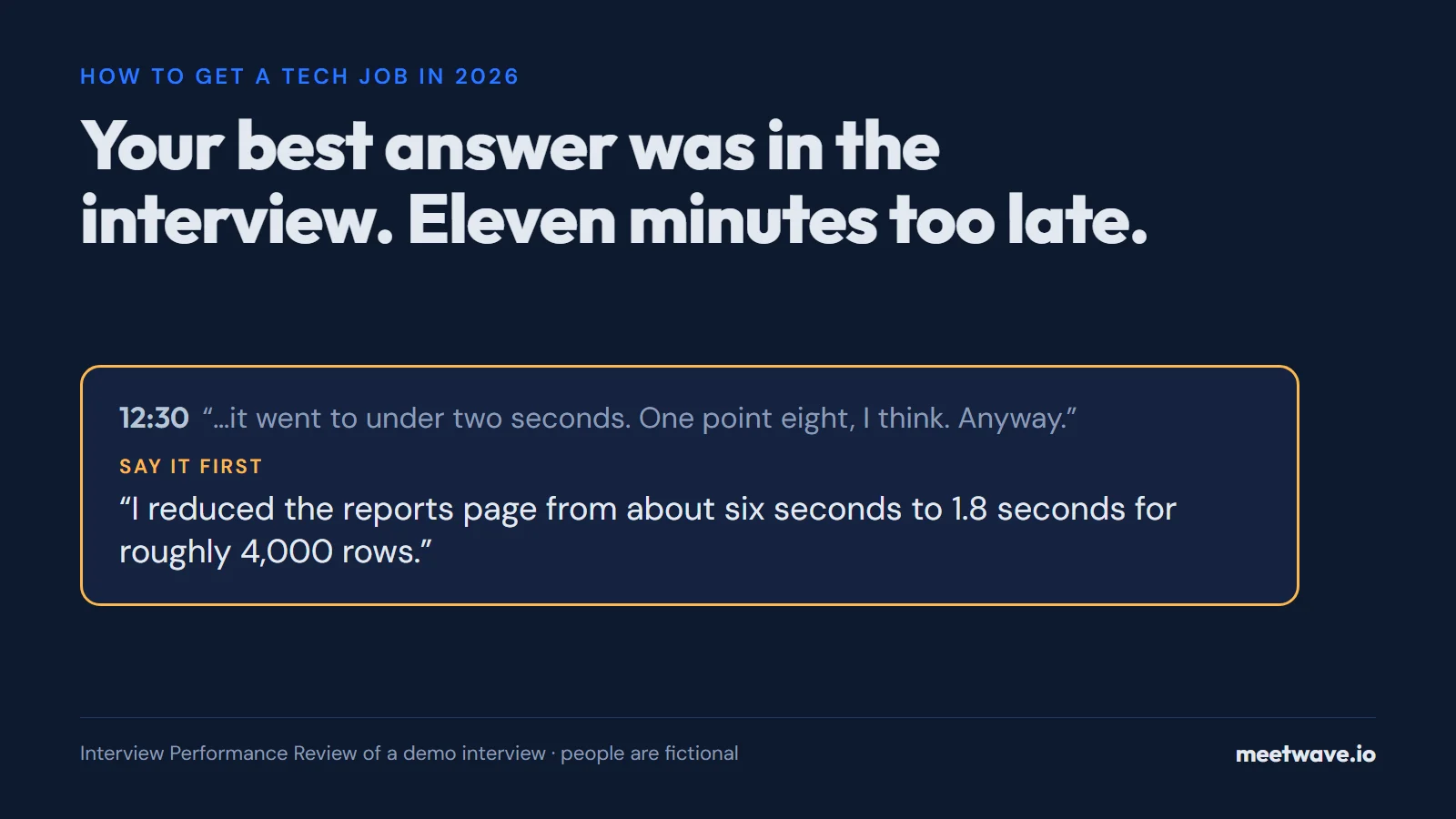
Get a tech job in 2026 by treating every interview as practice you review the same day, because the company will rarely tell you what went wrong. Software developer postings on Indeed are still 21% below February 2020, and an average recruiter processes 291 applications per hire, so each interview you land is scarce. The review has to be about the work, not about you: in a meta-analysis of 607 effects, feedback raised performance on average (d = .41), but over a third of feedback made people worse, more so the closer it pointed at the person instead of the task.
The 2026 tech job market in numbers
The market recovered from its 2025 low, but it has not come back. Indeed's index of US software development job postings stood at 78.9 on October 16, 2026, where February 2020 is 100. It bottomed at 61.1 in May 2025. Postings for all jobs stood at 103.8, so software is the part of the market that is still short.
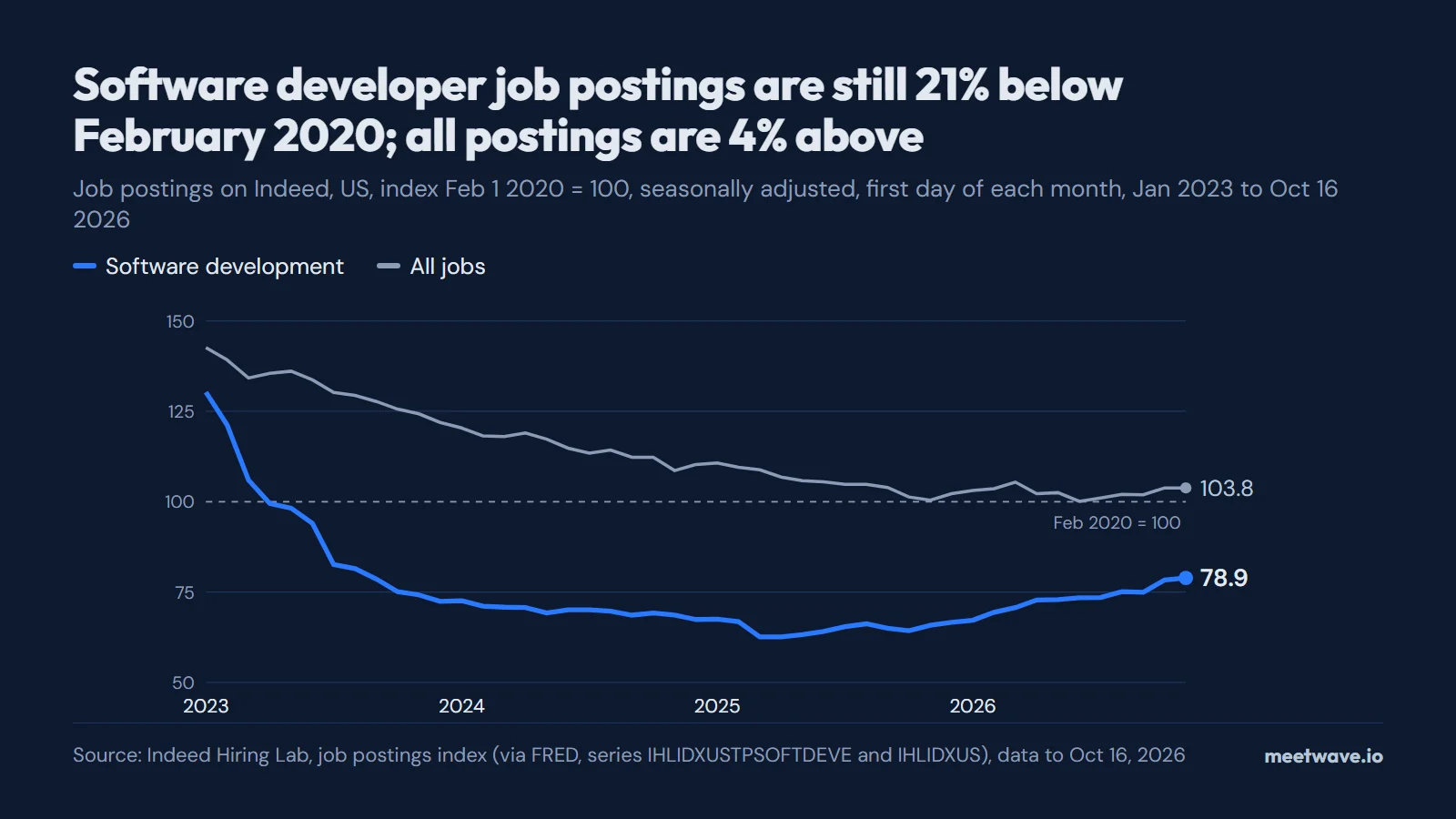 Figure 1. Software developer job postings are still 21% below February 2020, while all postings are above it. Source: Indeed Hiring Lab job postings index via FRED, data to October 16, 2026.
Layoffs did not stop either. Challenger, Gray & Christmas counted 165,925 announced job cuts in technology from January to September 2026, 54% more than the 107,878 a year earlier. Technology accounts for 29% of all cuts announced this year. These are announcements, not confirmed layoffs, but they mean more experienced people are applying for the same openings.
The longer view is calmer. The Bureau of Labor Statistics projects employment of software developers to grow 10.2% from 2025 to 2035, with about 95,300 openings a year. The unemployment rate for computer and mathematical occupations was 3.3% in September 2026, down from 3.9% a year earlier (one month, not seasonally adjusted).
So the jobs exist, there are fewer of them than in 2020, and each one gets a crowd.
Where applications die
No government agency measures how many applications it takes to get hired. Applicant-tracking vendors publish what passes through their systems, so the numbers below are vendor data with their sample sizes:
| Stage | Number | Source |
|---|---|---|
| Applications a recruiter processes per hire | 291 | Ashby, 109M applications, 2021 to March 2026 |
| Interviews per technical hire | 17.6 | Ashby, same data |
| Applications sent through LinkedIn that reached an interview or later | 3.1% | Huntr, 598,627 tracked applications, 2025 |
| Median time to first offer for a job seeker | 57 to 83 days, by quarter of 2025 | Huntr, 57,000+ job seekers |
| Median time to fill a mid-level opening | 63 days | Ashby, 54M applications, 2021 to March 2026 |
Source: Ashby recruiter productivity and recruiting benchmarks; Huntr 2025 job search report, accessed 2026-10-26.
Two things follow. First, an interview is the rare event in this funnel: most applications never get a reply. Second, about 17.6 interviews, across all candidates, go into each technical hire, so a "no" after a call that felt good is the normal outcome, not a sign you are unemployable.
What the funnel does not give you is the reason. Job seekers describe the same silence over and over: "All the conversations seemed to go well so I have no idea what happened" (Hacker News, July 2026). If you want to know what to fix before the next interview, you have to find it yourself.
Review the interview, not yourself
The feedback research is clear on how to do this. Kluger and DeNisi pooled 607 effects of feedback on performance: on average feedback helped, but more than a third of the time it made performance worse, and it helped less the more it pulled attention toward the self ("I'm bad at interviews") and away from the task ("at minute 12 I answered a question about my project without a number").
So a useful interview review has three rules:
- Every point is a moment. A minute of the call and what you said, not a feeling about how it went.
- Every point comes with the fix. The answer you could have given, built only from facts you said yourself.
- The plan is habits, not tasks. The next interview is a different company and a different exercise; what carries over is how you answer, not the answer.
Four interviews, one offer: a demo series
Here is that review on a series of four demo interviews. Maya, a frontend engineer with two years at an insurance software company, applies for mid-level roles in August and September 2026. The people and companies are fictional; the interviews were written as real calls, and MeetWave's Interview Performance Review read each one for her. Every frame below is cut from those notes, and every caption links to the full notes.
Interview 1: the best fact came 11 minutes too late
Asked about a project she was proud of, Maya said the reports page "got a lot faster and people liked it". Asked what her part was: "I mean, it was a team thing, we all worked on it." Asked what faster meant: "noticeably faster."
Eleven minutes later (interview 1 notes), answering a question about rendering 5,000 rows, she said in passing: "it was taking like six seconds to load… I moved it to a virtualized table and split out the chart code, and it went to under two seconds. One point eight, I think. Anyway."
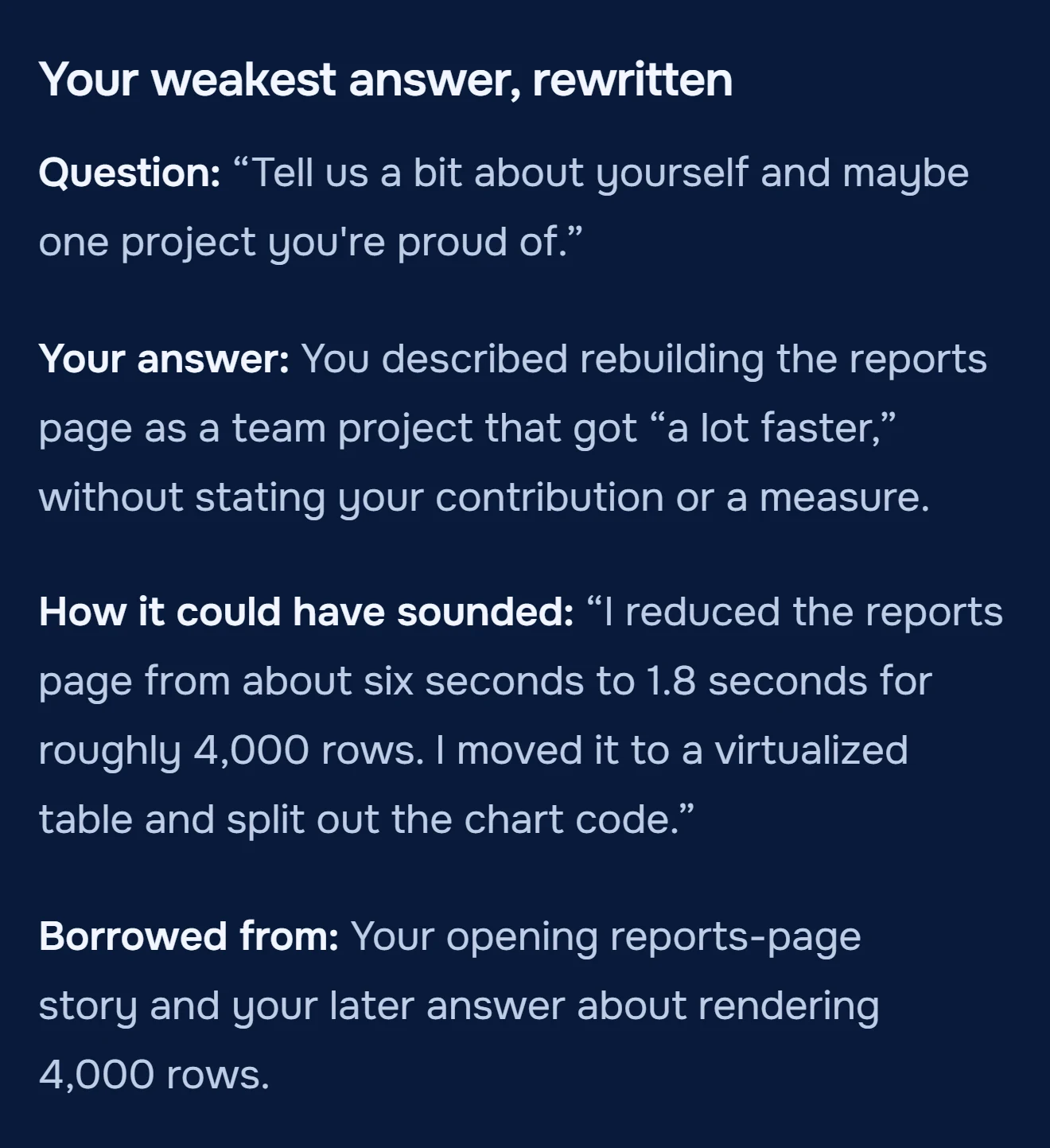 Figure 2. Demo meeting, people are fictional. Interview 1: the 1.8 seconds Maya said in passing at 12:30 is moved to the first sentence of her project answer. Source: demo interview 1, technical screen notes, October 2026.Analyzed with MeetWaveSee the full notesTry it on your next interview
That is the most common way a strong candidate loses a screen: the evidence is in the call, but not where the interviewer is scoring. The rewrite adds nothing new. It moves the number to the first words and says "I" for the work she did alone.
| What Maya said at 01:42 | What to say instead |
|---|---|
| "We kind of rebuilt it, it was a pretty big project, and it got a lot faster and people liked it." | "I reduced the reports page from about six seconds to 1.8 seconds for roughly 4,000 rows. I moved it to a virtualized table and split out the chart code." |
Source: demo interview 1, technical screen notes.
The same review caught the second gap: she started coding a "group transactions by day" function at once, used the UTC date, and found the timezone problem and the empty days only after the interviewer raised them. The study plan turned both into habits for any interview:
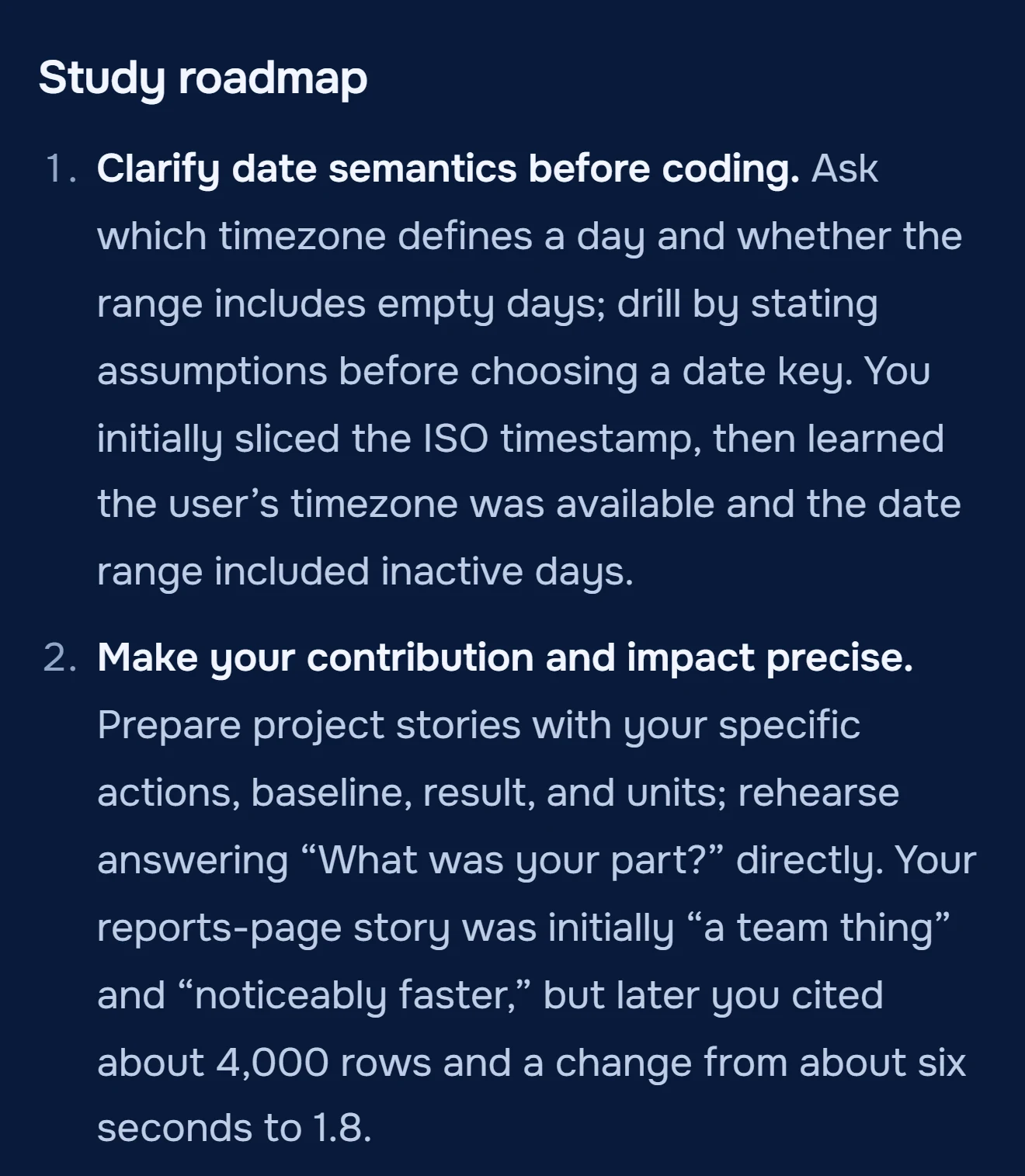 Figure 3. Demo meeting, people are fictional. Interview 1 study plan: two habits, each tied to the moment that showed it was missing. Source: demo interview 1, technical screen notes, October 2026.Analyzed with MeetWaveSee the full notesTry it on your next interview
Interview 2: the project story is fixed, the conflict story is not
Two weeks later Maya opened with the number: "When I picked it up it took six point two seconds to load… it went to one point eight seconds. I did it on my own over two sprints." (interview 2 notes) She also asked about timezones before coding, the habit from interview 1, though she still missed that back-to-back appointments (9:00 to 9:30 and 9:30 to 10:00) should both be bookable.
The new gap was the behavioural question. Asked about a disagreement, she described a backend team that kept breaking the API and ended with "eventually it kind of worked out". Asked what she did: "I brought it up in standup a few times."
A minute later, answering a testing question, she told the real story without noticing it: she had written contract tests against the backend's API file, the build failed before a page broke, there were zero breakages for three months, and the backend lead set the tests up for two more teams.
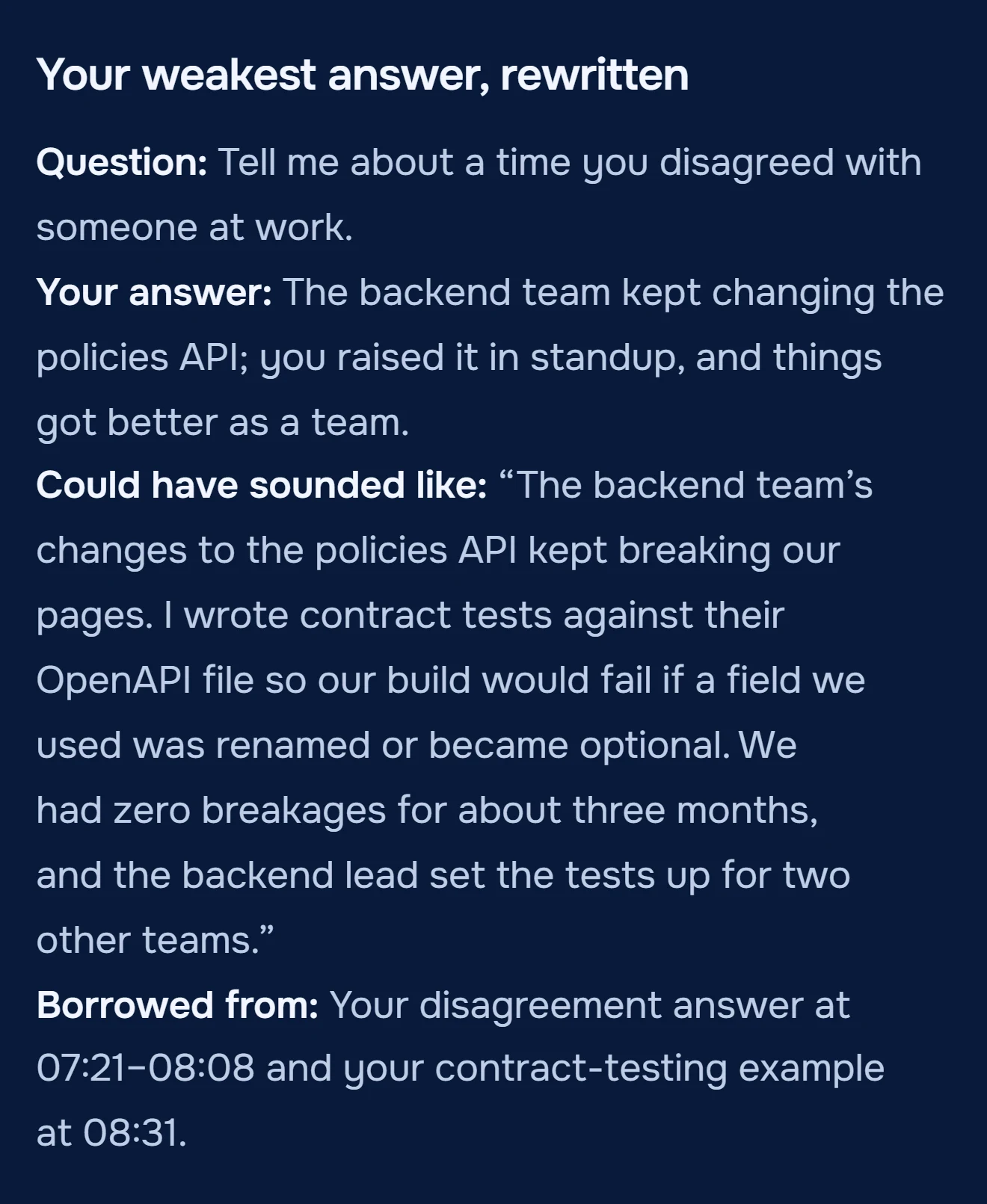 Figure 4. Demo meeting, people are fictional. Interview 2: the conflict answer rebuilt from a result she told a minute later as a separate story. Source: demo interview 2, coding and behavioural notes, October 2026.Analyzed with MeetWaveSee the full notesTry it on your next interview
A story answer has a different order from a project answer, but the same rule: the result with its number is said out loud, and the action is yours.
Situation in one sentence · what I did · the result with its number · who adopted it
Interview 3: the stories hold, the numbers do not
The system design round (interview 3 notes) asked for a live map of 12,000 trucks that each send a position every 10 seconds. Maya asked about scale, frequency, freshness and history before drawing anything, and told the contract-test story in full when asked about a disagreement. Both habits from the first two reviews held.
The new gap was arithmetic (interview 3 notes). She said the design would need "some kind of cache, because it'd be a lot of traffic". Asked how much: "Um, a lot? I'm not sure." Asked to put a number on it, she said 120 writes a second and corrected it to 1,200 only when the interviewer asked her to check.
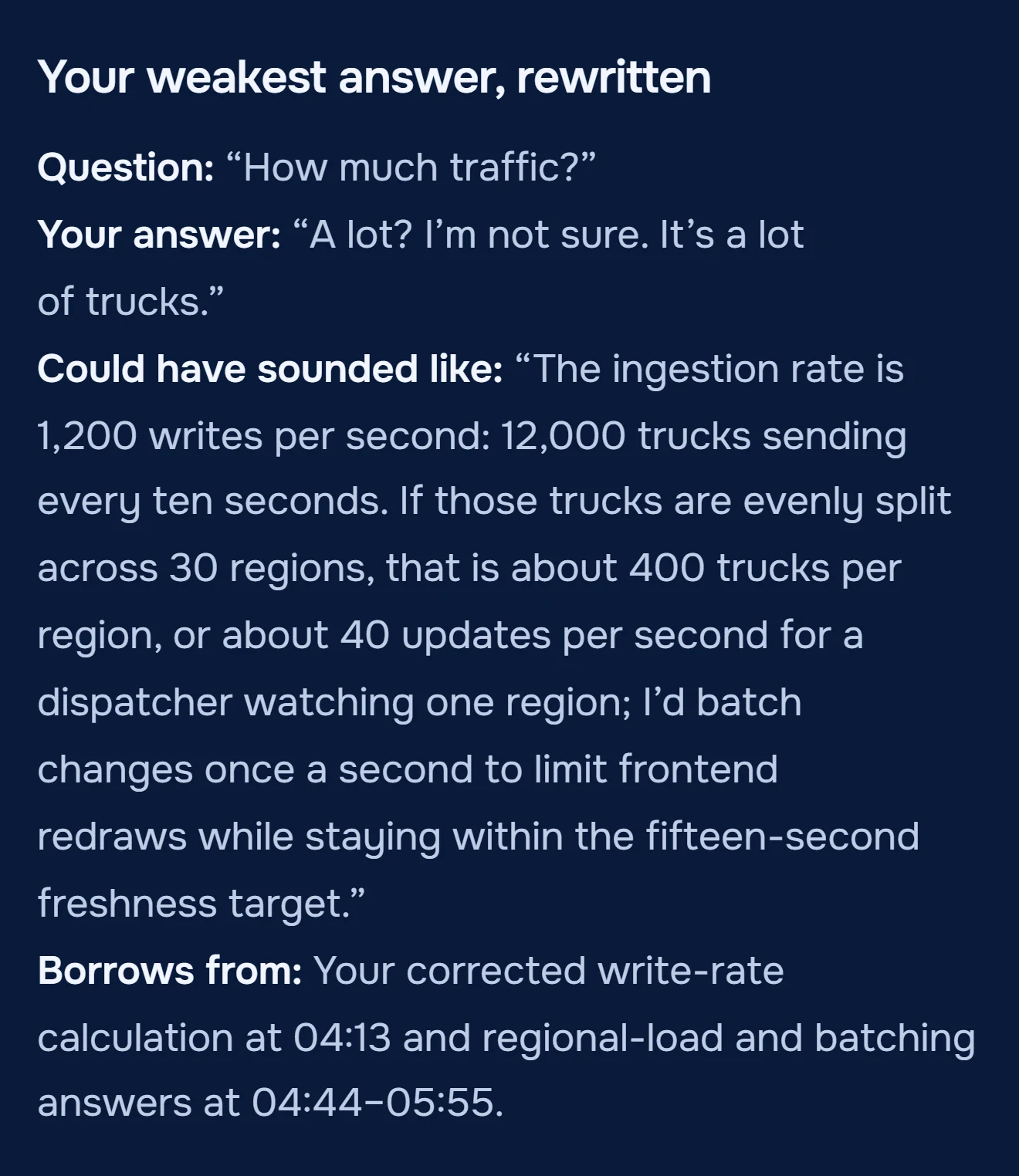 Figure 5. Demo meeting, people are fictional. Interview 3: the traffic question answered with the numbers she worked out later in the same call. Source: demo interview 3, system design notes, October 2026.Analyzed with MeetWaveSee the full notesTry it on your next interview
The fix is one habit: before you name a component, say the load it has to carry, with units, and check the division out loud.
Interview 4: the final round
In the final round (interview 4 notes), asked to design an invoice list for customers with 50,000 invoices, Maya asked about users, paging and freshness first, then estimated without being asked: about 25 MB for every row, about 25 KB a page, a few hundred requests a second. She told a mistake story with its numbers (about 40 users hit a Safari bug, rolled back within an hour, Safari added to the test run). Her one weak answer was honest: on accessibility she knew the basics and had never run an audit.
At the end the director of engineering said: "I'm going to recommend we move forward."
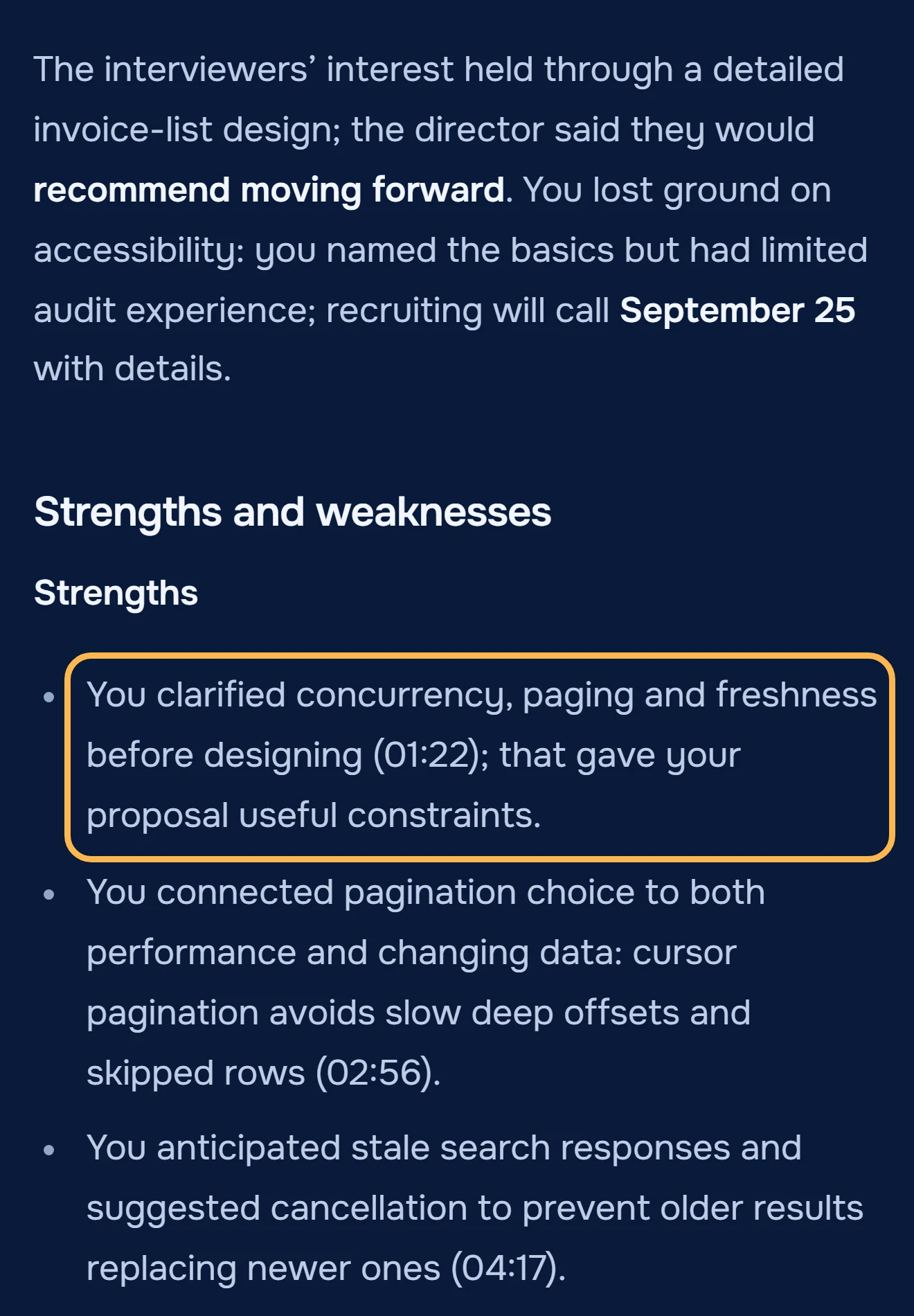 Figure 6. Demo meeting, people are fictional. Interview 4: the habits from the three earlier reviews show up as strengths. Source: demo interview 4, final round notes, October 2026.Analyzed with MeetWaveSee the full notesTry it on your next interview
The four habits across four interviews
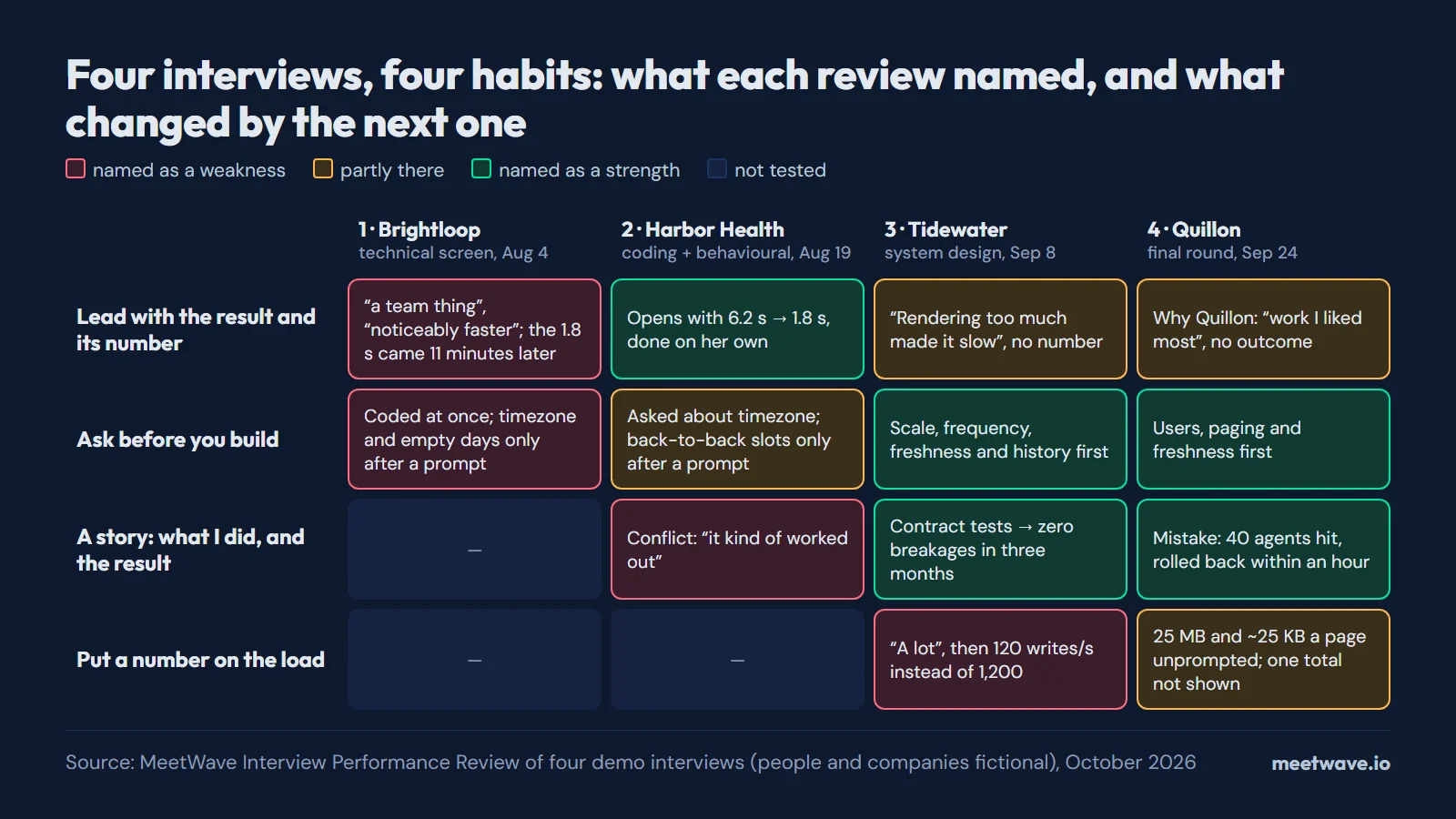 Figure 7. What each review named as a weakness or a strength, habit by habit. Source: MeetWave Interview Performance Review of four demo interviews (people and companies fictional), October 2026.
| Habit | 1 · screen | 2 · coding + behavioural | 3 · system design | 4 · final |
|---|---|---|---|---|
| Lead with the result and its number | weakness | strength | partly | partly |
| Ask before you build | weakness | partly | strength | strength |
| A story: what I did, and the result | not tested | weakness | strength | strength |
| Put a number on the load | not tested | not tested | weakness | partly |
Nothing in the grid is talent. Each row is a habit you can drill in an evening once you know it is the one that cost you.
Write your answers before the next interview
Copy this sheet and fill it from your last interview, your notes or a recording. Every line must be a fact you can say with a number; if there is no number yet, find it before the call.
INTERVIEW ANSWER SHEET — [company], [round], [date]

1. Project I'm proud of (result first)
   I [cut / grew / saved] [what] from [before] to [after], [per period].
   What I did: [one sentence, "I", not "we"].
   How long it took / who used it: [fact].

2. A disagreement (situation · what I did · result)
   Situation: [one sentence].
   What I did: [the action you took, not "we talked about it"].
   Result: [the number] — and who adopted it: [team / person].

3. A mistake (what broke · how fast I fixed it · what I changed)
   [What broke, for how many people] · [fixed within …] · [the change that stopped it repeating].

4. Before I code or design, I ask
   - Input: format, timezone, size.
   - Edges: empty, duplicates, boundaries (does 9:30 end touch 9:30 start?).
   - Load: how many users, how often, how fresh.

5. The load, out loud
   [count] × [rate] = [per second], check: [division again].

6. My questions for them, from what they said
   - You mentioned [their problem] — how often does it happen and who owns it?
Do it tonight: a mock interview with a review
You do not need a real interview to practise the review. A mock interview with a friend or a colleague, recorded with their consent, gives the same material:
- Pick a real job post and ask your partner to run a 30-minute round from it: five minutes of background, one exercise, one behavioural question, five minutes of your questions.
- Record the call with their consent. Tell them at the start, and keep the recording for yourself.
- Get the review the same evening: the moments where they pressed longest, your weakest answer rewritten from your own facts, and the habits to drill. In MeetWave this is the Interview Performance Review template; without it, play the recording back with the three rules above and the answer sheet open.
- Fill in the answer sheet from what you actually said, and move every number you said late into the first sentence of its answer.
- Drill one habit, not five, before the next round. Maya fixed one or two per interview.
MOCK INTERVIEW CHECKLIST

Before
[ ] Job post chosen; partner has it 24 hours before
[ ] Partner agreed to be recorded; recording is for my review only
[ ] Timer: 5 min background · 15 min exercise · 5 min behavioural · 5 min my questions

After (same evening)
[ ] Three moments where they pressed longest, with minutes
[ ] My weakest answer, rewritten from facts I said myself
[ ] Every number I said late, moved to the first sentence of its answer
[ ] One habit to drill before the next interview
[ ] Answer sheet updated
Recording interviews: consent first
Record an interview only when everyone on the call agrees, and say so at the start. In some US states every party must consent: Florida's statute 934.03, for example, makes intercepting a conversation lawful when all of the parties have given prior consent. In the EU a recording of a person is personal data under the GDPR, information relating to an identifiable person, so the people in it have to know. Many interviewers will say no to a recording, and that is their right.
When they do, the method still works: write down the questions and your answers within an hour of the call, with the minute you remember them at, and review those notes with the same three rules. Mock interviews are the safe default for recording. This is not legal advice.
Key numbers
- Indeed's US software development postings index: 78.9 on October 16, 2026 (February 2020 = 100); low 61.1 in May 2025; all postings 103.8 (Indeed Hiring Lab via FRED).
- Announced technology job cuts: 165,925 in January to September 2026, up 54% from 107,878 a year earlier; 154,445 in 2025 and 133,988 in 2024 (Challenger, Gray & Christmas).
- Projected growth of software developer employment, 2025 to 2035: 10.2%, about 95,300 openings a year (BLS Employment Projections).
- Unemployment rate, computer and mathematical occupations: 3.3% in September 2026, 3.9% a year earlier, not seasonally adjusted (BLS CPS table A-30).
- Applications a recruiter processes per hire: 291; interviews per technical hire: 17.6 (vendor data, Ashby).
- Feedback raised performance on average by d = .41 across 607 effects, and lowered it in over a third of cases (Kluger & DeNisi, 1996).
How we calculated
- 21% below February 2020 is 100 minus Indeed's index value of 78.86 on October 16, 2026, from the FRED series IHLIDXUSTPSOFTDEVE (seasonally adjusted, 7-day). The chart plots the first day of each month from January 2023 and the latest day.
- The four interviews are demo meetings written for this article: fictional people and companies, one transcript each, the gaps planted before the transcripts were written. Each was read once by MeetWave's Interview Performance Review on October 26, 2026; the frames and the linked notes are that run, unedited.
- The habit grid is our reading of those four reviews: a cell is "weakness" when that review lists the habit among the weaknesses or rewrites the answer for it, "strength" when it lists it among the strengths, "partly" when it names both, and "not tested" when the interview did not ask for it.
- Vendor numbers (Ashby, Huntr) come from the vendors' own pages with their sample sizes; they describe people who use those products, not the whole market.
FAQ
Is it hard to get a tech job in 2026?
Harder than in 2020 and easier than in 2025. Software development postings on Indeed are 21% below February 2020 but up from 39% below in May 2025, and unemployment in computer and mathematical occupations was 3.3% in September 2026. The difficulty is volume: an average recruiter sees 291 applications per hire, so each interview you get matters more.
How do I get into tech with no experience?
Get to interviews with something you can show, then get better at each interview faster than other candidates. Build one project with a result you can measure (load time, users, hours saved) and say that number first. Practise with mock interviews, recorded with consent and reviewed the same day, before you spend real interviews.
How many applications does it take to get a tech job?
No public dataset answers this for job seekers as a whole. On the hiring side, an average recruiter using Ashby processes 291 applications per hire. In Huntr's 2025 data from people tracking their own search, about 38% of those who got an offer needed 30 or fewer applications, and about 18% needed more than 100.
Why do I keep failing technical interviews?
Usually for a reason you can see in the call: an answer without a number, a story without your own action, an exercise started before asking about the input. Companies rarely say which. Review each interview by its moments, rewrite your weakest answer from facts you said yourself, and drill one habit before the next round.
How do I know if an interview went well?
Look at where the interviewers dug longest and whether you got out of it yourself, not at how friendly the call felt. Questions repeated, "and what if…" scenarios and requests to check a calculation mark the parts they are scoring. A clear next step with a date, said by the interviewer, is a better sign than praise.
Can I record a job interview?
Only with the consent of everyone on the call; in some US states all parties must agree by law. Ask at the start and accept a no. Mock interviews are the safe place to record; after a real one, write down the questions and your answers within an hour and review those.
Sources
- Indeed Hiring Lab. Software Development Job Postings on Indeed in the United States (IHLIDXUSTPSOFTDEVE) and Job Postings on Indeed in the United States (IHLIDXUS), via FRED, Federal Reserve Bank of St. Louis. https://fred.stlouisfed.org/series/IHLIDXUSTPSOFTDEVE (data to October 16, 2026), accessed 2026-10-26.
- Challenger, Gray & Christmas. The Challenger Report, September 2026. https://www.challengergray.com/wp-content/uploads/2026/10/Challenger-Report-September-2026.pdf, and December 2025, https://www.challengergray.com/wp-content/uploads/2026/01/Challenger-Report-December-2025.pdf accessed 2026-10-26.
- U.S. Bureau of Labor Statistics. Employment Projections, Occupational projections 2025–35, Table 1.2. https://www.bls.gov/emp/tables/emp-by-detailed-occupation.htm accessed 2026-10-26.
- U.S. Bureau of Labor Statistics. Current Population Survey, Table A-30, Unemployed persons by industry and occupation. https://www.bls.gov/web/empsit/cpseea30.htm accessed 2026-10-26.
- Ashby. Recruiter Productivity, Talent Trends Report (April 2026). https://www.ashbyhq.com/talent-trends-report/reports/2023-recruiter-productivity-trends-report, and Recruiting Operations Benchmarks (May 2026), https://www.ashbyhq.com/talent-trends-report/reports/recruiting-operations-benchmarks-talent-trends accessed 2026-10-26.
- Huntr. 2025 Annual Job Search Trends Report. https://huntr.co/research/2025-annual-job-search-trends-report accessed 2026-10-26.
- Kluger, A. N., & DeNisi, A. (1996). The effects of feedback interventions on performance: A historical review, a meta-analysis, and a preliminary feedback intervention theory. Psychological Bulletin, 119(2), 254–284. https://doi.org/10.1037/0033-2909.119.2.254, accessed 2026-10-26
- Florida Statutes § 934.03, Interception and disclosure of wire, oral, or electronic communications. https://www.flsenate.gov/Laws/Statutes/2025/934.03 ; Regulation (EU) 2016/679 (GDPR), Article 4(1). https://gdpr-info.eu/art-4-gdpr/ accessed 2026-10-26.
Still comparing tools?
See how MeetWave stacks up against the tools most teams evaluate alongside it.
- MeetWave vs GranolaSee how MeetWave compares to Granola for bot-free meeting notes
- MeetWave vs TactiqSee how MeetWave compares to Tactiq for meeting transcripts
- MeetWave vs NottaSee how MeetWave compares to Notta for meeting transcription
More on this: Meeting minutes template