How Do You Write CRM Notes After a Sales Call?
A CRM note after a sales call needs ten fields with values, not impressions: stage, amount, decision date, hard deadline, who decides, who signs, competitor, the buyer's priorities, the next step with a date, and what you promised. In our test on a 35-minute demo call, a note from memory got 5 of 10 fields right and one wrong. Pasting the call notes and checking them got 10 of 10 in about 3 minutes, against 38 minutes for re-listening to the recording. Memory fades fast: a week after a conversation, both partners recalled only 4.7% of its details.
What a CRM note after a sales call must hold
A CRM note is for the person who reads it next: your manager building the forecast, or you before the next call. So each field holds the buyer's value, with a number or a date, and the minute it was said. The table shows the ten fields filled from our demo discovery call: a seller, Mia, and a solutions engineer, Ben, talk to Ingrid, head of operations at a logistics company with 140 trucks.
| Field | The demo call | Minute |
|---|---|---|
| Stage | Discovery done | whole call |
| Amount | About €60,000 a year approved | 18:35 |
| Decision date | Choose by mid-December; budget closes in December | 17:03 |
| Hard deadline | Current vendor ends March 31 | 06:01 |
| Decision maker | Ingrid, head of operations, chooses | 11:47 |
| Signer | Marit Olsen, CFO, signs over €50,000 | 11:47 |
| Competitor | FleetLoop, about €32 per vehicle per month | 19:18 |
| Buyer's priorities | Driver adoption and integration equal, price third | 33:53 |
| Next step | Integration deep-dive, Thursday October 15, 2:00 p.m. | 29:27 |
| Our commitments | Proposal and case study by Friday October 9, Mia | 31:09 |
Source: demo discovery call, transcript minutes, October 2026; scoring rules in How we calculated.
A good note and a bad note of the same call
A bad note records how the call felt; a good note records what the buyer said. The bad note below was written for this article from the seller's own lines on the demo call: her "next step" is the proposal the buyer turned down, and her list of concerns is in the order the buyer corrected. Figure 1 puts each line next to the minute that contradicts it.
Great call with Halverson, very engaged. Budget OK. Closing Q4. Concerns: integration, drivers, price. Next step: pricing workshop. Sending proposal Friday.
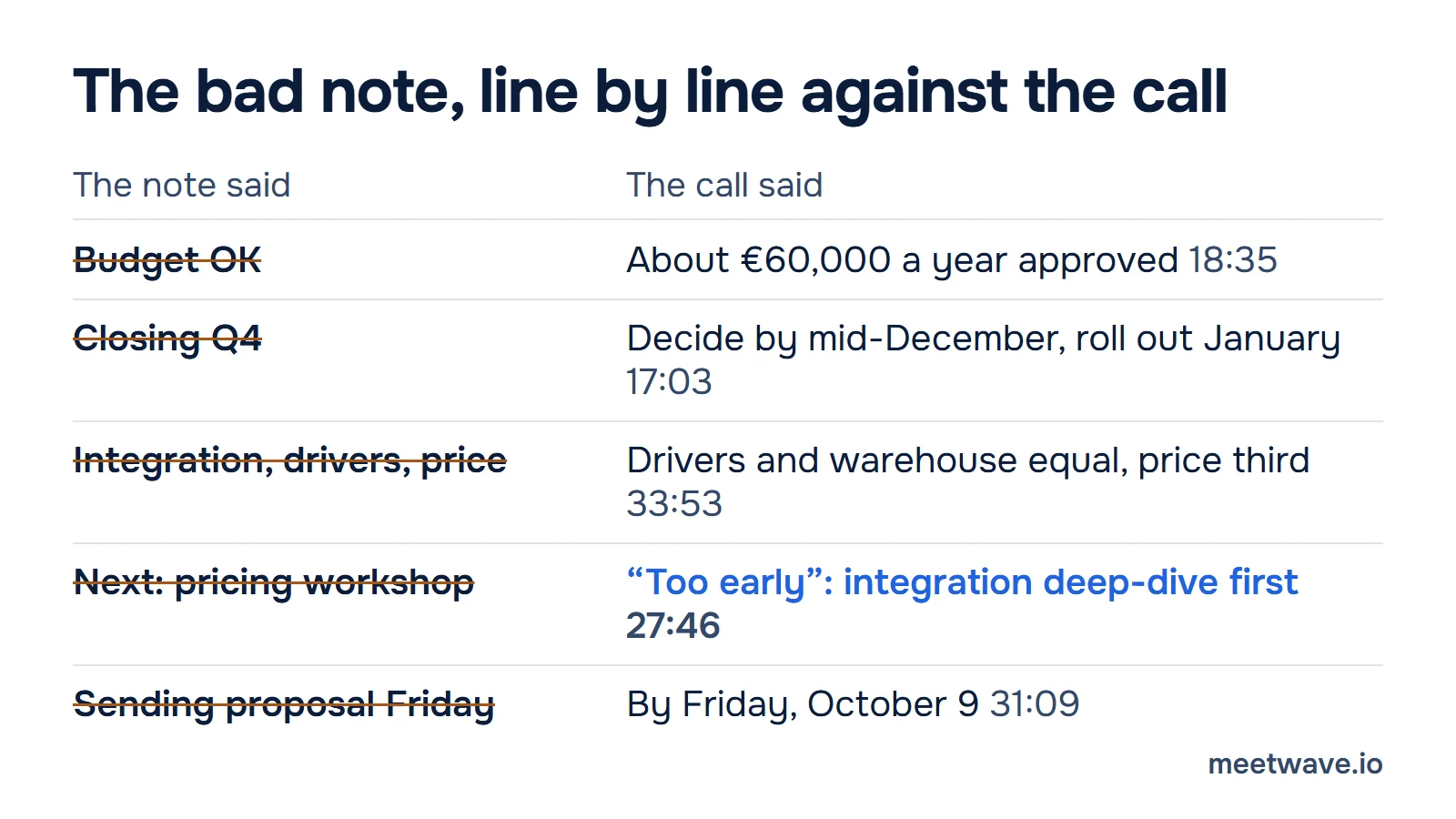
 Figure 1. Every line of the bad note is contradicted by a minute of the call. Source: MeetWave review of the demo discovery call, October 2026.
The worst line is the next step. At 27:11 the seller proposed a pricing workshop with the CFO; at 27:46 the buyer said "I think it's too early" and asked for a technical session first (demo call). A note written from what the seller wanted puts the deal one stage ahead of where it is, and the forecast inherits it.
The good note of the same call, built with the template at the end of this article:
Account: Halvorsen Logistics
Stage: Discovery done, October 6, 2026
Amount: about €60,000 a year approved for planning and tracking together
Decision date: Ingrid chooses by mid-December; budget closes in December
Hard deadline: current tracking contract ends March 31; no gap on April 1
Decision maker: Ingrid Sato, Head of Operations, chooses the tool
Signer: Marit Olsen, CFO, signs anything over €50,000
Competitor: FleetLoop, about €32 per vehicle per month, "all included"
Buyer's priorities: driver adoption and warehouse integration equal; price third
Next step: integration deep-dive, Thu October 15, 2:00 p.m. Hamburg, Ben + IT
Our commitments: proposal for 140 vehicles + case study, Mia, by Fri October 9
Not promised: all three depots live by March 31; keeping the old boxes
Where each CRM field comes from in the call notes
Six deal fields come from three blocks of the call notes: the CRM note, the deal snapshot and the next steps (Figure 2). MeetWave's Sales Call Intelligence ends every recorded sales call with these blocks, ready to paste. Each row of the table in Figure 2 names a block that exists in the demo call's notes, so the field can be traced back to the minute it came from.
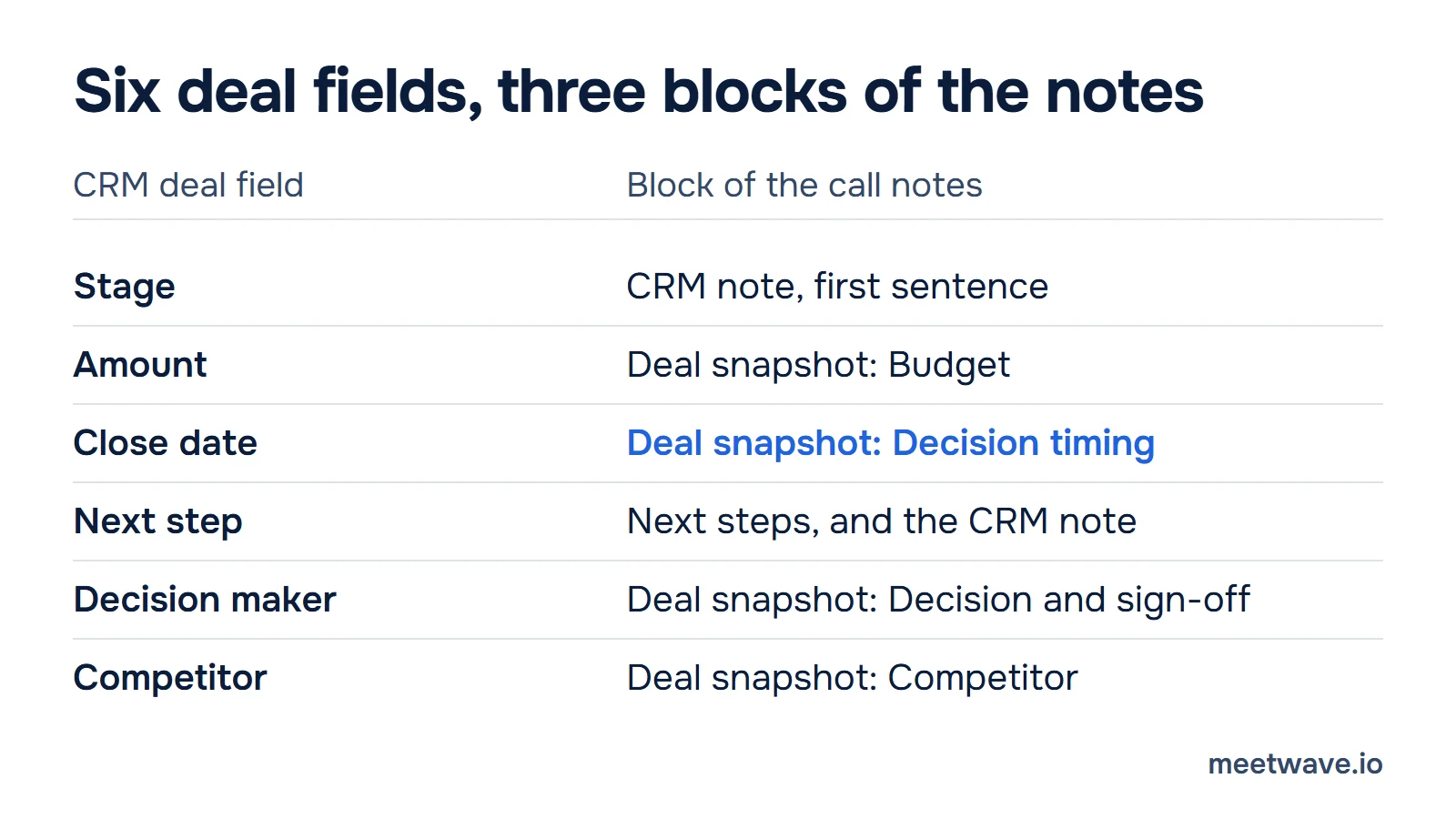
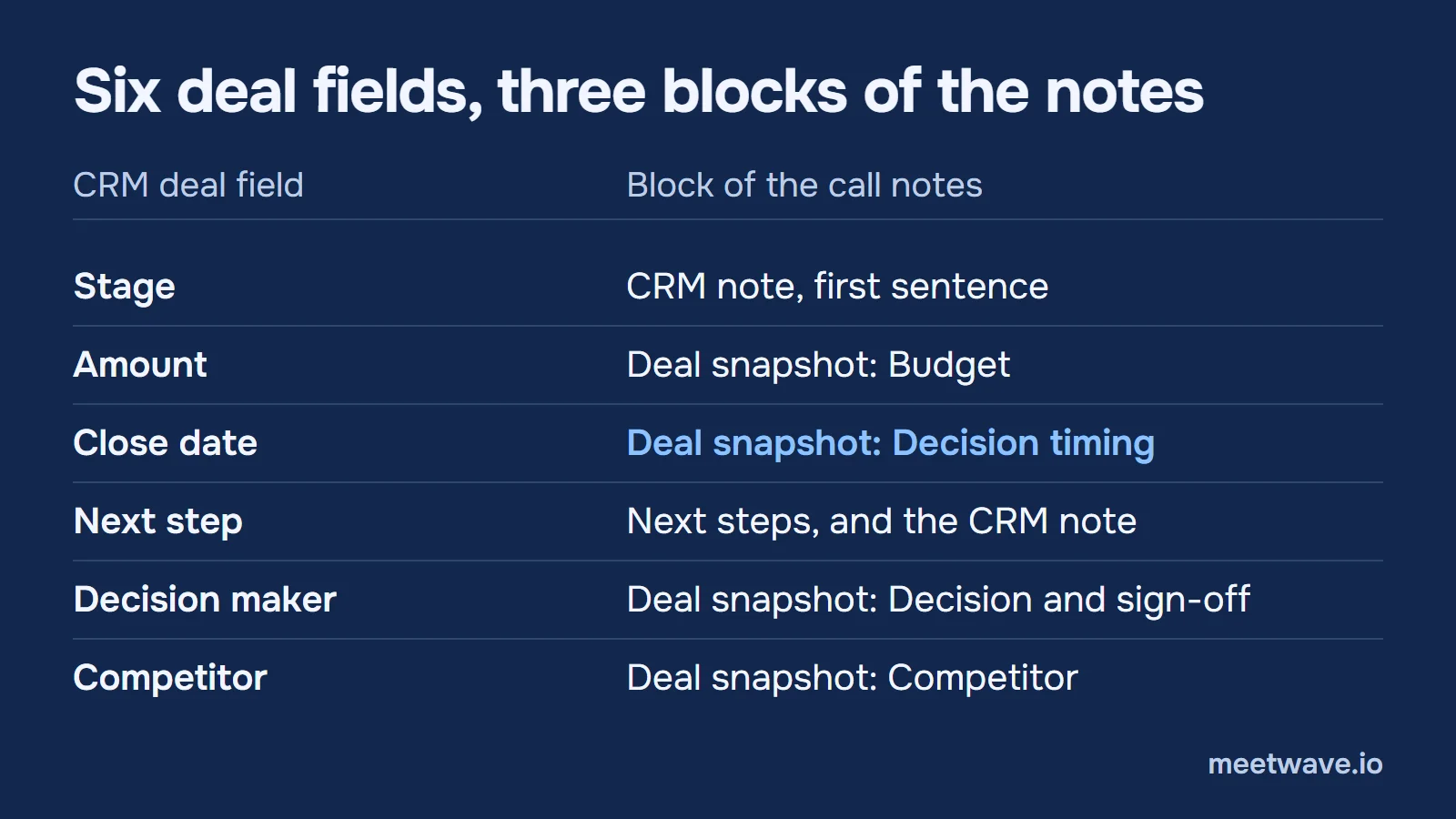 Figure 2. Six deal fields, three blocks of the call notes. Source: MeetWave mapping of the demo discovery call, October 2026; method in How we calculated.
The short CRM note is not enough on its own. Pasted as it is, it carried 6 of the 10 fields: amount, competitor, the buyer's priorities and the hard deadline sit in the deal snapshot instead (How we calculated). Figure 3 rings those four rows.
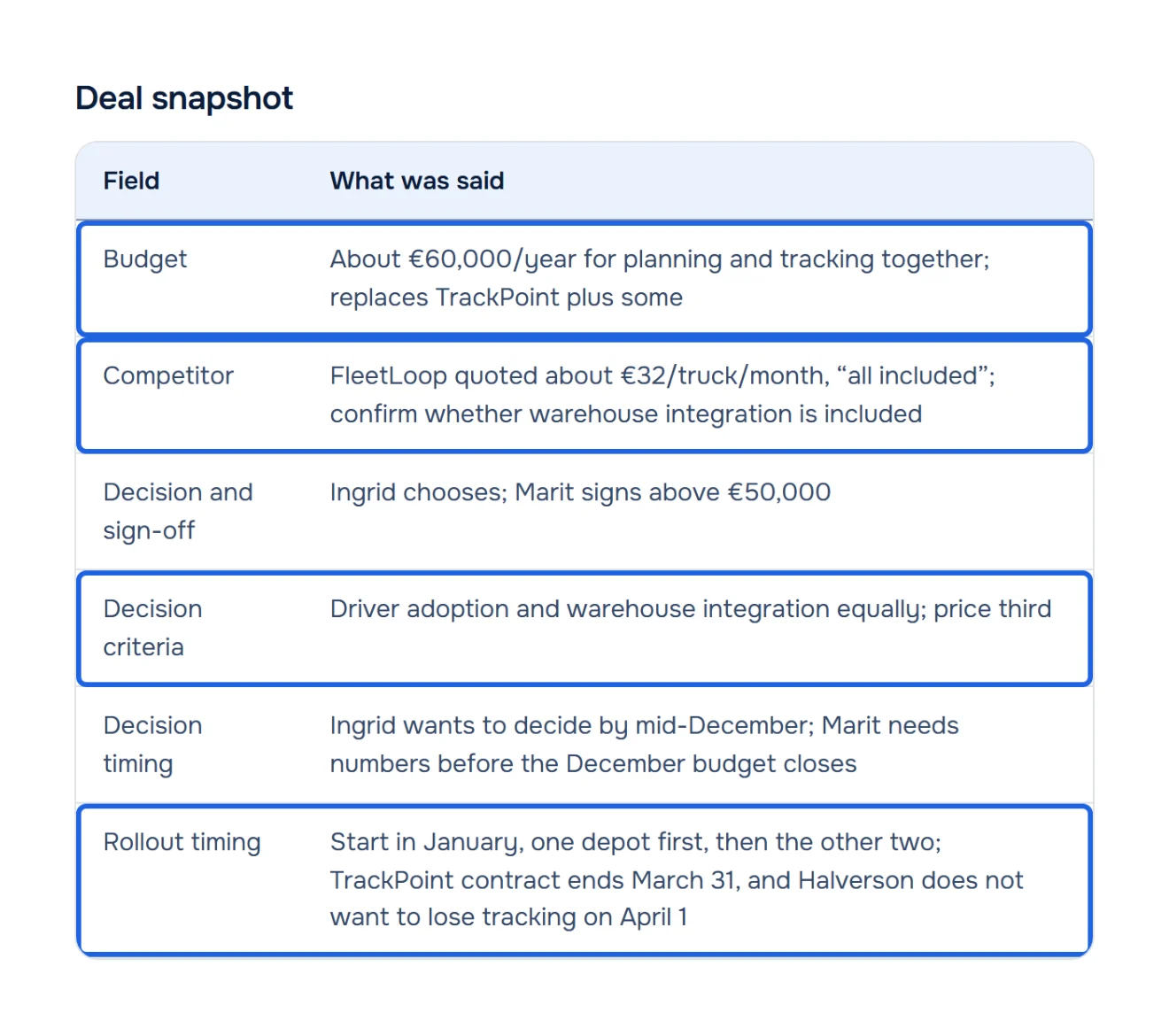
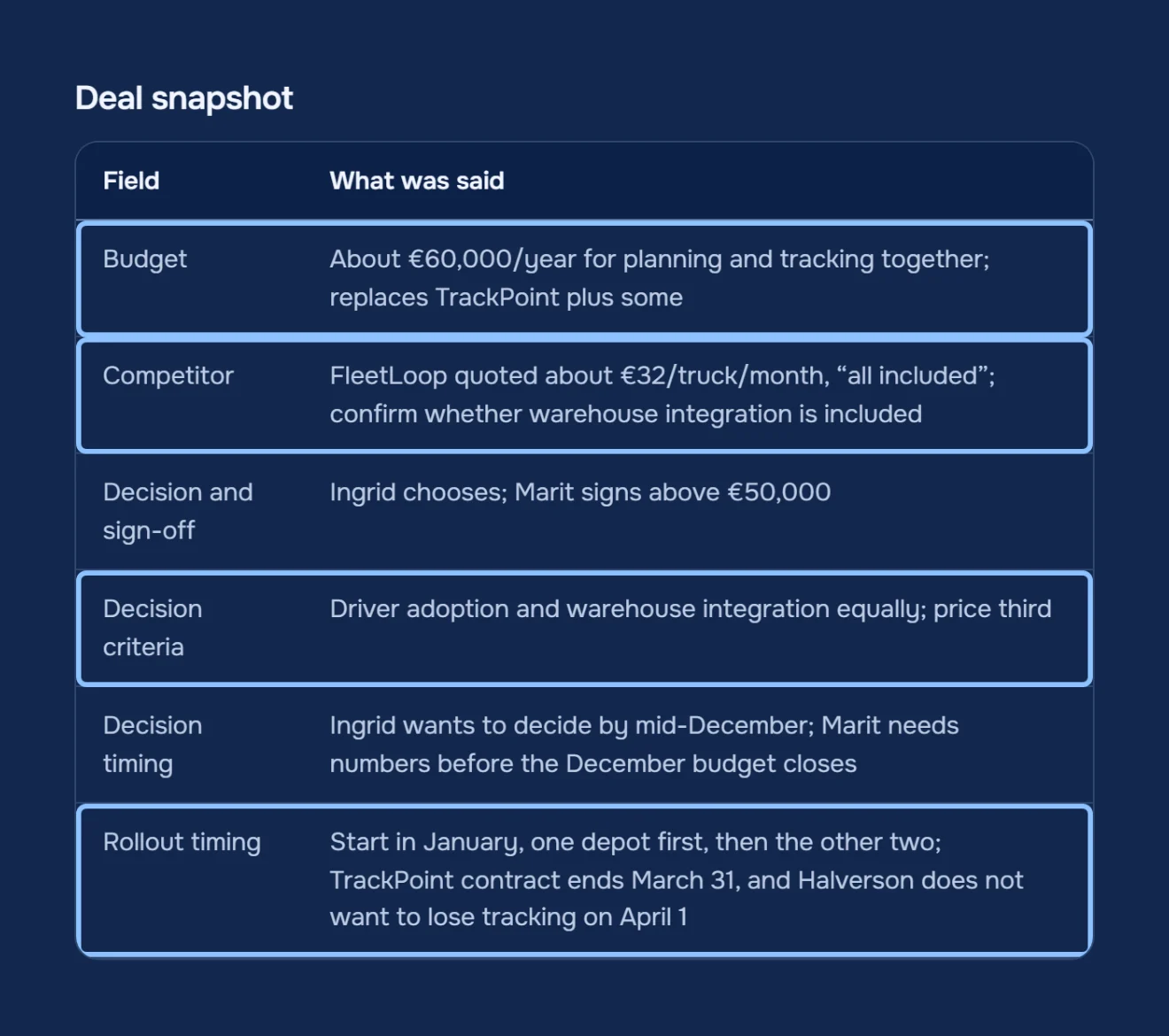 Figure 3. Demo meeting, people are fictional. The four ringed rows are the fields the short CRM note leaves out. Source: demo discovery call, Sales Call Intelligence notes, October 2026.Analyzed with MeetWaveSee the full notesTry it on your next sales call
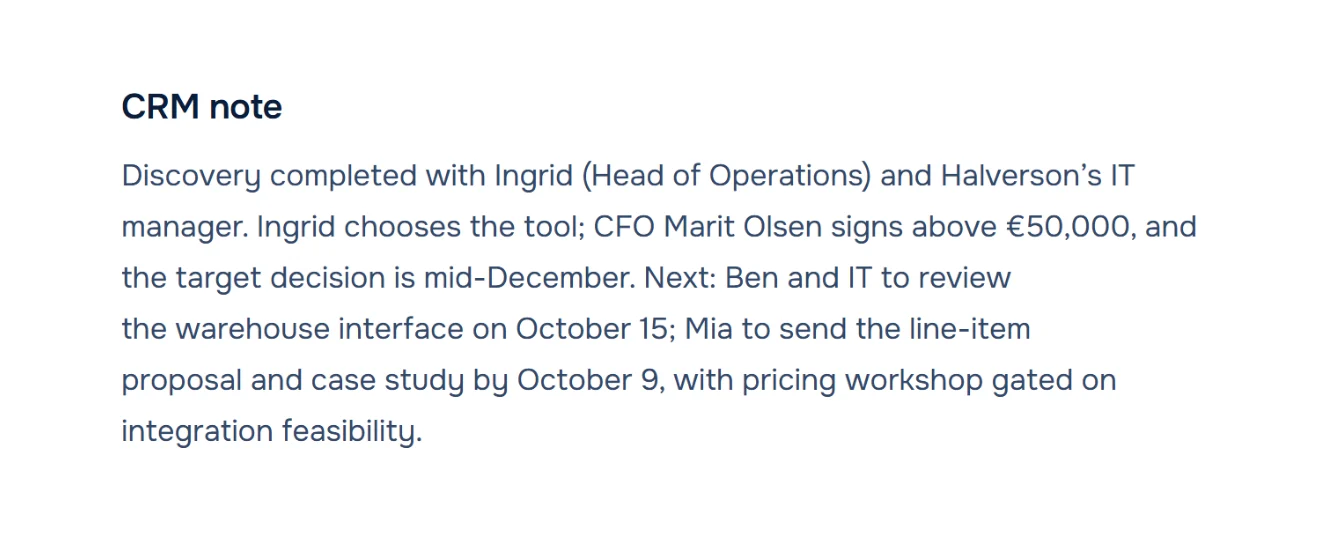
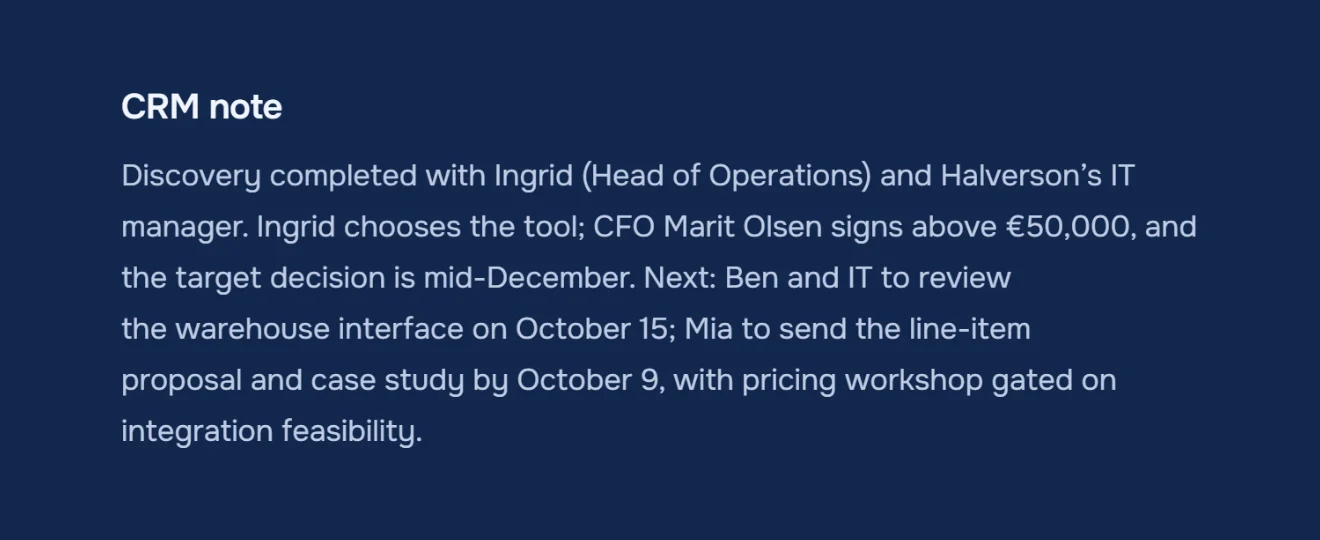 Figure 4. Demo meeting, people are fictional. Stage, decision maker, signer, decision date, next step and commitments: 6 of 10 fields. Source: demo discovery call, Sales Call Intelligence notes, October 2026.Analyzed with MeetWaveSee the full notesTry it on your next sales call
The check pass caught one more thing: the notes spell the account "Halverson", as the name was heard on the call, while the company is Halvorsen. A pasted note is read once before it is saved; the account name, the amount and the next-step date are the three things to check (demo call).
How long each note took in our test
In our test, pasting the call notes and checking them took about 3 minutes and got 10 of 10 fields right; re-listening to the 35-minute recording to get the same 10 took 38 minutes (Figure 5). The note from memory was the seller's own recap at minute 33, said aloud before the call ended: the best case for memory, not a note typed at 6 p.m. It still got 5 of 10 fields right, 2 partly, missed 2 and put the buyer's priorities in the wrong order (How we calculated).
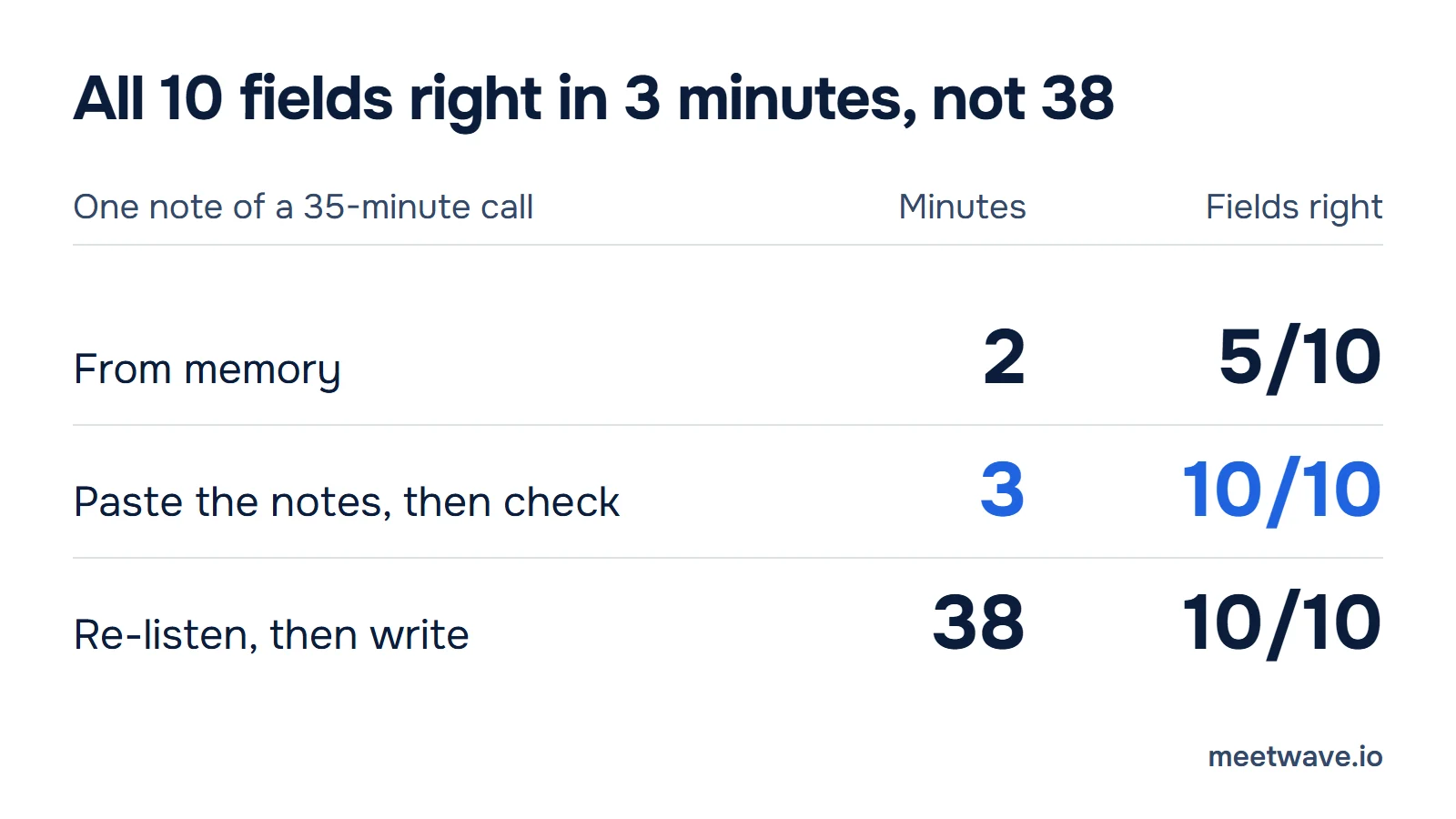
 Figure 5. All 10 fields right in 3 minutes, not 38. One calculated note per method on one demo call, not a population benchmark. Source: MeetWave test, November 2026; reading and typing rates from Brysbaert (2019) and Dhakal et al. (2018).
| Method | Minutes | Right | Partly | Missing | Wrong |
|---|---|---|---|---|---|
| From memory (seller's recap at 33:09) | 2 | 5 | 2 | 2 | 1 |
| Paste the short CRM note as it is | 0.2 | 6 | 0 | 4 | 0 |
| Paste the notes, add 4 snapshot rows, check | 3 | 10 | 0 | 0 | 0 |
| Re-listen to the recording, then write | 38 | 10 | 0 | 0 | 0 |
Source: our test on the demo discovery call, November 2026.
These are calculated minutes for one note of one call, not a stopwatch average across sellers. The point is the shape: memory is fast and wrong, re-listening is right and slow, and only the paste is both (How we calculated).
How much of a seller's week goes to admin
Sellers said they spend 28% of their week actually selling, in a Salesforce survey of 7,775 sales professionals in 38 countries, run from August 24 to September 30, 2022. The rest goes to "other tasks like deal management and data entry" (Salesforce, State of Sales, 2022). It is a vendor survey of self-reported time, and Salesforce sells a CRM.
Writing the note right away also helps the memory itself. In a study of pairs who talked and were tested a week later, the partner who wrote a note of the conversation shortly after it recalled more details than the one who did not (Brown-Schmidt et al., Cognitive Science, 2023).
A CRM note template you can copy
The template has one line per field and says what each line needs. Leave a line as "not discussed" rather than guessing: an empty field is the agenda of your next call, a guessed one is a wrong forecast (demo call).
Account:
Stage: (what this call completed, with the date)
Amount: (the buyer's number, or "not discussed")
Decision date: (the buyer's date and the reason behind it)
Hard deadline: (contract end, budget close, or "none said")
Decision maker: (name, title, what they decide)
Signer: (name, title, threshold)
Competitor: (name and their quote, or "none named")
Buyer's priorities: (in the buyer's order; corrected if they corrected you)
Next step: (what, absolute date and time, who)
Our commitments: (what, absolute date, owner)
Not promised: (what you said is possible but did not commit to)
What never goes into a CRM note, each from a line of the demo call:
- A promise you cannot keep yet. The engineer said all three depots live by March 31 was "tight, but possible. I wouldn't promise it today" (32:40); it goes under "Not promised", not into the plan.
- A guess written as a fact. "Closing Q4" when the buyer said she decides by mid-December and the CFO signs after.
- Your proposal as the next step. The next step is what the buyer agreed to, with a date.
- Relative dates. "Friday" means nothing in a week; write October 9.
- Opinions about the call. "Great call, very engaged" fills no field.
The sales call notes template is a free page for writing up the call itself when there is no recording.
Recording sales calls: consent first
Record a sales call only when everyone on it agrees, and say so at the start; in some US states every party must consent, and in the EU a recording of a person is personal data under the GDPR. Without a recording, write the note within an hour, with the same twelve lines. This is not legal advice.
Key numbers
- In our 2026 test on a 35-minute demo call, a CRM note from the seller's memory got 5 of 10 fields right and 1 wrong (How we calculated).
- Pasting the call notes and checking them got 10 of 10 fields in about 3 minutes; re-listening to the recording took 38 minutes for the same 10 (How we calculated, 2026).
- The short CRM note pasted as it is carried 6 of 10 fields; amount, competitor, priorities and the hard deadline were in the deal snapshot (demo call notes, 2026).
- Sales reps said they spend 28% of their week actually selling (Salesforce survey of 7,775 sales professionals, 2022) (Salesforce).
- A week after a conversation, both partners recalled only 4.7% of its details (Brown-Schmidt et al., Cognitive Science, 2023).
How we calculated
We wrote the ten reference fields of the demo discovery call from its transcript, each with the minute it was said, and scored three notes against them in November 2026. Right means the value matches the call, with a number or an absolute date where the field has one; partly means it is there without the number or with a relative date; wrong means it contradicts the call.
- From memory: the seller's own recap at 33:09–34:28, written down as a note (110 words). Minutes = words typed ÷ 51.56 words per minute, the mean of 168,000 typists in Dhakal et al., CHI 2018. Recall time is not counted, so 2 minutes is a floor.
- Paste and check: read the CRM note, deal snapshot, next steps and unverified promises (450 words) at 238 words per minute, the silent reading rate for English non-fiction in Brysbaert, 2019, and type the 36 words of the good note that are not in those blocks, field labels included: about 3 minutes.
- Re-listen: the full recording at normal speed (2,111 seconds) plus typing the 144-word good note at the same rate: 38 minutes. Skipping or speeding up the audio cuts this, and makes missed fields more likely (How we calculated).
The typing rate comes from copying given sentences; composing a note is slower, so every typing time here is a lower bound (Dhakal et al., 2018). One person timing the three passes with a stopwatch would replace these inputs; we report a calculation on one demo call, not a benchmark.
FAQ
How do you write good CRM notes?
Write one line per field with the buyer's value, a number or an absolute date, and the minute it was said; leave a field "not discussed" rather than guessing. In our test, the notes that followed this rule got 10 of 10 fields right (How we calculated).
What should be in sales call notes?
Stage, amount, decision date, hard deadline, decision maker, signer, competitor, the buyer's priorities in their order, the next step with a date, and what you promised. The table at the top shows each one filled from a demo call.
How do you reduce CRM data entry?
Record the call with everyone's consent and paste notes that already hold the fields, then check the account name, the amount and the next-step date. That took about 3 minutes in our test, against 38 for re-listening (How we calculated).
Sources
- Brown-Schmidt, S., Jaeger, C. B., Evans, K., & Benjamin, A. S. — MEMCONS: How Contemporaneous Note-Taking Shapes Memory for Conversation, Cognitive Science (2023). Accessed 2026-11-09.
- Salesforce — New Research Reveals Sales Reps Need a Productivity Overhaul – Spend Less than 30% Of Their Time Actually Selling (2022). Accessed 2026-11-09.
- Dhakal, V., Feit, A., Kristensson, P. O., & Oulasvirta, A. — Observations on Typing from 136 Million Keystrokes, CHI (2018). Accessed 2026-11-09.
- Brysbaert, M. — How many words do we read per minute? A review and meta-analysis of reading rate, Journal of Memory and Language (2019). Accessed 2026-11-09.
- GDPR — Article 4, Definitions. Accessed 2026-11-09.
- MeetWave — Demo discovery call notes (2026). Accessed 2026-11-09.
Still comparing tools?
See how MeetWave stacks up against the tools most teams evaluate alongside it.
- MeetWave vs FathomFree AI meeting assistant and note taker focused on sales teams
- MeetWave vs FellowSee how MeetWave compares to Fellow for meeting notes and AI summaries
- MeetWave vs GranolaSee how MeetWave compares to Granola for bot-free meeting notes
More on this: Meeting minutes template