
How Accurate Is AI Transcription on Real Meetings? The 2026 Numbers
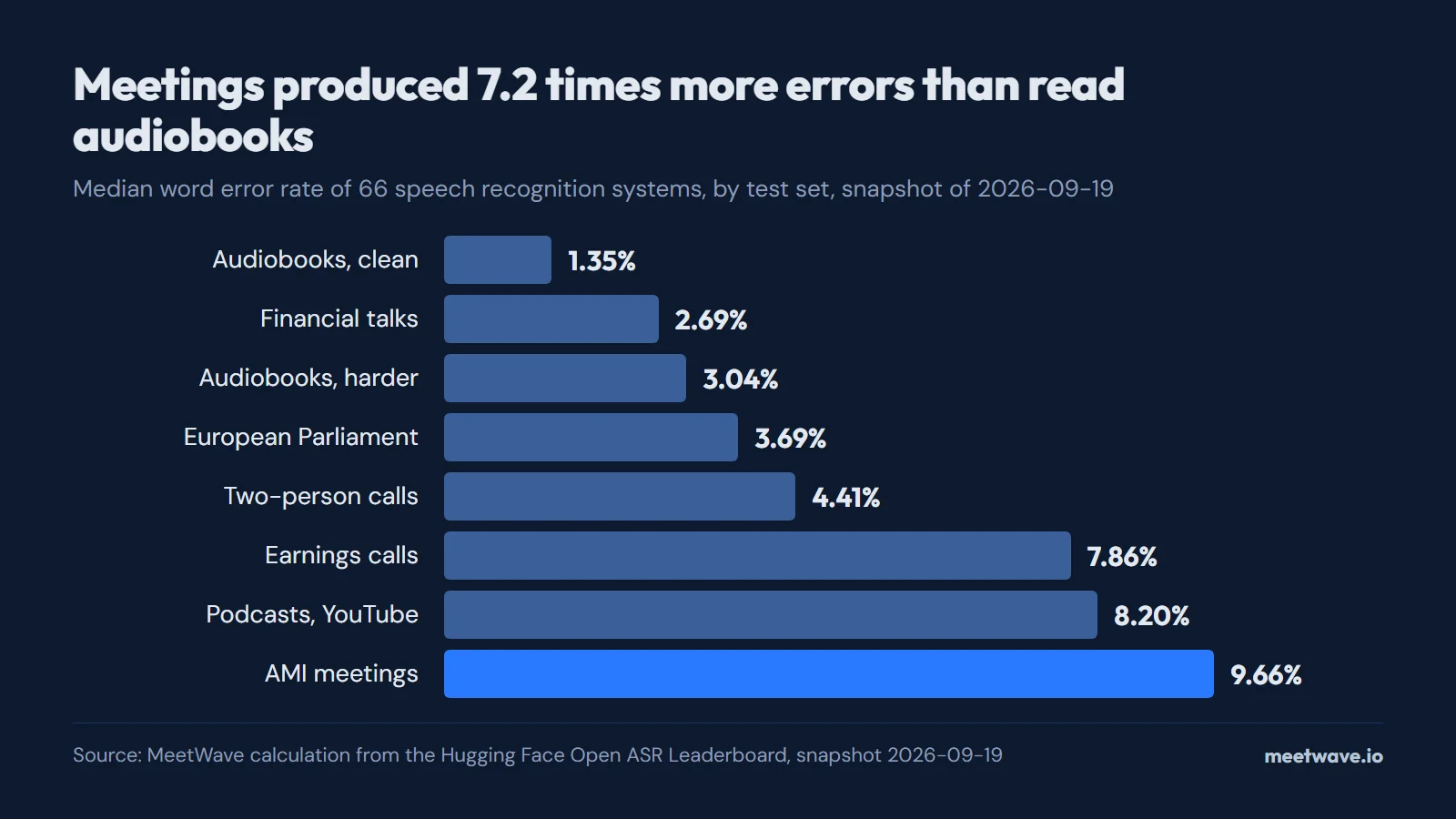
AI transcription is not 95% accurate on meetings. On the AMI meeting corpus, none of the 66 speech recognition systems on the Hugging Face Open ASR Leaderboard reached a word error rate of 5% or lower as of September 19, 2026; the median system scored 9.66%. The same systems scored a median 1.35% on read audiobooks, so meeting audio produced 7.2 times more errors. Whisper large-v3-turbo, a widely used open model, scored 13.88% on AMI: roughly one word in seven was wrong.
Key numbers
- 0 of 66 speech recognition systems reached a word error rate of 5% or lower on AMI meeting recordings on the Hugging Face Open ASR Leaderboard, snapshot of September 19, 2026 (method).
- The median system scored 9.66% WER on AMI meetings and 1.35% on LibriSpeech read audiobooks in 2026 (Open ASR Leaderboard).
- Whisper large-v3-turbo scored 13.88% WER on AMI, 8.09% on Earnings-22 earnings calls and 2.13% on LibriSpeech in 2026 (Open ASR Leaderboard).
- A distant room microphone more than doubled Whisper's errors on AMI: 36.4% WER versus 16.9% with headset microphones (Radford et al., 2022).
- Professional human transcribers made 5.9% word errors on Switchboard phone conversations (Xiong et al., Microsoft, 2016).
"95% accurate" is a read-speech number
A claim of 95% accuracy, a word error rate of 5%, holds for read speech and fails for meetings. The same 66 systems had a median of 1.35% WER on LibriSpeech audiobooks and 9.66% on AMI meetings, and 64 of them stayed at or under 5% on the audiobooks against none on the meetings (Open ASR Leaderboard, method). Figure 1 ranks the eight English test sets by their median.
Figure 1. Meeting audio produced 7.2 times more transcription errors than read audiobooks. Source: MeetWave calculation from the Hugging Face Open ASR Leaderboard, snapshot 2026-09-19.
| Test set (type of speech) | Median WER, 66 systems | Systems at 5% or lower | Whisper large-v3-turbo |
|---|---|---|---|
| LibriSpeech clean (read audiobooks) | 1.35% | 64 | 2.13% |
| SPGISpeech (financial meetings) | 2.69% | 62 | 2.79% |
| LibriSpeech other (harder audiobooks) | 3.04% | 58 | 3.71% |
| VoxPopuli (European Parliament) | 3.69% | 61 | 7.02% |
| Voice Arena en-IN (two-person calls, separate channels) | 4.41% | 48 | 4.77% |
| Earnings-22 (earnings calls, accents) | 7.86% | 3 | 8.09% |
| GigaSpeech (podcasts, YouTube) | 8.20% | 0 | 8.47% |
| AMI (meetings) | 9.66% | 0 | 13.88% |
Source: Hugging Face Open ASR Leaderboard results, revision of 2026-09-19; medians and counts are our calculation (method).
What "accuracy" means: word error rate
Accuracy is 100% minus the word error rate, and WER counts three kinds of mistakes. WER = (substituted words + deleted words + inserted words) ÷ words in the reference transcript. Before counting, the leaderboard normalizes both texts: it removes punctuation and casing, normalizes numbers, standardizes spelling and removes filler words (Srivastav et al., Open ASR Leaderboard, 2026). Without the same normalization, one transcript gets different scores, so an accuracy figure without its method cannot be compared with another. Figure 2 works one sentence through.
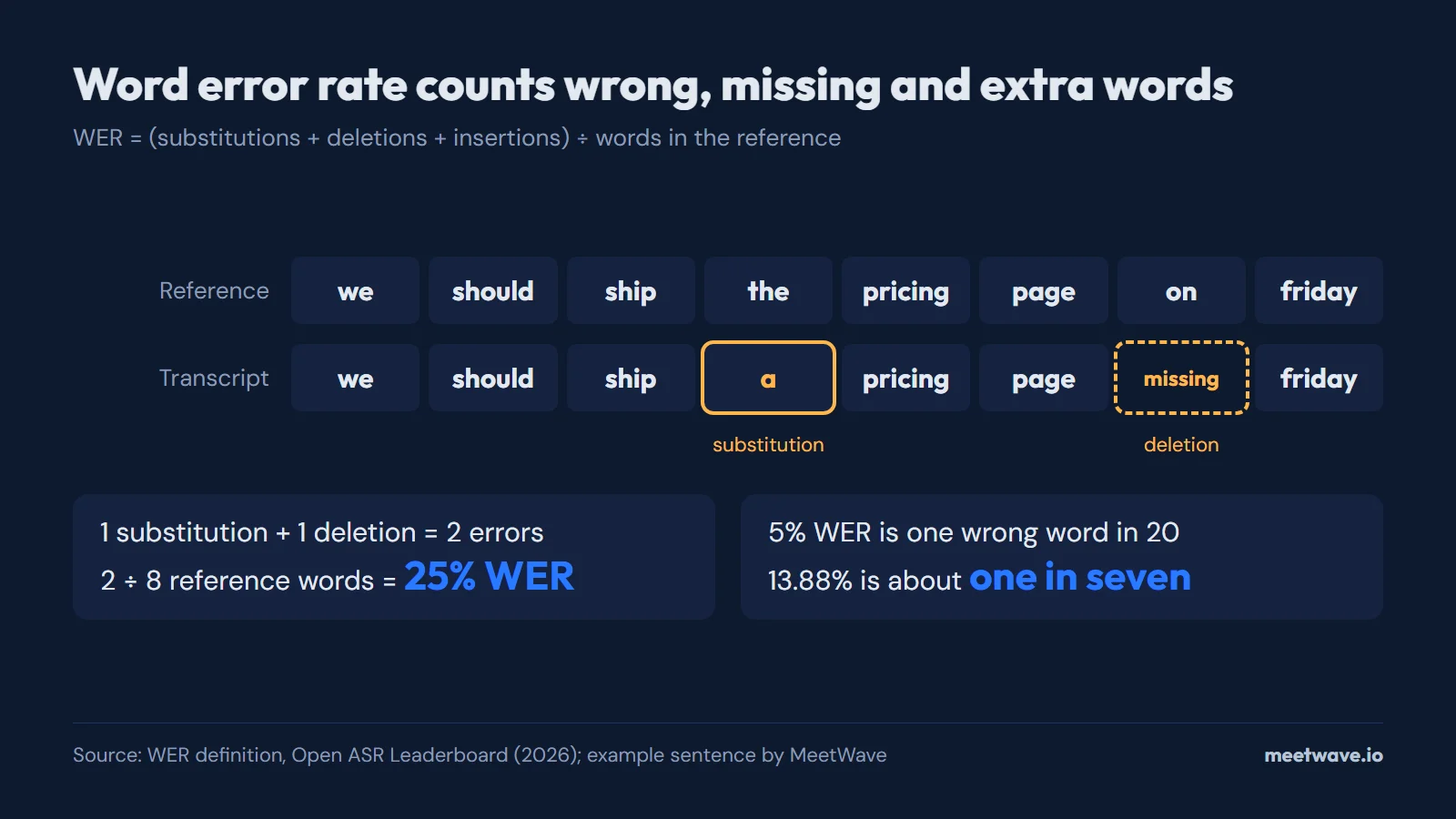 Figure 2. Word error rate on one sentence: 1 substitution plus 1 deletion out of 8 reference words is 25% WER; 5% WER is one wrong word in 20. Source: WER definition, Open ASR Leaderboard (2026).
Meeting audio: where every system drops
Even with headset microphones, the cleanest audio a meeting offers, no system on the leaderboard reached 5% WER on AMI. AMI is a corpus of real meetings released under CC BY 4.0, and the leaderboard tests on 9 hours of it (University of Edinburgh, AMI licence, Srivastav et al., 2026). It uses the individual headset microphone version, AMI-IHM, cut into short single-speaker segments (Gandhi et al., ESB, 2022). Figure 3 places Whisper against the lowest scores and the median.
- No system reached 5% (method).
- The lowest WER was 6.08%, from Zoom Scribe v2 Pro (Open ASR Leaderboard).
- The lowest among open-weight models was 6.96%, from IBM Granite Speech 4.1 2B NAR (Open ASR Leaderboard).
- The 14 proprietary systems had a median of 8.2%; the 52 open-weight systems, 10.7% (method).
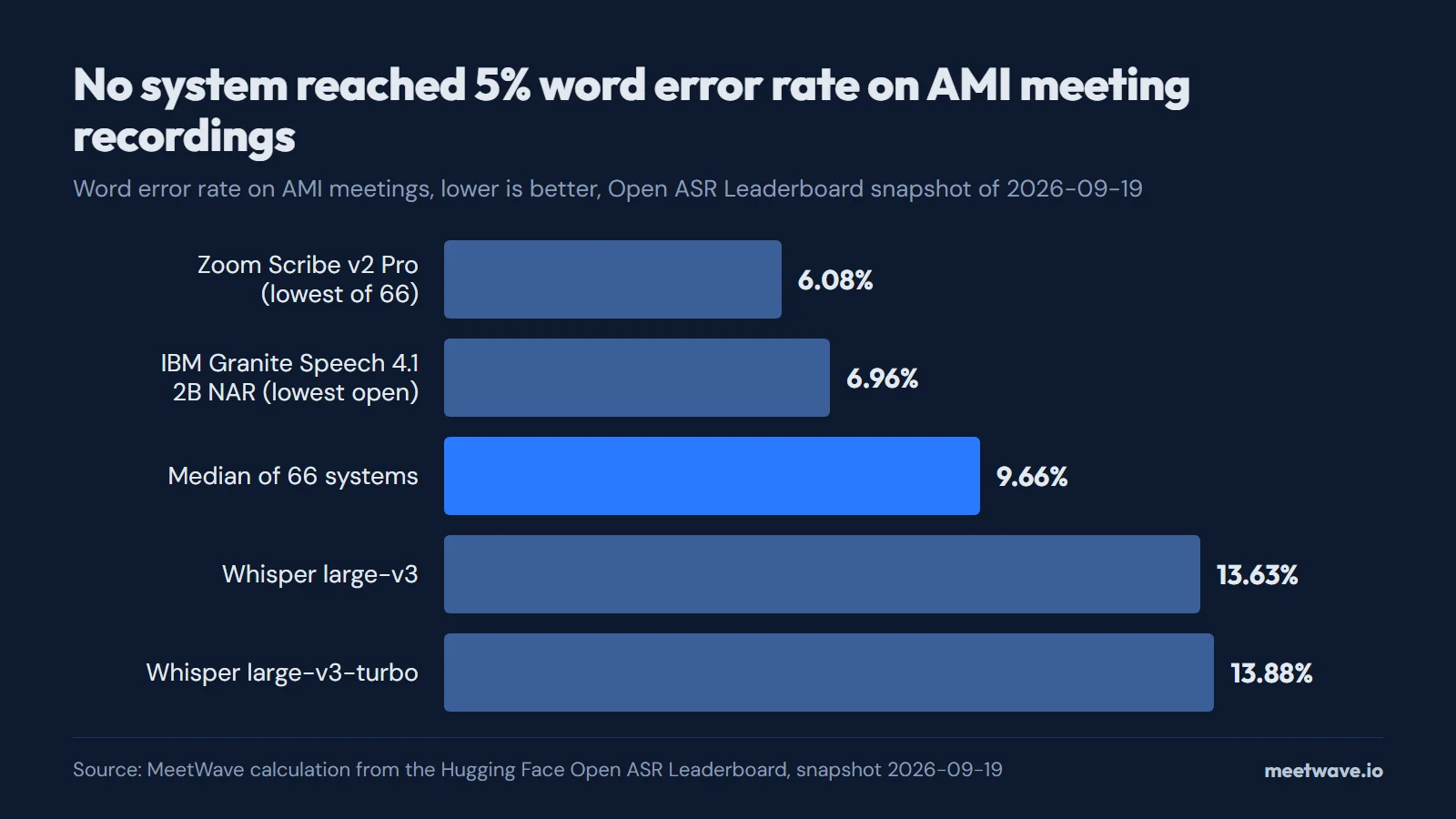 Figure 3. No system reached 5% word error rate on AMI meeting recordings. Source: MeetWave calculation from the Hugging Face Open ASR Leaderboard, snapshot 2026-09-19.
Which transcription engine is most accurate on meetings
On the September 19, 2026 snapshot, the engine with the lowest meeting error rate was Zoom Scribe v2 Pro at 6.08%, and it also led Earnings-22 at 4.12%. Whisper large-v3 ranked 55th of 66 on AMI and large-v3-turbo 58th (Open ASR Leaderboard). The gap between the lowest score and Whisper, 6.08% against 13.88%, is real, but no engine comes near its own read-speech score on meetings. These are the leaderboard's published results; we did not test the engines ourselves.
| System | AMI meetings WER | Earnings-22 WER |
|---|---|---|
| Zoom Scribe v2 Pro | 6.08% | 4.12% |
| Modulate multilingual | 6.31% | 6.00% |
| Zoom Scribe v1 | 6.94% | 6.07% |
| Microsoft Azure Speech (June 2026) | 6.95% | 5.59% |
| IBM Granite Speech 4.1 2B NAR (open weights) | 6.96% | 6.67% |
| Whisper large-v3 | 13.63% | 7.99% |
| Whisper large-v3-turbo | 13.88% | 8.09% |
Source: Hugging Face Open ASR Leaderboard results, revision of 2026-09-19, "Cleaned" columns.
Accents and jargon: earnings calls
Only 3 of 66 systems reached 5% WER on earnings calls, and the median was 7.86% (method). Earnings-22 is a 125-file, 119-hour corpus of English-language earnings calls from companies around the world, released under CC BY-SA 4.0 to test accented speech (Del Rio et al., 2022). The three were Zoom Scribe v2 Pro at 4.12%, Smallest AI Pulse at 4.74% and ElevenLabs Scribe v2 at 4.80% (Open ASR Leaderboard).
How close is a human transcriber?
Human transcripts have errors too. Professional transcribers made 5.9% word errors on Switchboard phone calls and 11.3% on CallHome conversations between friends and family (Xiong et al., 2016). On 25 recordings from the Kincaid46 set, OpenAI found that pure-human services were only a fraction of a percentage point better than Whisper, and a computer-assisted service was 1.15 points better (Radford et al., 2022).
MeetWave transcribes with Whisper large-v3-turbo, the model that scored 13.88% on AMI in the snapshot above (Open ASR Leaderboard). That is a leaderboard score on short headset segments, not a test of MeetWave's full-meeting pipeline, and we publish it here rather than the unmeasured 95% that used to circulate.
What changes accuracy on your own recordings
The microphone moves the error rate more than the choice of engine. The same Whisper model on the same AMI meetings scored 16.9% WER from headset microphones and 36.4% from a single distant microphone in the room (Radford et al., 2022). Two-person calls recorded on separate channels, the Voice Arena set, had a median of 4.41%, less than half the 9.66% for AMI meetings (Open ASR Leaderboard). Accents and financial terms push earnings calls to a 7.86% median (Del Rio et al., 2022).
How to test transcription accuracy yourself
Ten minutes of your own audio and a hand-made reference give a number that means more for you than any benchmark. The method mirrors the leaderboard's (Srivastav et al., 2026):
- Take ten minutes of a typical recording, with your usual microphones and speakers.
- Type a reference transcript by hand, word for word.
- Run the same file through 2 or 3 services and export plain text; a caption export converts with the free VTT to TXT converter.
- Normalize both texts the same way and score them with the open-source
jiwerlibrary (jiwer). - Report one WER over all files together, total errors ÷ total reference words, not an average of per-file scores (method).
# pip install jiwer openai-whisper
import jiwer
from whisper.normalizers import EnglishTextNormalizer

norm = EnglishTextNormalizer()
refs = [norm(open(f"ref_{i}.txt", encoding="utf-8").read()) for i in range(3)]
hyps = [norm(open(f"service_a_{i}.txt", encoding="utf-8").read()) for i in range(3)]
print(f"WER: {jiwer.wer(refs, hyps):.2%}")  # errors over all files ÷ all reference words
To see what a transcript of your own meeting looks like before you test it, meeting transcription in MeetWave runs the same Whisper model covered above.
How we calculated
All leaderboard numbers come from one pinned file: english_short_latest.csv in the Hugging Face dataset hf-audio/open-asr-leaderboard-results, revision 7e57dda97fe368a406fbfe5fee1de6f8266a5a04, the version the leaderboard labels 19-09-2026. The file has 66 systems, each scored on all eight English test sets; its SHA-256 is 96ca1830d628561fe8bb7cbc926b07020be3bd02370d30d495b4acd80e602288 (results dataset).
- We use the "Cleaned" columns for AMI, Earnings-22, GigaSpeech and VoxPopuli, because all 66 systems have them. The original AMI column covers 44 systems, and its lowest score is 7.64%, so the finding does not change (results dataset).
- Medians are taken over all 66 systems with no outliers removed; "proprietary" and "open" follow the licence column of the file (results dataset).
- 7.2 is 9.66 ÷ 1.35. Accuracy is 100% − WER, so 13.88% WER is about 86% of words right, one in seven wrong (Srivastav et al., 2026).
- Limits: the leaderboard scores short segments, not whole hour-long meetings, and each system is run the way its maintainers chose (Gandhi et al., 2022).
The whole calculation reruns in under a minute with no account:
curl -sL -o english_short.csv "https://huggingface.co/datasets/hf-audio/open-asr-leaderboard-results/resolve/7e57dda97fe368a406fbfe5fee1de6f8266a5a04/english_short_latest.csv"
sha256sum english_short.csv
python - <<'PY'
import csv, statistics as st
rows = list(csv.DictReader(open("english_short.csv", encoding="utf-8")))
sets = ["LS Clean", "SPGISpeech", "LS Other", "Voxpopuli-AA-Cleaned", "Voice Arena Monsoon",
        "Earnings22-Cleaned-AA-chunked", "Gigaspeech-Cleaned", "AMI-Cleaned"]
for s in sets:
    v = [float(r[f"{s} WER"]) for r in rows]
    print(f"{s:32s} n={len(v)} median={st.median(v):.2f} <=5%: {sum(x <= 5 for x in v)}/{len(v)}")
PY
We recalculate on a fresh revision every quarter and change the date above when we do.
FAQ
How accurate is AI transcription?
On meeting recordings, the median of 66 systems was 9.66% WER, about 90% of words right, and none reached 95% (Open ASR Leaderboard). On read audiobooks the median was 1.35%.
What is the most accurate transcription software?
On the September 2026 snapshot, Zoom Scribe v2 Pro had the lowest error rate on both AMI meetings (6.08%) and Earnings-22 calls (4.12%) (Open ASR Leaderboard). On a meeting, a distant microphone changes the result more than the gap between engines (Radford et al., 2022).
What is a good word error rate?
Useful reference points: 1.35% is the median on read audiobooks, 9.66% on meetings, and 5.9% is what professional human transcribers scored on phone calls (Open ASR Leaderboard, Xiong et al., 2016).
Is AI transcription as accurate as a human?
On phone conversations, Microsoft's 2016 system matched professional transcribers at 5.8% against 5.9% WER, and on 25 Kincaid46 recordings Whisper came within a fraction of a point of pure-human services (Xiong et al., 2016, Radford et al., 2022).
Why is meeting transcription less accurate than podcasts?
People interrupt each other, speak off-mic and share one room. On the leaderboard, AMI meetings had a median of 9.66% WER against 4.41% for two-person calls on separate channels, and one distant microphone raised Whisper's AMI error rate from 16.9% to 36.4% (Open ASR Leaderboard, Radford et al., 2022).
Sources
- Hugging Face — Open ASR Leaderboard (2026). Accessed 2026-09-23.
- Hugging Face — open-asr-leaderboard-results, english_short_latest.csv, revision 7e57dda9 (2026). Accessed 2026-09-23.
- Srivastav et al. — Open ASR Leaderboard: Towards Reproducible and Transparent Multilingual and Long-Form Speech Recognition Evaluation (2026). Accessed 2026-09-23.
- Gandhi, von Platen, Rush — ESB: A Benchmark For Multi-Domain End-to-End Speech Recognition (2022). Accessed 2026-09-23.
- Del Rio et al. — Earnings-22: A Practical Benchmark for Accents in the Wild (2022). Accessed 2026-09-23.
- Radford et al. (OpenAI) — the Whisper paper, arXiv 2212.04356 (2022). Accessed 2026-09-23.
- Xiong et al. (Microsoft) — Achieving Human Parity in Conversational Speech Recognition (2016). Accessed 2026-09-23.
Ready to try AI meeting summaries?
Try MeetWave free — no credit card required.
Still comparing tools?
See how MeetWave stacks up against the tools most teams evaluate alongside it.
- MeetWave vs TactiqSee how MeetWave compares to Tactiq for meeting transcripts
- MeetWave vs NottaSee how MeetWave compares to Notta for meeting transcription
- MeetWave vs KrispSee how MeetWave compares to Krisp for meeting notes