ADHD at Work: How Do I Stop Forgetting What We Agreed in Meetings?
Take the promises out of your head before the next meeting starts. In a randomized online experiment with 557 adults, people allowed to set reminders carried out 89% of their delayed tasks, against 80% for those who had to remember them. ADHD makes the memory side harder: a meta-analysis of 38 studies found moderate working-memory deficits in adults with ADHD. And in a trial of 88 adults with ADHD, 12 weeks of training in planners and organization cut inattention by at least 30% in 42% of them, against 12% with supportive therapy.
Why meetings are where tasks get lost
A meeting asks working memory to do two jobs at once: follow the talk and hold what you just agreed to. In adults with ADHD that memory is measurably weaker: a meta-analysis of 38 studies found "moderate-magnitude" gaps against healthy controls, for both verbal and visual-spatial working memory (Alderson et al., 2013).
The gap is in making the plan, not in keeping it. In a lab study of 45 adults with ADHD and 45 matched controls, the ADHD group made far weaker plans for a set of tasks (d = 1.60), but once a plan existed they recalled it as well as everyone else (d = 0.03) (Fuermaier et al., 2013). A written list of who does what by when is a plan made for you.
The cost is real. Across 10 countries and 7,075 workers, 3.5% met criteria for adult ADHD, and ADHD went with 22.1 more days a year of lost work performance than in similar workers without it (de Graaf et al., 2008). That is a self-reported survey measure, not missed meetings.
This article is general information, not medical advice. Treatment is a conversation for your clinician.
What the research says about writing it down
An outside record helps people carry out what they intended, and the clearest number comes from adults in general, not from ADHD studies.
- Reminders. In a randomized online experiment, 557 adults kept several delayed tasks in mind while doing something else. With three tasks to remember, the group allowed to set reminders carried out 89% of them, against 80% for the memory-only group; with one task, 93% against 84% (Gilbert, 2015).
- If-then plans. Writing the when, where and how of a task ("if it is Friday at 10, I email Tom") raised goal attainment with an effect of d = .65 across 94 independent tests. That is an effect size of medium-to-large magnitude, not a percentage (Gollwitzer & Sheeran, 2006).
- Organization skills in ADHD. In a trial of 88 adults with ADHD, 12 weekly two-hour sessions that started with how to use a planner and moved on to time management and planning cut inattention by at least 30% in 42% of participants, against 12% with supportive therapy (Solanto et al., 2010).
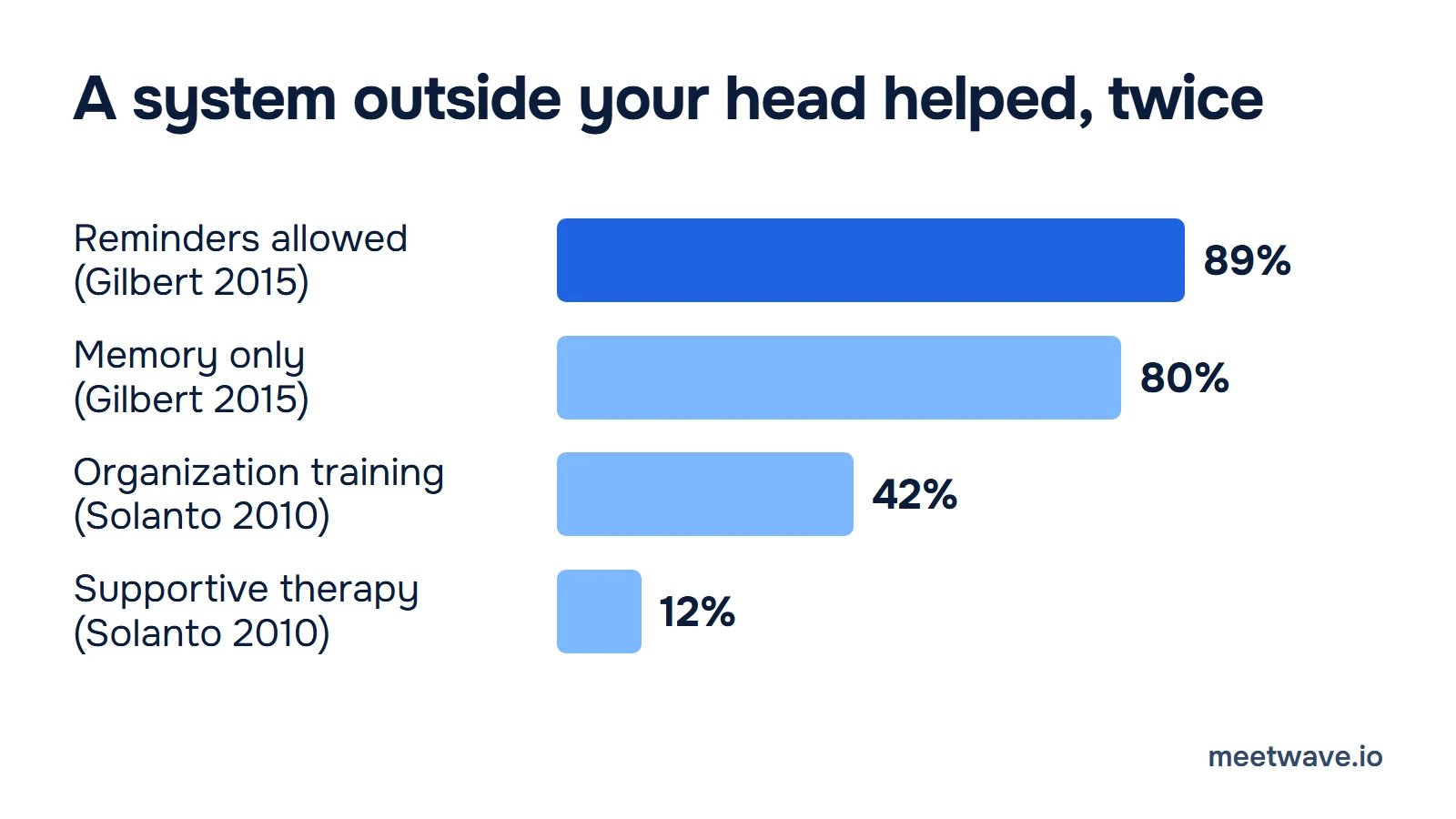
 Figure 1. Gilbert 2015: share of delayed tasks carried out with three to remember, randomized online experiment, 557 adults (not an ADHD sample). Solanto 2010: share of adults with ADHD whose inattention fell by at least 30%, randomized trial, 88 adults. Different measures, two studies. Source: Gilbert, 2015; Solanto et al., 2010.
What the research does not show, said plainly:
- Reminders alone are not proven for adults with ADHD. In a randomized trial of 109 adults with self-reported ADHD in an online self-help program, text reminders did not change how many modules people completed (Nordby et al., 2022).
- We found no trial that measured tasks completed or deadlines missed after recording meetings or reading meeting summaries, in ADHD or anyone else.
- The Solanto trial measured symptoms, not finished tasks. Its program taught a whole method, so it does not show which part did the work (Solanto et al., 2010).
The system: capture, find yours, move them
The method has four steps, and the order matters more than the tool. Capture the meeting, pull out the tasks with your name on them, move them into the one list you already check, and read the last minutes twice. Figure 2 is the whole thing; steps 1 to 3 build on the findings above (Gilbert, 2015; Fuermaier et al., 2013).
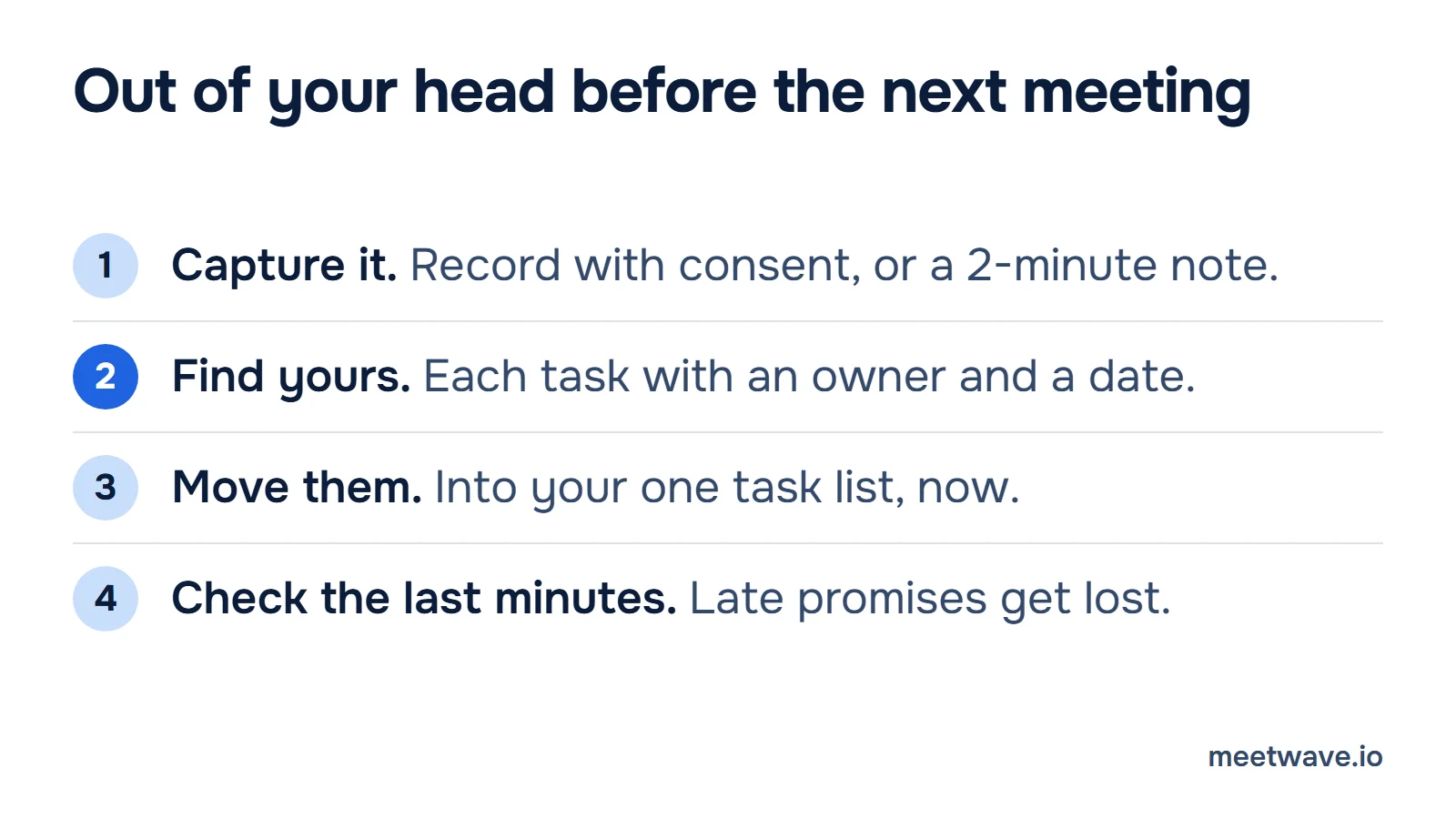
 Figure 2. Capture, find yours, move them, check the end. Source: MeetWave, 2026, built on Gilbert 2015 and Fuermaier et al. 2013.
Record only with everyone's consent: in some U.S. states every party must agree, and a company rule can forbid it even where the law allows it (state-by-state guide). Where recording is a no, the 2-minute note below does the same job.
What a late promise looks like
In a 9-minute demo status meeting, five tasks were agreed and two belonged to the project lead. At 02:50 she tells the vendor, "I'll send you an email by Friday so it's on record." At 07:58 she reads the action list aloud, four items. At 08:56, after that recap, Nate asks to hear about a date change the same day, and she answers, "I'll ask [Kofi] to join next week" (demo notes).
That last promise is the one a recap misses, because it was made after the recap. The notes list both of hers with an owner and a date, as Figure 3 shows (demo notes).
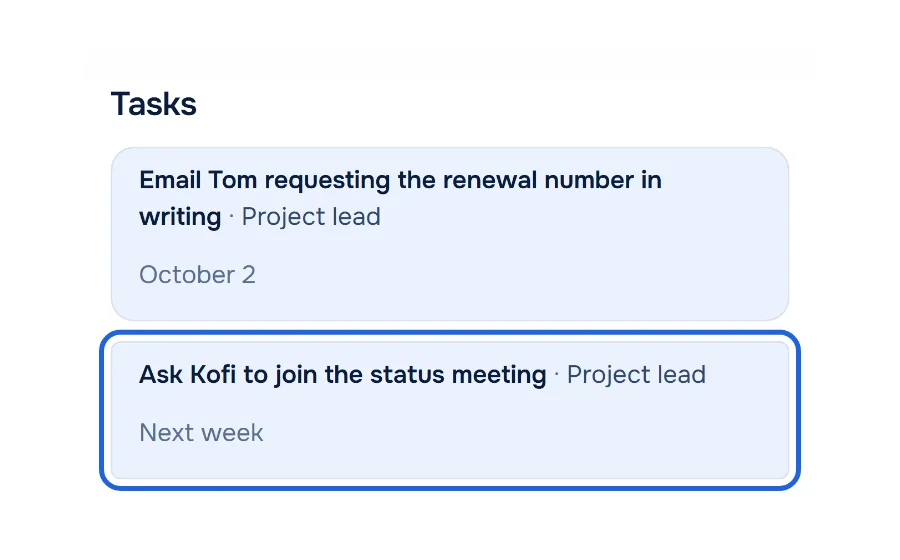
 Figure 3. Demo meeting, people are fictional. Two of its five tasks, both the project lead's; the outlined one was promised after the action recap. Source: demo status meeting notes, September 2026.Analyzed with MeetWaveSee the full notesTry it on your next status meeting
The formula for your own meetings: anything you said "I'll" to in the last five minutes, after the recap, goes on your list before you leave the call. MeetWave records the call without a bot joining it and writes the task table with owners and dates, so the late promise is on the page even when nobody repeats it (demo notes).
Ask for it as a workplace accommodation
Written instructions, recorded materials, reminders and to-do lists are on the Job Accommodation Network's list of workplace accommodations for ADHD. The Network, which is funded by the U.S. Department of Labor, lists "Written Instructions", "Recorded Directives, Messages, Materials", "Reminders", "Checklists" and "Provide to-do lists" on its ADHD page (JAN). Its page on recorded materials names "meeting notes" among the print items people with memory deficits struggle with (JAN).
The request needs no legal words. Under the ADA, which covers U.S. employers with 15 or more employees, you may ask in "plain English" and need not mention the law, and the request does not have to be in writing (EEOC; EEOC). Your employer may ask for reasonable documentation of the condition and its limits (EEOC).
We still suggest an email: it gives both sides the same dated record. This is general information, not legal advice; rules outside the U.S. differ (EEOC).
Subject: Request for a workplace adjustment for meetings

Hi [manager or HR name],

I have ADHD, and it affects how much I can hold in memory during a meeting while also following the discussion. I want to make sure I never miss what I agreed to do.

I'm asking for these adjustments:
- Written action items after meetings where I have tasks: what, who, and by when.
- Permission to record [team meetings / our 1:1s], with everyone's consent, for my own notes only. I won't share the recordings.
- A minute at the end of each meeting to confirm my tasks out loud.

The Job Accommodation Network lists written instructions, recorded materials and to-do lists among accommodations for ADHD.

Could we talk about this this week? I'm happy to try it for a month and review how it works.

Thanks,
[your name]
Without recording: the 2-minute note
The same method works with a pen. Right after the meeting, before you open anything else, write the note below, then move each "Mine" line into your task list. A written if-then line ("when X, I do Y") is the form with the research behind it (Gollwitzer & Sheeran, 2006).
Meeting: [name], [date]

Mine (I said "I'll"):
- [task] by [date]. When [moment], I [first step].
- [task] by [date]. When [moment], I [first step].

Waiting on others:
- [person]: [task] by [date]

Said in the last 5 minutes, after the recap:
- [anything you agreed to]

Not sure? Ask today:
- "[question about who does what]"
To keep the tasks with owners and dates in one place across meetings, the free meeting action items tracker does it in your browser, without an account (JAN lists to-do lists and checklists as accommodations).
What else helps, and how sure we are
Only four supports have evidence we could open, and none of them was tested on meetings.
| Support | Evidence | Who was studied |
|---|---|---|
| One planner or task list, taught as a method | 42% vs 12% improved on inattention | 88 adults with ADHD, randomized trial |
| Reminders you set yourself | 89% vs 80% of delayed tasks done | 557 adults, randomized online experiment |
| If-then plans, written down | d = .65 on goal attainment | 94 tests, populations not limited to ADHD |
| Text reminders sent to you | no effect on completion | 109 adults with self-reported ADHD, randomized trial |
Source: Solanto et al., 2010; Gilbert, 2015; Gollwitzer & Sheeran, 2006; Nordby et al., 2022.
The pattern: reminders you choose and a list you own did better than reminders that arrive from outside. That is a reading across studies of different people, not a tested comparison (Gilbert, 2015; Nordby et al., 2022).
Key numbers
- With three delayed tasks to remember, adults allowed to set reminders carried out 89% of them, against 80% for a memory-only group, in a randomized online experiment with 557 adults (Gilbert, 2015).
- A meta-analysis of 38 studies found moderate working-memory deficits in adults with ADHD compared with healthy controls (Alderson et al., 2013).
- In a randomized trial of 88 adults with ADHD, 12 weeks of training in planners and organization cut inattention by at least 30% in 42% of participants, against 12% with supportive therapy (Solanto et al., 2010).
- Written if-then plans raised goal attainment with an effect of d = .65 across 94 independent tests (Gollwitzer & Sheeran, 2006).
- Adult ADHD went with 22.1 more days a year of lost work performance, across 7,075 workers in 10 countries (de Graaf et al., 2008).
How we calculated
Every number above was read in the paper or its official abstract on 2026-11-03. We rounded 89.1% and 79.8% to 89% and 80%, 92.6% and 84.1% to 93% and 84%, and 42.2% to 42% (Gilbert, 2015, Table 1, Experiment 2b; Solanto et al., 2010). We did not turn the effect sizes d = .65, 1.60 and 0.03 into percentages, because they are not percentages (Gollwitzer & Sheeran, 2006).
The demo meeting is fictional. The minutes come from its transcript and the task table from its notes, counted by hand: five tasks, two owned by the project lead, one of them promised after the recap (demo notes).
FAQ
Does ADHD affect working memory?
Yes, on average. A meta-analysis of 38 studies found moderate working-memory deficits in adults with ADHD, for both verbal and visual-spatial working memory (Alderson et al., 2013). Averages hide wide differences between people.
What accommodations can I ask for with ADHD at work?
The Job Accommodation Network lists written instructions, recorded materials, reminders, checklists and to-do lists, among others (JAN). In the U.S. you can ask in plain words, and the request does not have to be written (EEOC).
How do I remember things at work with ADHD?
Do not try to hold them: write each task you agreed to, with a date, before the next meeting starts. In an experiment with 557 adults, people allowed to set reminders carried out 89% of delayed tasks, against 80% without (Gilbert, 2015).
Can I record meetings because I have ADHD?
You can ask for it as an accommodation, and you still need everyone's consent where the law or your company requires it (state-by-state guide). The Job Accommodation Network lists recorded materials among accommodations for people with memory deficits (JAN).
Do reminders work for adults with ADHD?
Text reminders alone did not raise completion in a randomized trial of 109 adults with self-reported ADHD (Nordby et al., 2022). Training in planners and organization helped adults with ADHD more than supportive therapy in one trial (Solanto et al., 2010); it was not compared with reminders directly.
Sources
- Alderson RM, Kasper LJ, Hudec KL, Patros CH — ADHD and working memory in adults: a meta-analytic review. Neuropsychology 27(3):287–302 (2013). Accessed 2026-11-03.
- Fuermaier ABM et al. — Complex prospective memory in adults with attention deficit hyperactivity disorder. PLoS ONE 8(3):e58338 (2013). Accessed 2026-11-03.
- de Graaf R et al. — The prevalence and effects of adult ADHD on the performance of workers: results from the WHO World Mental Health Survey Initiative. Occupational and Environmental Medicine 65(12):835–842 (2008). Accessed 2026-11-03.
- Gilbert SJ — Strategic offloading of delayed intentions into the external environment. Quarterly Journal of Experimental Psychology 68(5):971–992 (2015). Accessed 2026-11-03.
- Gollwitzer PM, Sheeran P — Implementation intentions and goal achievement: a meta-analysis of effects and processes. Advances in Experimental Social Psychology 38:69–119 (2006). Accessed 2026-11-03.
- Solanto MV et al. — Efficacy of meta-cognitive therapy for adult ADHD. American Journal of Psychiatry 167(8):958–968 (2010). Accessed 2026-11-03.
- Nordby ES et al. — The effect of SMS reminders on adherence in a self-guided internet-delivered intervention for adults with ADHD. Frontiers in Digital Health 4:821031 (2022). Accessed 2026-11-03.
- Job Accommodation Network — Attention Deficit/Hyperactivity Disorder (ADHD). Accessed 2026-11-03.
- Job Accommodation Network — Recorded Directives, Messages, Materials. Accessed 2026-11-03.
- U.S. EEOC — Enforcement Guidance: Reasonable Accommodation and Undue Hardship under the ADA. Accessed 2026-11-03.
- U.S. EEOC — The ADA: Your Employment Rights as an Individual With a Disability. Accessed 2026-11-03.
Still comparing tools?
See how MeetWave stacks up against the tools most teams evaluate alongside it.
- MeetWave vs Otter AISee how MeetWave compares to Otter AI for meeting intelligence
- MeetWave vs Fireflies.aiSee how MeetWave compares to Fireflies.ai for meeting intelligence
- MeetWave vs tl;dvSee how MeetWave compares to tl;dv for meeting intelligence
More on this: Meeting minutes template