What Does the Research Say About Zoom Fatigue?
Zoom fatigue tracks how people feel on camera more than how long they meet: in a February 2023 survey of 291 adults in China, fatigue correlated with mirror anxiety at r = 0.446, while meeting length (r = 0.089) and meetings per week (r = 0.084) were not significantly related (Ma et al., 2025). The one field experiment found, on 103 remote employees over four weeks, linked the camera-on condition to more daily fatigue (Shockley et al., 2021). The four proposed causes were first tested in a 2023 survey of 9,787 people (Fauville et al., 2023).
What Zoom fatigue is, and how it is measured
Zoom fatigue is the feeling of being drained and lacking energy after a day of virtual meetings, and researchers measure it with a scale rather than a hunch. The field experiment on camera use defines it in exactly those words (Shockley et al., 2021). The standard scale started as 49 survey items, was cut to 15 by factor analysis on 395 respondents, and was then validated on 2,724 respondents (Fauville et al., 2021).
The scale finds five dimensions: general, social, emotional, visual and motivational fatigue (Fauville et al., 2021). That is the useful part for a reader: tiredness from video calls is not one feeling, and the five-question check at the end of this article follows those five names. A review paper adds a definition and a framework of root causes drawn from media naturalness theory, and states hypotheses rather than results (Riedl, 2022).
The causes: proposed or measured
Four causes dominate the discussion, and the paper that named them says they are hypotheses. Bailenson (2021) argues that the Zoom interface produces close-up eye gaze, cognitive load, an all-day mirror and reduced mobility, and states that "almost none of them have been directly tested" (Bailenson, 2021).
The first tests came from surveys. A 2023 study of an online convenience sample of 9,787 people found that mirror anxiety, hyper-gaze, feeling physically trapped and the effort of producing and monitoring nonverbal cues each predicted fatigue (Fauville et al., 2023). Figure 1 pairs each proposed cause with the measure that tested it. These are associations in self-reports, not experiments that changed one cause and watched fatigue move.
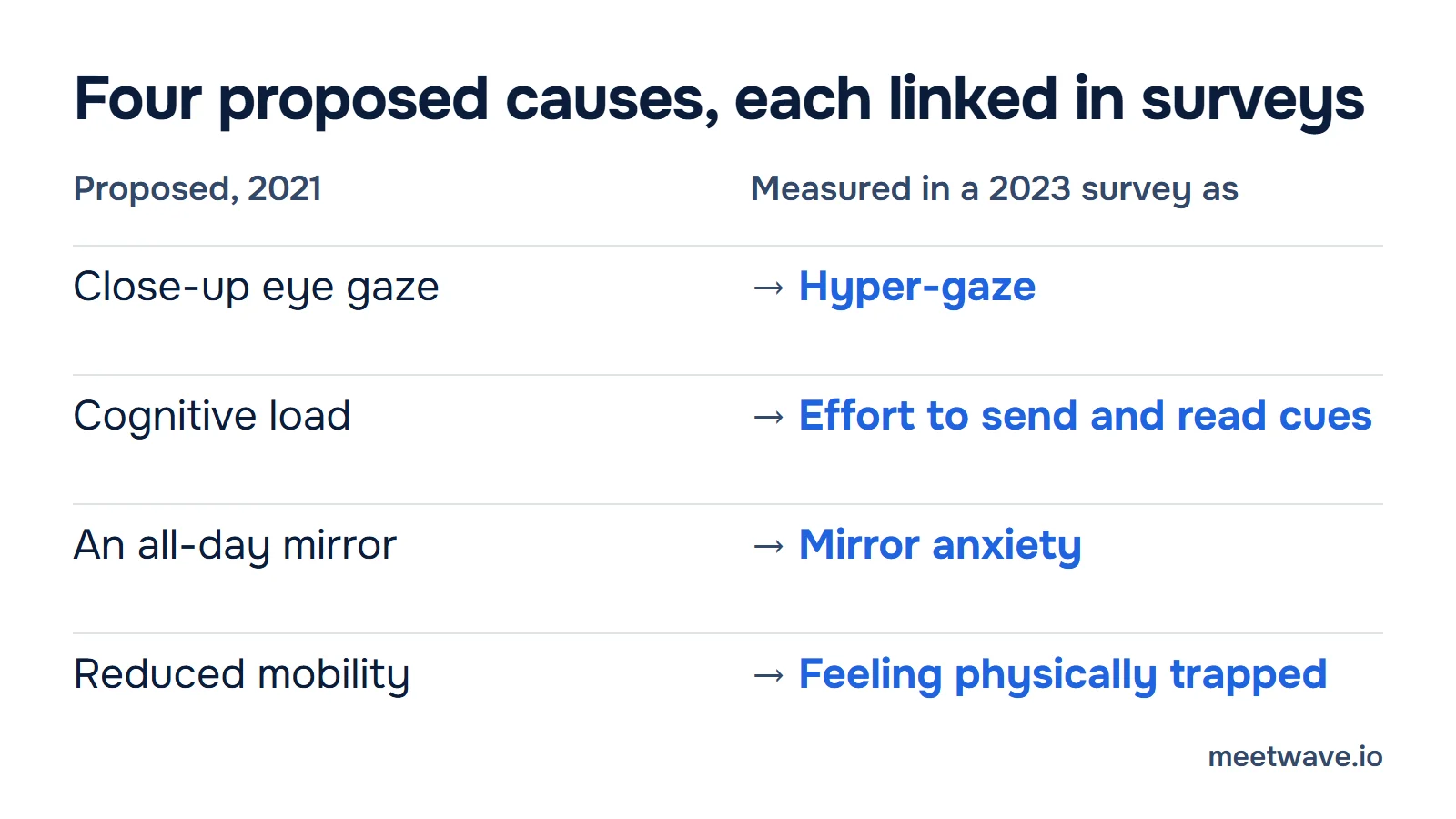
 Figure 1. Four causes proposed in 2021 and the survey measures that tested them in 2023. Associations, not experiments. Source: Bailenson 2021; Fauville et al. 2023.
| Cause | Status in the papers | Evidence |
|---|---|---|
| Close-up eye gaze | Proposed (2021), measured as hyper-gaze (2023) | Bailenson, 2021; Fauville et al., 2023 |
| Cognitive load | Proposed (2021), measured as effort to produce and read cues (2023) | Bailenson, 2021; Fauville et al., 2023 |
| An all-day mirror | Proposed (2021), measured as mirror anxiety (2023) | Bailenson, 2021; Fauville et al., 2023 |
| Reduced mobility | Proposed (2021), measured as feeling physically trapped (2023) | Bailenson, 2021; Fauville et al., 2023 |
Source: Bailenson, 2021; Fauville et al., 2023.
A smaller survey agrees on direction. In 291 adults in China in February 2023, mirror anxiety correlated with fatigue at r = 0.446, and feeling physically trapped and the cognitive load of producing cues stayed significant in a regression (Ma et al., 2025).
Who is more tired, and when
Women, newer employees and people with weak group ties come out more fatigued in the studies that looked. In the 2023 survey, women reported more fatigue than men, and the authors attribute it to women experiencing the nonverbal mechanisms more strongly (Fauville et al., 2023). In the camera experiment, the effects were stronger for women and newer employees (University of Arizona, Eller College, 2021).
Timing matters less than belonging. A study that asked 55 remote employees about fatigue every hour for five workdays, covering 279 videoconferences, found that turning off the microphone and higher group belongingness were related to lower fatigue after a call, and that belongingness was the most consistent protective factor (Bennett et al., 2021).
On usage, the evidence splits. In the large 2023 survey, people who used video conferencing more often, for longer and with fewer breaks reported more fatigue (Fauville et al., 2023). The 2021 scale paper found the same for frequency, duration and burstiness (Fauville et al., 2021). In the 291-person sample from China, meeting length (r = 0.089), meetings per week (r = 0.084) and the gap between meetings (r = -0.069) were not significantly related to fatigue, while mirror anxiety was (Ma et al., 2025). Figure 2 shows the five correlations. That sample was 67.35% women and 73.20% health care workers, so it does not settle the question for everyone.
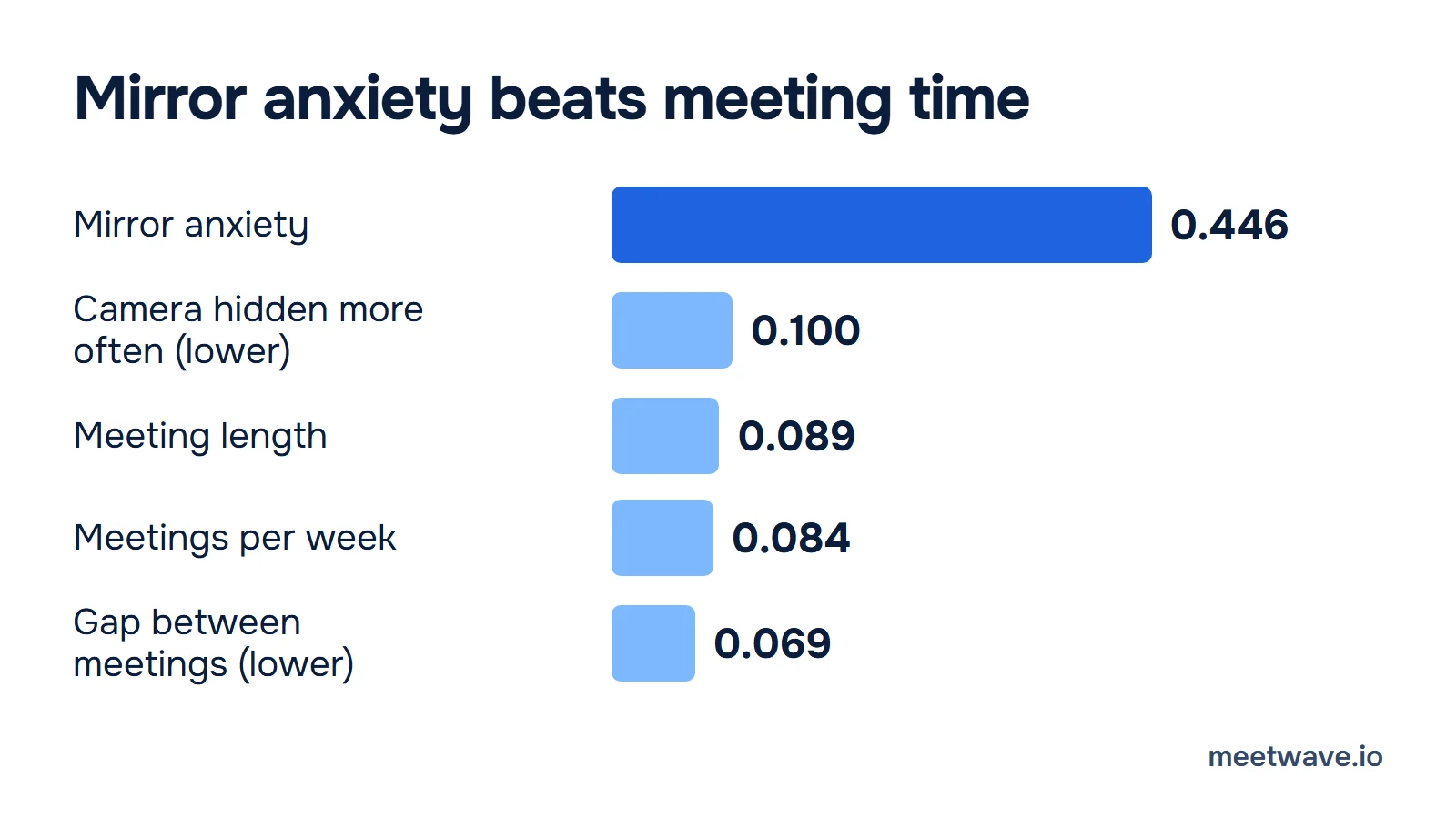
 Figure 2. Size of the correlation with Zoom fatigue score, 291 adults in China, February 2023. The camera and gap bars are negative correlations; only mirror anxiety was significant. Source: Ma et al., Scientific Reports, 2025.
What helps, by the evidence
Only one intervention here has an experiment behind it: turning the camera off. Each other line below is either a correlation or a proposal, and the table says which.
| Action | What the study found | Status |
|---|---|---|
| Camera off | Camera condition was linked to daily fatigue in 103 employees over 4 weeks (Shockley et al., 2021) | Experiment |
| Microphone off | Related to lower fatigue after 279 meetings (Bennett et al., 2021) | Observational |
| Feel part of the group | Most consistent protective factor in the same study (Bennett et al., 2021) | Observational |
| Hide your own video | Proposed as a fix for the all-day mirror (Bailenson, 2021) | Untested |
| Audio-only or phone calls | Proposed to free the body from the camera frame (Bailenson, 2021) | Untested |
| Shorter calls, more gaps, fewer calls | Linked to less fatigue in a survey of 9,787 (Fauville et al., 2023), not in a sample of 291 (Ma et al., 2025) | Mixed, no experiment |
Source: Shockley et al., 2021; Bennett et al., 2021; Bailenson, 2021; Fauville et al., 2023; Ma et al., 2025.
The lead author of the camera study does not argue for cameras off all the time but for letting people decide, as the University of Arizona's report quotes it (Eller College, 2021). If exhaustion persists after you change your calls, see a doctor: these studies describe work fatigue, not a diagnosis.
The calls you join only for the notes
No paper opened for this article tested whether skipping a meeting lowers fatigue, so this section makes no science claim. The nearest evidence is the usage association above, and it split between a 9,787-person survey and a 291-person one (Fauville et al., 2023; Ma et al., 2025).
What you can do without waiting for an experiment is count the calls you attend only to learn what was decided. MeetWave is an AI note taker that turns a call into a transcript, a summary and action items with no bot joining it, so for such a call a teammate can record it and you read the summary instead (MeetWave). On a call you must attend, the recording means you do not type notes while on camera. Record only with the consent of the people on the call. To put hours and money on those meetings, run them through the meeting cost calculator; the method behind its numbers is in How Much Does a Meeting Cost in 2026?.
Take-away: a five-question self-check
Answer the five questions below about the past week, then read the dimension with the highest score against the table above. The questions are ours and follow the five dimension names of the published scale (Fauville et al., 2021); they are not its items, and the score diagnoses nothing. For the validated version, use the original scale in the paper.
Zoom fatigue self-check (our own, one question per dimension of the ZEF Scale)
Score each 0 = never, 1 = rarely, 2 = sometimes, 3 = often, 4 = always. Think of the past week.

1. General: After my last video call of the day I feel drained, not just tired.
2. Social: After a day of calls I want to avoid talking to anyone.
3. Emotional: Video calls leave me irritable or low.
4. Visual: My eyes or my attention give out before the end of the afternoon.
5. Motivational: I put off work that needs another call.

Total: __ / 20. Highest-scoring question: __
Key numbers
- 103 employees and 1,408 daily observations over 4 weeks in a field experiment on camera use in virtual meetings, 2021 (Shockley et al., Journal of Applied Psychology).
- 55 employees and 279 videoconferences: microphone off and higher group belongingness were related to lower post-meeting fatigue, 2021 (Bennett et al., Journal of Applied Psychology).
- 2,724 respondents validated a 15-item scale with five dimensions of fatigue, 2021 (Fauville et al., Computers in Human Behavior Reports).
- 9,787 people in an online survey: more frequent and longer use, with fewer breaks, went with more fatigue, 2023 (Fauville et al., Computers in Human Behavior Reports).
- In 291 adults in China in February 2023, mirror anxiety correlated with fatigue at r = 0.446 and meeting length at r = 0.089, not significant (Ma et al., Scientific Reports, 2025).
FAQ
What causes Zoom fatigue?
Nobody has isolated one cause. Four were proposed in 2021 (close-up gaze, cognitive load, an all-day mirror, reduced mobility), and each was linked to fatigue in a 2023 survey of 9,787 people, which shows association, not proof (Fauville et al., 2023).
Is Zoom fatigue real?
Yes, as a measurable state: a 15-item scale with five dimensions was validated on 2,724 respondents (Fauville et al., 2021), and a four-week field experiment on 103 employees linked camera use to daily fatigue (Shockley et al., 2021).
Does turning off the camera help?
In the one field experiment found, the camera-on condition was linked to more fatigue, with stronger effects for women and newer employees (Eller College, 2021). The authors favour giving people the choice, not a rule.
Sources
- Shockley K.M. et al. — The fatiguing effects of camera use in virtual meetings: a within-person field experiment, Journal of Applied Psychology 106(8) (2021). Accessed 2026-11-09 (abstract via Europe PMC and the University of Arizona record).
- Bennett A.A. et al. — Videoconference fatigue? Exploring changes in fatigue after videoconference meetings during COVID-19, Journal of Applied Psychology 106(3) (2021). Accessed 2026-11-09 (abstract via Europe PMC).
- Fauville G. et al. — Zoom Exhaustion & Fatigue Scale, Computers in Human Behavior Reports 4 (2021). Accessed 2026-11-09 (abstract via Semantic Scholar).
- Fauville G. et al. — Video-conferencing usage dynamics and nonverbal mechanisms exacerbate Zoom Fatigue, particularly for women, Computers in Human Behavior Reports 10 (2023). Accessed 2026-11-09 (abstract via the Stanford Social Media Lab record).
- Bailenson J.N. — Nonverbal overload: a theoretical argument for the causes of Zoom fatigue, Technology, Mind, and Behavior 2(1) (2021). Accessed 2026-11-09 (full text).
- Riedl R. — On the stress potential of videoconferencing: definition and root causes of Zoom fatigue, Electronic Markets 32 (2022). Accessed 2026-11-09 (abstract via Crossref).
- Ma Y. et al. — A cross-sectional survey of videoconferencing fatigue and its influencing factors during COVID-19 in the Chinese population, Scientific Reports 15 (2025). Accessed 2026-11-09 (full text).
- University of Arizona, Eller College of Management — Cameras on or off? Research suggests cameras during virtual meetings lowers fatigue (2021). Accessed 2026-11-09.
Still comparing tools?
See how MeetWave stacks up against the tools most teams evaluate alongside it.
- MeetWave vs JamieSee how MeetWave compares to Jamie AI for bot-free meeting notes
- MeetWave vs Otter AISee how MeetWave compares to Otter AI for meeting intelligence
- MeetWave vs Fireflies.aiSee how MeetWave compares to Fireflies.ai for meeting intelligence
More on this: Free tools