
Subtitle Reading Speed: How Fast Can Captions Go?
Most subtitle guidelines cap reading speed at 17–21 characters per second and lines at 32–42 characters: Netflix allows 20 CPS for adult English content, 17 for children's, and 42 characters per line; the BBC recommends 160–180 words per minute and 37 characters. In our September 2026 test of 100 YouTube videos, the median video had 28% of its auto-caption lines arriving faster than 20 CPS, while only 1.2% of lines ran past 42 characters. Speech rate, not line length, is what breaks the limit.
Key numbers
- Netflix caps English (USA) subtitles at 42 characters per line and 20 characters per second for adult programs, 17 for children's, in its style guide last revised in December 2025 (Netflix Partner Help).
- The BBC recommends 160–180 words per minute and 37 characters per line for broadcast, or 68% of the frame width online (BBC Subtitle Guidelines v1.2.5, March 2026, BBC).
- DCMP asks for a 32-character line in open captions, 150–160 words per minute for adult special-interest video and never more than 225 for adult movies (2026, DCMP Captioning Guidelines).
- In 100 YouTube videos tested in September 2026, the median video had 28% of auto-caption lines faster than 20 CPS; the middle half of videos ranged from 18% to 36% (how we calculated).
- Only 1.2% of 138,587 YouTube auto-caption lines in that 2026 test ran past 42 characters, and the longest had 44 (how we calculated).
What subtitle reading speed measures
Reading speed is the text of one subtitle divided by the time it stays on screen. Netflix counts it in characters per second (CPS), and "spaces and punctuation are counted" toward both the character count and the limit (Netflix Partner Help):
CPS = characters in the subtitle, including spaces and punctuation ÷ seconds on screen
The BBC and DCMP count words per minute instead, and the two scales do not convert exactly because word length varies. One reference point: the old "six-second rule" for a full two-line subtitle is about 140–150 words per minute, or 12 CPS (Szarkowska and Gerber-Morón, PLOS ONE, 2018).
Subtitle speed and line length limits compared
The guidelines agree more than they differ: 17–21 CPS for reading speed and 32–42 characters for a line, two lines at most (Netflix, TED).
| Guideline | Reading speed | Time on screen |
|---|---|---|
| Netflix, English (USA) | 20 CPS adult, 17 CPS children's | 20 frames (5/6 s at 24 fps) to 7 s |
| BBC | 160–180 wpm | About 0.3 s per word |
| DCMP | 150–160 wpm, adult special interest; at most 225 wpm, adult movies | At least 2 s, adult movies |
| TED | At most 21 CPS | — |
| YouTube | Not published | Not published |
| Guideline | Characters per line | Lines |
|---|---|---|
| Netflix, English (USA) | 42 | 2 |
| BBC | 37 broadcast; 68% of a 16:9 frame online | 2 (3 for vertical 9:16 video) |
| DCMP | 32 (open captions) | — |
| TED | 42 | 2 |
| YouTube | Not published | Not published |
Source: Netflix English (USA) Timed Text Style Guide, Netflix General Requirements, BBC Subtitle Guidelines, DCMP, TED Subtitling Tips, YouTube Help; all checked 2026-09-23. Versions: Netflix style guide revised 2025-12-19, BBC v1.2.5 (March 2026), DCMP and TED pages undated.
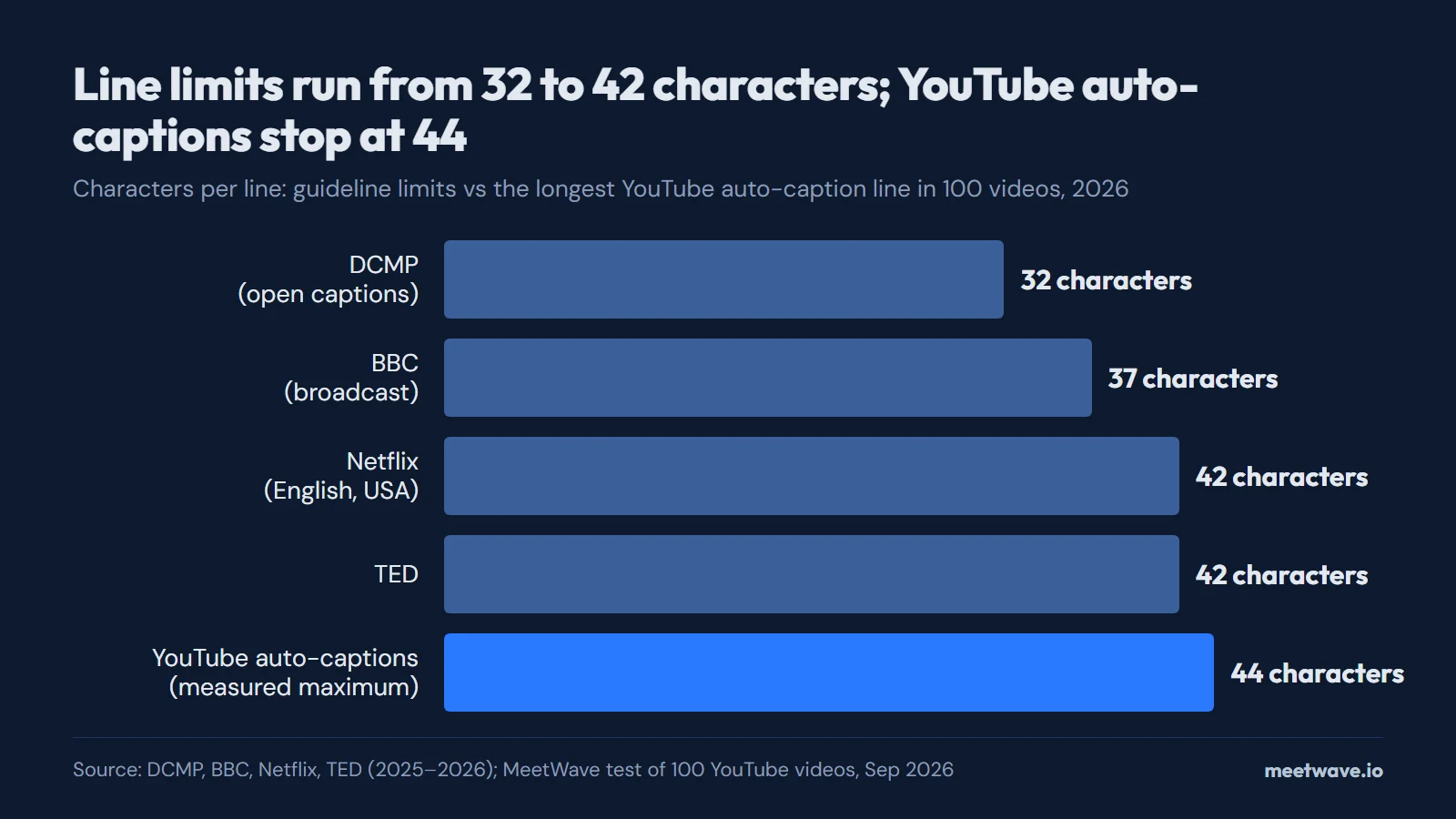
Netflix states the minimum twice: 5/6 of a second in its general requirements and "20 frames (or 4/5 sec)" in its timing guidelines, which also ask for at least 2 frames between subtitles (Netflix Subtitle Timing Guidelines). Twenty frames is 5/6 s at 24 fps and 0.8 s at 25 fps. Figure 1 puts the line limits next to what YouTube's automatic captions actually produce.
Figure 1. Line length limits run from 32 to 42 characters; the longest YouTube auto-caption line in our test had 44. Source: DCMP, BBC, Netflix, TED (2025–2026); MeetWave test of 100 YouTube videos, September 2026.
How fast YouTube captions actually are
YouTube's automatic captions keep lines short and run fast. We measured the English automatic (ASR) track of 100 recent videos from 20 English-language channels on September 23, 2026: 138,587 lines, 85.3 hours of video (how we calculated). The median video's lines arrived at a median 16.9 CPS, and in the median video 28% of lines arrived faster than Netflix's 20 CPS and 49% faster than its 17 CPS children's limit (how we calculated).
Figure 2 shows all lines pooled: 29% sit above 20 CPS (how we calculated).
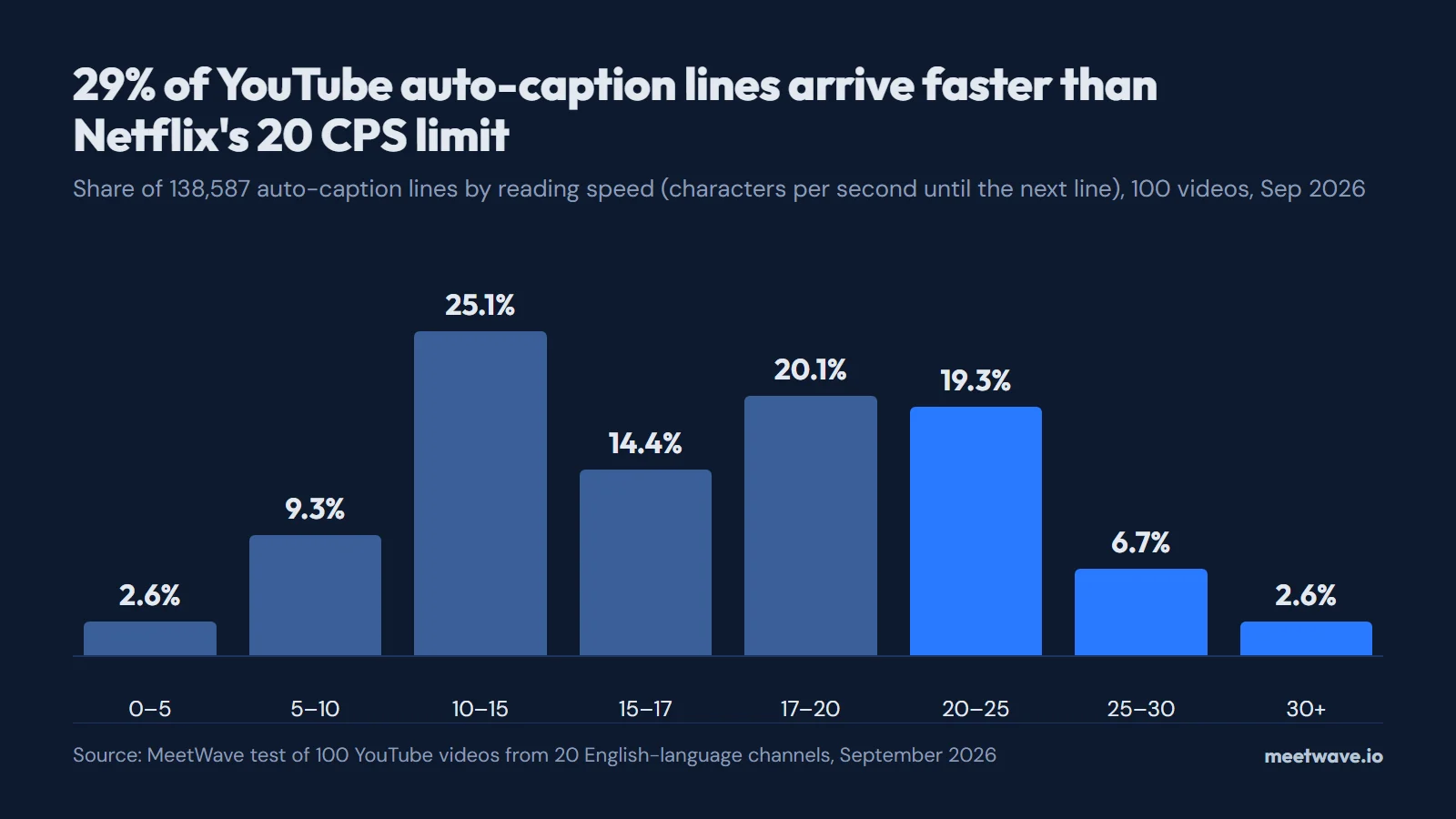 Figure 2. 29% of 138,587 YouTube auto-caption lines arrive faster than Netflix's 20 CPS limit. Source: MeetWave test of 100 YouTube videos, September 2026.
Genre moves the number more than anything else. Lectures and talks had a median of 11% of lines above 20 CPS; vlogs and entertainment had 34% (how we calculated). Figure 3 shows all five genres, 20 videos each.
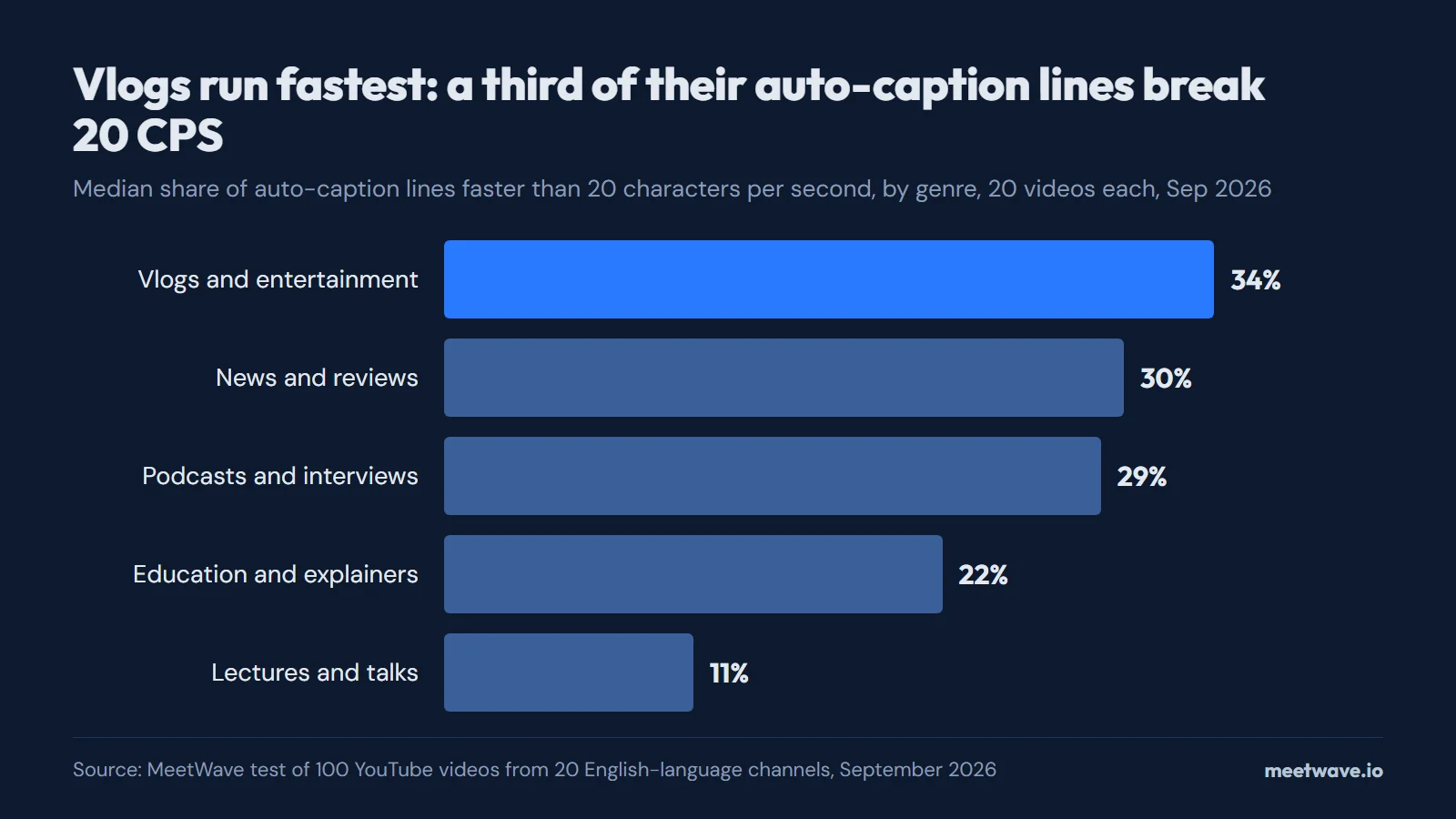 Figure 3. Share of auto-caption lines faster than 20 CPS, median by genre. Source: MeetWave test of 100 YouTube videos, September 2026.
| Genre (20 videos each) | Median CPS | Over 20 CPS | Words per minute |
|---|---|---|---|
| Lectures and talks | 12.7 | 11% | 134 |
| Education and explainers | 17.0 | 22% | 179 |
| Podcasts and interviews | 17.0 | 29% | 188 |
| News and reviews | 17.0 | 30% | 187 |
| Vlogs and entertainment | 17.5 | 34% | 208 |
Source: MeetWave test of 100 YouTube videos, September 2026.
Line length is the limit auto-captions nearly keep. Every automatic line was a single line, the longest had 44 characters, and 1.2% of lines (1,715 of 138,587) were longer than the 42 Netflix and TED allow (how we calculated).
Why auto-captions run fast
The speed comes from the speech, not from the machine. Auto-captions are verbatim, and people talk fast: the median video ran at 187 words per minute, and 59 of 100 videos were above the BBC's upper recommendation of 180 (BBC, our test).
Tracks uploaded by the creators are just as fast. 58 of the 100 videos also had an English track uploaded by the channel; on those 58, the median share of lines above 20 CPS was 27% for the automatic track and 26% for the uploaded one (how we calculated). The BBC itself notes that viewers prefer verbatim subtitles, and nobody edits these down (BBC).
The downloaded file hides the speed. YouTube's automatic lines roll: each line's duration runs past the start of the next, which happened to 98.7% of lines in the median video (how we calculated). Measured by the duration written in the file, the median video looks like a comfortable 8.3 CPS; measured until the next line appears, it is 16.9. The YouTube subtitles downloader now ends each line where the next one starts, so the SRT it writes has no overlaps.
How to bring a subtitle file within the limits
Five edits cover most of the gap, each tied to a published number (Netflix):
- Break any line longer than 42 characters into two, and never use more than two lines (Netflix, TED).
- Keep each subtitle on screen for no more than 7 seconds (Netflix General Requirements).
- Keep each subtitle up for at least 20 frames, 5/6 s at 24 fps (Netflix Timing Guidelines).
- Leave at least 2 frames between consecutive subtitles (Netflix Timing Guidelines).
- Where a subtitle runs above 20 CPS, lengthen its time on screen or shorten the text (Netflix).
You can edit cue text and timings in a free subtitle editor from MeetWave: it changes each line's text and start and end times and adds or removes lines, all in the browser. It does not calculate CPS for you, so check fast lines with the formula above. How the file itself is built, block by block, is in the SRT file format guide.
How we calculated
We chose 20 English-language channels before measuring, four per genre, and took the five most recent videos of each from YouTube's public RSS feeds (how we calculated). Videos shorter than 3 minutes (including Shorts) and videos without an English automatic track were skipped and replaced by the next one: 132 were too short and 18 had no English automatic track. Where a channel's main feed ran out of long videos, we continued with its long-form uploads feed.
- Lectures and talks: TED, TEDx Talks, Stanford, Big Think.
- Podcasts and interviews: Lex Fridman, Andrew Huberman, The Diary Of A CEO, Tim Ferriss.
- Education and explainers: Veritasium, Kurzgesagt, CrashCourse, TED-Ed.
- Vlogs and entertainment: MrBeast, Mark Rober, Dude Perfect, Casey Neistat.
- News and reviews: Marques Brownlee, Linus Tech Tips, NBC News, CNBC.
For each video we read the caption track list YouTube's player returns, fetched the English track marked asr (automatic) and, where present, an English track uploaded by the channel, and kept only numbers per line: start, duration, character count, line lengths and word count. The caption text itself was not stored. Collection ran on September 23, 2026, with 1.5 seconds between requests (how we calculated).
- Pure sound labels such as
[Music]or(Laughter)are excluded. - Characters count spaces and punctuation, per Netflix (Netflix Partner Help).
- Effective time on screen is the shorter of the line's duration and the time until the next line starts; CPS is characters divided by that time. For uploaded tracks, which do not overlap, the two are the same (how we calculated).
- Shares are computed per video, then the median across videos is reported, so a three-hour podcast weighs the same as a ten-minute video. Figure 2 alone pools all 138,587 lines (how we calculated).
Video IDs, grouped by channel in the order above: TED Zgu97mCGS74, e0Q_TcQUCks, 4qtsOh2FwIs, zYO9UbpEC9Y, 5vwbbLB3Uww; TEDx Talks k-LtJ0gc3is, b9rTG6CfOXY, ltlgM23ktyQ, U2r47qDJBQc, b-8lQcmtKpY; Stanford 2HEnBMsp_sY, 481VBe6YHpE, SiW8ZsalYIQ, q0PR1sKZuFk, 6CyVl1_Wdqw; Big Think 8vYZ5oQb4M8, gVars5PNOMg, arte3arYBrU, OOMx2BHHWtE, hqa06hmCayo; Lex Fridman s7d2d8FhevU, NYFGCESmikA, l6USUAIKJls, XyXBwO5jYpw, pv1TUJSEM2k; Andrew Huberman ecjEM3NJ0lU, VjaPWC4VPPU, Gk2ArbsrZwE, 1_iNTFSw4Nc, bv56Cuq-fyY; The Diary Of A CEO a_GiFiHXJ6g, OhOmLqR5nN4, C5o3tgr-AgI, q2cg1gEYWJQ, AcK_zgJjnoo; Tim Ferriss r2j6tUj35F0, JW3Q8Qd4Xxc, WBkqu67Ioiw, aj6xxm1N-UI, Q3OZFwgq3RM; Veritasium JsBZOcqZerk, J1WoNuemKOg, wt4p2oalmRY, tL9Lw250spc, GK2pZ_oVU1o; Kurzgesagt QW_jlUn4gA8, 0NY2gAftzJE, Cyl3X88KEgg, PqtggjVAi8M, 8qQW4LTWgtc; CrashCourse dsGoS_M7AW8, HICDzXfCAs4, KibgDxh68I8, iWUp2kMCv6o, mIIJd66Ycr8; TED-Ed EMbZ72cCAzI, JOs-q7rXqdk, krNP8RlDsbw, 5jPCAlE0z7I, 5ljV0Vxu00M; MrBeast v9QtM6qnG50, gTKS8SAwUzE, Qtl8lJwbd4g, Af6i6ChAVTw, lVylRtlPOIE; Mark Rober _L1Rim7-IPo, h0EGCnBjTVk, S7UM5lSgAg8, Xg1ro-zG7AM, jjpjjcMeujM; Dude Perfect LVhFuyABxBE, 6BjR_UP2dzM, MhXPm7JcWCo, IRaXnX_Dufo, LW49IzWVCcY; Casey Neistat s-ZSuar3ihs, B-46uG6raX4, zLganMVbY8g, XJBm88g-e8Q, YxJIHbHXVrs; Marques Brownlee pOX1l1edBME, ohqxP8EEumo, 6D__H_DO2Xk, Od6M0AXpcxQ, ANmTVYkEtLw; Linus Tech Tips GaX0frxNwfQ, Z1sqWFs86uU, qgLaCZyKv_8, zg-rMHEqg-4, 3xngArcFpek; NBC News pW1dr36igW0, _93vhH8X9o4, a0YxRItdh3M, yp7o4RtKhWI, rS5q1huaNOw; CNBC N6--id0Up7c, SL3_a0fIJ8A, oHW7KAFJ77c, WKLU6p5Ezmc, cq2ZF8nv-ik.
Limits: the channels are large and popular, not a random sample of YouTube; "uploaded by the channel" does not mean written by a person; and YouTube can regenerate an automatic track, so a rerun on the same IDs may differ slightly (how we calculated).
FAQ
What is CPS in subtitles?
Characters per second: every character of a subtitle, spaces and punctuation included, divided by the seconds it stays on screen (Netflix Partner Help).
What is Netflix's subtitle reading speed limit?
For English (USA), up to 20 characters per second for adult programs and 17 for children's programs (Netflix Partner Help).
How many characters per line should subtitles have?
42 at Netflix and TED, 37 for BBC broadcast and 32 for DCMP open captions, with no more than two lines (Netflix, BBC, DCMP).
How many characters per line do YouTube subtitles have?
YouTube publishes no limit. In our 2026 test, automatic caption lines stopped at 44 characters, and 1.2% were longer than 42 (how we calculated).
How long should a subtitle stay on screen?
Netflix asks for at least 20 frames (5/6 s at 24 fps) and at most 7 seconds; DCMP asks for at least 2 seconds in adult movies (Netflix, DCMP).
Can viewers read 20 CPS subtitles?
In a 2018 eye-tracking study of 74 viewers, subtitle speeds of 12, 16 and 20 CPS made no difference to comprehension (PLOS ONE).
Sources
- Netflix Partner Help — English (USA) Timed Text Style Guide (2025). Accessed 2026-09-23.
- Netflix Partner Help — Timed Text Style Guide: General Requirements (2022). Accessed 2026-09-23.
- Netflix Partner Help — Timed Text Style Guide: Subtitle Timing Guidelines (2025). Accessed 2026-09-23.
- Netflix Partner Help — How is reading speed measured? Do punctuation and spaces count? (2026). Accessed 2026-09-23.
- BBC — Subtitle Guidelines, version 1.2.5 (2026). Accessed 2026-09-23.
- DCMP — Captioning Guidelines for the DCMP (2026). Accessed 2026-09-23.
- TED — Subtitling Tips (2026). Accessed 2026-09-23.
- Google — YouTube Help: Use automatic captioning (2026). Accessed 2026-09-23.
- Agnieszka Szarkowska and Olivia Gerber-Morón — Viewers can keep up with fast subtitles: Evidence from eye movements, PLOS ONE 13(6): e0199331 (2018). Accessed 2026-09-23.
Ready to try AI meeting summaries?
Try MeetWave free — no credit card required.
Still comparing tools?
See how MeetWave stacks up against the tools most teams evaluate alongside it.
- MeetWave vs GranolaSee how MeetWave compares to Granola for bot-free meeting notes
- MeetWave vs TactiqSee how MeetWave compares to Tactiq for meeting transcripts
- MeetWave vs NottaSee how MeetWave compares to Notta for meeting transcription