What Is Speaker Diarization? How It Works and How It Is Measured (2026)
Speaker diarization answers "who spoke when": it splits a recording into turns and gives each turn a speaker label. It is measured by the diarization error rate (DER), the share of speech time that is missed, falsely detected or given to the wrong speaker. A DER is comparable only under the same scoring rules and audio. In our 2026-10-22 test, 16 recorded AMI meetings scored 25.1% DER with a 0.25-second forgiveness collar, and the speaker count was right in 1 of 16.
Key numbers
- On meeting speech, the median system in the DIHARD III challenge scored 35% to 45% diarization error rate even when given the reference speech segments, with no forgiveness collar (Ryant et al., 2021).
- The median DIHARD diarization error rate on track 1 fell from over 30% in DIHARD I to under 20% in DIHARD III, across 11 domains and 499 submitted systems (Ryant et al., 2021).
- 16 AMI meeting recordings (9.06 hours) sent through the MeetWave API on 2026-10-22 scored 25.1% diarization error rate with a ±0.25-second collar and overlapping speech scored (How we calculated).
- In that 2026-10-22 test, missed speech made up 71% of the error time, false alarms 20% and speaker confusion 9% (How we calculated).
- The number of speakers found in the same 2026-10-22 test matched the reference in 1 of 16 meetings, was off by one in 9, and was too high in 14 (How we calculated).
What diarization returns
Diarization does not know names; it returns anonymous labels with start and end times. A transcript with speakers then joins those turns to the words, so each line reads "Speaker A: …". Speaker names are a separate step that maps a label to a person, for example when someone says their own name. In the MeetWave API's transcript format, each segment carries a speaker_id such as A and a speaker name, which stays the letter when no name was found (MeetWave transcript format).
{
  "speakers": [
    { "id": "A", "name": "Maya Chen" },
    { "id": "B", "name": "Tom Becker" },
    { "id": "C", "name": null }
  ],
  "segments": [
    { "start": 4.2, "end": 7.1, "speaker_id": "B", "speaker": "Tom Becker",
      "text": "Thanks Maya, this is Tom Becker. Our export keeps failing." },
    { "start": 14.6, "end": 16.3, "speaker_id": "C", "speaker": "C",
      "text": "Sounds good, I can join that." }
  ]
}
In this example two people said their names and the third did not, so the third keeps the label C (MeetWave transcript format). The diarization error rate scores only the labels and times, never the names.
How DER is calculated
DER is the sum of missed speech, false alarm speech and speaker confusion, divided by the total speech in the reference (Ryant et al., 2021). Missed speech is time when someone spoke and the system gave no speaker; false alarm is time the system gave a speaker when nobody spoke; confusion is speech assigned to the wrong person after the best one-to-one matching of system labels to reference speakers. Figure 1 works one example through.
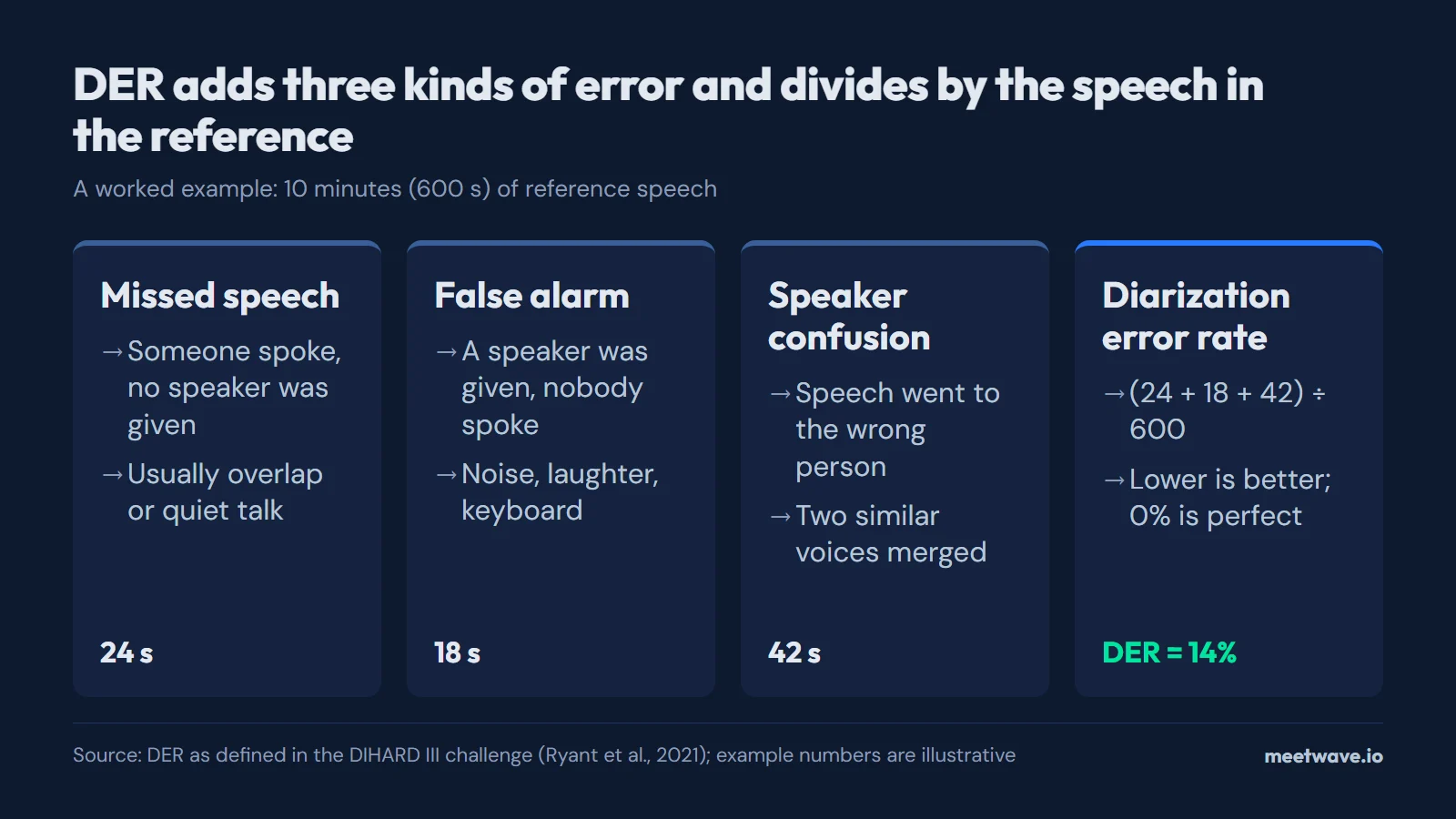 Figure 1. DER adds three kinds of error and divides by the reference speech: 84 s of error in 600 s of speech is 14%. Source: DER as defined in DIHARD III (Ryant et al., 2021); illustrative numbers.
Because the three errors add up, DER can exceed 100% when a system invents a lot of speech. Lower is better, and 0% means every second of speech went to the right speaker (Ryant et al., 2021).
Why two DER numbers are rarely comparable
The same output gets a different DER under different scoring rules, so a DER without its rules cannot be compared with another. DIHARD III scored with no forgiveness collar and with overlapping speech included, the strictest setting (Ryant et al., 2021). Our own result below ignores 0.25 seconds on each side of every reference boundary, a forgiveness collar for small timing differences, and keeps overlap in, so it is not directly comparable with DIHARD's numbers (How we calculated).
The task matters as much as the rules. DIHARD track 1 gives systems the reference speech segments, so false alarm is near zero and its DER is mostly speaker confusion and missed overlapped speech; track 2 starts from raw audio and was about 5 points harder for both DER and the Jaccard error rate (Ryant et al., 2021).
How well diarization works on meetings
Meetings are among the hardest audio for diarization. In DIHARD III, the median track 1 DER was below 10% for 6 of 11 domains, mostly one- or two-person recordings, while meeting speech, web video and restaurant recordings ranged from 35% to 45% (Ryant et al., 2021). The challenge baseline scored 25.36% DER on the full evaluation set of track 2 (Ryant et al., 2021, Table 4).
We ran the 16 meetings of the AMI test split, 9.06 hours of three- and four-person meetings, through the MeetWave API on 2026-10-22 and scored its speaker labels against AMI's own speaker turns (How we calculated). The DER over all 16 was 25.1%, the median meeting scored 23.9%, and single meetings ranged from 9.7% to 39.1% (How we calculated). The speaker count matched in 1 of 16 meetings; 14 got too many speakers and 1 got one too few, as Figure 2 shows (How we calculated). The run sent no expected speaker count. Speaker confusion, which counts speech given to a wrong or extra label, was 536 seconds, 2.3% of scored speech (How we calculated). If you know how many people were in the meeting, pass speakers_expected (transcriptions reference).
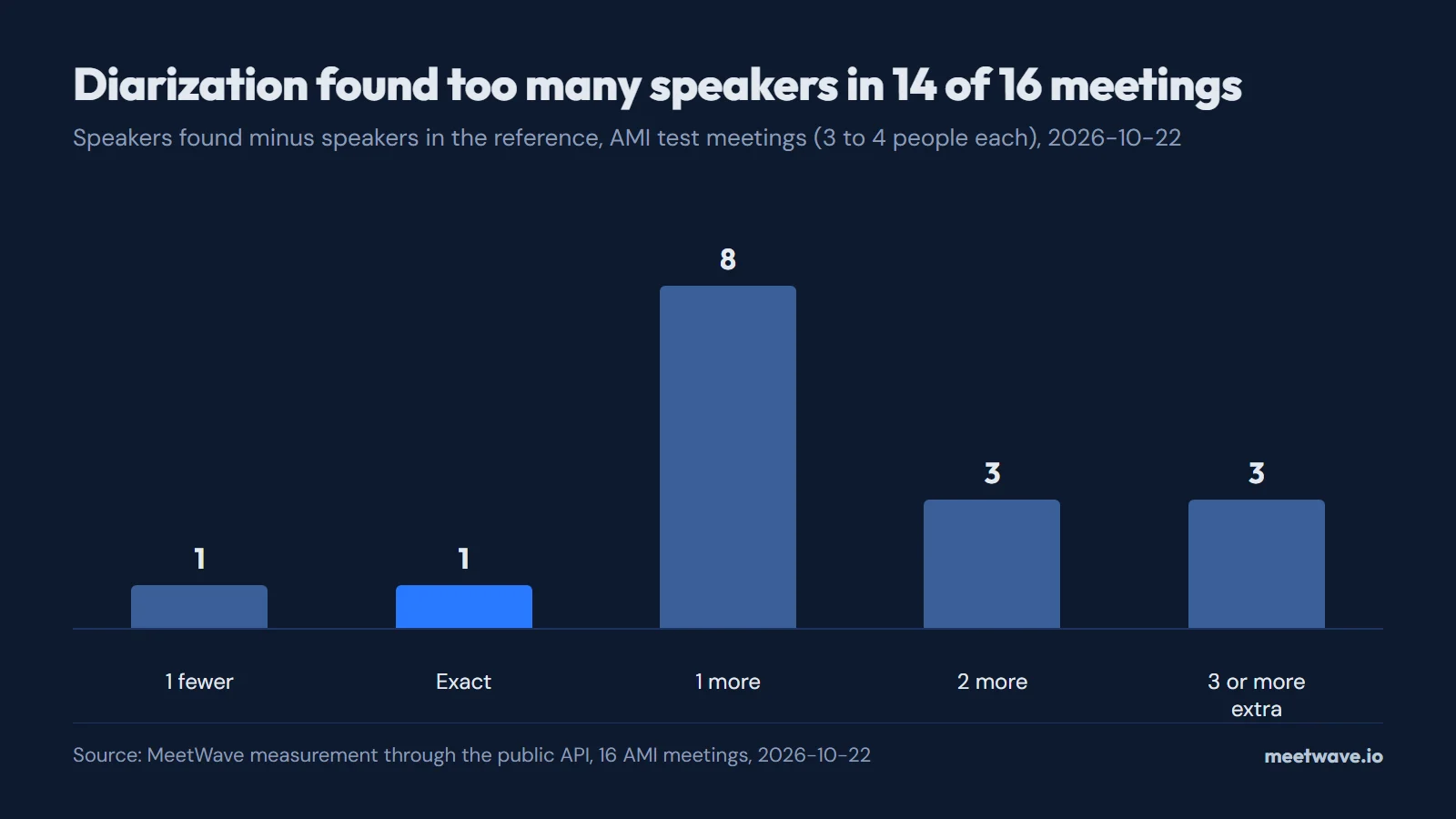 Figure 2. The speaker count was exact in 1 of 16 AMI meetings and too high in 14. Source: MeetWave measurement through the public API, 2026-10-22.
Most of the error was speech with no speaker, not speech given to the wrong person. Missed speech made up 71% of the error time, false alarms 20% and speaker confusion 9% (How we calculated). With overlap scored, a moment when two people talk and one label is given counts as missed speech for the other person, so meetings with cross-talk lose most here (Ryant et al., 2021). Figure 3 shows the split.
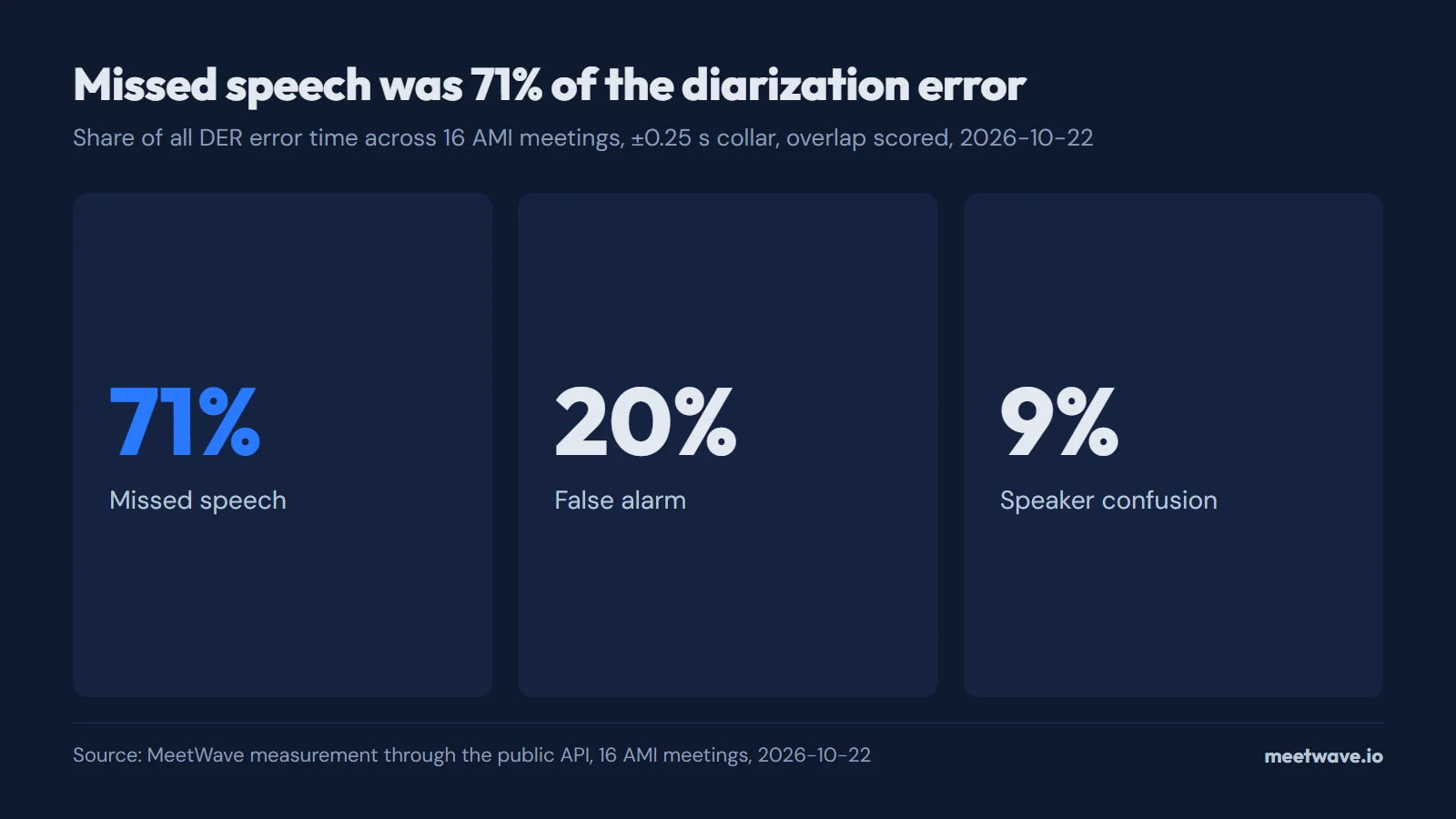 Figure 3. Missed speech was 71% of the diarization error, speaker confusion only 9%. Source: MeetWave measurement through the public API, 16 AMI meetings, ±0.25 s collar, overlap scored, 2026-10-22.
How we calculated
On 2026-10-22 a script sent the 16 meetings of the AMI Meeting Corpus test split, Mix-Headset audio, 9.06 hours, CC BY 4.0, to the MeetWave public API on its staging copy, which runs the same code and prices, with speaker labels on, no expected speaker count (speakers_expected not sent) and the language detected (AMI licence). The reference is AMI's own speaker turns for the same meetings.
DER is (missed + false alarm + confusion) ÷ reference speech, summed over all 16 meetings, with a forgiveness collar of 0.25 seconds on each side of every reference boundary and overlapping speech scored, computed with a standard open-source DER scorer pinned to a fixed version. The sums were 4,206 seconds missed, 1,180 false alarm and 536 confusion in 23,629 seconds of scored speech: 5,922 ÷ 23,629 = 25.1%. The definition is DIHARD's (Ryant et al., 2021); only the collar differs. The median meeting DER is the middle of the 16 per-meeting values. A speaker count compares the distinct labels in each result with the speakers in the reference.
The same run's word error rate, 23.7% on these meetings after the Open ASR Leaderboard's English text normaliser, scored with the open-source jiwer library, is described with the prices in our speech-to-text API price comparison.
FAQ
What is the difference between speaker diarization and speaker recognition?
Diarization separates speakers within one recording and labels them A, B, C without knowing who they are; recognition matches a voice against known people. DIHARD scores only the first, by matching system labels to reference speakers (Ryant et al., 2021).
What is a good diarization error rate?
It depends on the audio and the scoring rules. On meeting speech the median DIHARD III system scored 35% to 45% with no collar, while one- and two-person domains were mostly below 10% (Ryant et al., 2021).
Why does overlapping speech raise DER?
When two people talk at once, the reference counts both, and a system that gives one speaker per moment misses the other. In our 16 AMI meetings, missed speech was 71% of all diarization error with overlap scored (How we calculated).
Can I get speaker names, not just labels?
Names are a step after diarization. The MeetWave API returns names when people introduce themselves and keeps the letter otherwise (MeetWave transcript format); you can try it on a file in the free audio to text tool.
Sources
- Ryant et al. — The Third DIHARD Diarization Challenge (2021). Accessed 2026-10-22.
- MeetWave — Transcript format (2026). Accessed 2026-10-22.
- University of Edinburgh — AMI Meeting Corpus licence (CC BY 4.0). Accessed 2026-09-23.
More on this: API docs