Deepgram vs AssemblyAI, and Four Alternatives: Prices and Data Rules (2026)
On 2026-10-21, Deepgram listed pre-recorded English with speaker labels at $0.26 per hour (Nova-3, diarization included) and AssemblyAI at $0.17 per hour (Universal-2 plus its $0.02 diarization add-on). Four alternatives publish self-serve prices: Speechmatics $0.24, Rev.ai $0.20, Gladia €0.16 and MeetWave $0.15 with speaker labels. The bigger difference is what happens to your audio: Gladia's self-serve plan trains on it by default, Speechmatics only if you opt in.
Key numbers
- Deepgram lists Nova-3 pre-recorded audio at $0.0043 per minute for one language and $0.0052 for multilingual, with speaker diarization included and $200 of free credit, as of 2026-10-21 (Deepgram pricing).
- AssemblyAI lists Universal-2 at $0.15 per hour and Universal-3.5 Pro at $0.21, plus $0.02 per hour for speaker diarization and $0.02 for speaker identification, in a rate card last updated 2026-09-28 (AssemblyAI pricing).
- Speechmatics lists Melia 1 at $0.24 per hour for pre-recorded audio with diarization included, and takes 33% off if you opt in to model training, as of 2026-10-21 (Speechmatics pricing).
- Gladia's self-serve plan starts at €0.16 per hour for Solaria-3 and uses customer audio for model training by default, with an opt-out, as of 2026-10-21 (Gladia pricing).
- AssemblyAI keeps async transcripts for 30 days by default, unless you set a shorter time to live (AssemblyAI FAQ, 2026).
Deepgram vs AssemblyAI on price
AssemblyAI is cheaper per pre-recorded hour; Deepgram bundles speaker labels into the base price. Deepgram's $0.0043 per minute is $0.26 per hour for Nova-3 in one language, and diarization costs nothing extra on pre-recorded audio (Deepgram pricing). AssemblyAI's Universal-2 is $0.15 per hour and speaker diarization adds $0.02, so $0.17; its newer Universal-3.5 Pro with diarization is $0.23 (AssemblyAI pricing). Figure 1 puts the prices with speaker labels side by side.
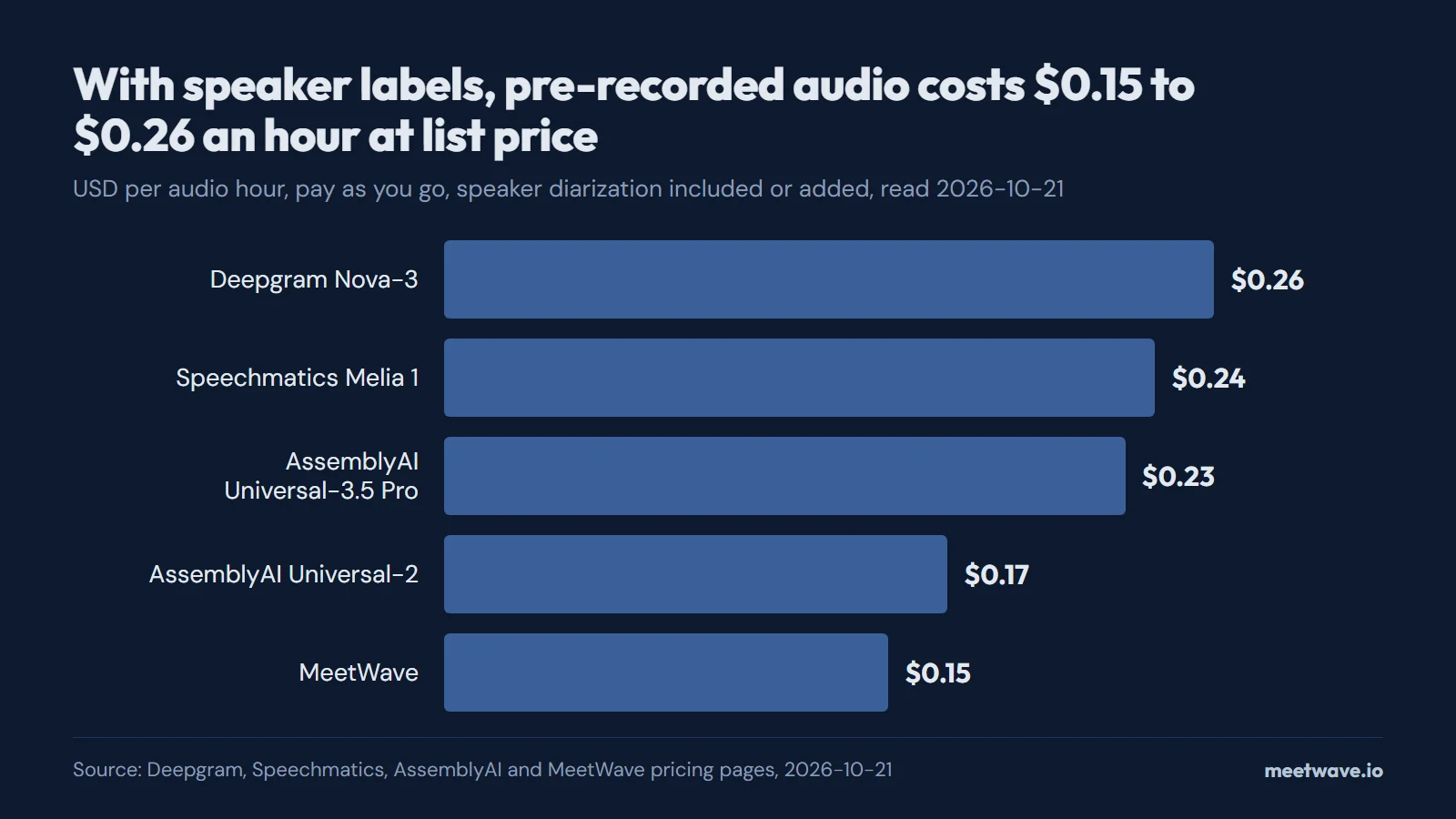 Figure 1. List price per hour of pre-recorded audio with speaker labels; Gladia (priced in euros) and Rev.ai (no speaker-label price on its page) are left out. Source: vendors' pricing pages, read 2026-10-21.
For live audio the order flips. Deepgram streams Nova-3 at $0.0048 per minute and charges $0.0020 per minute more for diarization, $0.41 per hour together (Deepgram pricing). AssemblyAI's Universal-Streaming is $0.15 per hour plus $0.12 for streaming diarization, $0.27 (AssemblyAI pricing).
The four alternatives
Each of these publishes a self-serve price and lets you start without a sales call. The table lists what the pricing pages say, nothing measured by us; we do not publish accuracy tests of named vendors.
| Vendor | Pre-recorded, per hour | Speaker labels | Free credit at sign-up | Billing |
|---|---|---|---|---|
| Deepgram (Nova-3) | $0.26 | Included | $200 | Per second |
| AssemblyAI (Universal-2) | $0.15 | +$0.02 | $50 | Not stated on the pricing page |
| Speechmatics (Melia 1) | $0.24 | Included | $100 | Per second |
| Gladia (Solaria-3) | €0.16 | Included, async only | €50 for one year | Not stated |
| Rev.ai (Reverb English) | $0.20 | Not stated on the pricing page | 5 hours | Per second, 15 s minimum |
| MeetWave | $0.15 ($0.20 with names) | Included in the $0.15 tier | 1 hour | Per second, no minimum |
Source: Deepgram, AssemblyAI, Speechmatics, Gladia, Rev.ai, MeetWave pricing pages, read 2026-10-21.
Speechmatics prices Melia 1 at $0.24 and its Enhanced model at $0.75 per hour, bills to the second and gives $100 of credit without a card (Speechmatics pricing). Gladia's €50 of credit is valid for one year, and its real-time plan starts at €0.68 per hour without diarization in the self-serve list (Gladia pricing). Rev.ai charges $0.20 per hour for English and $0.30 for other languages, rounds up to the second with a 15-second minimum, and gives 5 hours of credit (Rev.ai pricing).
What each vendor does with your audio
If your audio is meetings, calls or interviews, the training default matters as much as the price. Gladia's self-serve plan is opted in to model training by default and zero data retention is listed only for Enterprise (Gladia pricing). Speechmatics keeps training off by default and offers 33% off for opting in (Speechmatics pricing). Figure 2 shows the five defaults we could read.
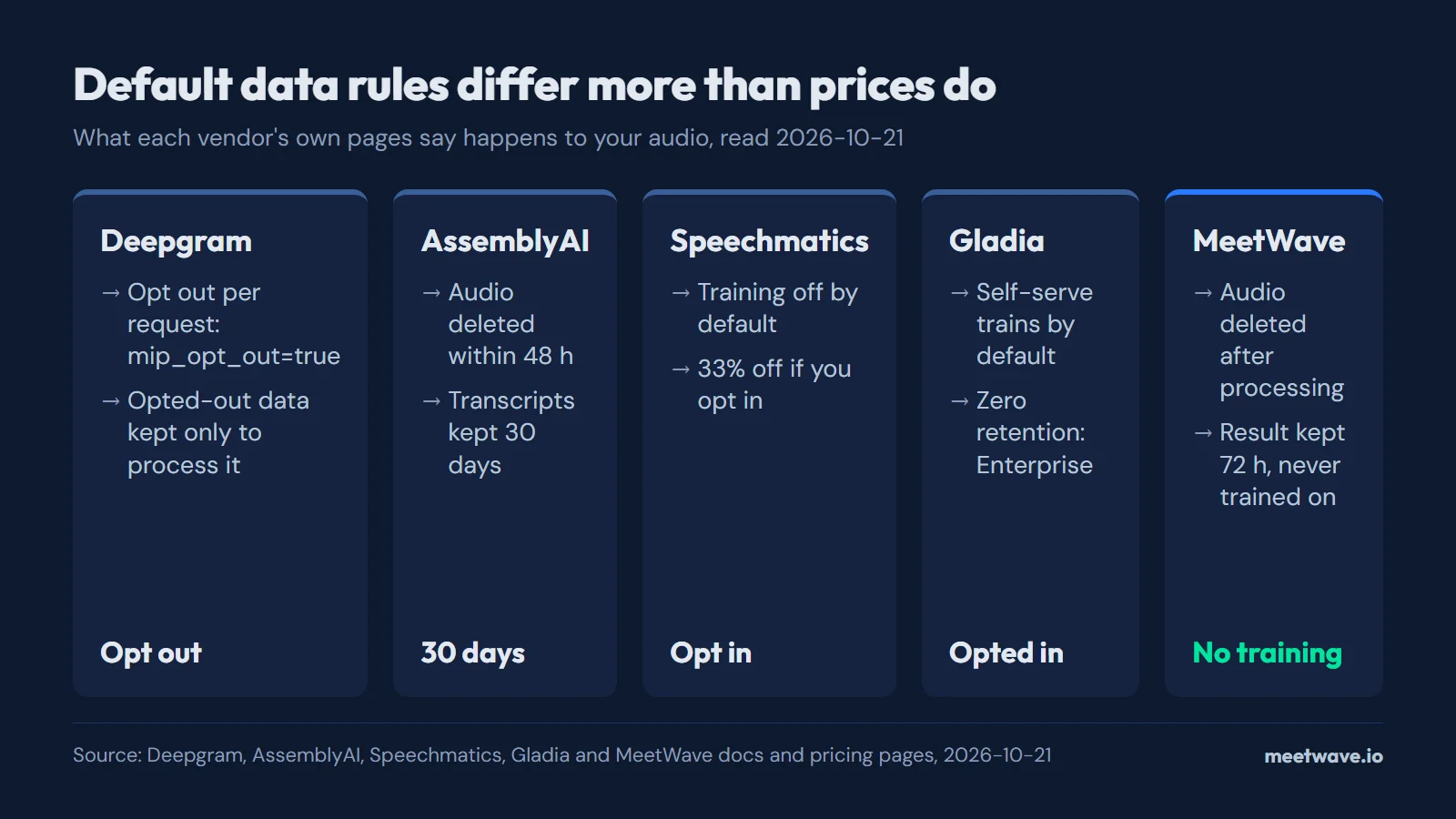 Figure 2. Default data rules as each vendor's own pages state them. Source: Deepgram, AssemblyAI, Speechmatics, Gladia and MeetWave docs and pricing pages, read 2026-10-21.
Deepgram excludes a request from its Model Improvement Partnership Program when it carries mip_opt_out=true, and keeps opted-out data only as long as it takes to process the request (Deepgram docs). AssemblyAI starts deleting uploaded audio 24 hours after an async request and finishes within 48, and keeps the transcript for 30 days unless you set a shorter time to live (AssemblyAI data retention, AssemblyAI FAQ). The MeetWave API deletes the audio once it is processed, keeps the result for 72 hours and never uses either for training (MeetWave API docs).
Which one fits
Pick by the job, not the brand. If you need live captions with speaker labels, compare Deepgram's $0.41 and AssemblyAI's $0.27 per streamed hour (Deepgram pricing, AssemblyAI pricing). If you transcribe recorded meetings and want speaker names rather than "Speaker A", AssemblyAI's speaker identification adds $0.02 per hour, and the MeetWave API's names tier is $0.20 per hour in total (AssemblyAI pricing, MeetWave API pricing). If the free allowance decides it, Deepgram's $200 is the largest we found (Deepgram pricing).
How we calculated
Per-hour prices are the vendors' list prices on their public pricing pages, read on 2026-10-21, without volume discounts or committed plans. A per-minute price is multiplied by 60 and rounded to the cent: Deepgram $0.0043 × 60 = $0.258, shown as $0.26; streaming ($0.0048 + $0.0020) × 60 = $0.408, shown as $0.41 (Deepgram pricing). "With speaker labels" adds the vendor's diarization add-on where it is sold separately: AssemblyAI $0.15 + $0.02 = $0.17 and $0.21 + $0.02 = $0.23 (AssemblyAI pricing). Gladia prices in euros and is not converted.
FAQ
Is AssemblyAI cheaper than Deepgram?
For pre-recorded audio, yes: $0.17 per hour for Universal-2 with diarization against $0.26 for Deepgram Nova-3, by list prices on 2026-10-21 (AssemblyAI pricing, Deepgram pricing). For streaming with diarization, AssemblyAI is also lower, $0.27 against $0.41.
Which speech-to-text API does not train on my audio?
Speechmatics keeps training off unless you opt in, Deepgram excludes requests sent with mip_opt_out=true, and the MeetWave API never trains on audio or transcripts (Speechmatics pricing, Deepgram docs, MeetWave API docs).
Which alternative gives the most free credit?
Deepgram, with $200 at sign-up; Speechmatics gives $100 and AssemblyAI $50 (Deepgram pricing, Speechmatics pricing, AssemblyAI pricing).
How accurate are they?
We do not publish accuracy tests of named vendors. Our own results on public test sets are in our transcription accuracy research; you can also try a recording in the free audio to text tool.
Sources
- Deepgram — Pricing (2026). Accessed 2026-10-21.
- AssemblyAI — Pricing (2026-09-28). Accessed 2026-10-21.
- AssemblyAI — How long are outputs retained? (2026). Accessed 2026-10-21.
- AssemblyAI — Data retention and model training (2026). Accessed 2026-10-21.
- Deepgram — The Deepgram Model Improvement Partnership Program (2026). Accessed 2026-10-21.
- Speechmatics — Pricing (2026). Accessed 2026-10-21.
- Gladia — Pricing (2026). Accessed 2026-10-21.
- Rev.ai — Pricing (2026). Accessed 2026-10-21.
- MeetWave — Speech-to-text API pricing (2026). Accessed 2026-10-21.
More on this: API docs