Board Meeting Minutes Example: A Full Sample With Every Section Explained
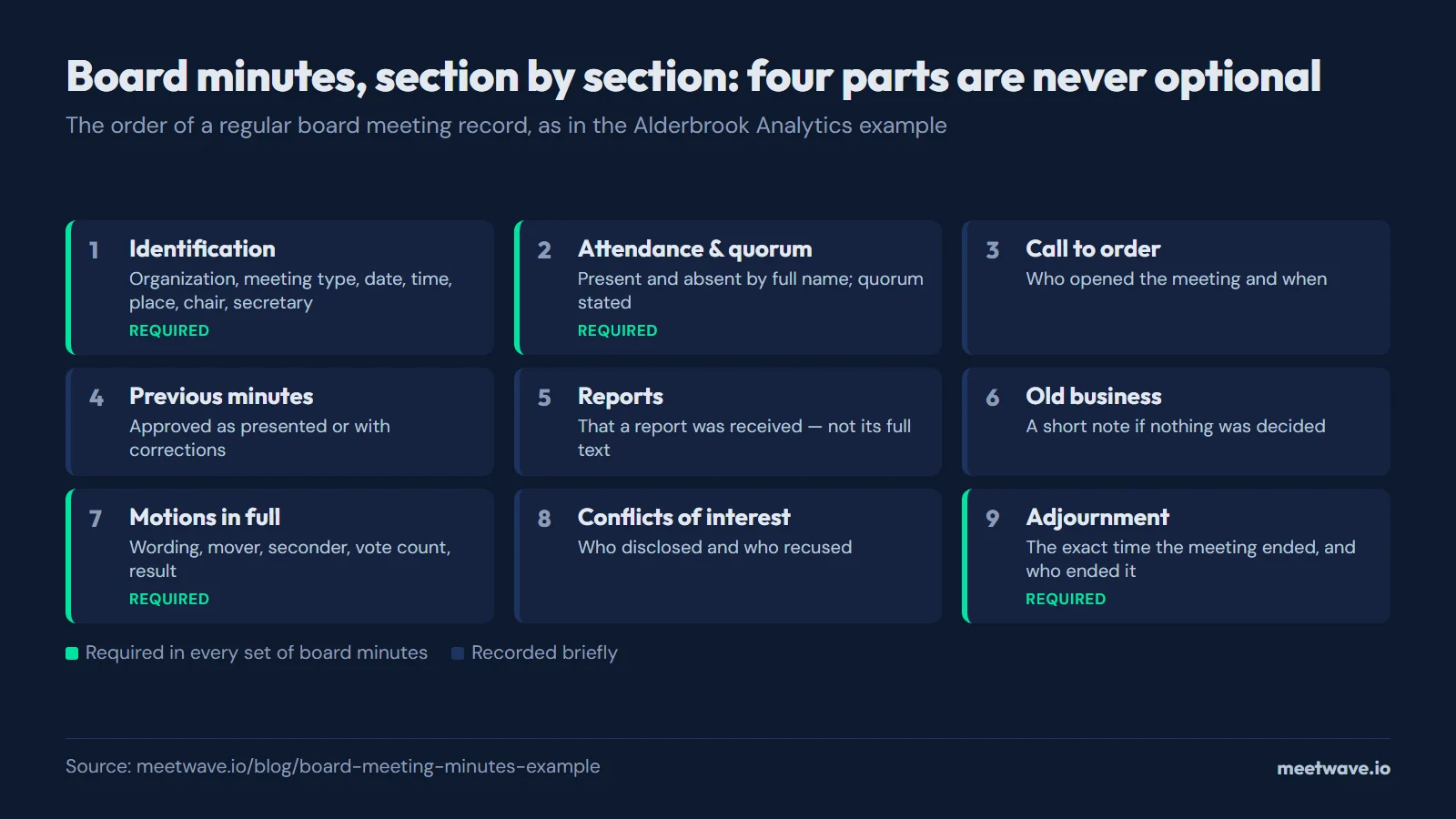
A board meeting minutes example is the fastest way to see what a formal board record actually looks like, rather than reading a list of requirements in the abstract. Below is a complete, filled-in example from a fictional company's quarterly board meeting, followed by a section-by-section breakdown of what is required, what is optional, and what should never appear in board minutes.
This is a formatting template and worked example, not legal or financial advice.
Full Board Meeting Minutes Example
Alderbrook Analytics, Inc. Board of Directors Meeting Regular Meeting
Date: July 14, 2026 Time: 9:00 AM – 10:35 AM (Pacific) Location / Platform: Video conference (Zoom)
Presiding: Priya Sundaram, Chair Secretary: Grace Odum, Corporate Secretary
Attendance
Directors Present:
- Priya Sundaram, Chair
- Marcus Aldana, Director
- Fatima Okonjo, Director
- Devin Bräun, Director
- Rosalind Marchetti, Director
Directors Absent:
- Tobias Ferreira (excused)
Others Present:
- Grace Odum, Corporate Secretary
- Wendell Ashworth, CFO (for the financial report only)
Quorum: A quorum of 5 directors was confirmed present, satisfying the bylaws' requirement of 4.
Call to Order
The meeting was called to order at 9:00 AM by Priya Sundaram.
Approval of Previous Minutes
The minutes of the April 14, 2026 board meeting were reviewed. Marcus Aldana moved to approve the minutes as presented. Fatima Okonjo seconded. The motion passed unanimously.
Reports
CFO Report: Wendell Ashworth presented Q2 financials, noting revenue of $2.1M against a budget of $1.9M, and cash runway of 14 months at current burn. The board received the report with no objections.
Old Business
Q2 Hiring Plan Follow-Up
The board revisited the two senior engineering hires approved in the April meeting. Both roles remain open; Aldana noted the delay is due to a competitive candidate market rather than budget concerns. No motion was made — the board asked for a status update at the October meeting.
New Business
Motion 1: Approve the FY2027 operating budget of $4.2M
Moved by: Marcus Aldana Seconded by: Fatima Okonjo
Discussion: Aldana walked through the budget's major line items. No concerns were raised.
Vote: Yes — 5 | No — 0 | Abstentions — 0
Result: The motion passed.
Motion 2: Authorize a $750,000 revolving credit facility with Meridian Bank
Moved by: Rosalind Marchetti Seconded by: Devin Bräun
Discussion: Aldana and Okonjo raised concerns about covenant terms restricting future equity raises. Marchetti responded that the terms are standard for the company's stage and the facility carries no early-repayment penalty.
Vote: Yes — 3 | No — 2 (Aldana, Okonjo) | Abstentions — 0
Result: The motion passed.
Resolution: The Company is authorized to enter into a revolving credit facility of up to $750,000 with Meridian Bank on the terms presented to the board.
Conflicts of Interest
None disclosed at this meeting.
Adjournment
There being no further business, the meeting was adjourned at 10:35 AM by Priya Sundaram.
Submitted by: Grace Odum, Corporate Secretary July 15, 2026
Approved by: Priya Sundaram, Chair Grace Odum, Corporate Secretary
Date of Approval: October 13, 2026 (at the following meeting)
What's Required in Every Section
Identification block. Organization name, meeting type, date, time, location, presiding officer, and secretary are required on every set of board minutes. Without this, there is no way to confirm which meeting the record belongs to.
Attendance and quorum. List directors present and absent by full name, and state explicitly that a quorum was confirmed. If a quorum was not present, the minutes must say so, since no binding decisions could be made, and that fact matters more than any decision discussed.
Every motion, in full. The exact wording of the motion, who moved it, who seconded it, the vote count, and the result are the part that matters most. This is not optional for any motion that was actually voted on.
Adjournment time. The exact time the meeting ended, and who ended it.
What's Optional
Discussion detail. The example above summarizes discussion in one or two sentences per topic. Minutes do not need to capture a debate word for word — they need to record that discussion occurred and note anything material to understanding the vote, such as a specific objection.
Old business without a vote. If an item is discussed but nothing is formally decided, a short note that the board reviewed it is enough. There is no requirement to force a motion where none was made.
Report detail. Minutes should record that a report was received, not transcribe it. Attach the full report as an exhibit if it needs to be part of the permanent record.
What Should Never Appear in Board Minutes
A verbatim transcript of the debate. Recording who said what, in what tone, or attributing informal remarks makes the record harder to trust and makes minutes harder to read. Summarize positions, not personalities. If the board meets over Zoom and someone keeps the Zoom transcript from the meeting as a working reference, it stays out of the official minutes.
Speculation about motive. Minutes record what was decided and how people voted — not why a director might have really voted that way, or characterizations of someone's reasoning that they did not state themselves.
Anything discussed in executive session, beyond the general subject. If the board entered executive session, note the start and end time and the general topic (for example, "a personnel matter"), but not the substance of what was said.
Build Your Own Board Minutes
The example above follows the same structure as the board meeting minutes template on this site — pick the Board preset, fill in your own motions and votes, and export the result as TXT, Markdown, or PDF. For the full guide on structure, formatting, and best practices, see board meeting minutes template: a complete guide. If you need the full "during the meeting" checklist for what to write down and what to skip, read how to take minutes.
Frequently Asked Questions
What is an example of board meeting minutes?
An example of board meeting minutes includes the organization name and meeting date, a list of directors present and absent with quorum confirmed, a summary of reports received, the exact wording of every motion with who moved and seconded it and the vote count, resolutions adopted, and the time of adjournment — see the full worked example above.
What format should board meeting minutes examples follow?
Most board meeting minutes examples follow the same core sections regardless of organization: identification, attendance and quorum, call to order, approval of prior minutes, reports, old and new business with motions and votes, resolutions, and adjournment. Formal signature lines from the secretary and presiding officer close out the document.
Do board minutes need to record how each director voted?
Recording the vote count (for, against, abstaining) is standard practice for every motion. Naming which specific directors voted against or abstained is common for contested votes, both to protect those directors' record and to give future readers a clear picture of where the board stood.
How detailed should the discussion section of board minutes be?
Discussion should be summarized, not transcribed. A sentence or two capturing the substance of any disagreement or concern that is relevant to understanding the vote is standard. There is no requirement, and no benefit, to recording who said what word for word.
Can I adapt this example for a nonprofit board?
Yes. The structure above, covering identification, attendance and quorum, motions and votes, resolutions, and adjournment, applies to nonprofit boards the same way it applies to corporate boards. Swap the CFO report for a treasurer's report, adjust the motion language to match your organization's typical business such as grants, program approvals, or budget votes, and keep the same level of detail on who moved, seconded, and voted on each item.
Still comparing tools?
See how MeetWave stacks up against the tools most teams evaluate alongside it.
- MeetWave vs Fireflies.aiSee how MeetWave compares to Fireflies.ai for meeting intelligence
- MeetWave vs tl;dvSee how MeetWave compares to tl;dv for meeting intelligence
- MeetWave vs FathomFree AI meeting assistant and note taker focused on sales teams
More on this: Meeting minutes template